A wind-resistant running top may promise both wind protection and breathability. This is not necessarily contradictory: bulk airflow and the movement of water vapour through material are properties that can be examined separately. The difficulty is that the everyday word “breathes” can be applied to both, although the measurements’ units and meanings differ. Without separating them, you can easily attribute capabilities to the top that its specification does not actually state.
The aim here is to draw an appropriate conclusion from air-permeability data without confusing it with wind speed, water-vapour resistance or opening a zip. We work through a simple unit conversion, two fictional comparisons and a description of a loop run in changing wind. The examples are exercises in reading data, not certifications of particular garments.
An air-permeability test examines air passing through a defined material area
The public description of ISO 9237:1995 identifies testing of fabrics’ air permeability. The Swedish research institute RISE’s own laboratory method description explains that the sample is secured, airflow is set at a specified pressure difference, and flow through the tested area is evaluated. Interpreting the report therefore requires the test area and pressure difference as well as the material sample.
This helps explain why a standalone number is insufficient: the test does not simply “blow some wind” at a jacket held arbitrarily. The sample’s position and the settings are controlled parts of measurement. Test documentation contains the particular procedure’s details; a product’s promotional sentence usually presents only an abbreviated conclusion.
Your question can therefore be: does the figure concern the material used, a particular panel or a finished-product test? If the top’s chest section uses a different material from its back, one sample’s result does not necessarily describe every section equally. Identifying the data’s scope is not nitpicking: it clarifies what the manufacturer substantiates with the number.
What can litres per square metre per second mean?
Air permeability can be described by the volume of air passing through a given area in a given time. The notation l/m²/s therefore combines litres, square metres and seconds. In another expression, flow per unit area simplifies to a length-per-time unit, such as mm/s. RISE’s description uses this latter form. The shortened unit does not mean that the wind beside the runner was measured.
In our example using only unit arithmetic, 1 litre is 0.001 cubic metres. Dividing this by one square metre and one second gives 0.001 m/s, which is 1 mm/s. For the same quantity under the same test conditions, 20 l/m²/s is therefore the same value expressed through unit conversion as 20 mm/s. This conversion makes no assumption about clothing performance: we have rewritten the units.
The lesson is precisely that a strikingly different-looking display can be another form of the same result. However, correct unit conversion does not repair a comparison made at different test pressures or on different samples. Interpret the unit first, then the measurement context. Do not combine these checks into an automatic “better–worse” ranking.
The laboratory’s mm/s is not meteorological wind speed
The wind information in a forecast you consult before running concerns external air movement. The mm/s in an air-permeability test expresses flow per unit area of the material sample under the test’s own settings. Although both may have length-per-time units, their measurement situations and questions differ. The same dimension does not imply the same meaning in use.
It would therefore be wrong to say that a material rated at 20 mm/s “protects up to exactly this wind speed”, then convert that to km/h and declare a weather limit. The flow figure in the report is not such a threshold. For the same reason, it cannot tell you at what running pace the top will feel comfortable in a headwind. Many further details of garment use and conditions are missing.
Imagine that one of two shops states a precise unit and test context, while the other displays a single “wind-protection speed”. The first provides laboratory information you can question and interpret. For the second, first clarify the method used and the claim reached. Do not copy both into the same table column merely because each uses a speed-like notation.
 Enlarge image
Water-vapour testing asks a different question
A method testing evaporative resistance is not another name for the volume flow of air through a jacket. The public summary of ISO 11092:2026 concerns thermal and water-vapour resistance under steady-state conditions. The standards’ names themselves place different quantities at the centre. RET cannot therefore substitute for an air-permeability value, or vice versa.
In practice, a material may substantially restrict airflow while behaving differently regarding water-vapour movement. Gore, for example, separately describes wind protection and moisture-vapour escape for its own wind-protection product family. This is a manufacturer’s product description, not a certificate for every top, but it illustrates that both properties can be named together.
When you see “windproof yet breathable”, first ask whether breathable refers to water-vapour performance. The next question is which test supports it and which part of that model it concerns. You need not assume a contradiction; clarifying terms helps more than interpreting the advertising phrase literally.
Low air permeability does not offer the same advantage in every use
You may seek a different experience on a wind-exposed section from that of a sheltered, more intensive interval. Relate the material property to the task rather than always declaring the lowest or highest number the winner. With the same test context, lower air permeability indicates less air passing through; this does not mean every runner will find it more comfortable on every loop.
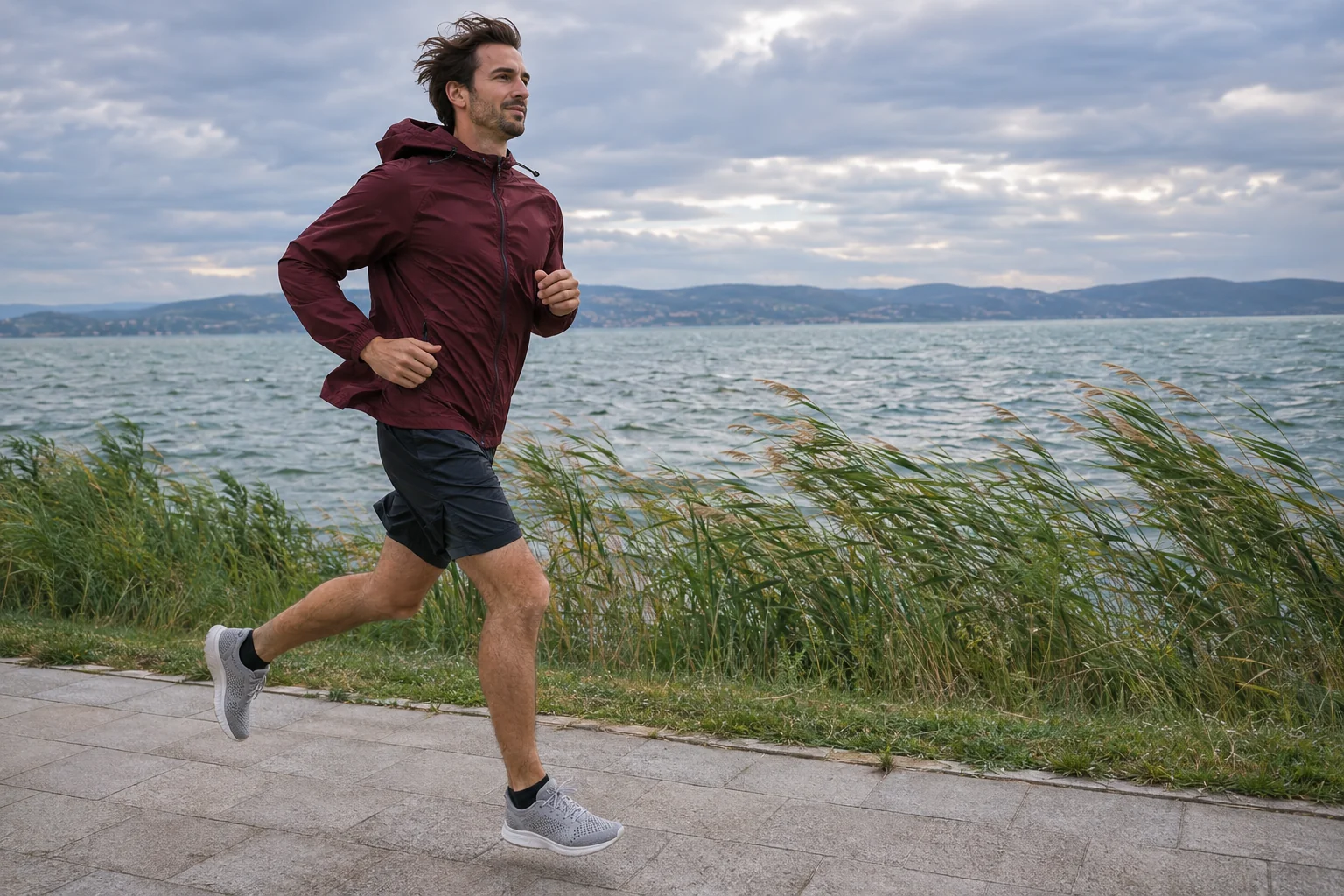
In our scenario, one runner starts on an open riverside and plans longer, easier activity. Another alternates shorter efforts at different intensities on a sheltered track. They can experience the same top differently without either account being false. Laboratory data record one material characteristic; personal feedback describes the clothing together with the situation of use.
Express an observable need of your own when choosing: “I want a layer that is easy to put on for the windier connecting section”, or “I need a fastening I can easily adjust at the track”. These statements let you try fit and operation. Simply asking for “the most breathable” does not even clarify whether you mean air or water-vapour permeability.
An open zip creates a separate air route
Air can also travel through garment openings. Opening the front, rolling up sleeves or using a separate vent changes the complete wearing system. This is different from placing another fabric sample on a laboratory test area. Keep adjustment of openings separate from the material’s own property when describing experience too.
In changing conditions without a change of clothes, ease of adjustment may be particularly important. A fitting can establish whether you find the pull with gloves, whether the intended movement is manageable one-handed, and whether a vest covers it. The fitting does not require repeating a stationary operation while running and distracting yourself: you can stop to adjust equipment when necessary.
If a friend says their jacket is windproof yet ventilates well, ask how they wear it. Alongside the material, they may mean an open vent, looser cut or panels using different materials. Their experience can inform your situation when those details are not hidden. A single adjective can easily conceal differences in use.
Why does the same loop feel different on the return?
The environment is not a laboratory: wind direction, shelter from surroundings and your direction of travel may change along the way. A top comfortable outbound may feel different on the return. The fabric itself has not necessarily changed; you are experiencing the material meeting different conditions. Note where the change occurred, rather than merely saying it was in the second half of the workout.
For example, distinguish the start between buildings, the open waterfront and the return through the park. You need not attach uncertain phone-based wind data to every section. Identifying where and after which change of direction you noticed a difference is already more useful than “It was windy”. If you also adjusted the zip or changed effort, keep those as further possible explanatory factors in your notes.
Trying clothing must not override decisions about weather hazards. A good top does not make dangerous conditions associated with strong wind, falling branches or warnings acceptable. Understanding the material is an equipment question; the safety of the route and departure is broader. Keep them separate even when you want to test new clothing.
 Enlarge image
Two figures are comparable only when the measurement context matches too
RISE’s laboratory description requires the same test area and pressure difference for comparison. This is a useful reminder that the small-print condition beside a number is not optional decoration. An arbitrary lower value under another setting does not necessarily represent the difference you first attribute to it.
If two products present data only in different forms, resolve unit conversion first. If the method or test conditions also differ, do not treat this as merely an arithmetic task. Comparability needs clarification. “Both are standardised” does not establish on its own whether those particular results answer the same question under the same conditions.
Add three short lines beside the specification: stated value and unit; method and test settings; and the material or garment section tested. Do not fill missing information with another model’s data. If customer service answers later, both the original gap and the clarification remain traceable.
A well-described experience does not try to be a home standards test
Observe how your own top works, but an improvised blow-through test or holding the garment in front of a window does not produce a valid ISO result. You need not expect it to. A personal trial can meaningfully describe fit, access, use of fastenings and comfort experienced under specified conditions.
A useful note might be: “On the open section it felt suitable with the front closed; in the park I stopped and opened it; I had to adjust the hood when turning.” This is a neutral observation. “Its RET must be low” or “I reached its wind-speed limit” adds a technical conclusion that the trial did not measure. Attaching inaccurate terminology does not strengthen genuine experience.
Naming wind protection, water-vapour movement and ventilation through openings separately clarifies what you seek in your next top. You need not know every technical detail to ask the right question. It is enough not to use every abbreviation for the same phenomenon, or turn your trial experience into measurement data that were never produced.
Sources and limitations of the explanation
For the subject of air-permeability testing, we used the public summary of ISO 9237:1995; for practical laboratory context, RISE’s own air-permeability service description. Distinguishing water-vapour testing is supported by the summary of ISO 11092:2026, while an example of describing both properties together comes from Gore’s official wind-protection clothing information. We did not analyse the full paid standards. The unit conversion, imagined situations and question sheet are our own editorial explanation. Sources checked: 20 November 2026.
How Futószív articles are prepared: our editorial guidelines.