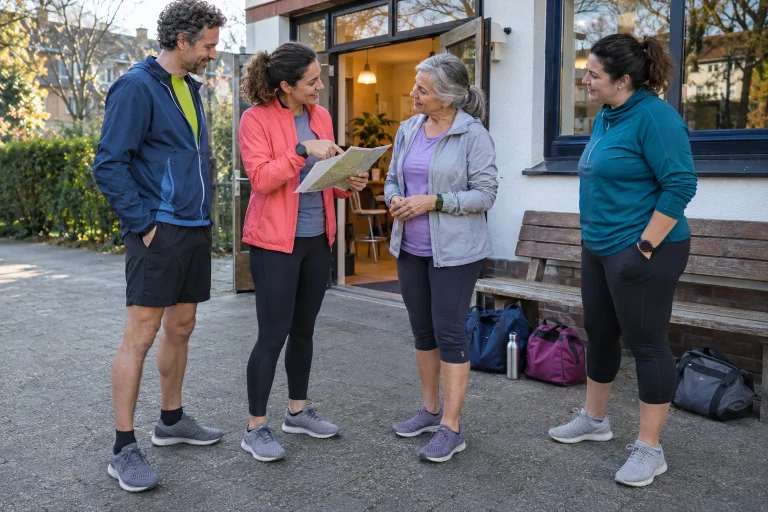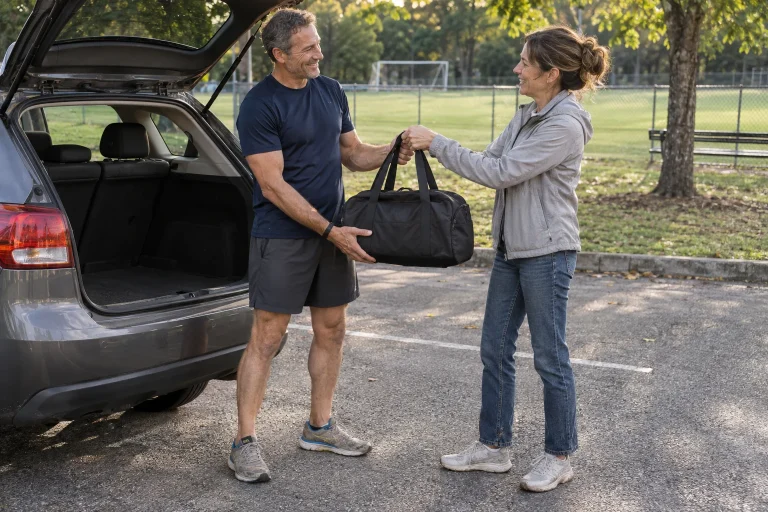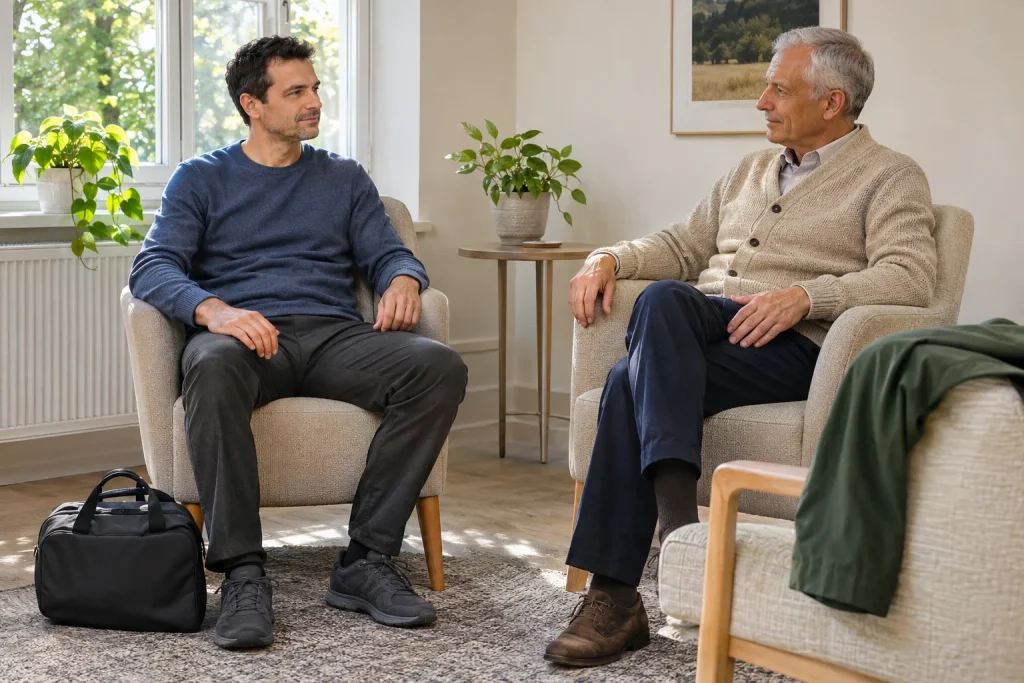
On a map, the park is nearby, the route is flat and the loop short. With agoraphobia, reaching it can still be difficult: the bus, meeting point, crowds or distance from home may raise a different question from physical distance. Planning outdoor activity therefore need not begin with finding a new running loop. First consider how it fits your individual treatment plan, your current goal and the role of support you have agreed.
Chosen activity can matter personally, but not every outdoor programme is a therapeutic task, and not every treatment step is sports training. This distinction can help both you and a running companion clarify roles. The article offers support for discussion and organisation. It does not create an exposure ladder of distances, durations or compulsory time alone: the purpose and conditions of such work need discussing in light of the individual’s situation.
It is not simply fear of a large space or a long journey
The NHS information on agoraphobia updated in November 2026 describes fear associated with situations in which someone worries that escape would be difficult or something bad might happen. Examples include open or crowded spaces, public transport, shops and being away from home. Patterns differ between individuals; in severe cases, leaving home can become difficult. The size of a space alone cannot predict which situation is demanding for someone.
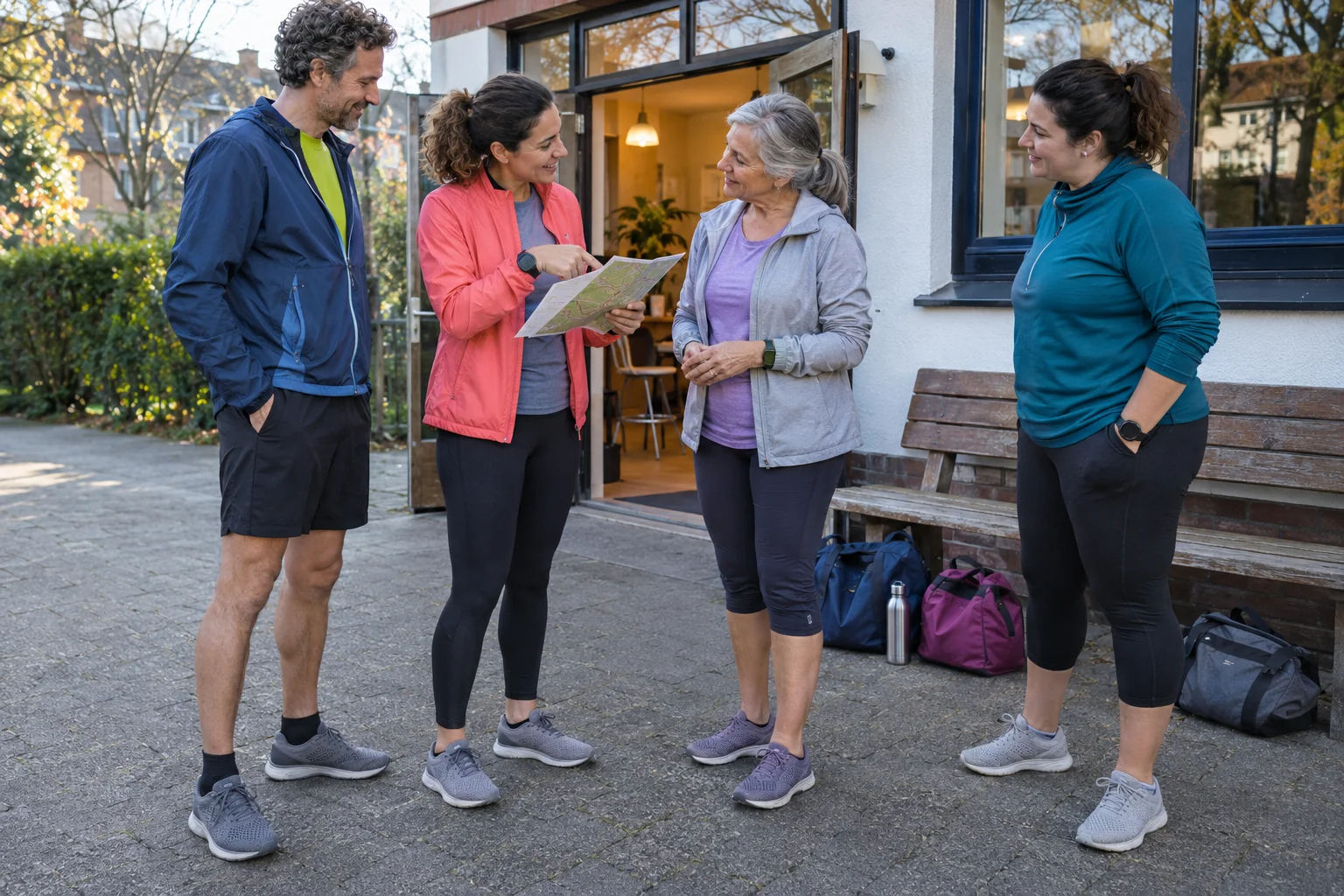
In running, for example, the forest section may not be the main concern. The journey there, an enclosed changing room or waiting before a group sets off may be difficult instead. These are everyday examples of our own, rather than compulsory symptoms of agoraphobia. They show why a general list of “safe running routes” is not an individual treatment plan. An organiser can provide precise location details without thereby knowing what the person currently needs.
The NIMH explanation of panic disorder also emphasises fears about difficulty escaping or help being unavailable in agoraphobia. Panic disorder and agoraphobia can be associated, but choosing a label after one distressing run does not replace an individual assessment. A diagnosis does not consist of a group leader’s, route-planning app’s or running partner’s opinion.
Your own account is useful even without technical terms. “I find it difficult not knowing how I would get back”; “I’m already worried about waiting before we start”; or “I’m afraid of the journey, rather than the movement” are all meaningful starting points. They help a professional understand the next question to ask. You do not need to try every frightening situation alone first to bring sufficiently detailed evidence.
Do not let treatment goals and sporting goals quietly swap places
In a running plan, progress often means greater distance, a new location or more independent participation. In a clinical plan, however, these sporting markers do not define a step’s meaning. The same park entrance can be part of a chosen everyday outing or the setting for an exercise prepared with a professional. Its purpose, preparation and who evaluates the experience distinguish the two. The progression logic familiar from running training cannot be copied automatically.
The NICE CG113 guideline also recommends evidence-based cognitive behavioural therapy delivered by appropriately trained and supervised professionals for panic disorder with or without agoraphobia. Care is adapted to individual circumstances and shared decisions. This involves more than a well-meaning companion suggesting you go a little farther today. The firmness of an encouraging statement does not guarantee the quality of treatment.
It is worth saying why outdoor activity matters to you. You may want to meet a close friend again, walk home from work or join a running group later. These are separate goals with different practical details. You do not need to take them all on at once. Naming the personal value can help the programme involve more than metres to complete, making room for your life rather than general training rules.
Also tell the professional about your current physical condition, other illnesses, medicines or activity restrictions. The clinical goal and the physical load of running are separate considerations. A situation being relevant psychologically does not establish suitability for a particular running intensity. Equally, good fitness does not itself resolve fear associated with situations. Both questions belong in the plan together, rather than replacing one another.
 Enlarge image
Why does professional preparation matter in exposure work?
Gloster and colleagues’ 2011 multicentre randomised trial compared two manual-based CBT variants and a waiting-list control in 369 participants with panic disorder and agoraphobia. Both active treatments had the same structure; they differed in delivery of exposure in real situations. In one, the therapist planned and accompanied it; in the other, the therapist prepared and discussed it without accompanying the participant. Both were professional treatment programmes.
Active treatments produced better results than the waiting list on several measures; therapist-accompanied treatment showed additional benefits on certain outcomes. The study was not about running clubs and did not test whether a friend could replace a therapist. The lesson is not that a professional must stand beside you for every outdoor step. The important distinction is that independently completed work still belonged to a prepared, discussed clinical programme, rather than a challenge invented by a stranger.
A map can at most provide environmental information for this work. It does not identify which fear the exercise should address, the task’s meaning or how to evaluate the outcome. Those cannot be reconstructed from whether a particular distance was completed. Do not independently turn a task in the environment into a contest against the previous outing, or automatically treat difficulty as failure. Interpreting the experience belongs in the treatment discussion.
A companion’s role should be agreed and predictable
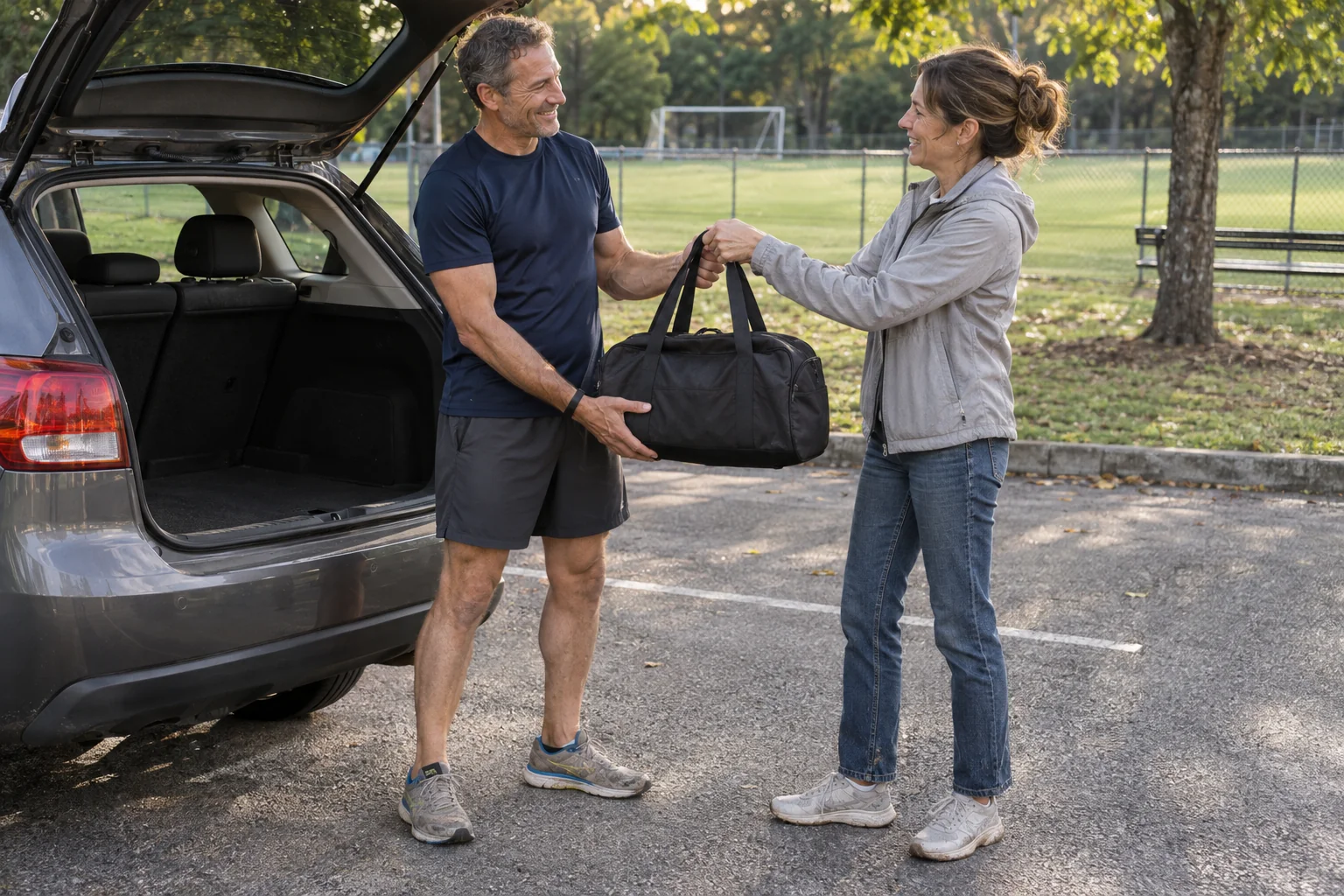
Support is clear when both people know what the agreement covers. Accompanying travel, sharing an ordinary activity and supporting a task agreed with the treating professional are different roles. A brief discussion before setting off can avoid the uncertainty of “we’ll decide there”. You do not need to give the companion complete therapy records, but they should know what is needed for their agreed role.
You might ask whether they will be available at the agreed time, can keep to the chosen programme and which changes they will tell you about in advance. If another commitment arises, they should say so rather than unexpectedly becoming unavailable on site. A supporter need not be available at every moment, and the person being supported need not accept every improvised arrangement. Clarifying the commitment also protects the relationship from either person feeling responsible for an impossible task.
The form of support also needs to fit the treatment plan. From outside, one scene cannot establish whether a behaviour is useful support or a pattern to modify in therapy. Neither “the companion must always stay throughout” nor “they should suddenly leave for the sake of progress” is a sound universal rule. If this is a question, take it to the professional together rather than interpreting each other’s intentions in the middle of a park.
A walk you chose should not become a treatment test without your consent. Unexpectedly lengthening the route, taking your phone or a companion secretly leaving are not exercises that can be derived from an article. Your questions and choices belong in the discussion. A friend does not help better by surprising you more cleverly, but by making their agreed role predictable and being honest about their own limits.
Ask for accurate facts about the place, rather than a guarantee of total safety
Once outdoor activity has a place in the individual plan, practical information can be genuinely useful. When and where will you meet, how does departure work, which route is involved and who can communicate a change? These are factual questions. Asking an organiser to guarantee that nothing unpleasant can happen, or that fear will be completely absent, is a different and impossible expectation. The programme description and your internal experience are separate matters.
| Area | A useful organisational question | What remains an individual professional question? |
|---|---|---|
| Journey there | How can the exact meeting point be reached? | Which travel situation fits the current treatment plan? |
| Programme | What is included in the advertised arrangements, and how are changes communicated? | What should your participation goal and task be? |
| Accompaniment | Who can actually offer what, and when? | What role should support play in treatment? |
Uncertainty in environmental information can be stated precisely too. The meeting point may be known but the day’s crowd cannot be predicted; a building’s opening hours may need checking before departure. This does not mean the person must take part. Real information supports a decision under the individual plan. An invented guarantee can cause misunderstanding later, while a clear limit provides an honest basis for discussion.
Ordinary environmental caution must not disappear either. An actual route closure, extreme weather or a new episode of physical illness should not simply be treated as fear to overcome. A clinical exercise’s purpose cannot be inferred as staying on the original map at any cost. Use the agreed contact and organisational arrangements for such changes, and have health symptoms assessed through the appropriate care pathway.
A difficult experience can be described without grading it
After an outing, “success” and “failure” are not the only possible answers. If there is a treatment task, review it in the agreed way. Your own account can include the situation, what you feared, what actually happened and your next question. You do not need to prove that you felt good throughout. Describing the experience can help even if an unexpected difficulty arose or the programme changed.
A companion should not turn the account into a sporting result either. “You went twice as far today” may be factual without saying anything about your personal goal. A more precise question might be: “What would you like to discuss about this, and what would you rather take to the professional?” Support then avoids taking over treatment evaluation. Privacy boundaries remain alongside distance measurement.
If you could not set out at all, you can report that at the next professional discussion too. Access to help does not require completing an outdoor task first. NICE discusses adapting care to personal circumstances and, in some cases, options responsive to difficulties accessing it. If getting to the appointment itself is a barrier, tell the provider and ask about available ways of making contact. These can vary locally.
 Enlarge image
Let discussion, rather than outside pressure, determine the next step
The NHS recommends professional help when difficulties suggesting agoraphobia affect life, or when treatment already started is not helping. Mention new physical symptoms in that discussion too. The NHS explanation of panic disorder also notes that panic-like symptoms can occur in other conditions. A previous diagnosis does not automatically explain every new episode of illness; an acute severe condition requires urgent help.
Three clear questions are enough for the next discussion: what should the outdoor activity’s current purpose be; what role can a chosen companion offer; and what will you discuss afterwards, and how? The map can then have a place as an environmental description of a possible programme. You do not need to turn treatment into a training plan alone, and your companion need not invent the next exposure task. Individual direction and cooperation provide a framework in which movement can connect to your own life.
Sources
- NHS: Agoraphobia, 2026 information
- NHS: Panic disorder
- NIMH: Panic Disorder – What You Need to Know
- NICE CG113: Recommendations
- Gloster and colleagues: randomised trial of therapist-accompanied exposure
How Futószív articles are prepared: our editorial guidelines.