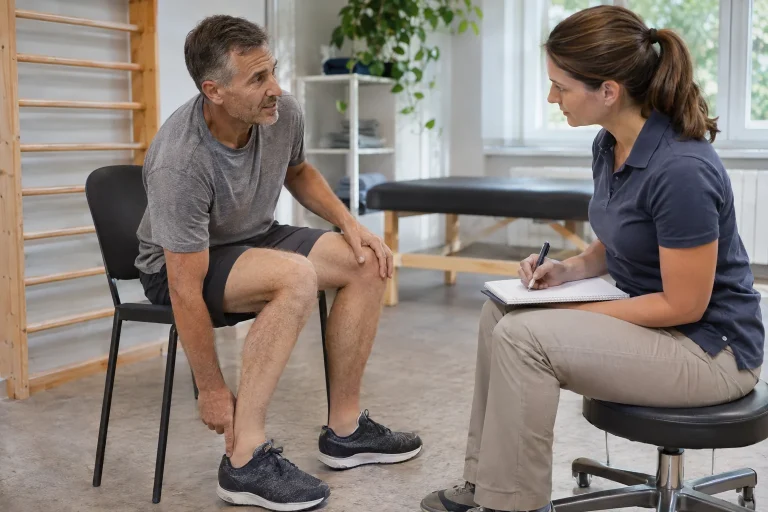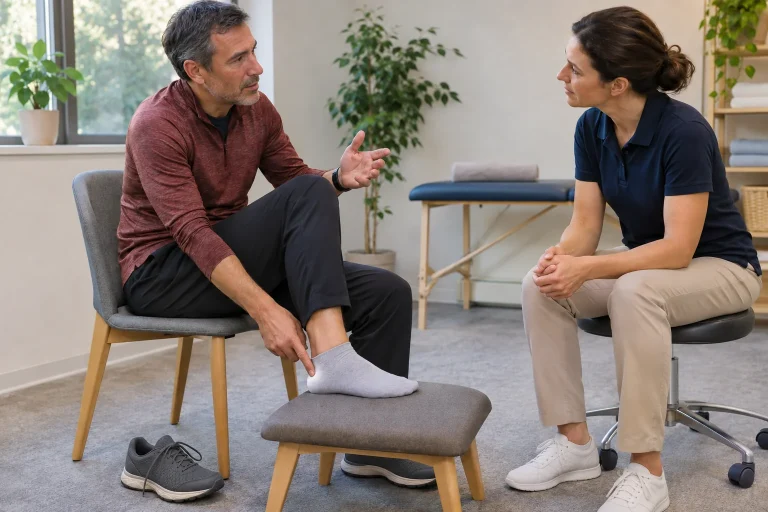
Looking for an exercise for Achilles symptoms soon brings up heel drops from a step. The demonstration looks easy to follow, and the tendon name matches where you feel pain. Yet an important detail may be missing: which section of the Achilles is involved? Symptoms at the heel-bone insertion and tendinopathy higher in the midportion do not automatically require identical movement ranges and loading plans.
If you felt a sudden snap at the back of the heel or calf and tendon rupture is possible, seek medical help immediately; AAOS specifically highlights this too. Do not try to rule it out by hopping or forcing a tiptoe rise. This article provides general information about insertional symptoms rather than home assessment of a new injury or a personal rehabilitation programme.
One tendon, different sections
The Achilles tendon connects calf muscles to the heel bone and contributes to walking, running and climbing stairs. The AAOS information distinguishes midportion problems from those at the heel-bone insertion. Naming pain location precisely is therefore not fussiness: it may clarify which condition and loading question need discussing.
The insertion is where tendon meets bone. The midportion lies higher. Home localisation is not a diagnosis, because heel-area pain may have another cause. You do not need to press hard to define the symptomatic part to the centimetre. Showing where you feel it and describing when and during which task it occurs may suffice.
Community conversations often call everything “Achilles inflammation”. The 2024 clinical guideline uses tendinopathy to describe local load-related tendon pain without assuming definite inflammation or tissue degeneration from the name alone. Clarifying the term helps because one general label cannot select appropriate treatment and exercise.
Both tensile and compressive loading can matter
A runner can readily imagine tendon tension: it transmits force between muscles and heel bone. Around the insertion, compressive loading can also matter during movement. The introduction to a 2025 trial explains this through loading near the insertion as strong upward bending of the foot brings it into a position closer to the upper heel bone.
This helps explain why exercise range matters as well as the weight used. Two similar-looking heel raises can differ in starting position and how far the heel lowers. This does not establish a general rule that every bending movement is harmful. Clarify which movement is useful and at which stage within the individual plan.
Unloading and appropriately selected loading are different too. Reducing compression does not necessarily mean removing all muscle work. How to give the tendon an appropriate task in its current condition can be a key rehabilitation question. General statements to “rest it” or “load it confidently” are insufficient: understand the movement’s place, aim and monitoring.
 Enlarge image
A midportion guideline is not an insertional recipe
The AOPT/APTA guideline published in 2024 names midportion Achilles tendinopathy in its title. It collects and evaluates evidence for that clinical situation. The shared word Achilles does not automatically make every recommendation applicable to a problem at the heel-bone insertion.
This distinction matters even when a video cites a genuine professional guideline. A credible source alone does not establish that it applies to the same patient group, tissue section or circumstances as your symptoms. Ask which diagnosis the demonstration addresses, under which conditions the task was selected and what professional follow-up accompanied it.
Reading sources well here is part of individual planning rather than obstruction. You need not process every paper yourself; clarify the condition being treated with the professional. If earlier guidance addressed midportion symptoms and pain is now elsewhere, say so. Retaining an old programme does not justify ignoring the location of new pain.
What did newer research on insertional symptoms show?
The randomised trial reported by Pringels and colleagues included 42 physically active adults with insertional Achilles tendinopathy persisting longer than three months. Both groups received progressive loading programmes. One programme also aimed to reduce compression around the insertion, including limiting ankle dorsiflexion and additional components.
In the reduced-compression group, VISA-A scores summarising pain and function improved more by weeks 12 and 24. The trial compared complete programmes rather than isolating one heel lift or movement. Its practical lesson is therefore the relevance of rehabilitation adapted to insertional disease, rather than proof of one device’s certain effect or a protocol to copy independently.
This small study in a defined group cannot predict every reader’s personal result across ages and conditions. It did not concern acute rupture or every heel pain. It nevertheless gives a meaningful explanation for considering movement range in insertional treatment. Retaining evidence limits still provides more information than saying every Achilles needs the same task.
Why is a deep heel drop from a step not a universal starting exercise?
The AAOS patient information specifically associates the exercise lowering the heel deeply from a step with non-insertional symptoms and does not recommend the version described there for insertional tendinopathy. Frequent appearance on running websites does not make a movement suitable. Diagnosis and execution details matter.
Repetition count is not the only source of difficulty in such an exercise. Floor versus step, depth, tempo and external weight are separate variables. Changing several together makes it hard to understand what relates to your experience. An individual plan should therefore clarify the basic position and next step rather than only say “Achilles strengthening”.
You do not need to demonstrate a painful deep position at the next consultation. Explain the task performed, its source and what you felt during or afterwards. An account does not become useful by reproducing the symptom. If a personally recommended exercise brings new or increasing symptoms, discuss modification with the professional who supplied the plan.
Shoe pressure and actual daily load
AAOS also describes discomfort at the back of the heel while wearing shoes. Report it separately: which shoe, where, after how long and whether symptoms occur without shoes too. A relationship with footwear does not establish it as the sole cause. Assessment may still be needed alongside considering replacement.
Include work and everyday shoes in the account, not only running shoes. Sport may occupy a small part of your day while you stand or travel for hours in other footwear. This does not mean a particular pair must be discarded. The useful question is which circumstances bring symptoms and which modification could fit the individual plan.
Do not choose and adjust a heel lift or other aid from one research sentence. Its use must fit footwear, comfort and individual condition too. If recommended, ask its purpose, how to use it and when it will be checked. A device may form part of the plan; it does not replace a learned task or declare a new symptom harmless.
 Enlarge image
Three distinct threads may inform assessment
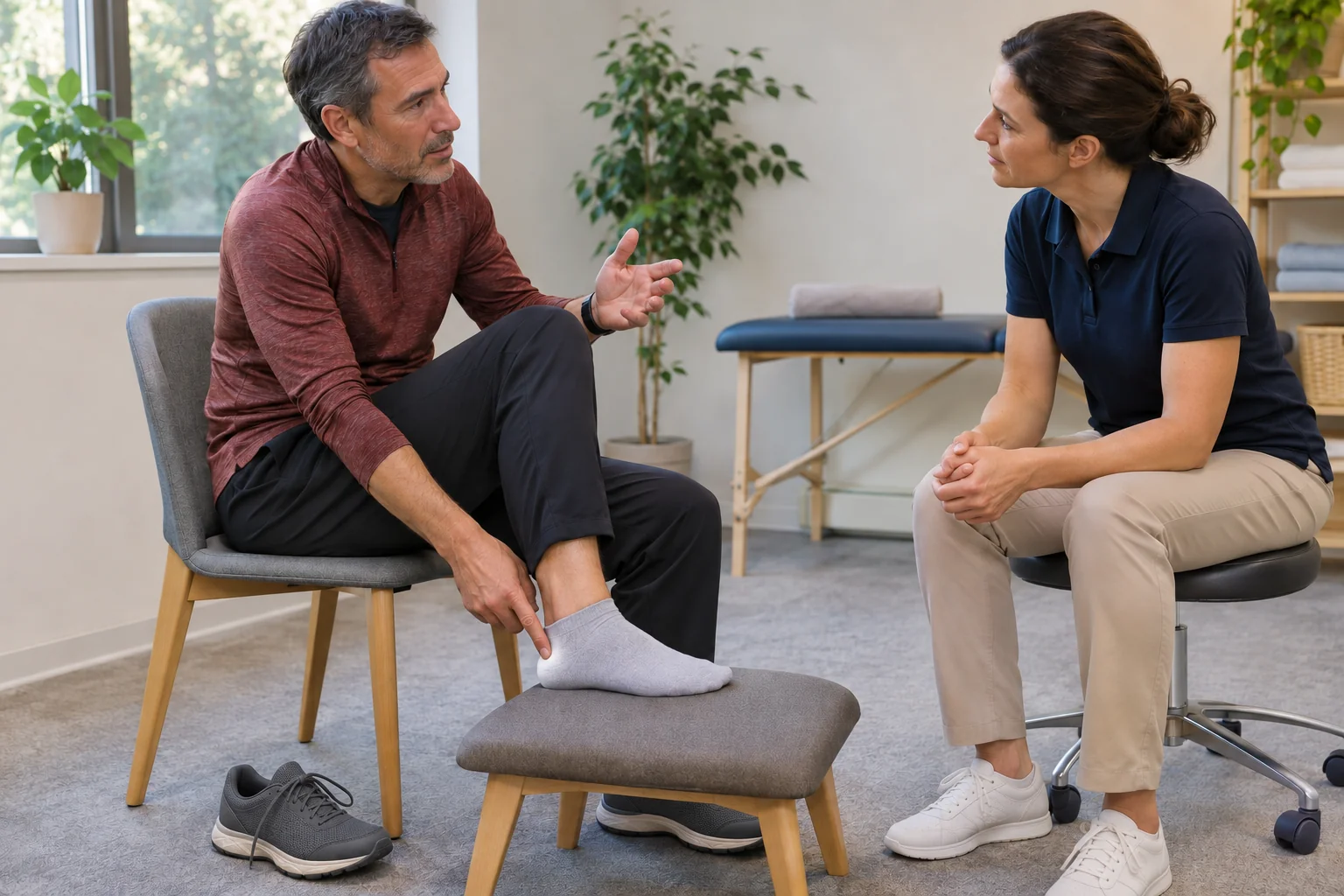
The first is the symptom: where it hurts, when it started, during which task and how it changes. The second is demand: running, walking, stairs, work, a new exercise or equipment. The third is care history: what was established, whether you received an individual plan and what it addressed. Together they provide more precision than “I have an Achilles problem”.
The professional selects necessary examination and considers other causes if needed. You do not need to draw a boundary between insertion and midportion at home. Report pain in several locations too. Clarifying location helps orientation rather than requiring independent selection of a diagnosis and programme.
At consultation, clarify the practical plan: what happens to running, how to handle essential daily walking, which task to learn and what to report sooner. “Gradually” alone allows many interpretations. A concrete explanation for your condition prevents loading changes becoming a random exchange of internet examples.
Progress may need more than deeper movement
A useful goal may be easier everyday walking, a more predictable working day or an agreed sporting task later. Not every improvement appears as a deeper heel drop. Movement range is one datum among many, to assess with goal-related function. Tolerated pain is not a performance target to increase from a general article.
Follow-up also asks whether the plan is understandable and feasible. Report uncertain timing or execution. Discuss advice about shoes or daily work that does not fit reality too. Individual rehabilitation means learning and modification linked to symptoms and function rather than a flawless calendar.
For symptoms at the Achilles insertion on the heel bone, exact location is part of the appropriate question rather than a minor detail. A midportion guideline, popular step exercise and new insertional trial provide different information. They become useful when connected with your condition. A meaningful loading plan comes from this rather than every reader repeating the same movement under the Achilles name.
Sources
- AAOS OrthoInfo: Achilles symptoms, insertional and non-insertional regions
- Chimenti and colleagues: midportion Achilles tendinopathy, 2024 clinical guideline
- AOPT/APTA: official 2024 guideline document
- Pringels and colleagues: compression-reducing rehabilitation for insertional Achilles tendinopathy, randomised trial, 2025
- PubMed record of the original 2025 trial
How Futószív articles are prepared: our editorial guidelines.