Leave room for adjustment in your marathon plan
A marathon goal is often formed months before the race. By event day, however, the course, transport, weather or your preparation may have changed. A good decision plan therefore contains more than one finishing time. It names the information used for decisions, how long the initial idea remains valid and whom to consult if something important differs from expectations. Prepare it calmly, without pressure from the approaching start or the venue’s atmosphere.
The framework below helps organisational decisions. It does not replace personalised healthcare advice or assign a suitable pace to every runner for a given wind speed or temperature. Organiser safety instructions, current race rules and your own health remain distinct considerations. The plan works when these can make not starting a genuine option.
Separate the different kinds of change
The phrase “poor conditions” is too broad for direct action. A windier-than-expected embankment, a closed railway station and an organiser removing part of the course create different tasks. Start by identifying what type of information has arrived.
| Change | What needs clarification first? | Possible organisational response |
|---|---|---|
| Your journey is delayed | Can you still reach the start and bag drop within the rules? | Another verified route or not starting |
| The official programme changes | Which distance, time and participant group does it concern? | New timetable and meeting plan |
| Conditions differ from expectations | Which official announcements and on-site information are available? | Reconsidering the goal and following organiser instructions |
| Your own condition is uncertain | Is professional discussion or help needed? | Handle the health question separately; do not start if necessary |
Do not try to solve all four rows by reducing pace. A last-minute travel problem, for example, is not resolved by running faster towards the starting gate. If conditions for starting safely are absent, address that situation first.
 Enlarge diagram
Text version of the illustration
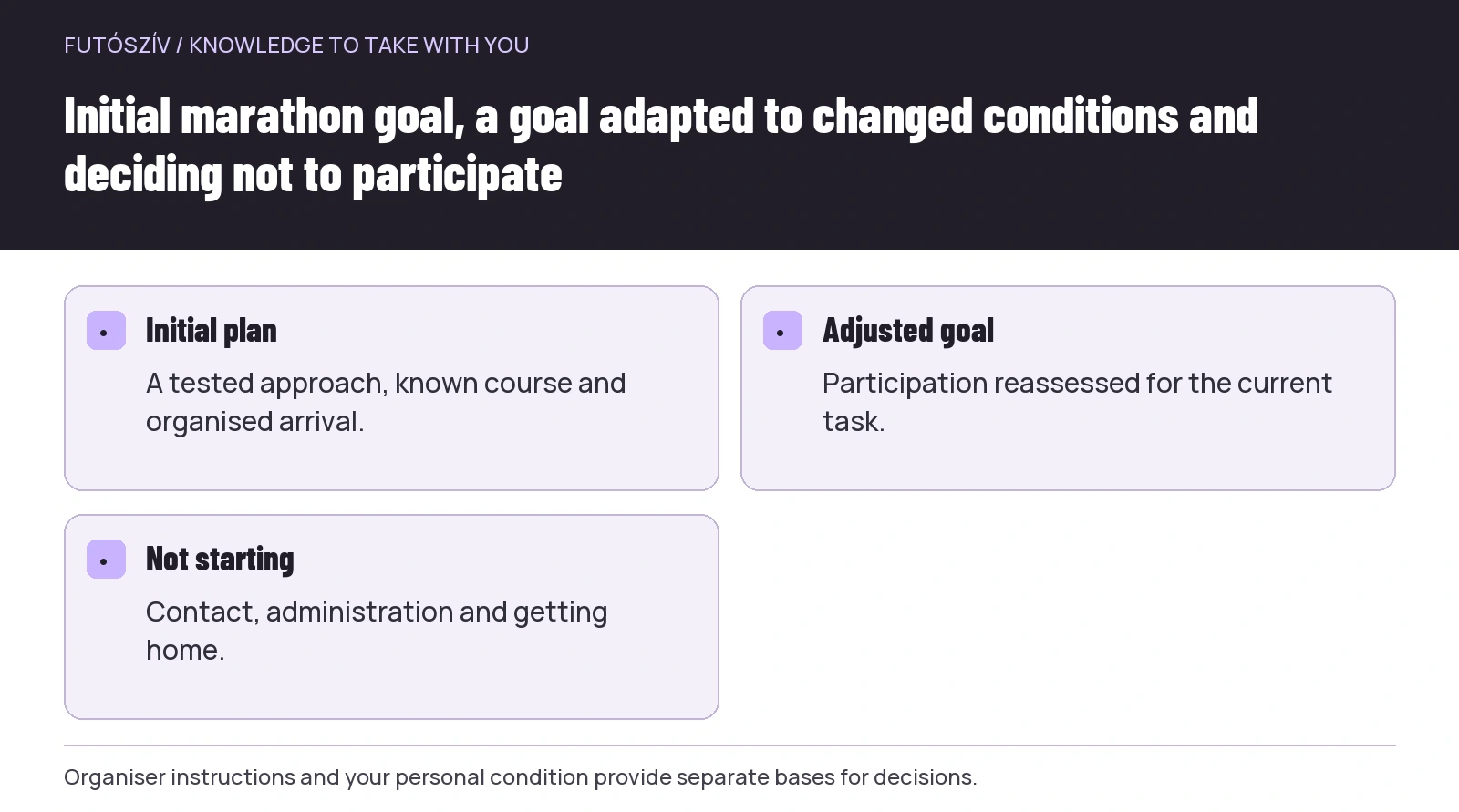
- Initial plan
- A tested approach, known course and organised arrival.
- Adjusted goal
- Participation reassessed for the current task.
- Not starting
- Contact, administration and getting home.
The source and validity of reliable information
At the top of the decision sheet, write the official event website, participant briefing location and channel used by the organiser to announce changes. A screenshot may not show whether it concerns last year’s or this year’s race. Check year, distance and update date too. If the homepage already shows next year while the detailed programme retains an earlier date, treat it as information to clarify.
Likewise, attach a time and area to weather information. The description of the HungaroMet warning system distinguishes warning forecasts from alerts. Map signals also have textual descriptions. Do not stop your check at a yellow or orange phone screen: read which phenomenon, area and period the information concerns.
A meteorological signal and an organiser’s decision are different information. Holding the race is not a personal fitness assessment, and a forecast is not a guarantee for every course point. Examine both together, rather than guessing the organiser’s decision from a social-media comment.
Define your goal for three separate situations
The initial goal may be a time result, but add two variants. One covers an event that can properly go ahead yet presents a substantially different task from the original time goal. The other covers participation conditions not coming together. These are not morally ranked stages, but plans for three situations.
For the first, record the tested race approach, start procedure and reference points. For the second, be specific: participation suited to current conditions within the official framework may be the aim, for example. For the third, state how to get home, notify your supporter and find the entry-related administrative rules.
“Whatever happens, I will finish” cannot replace any version. It names no decision basis and can conceal that you are now in a different situation from the one planned for. A short conditional statement is better: if the organiser changes the distance, I first read the new instructions and decide about participation only after understanding them.
Choose checking times beforehand
You need not check the forecast every minute all week. Choose points when you can still genuinely change something. Accommodation or travel amendment deadlines may differ from assembling your morning bag. Pair each decision with its last meaningful time in your plan.
| When will you check? | What will you check? | What can you still change? |
|---|---|---|
| Before finalising travel | Official programme, cancellation conditions and transport | Booking and travel route |
| While packing | Fresh participant information and weather situation | Tested equipment and supporter’s bag |
| Before departure | Organiser changes, services and arrival requirements | How to depart, or whether to go |
| On site before the start | Announcements, zones and current organiser instructions | An on-site decision within the rules |
| At a preselected course point | The plan’s validity and remaining task | Reassessment of the goal or participation |
A selected course checkpoint should not become a compulsory phone stop in the middle of the running lane. If you genuinely need to check information or seek help, find a way suited to the situation without obstructing others, and follow staff guidance.
Do not explain your condition solely through weather
If a health question arises before the start, do not absorb it into “today will be harder for everyone”. The London Marathon Events medical guide asks people with health concerns to consult a doctor and not make up missed training due to illness or injury by cramming in kilometres later. This is an important boundary around the organisational plan: starting is not merely logistical.
Do not therefore put a homemade symptom-based diagnostic table on your sheet. Include how to access necessary help, where to find the event’s medical information and recognition that uncertain health requires professional discussion. A prepared timetable cannot override new health information.
This distinction helps companions too. Your supporter need not decide whether a symptom comes from wind, excitement or something else. They should know whom to notify, where on-site help is available and how you stay in contact without tying the runner to one promised finishing time.
 Enlarge diagram
Text version of the illustration
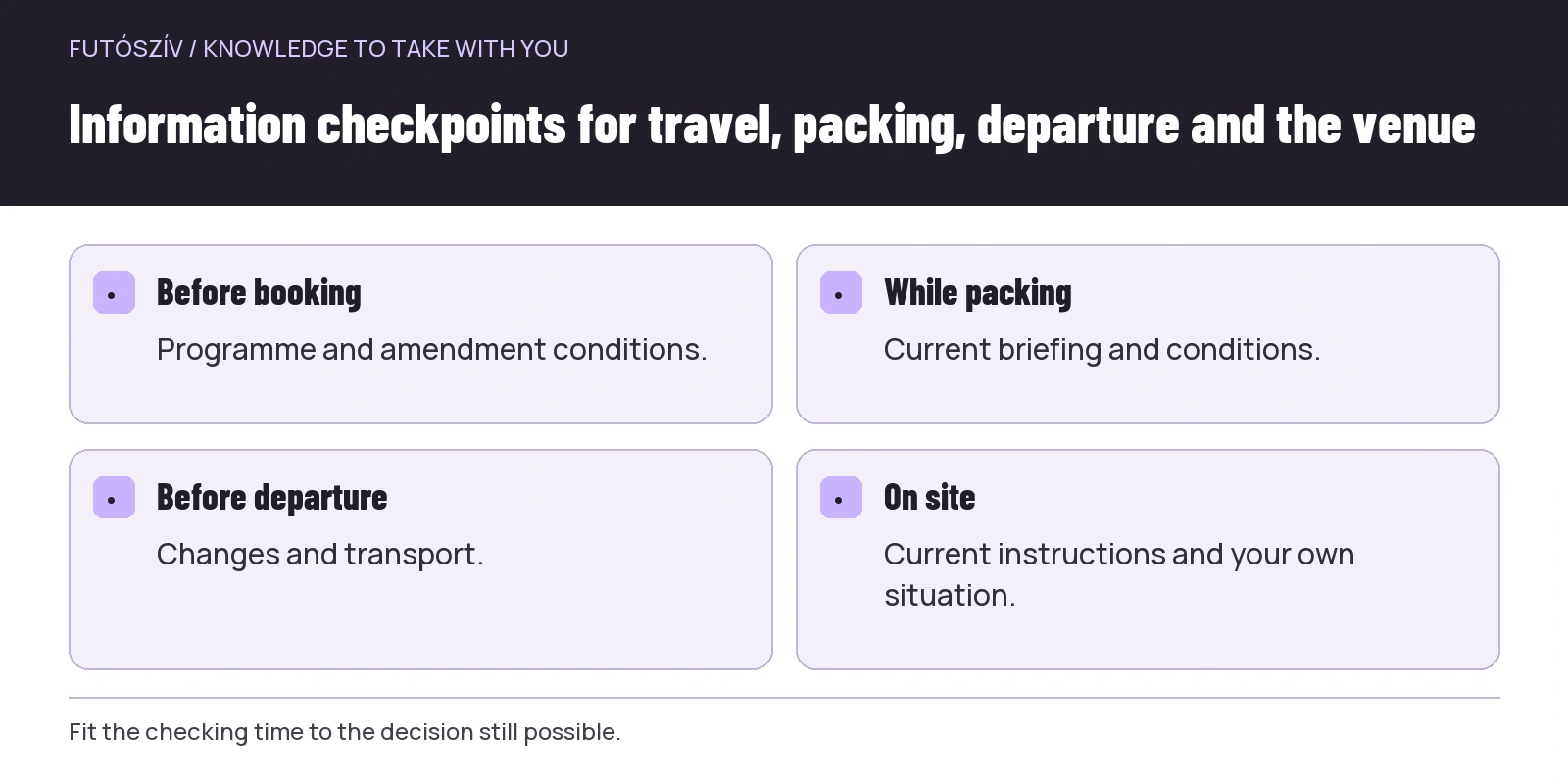
- Before booking
- Programme and amendment conditions.
- While packing
- Current briefing and conditions.
- Before departure
- Changes and transport.
- On site
- Current instructions and your own situation.
Plan a way home from outside the finish area too
We usually imagine marathon day ending at the finish. A decision plan should also provide a route if your programme ends differently. Find the required withdrawal procedure, available help and what happens to your deposited bag in the official event information. Do not automatically assume transport exists from every course point.
Choose a clear meeting location with your supporter that you can name precisely. “Near the finish” can mean several gates, closures and separated areas. The backup meeting place should be an actually accessible point outside the event route. Check its approach against closures that day.
Write the contact sequence too. For example, first a brief message, then the agreed waiting point, followed only by the next step agreed beforehand. Avoid everyone setting off to search simultaneously. In an exceptional situation or when help is needed, event instructions and appropriate assistance take priority over the family meeting scenario.
Illustrative example: the city course changes
Imagine a marathon whose organiser announces the day before that a closure requires a new approach to the start. Distance is unchanged, but bag drop cannot be reached from the previous tram stop. The runner’s original sheet allowed twenty minutes’ walking from the station to the start zone. That information now needs marking invalid; adding a few uncertain minutes is insufficient.
A useful new plan handles travel and the race goal separately. First, find a transport connection to the new pedestrian entrance. Then check bag drop and starting-area entry. Finally, coordinate again with the supporter. Only once arrival requirements are clear should the runner return to the running plan. Solving the organisational problem is not left for a rush after the start.
In another version, the organiser changes the programme too. Do not force previously calculated splits to fit the old goal. First clarify the new official task and participation rules. After renaming an event or shortening its distance, the old marathon result plan simply no longer concerns the same race.
What should you tell your running companion?
If planning to start together, discuss responses to difficult conditions too. “We will sort it out together” is insufficient. Clarify how important staying together is, who has an individual time goal and what happens if one changes plans. Starting together does not automatically commit you to every later decision.
It is especially important that the discussion does not pressure somebody to start or continue. Another person’s health and personal decisions cannot be settled in advance by a friendly vow. A good agreement makes communication easier: somebody can briefly indicate a different plan, and others know what happens to the meeting arrangements.
Also define what counts as new information. Losing a pacing group, a changed course and needing help are not events of equal weight. The first may call for a personal pacing plan, the second official guidance, and the third appropriate assistance. Companions then do not answer every situation with the same encouraging phrase.
A one-page decision sheet with visible gaps
The final sheet should not become another lengthy participant manual. At the top, put the date, exact event name and briefing version used. Then add the three goal variants, next information-check time, meeting location and necessary contact details. Keep unknown information clearly marked as a question.
An empty field is more useful than guessing. Not knowing where your bag goes if participation ends differently becomes a question for the organiser. Lacking a verified route from accommodation to the new entrance becomes a specific planning task. The aim is not making every row look reassuring, but noticing actual uncertainties in time.
After the race, retain the sheet alongside what actually happened. Which information was easy to find? Which backup route proved unusable? Which agreement remained too vague? These can produce a better organisational plan for the next marathon day without reducing the experience to one successful or unsuccessful finishing time.
How Futószív articles are prepared: our editorial guidelines.