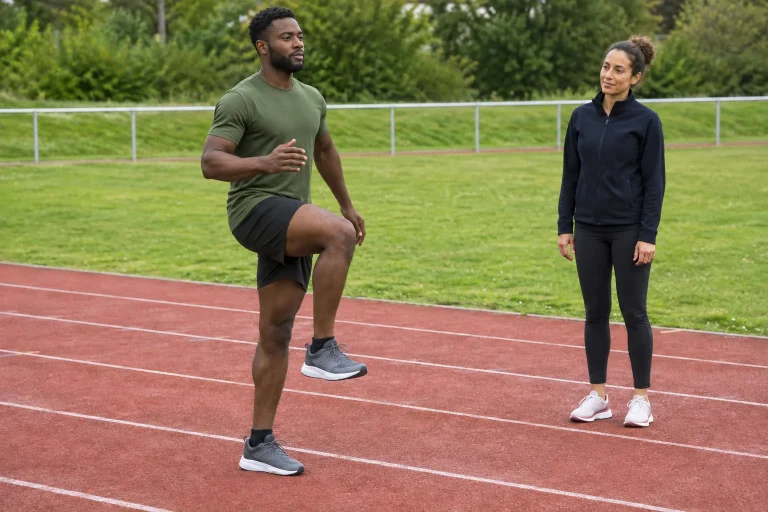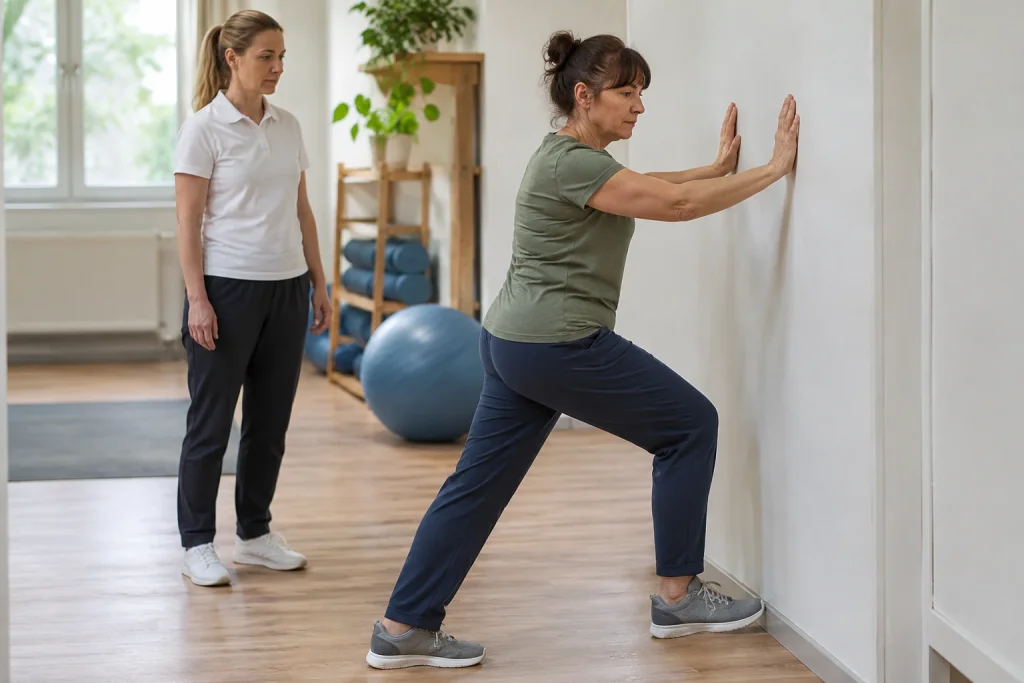
In many running programmes, mobility means an endless sequence: ankles, hips, spine, resistance bands, rollers and another video. A useful starting point is simpler. Which movement task do you want to perform more comfortably and with better control, and how will you recognise whether the chosen exercise helps?
Here, mobility means range of motion usable for a particular task and the control of that range. This is a practical definition, not a measure identical across all research. The term becomes worthwhile when connected to a specific movement and a goal you can check.
Name the task before the joint
“My hip mobility is poor” is less useful than describing a catching sensation during a particular step or exercise. Naming the task helps distinguish discomfort, uncertain coordination and a genuine movement restriction.
The movement may be new and need more practice. The selected range or load may be too great. Symptoms may warrant a health assessment too. One impressive online test cannot reliably distinguish these.
Describe when the problem arises: at the start of running, after a longer time, during a strength exercise or in everyday movement? A precise observation provides a better basis than a plan to “fix” every joint simultaneously.
Passive range, active movement and use while running
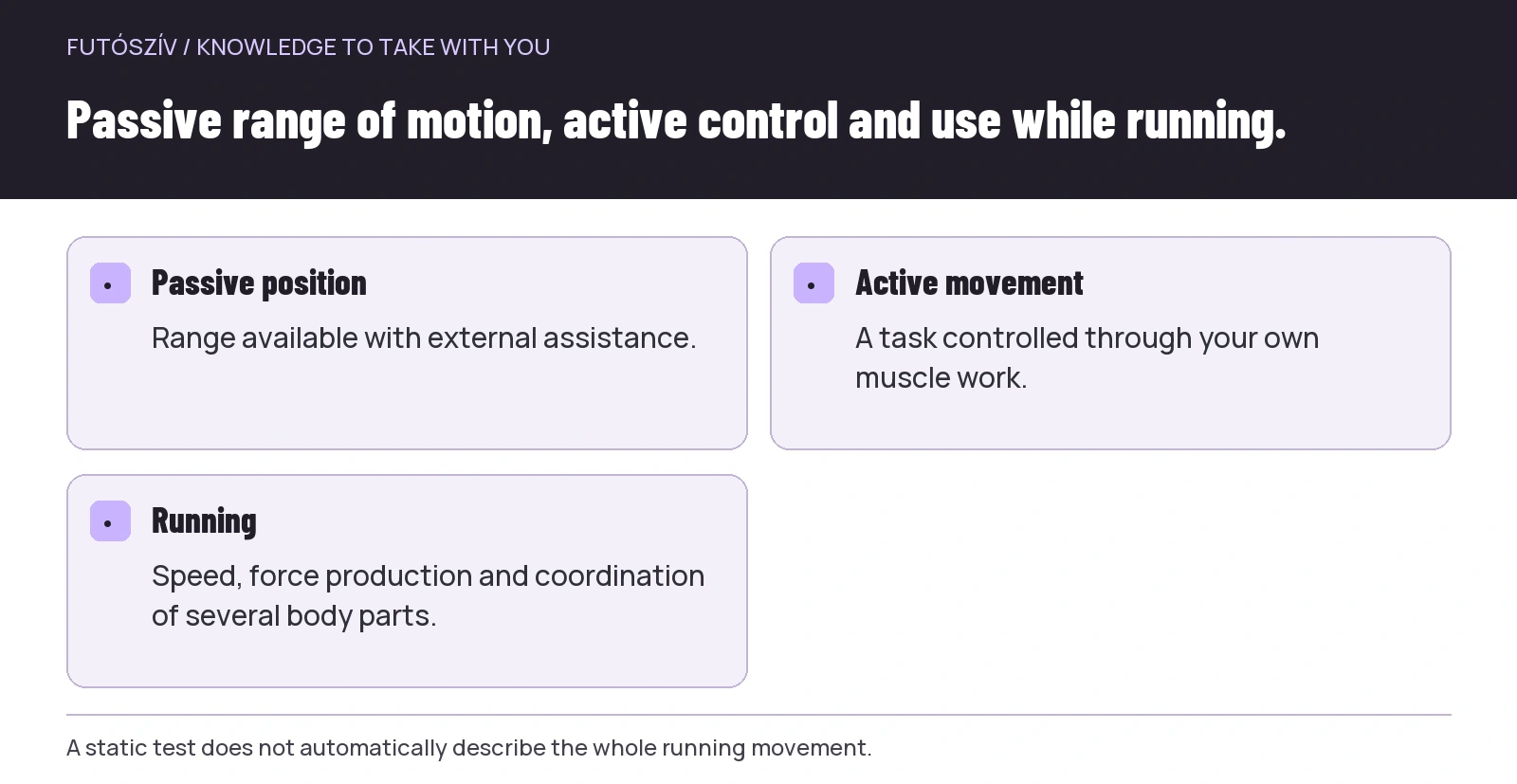
A position can be reached passively through another person’s help or external force. During active movement, you control it with your own muscle work. Running adds speed, loading and coordination of several body parts. The three situations may relate, but are not identical.
In an original study examining hip movement in elite runners a clinical static hip-extension test did not simply reflect dynamic movement while running. The study used a small sample and a particular speed, but still illustrates why transfer requires caution.
The practical lesson is not to construct a complete running-movement story from a lying or standing test. If the goal concerns a position during running, actual running may need examination too. One range value may be an important detail, but is not the whole picture.
Why is maximum range not needed everywhere?
The goal is movement usable for the task, not reaching every possible end position. Build, background and sporting situation may differ. A deep position in a social video is not a general requirement for being able to run.
Greater range also needs control. If you lose balance at the end of a movement or progress only through momentum, simplifying the task may be appropriate. More centimetres do not necessarily mean more usable skill.
If there are no symptoms and your movement task works well, you need not label every difference a problem. Base evaluation on your goal and function. Do not turn natural differences between bodies into an endless repair list.
 Enlarge diagram
Text version of the illustration
- Passive position
- Range available with external assistance.
- Active movement
- A task controlled through your own muscle work.
- Running
- Speed, force production and coordination of several body parts.
An ankle position illustrates the measurement question
A weight-bearing lunge test towards a wall is used, for example, to assess loaded ankle movement. Knee advancement is evaluated with specified heel and foot positions. Precise positioning and consistent measurement belong to the method.
An early reliability study analysed agreement between assessors and repeated measurements in healthy participants. Good reliability means the described procedure may be measured consistently, not that one value provides a diagnosis or complete injury prediction.
For home observation, the greatest distance should not be the goal. If using such a trial, learn it properly first and do not treat its result as a standalone health judgement. With pain or previous injury, an individual examination matters more.
Why measure the same way?
Lifting the heel, foot direction, the knee’s path and prior warm-up can change what a trial shows. If you perform it differently the second time, the difference may not reflect an actual change in condition.
A study involving participants with ankle symptoms examined reliability, validity and interpretation of change in the weight-bearing test. The research also shows why measurement uncertainty needs separate consideration.
Do not therefore treat every small difference in your log as progress or decline. Record the method and conditions. If a professional measures you, ask how large a change they would consider meaningfully interpretable.
Right–left differences are not automatically faults
The two sides may differ, but the task, history and measurement determine what that means. Every small asymmetry need not immediately be treated as a danger. Function and symptoms matter alongside the number.
A study examining measurement of side-to-side differences separately analysed reliability of single-leg range and symmetry. The two types of numbers cannot be interpreted with identical uncertainty. This matters particularly when drawing conclusions from two close values.
If the difference accompanies pain, a recent injury or clearly noticeable functional decline, individual assessment may be warranted. Even then, the aim is restoring appropriate movement and exercise tolerance, not merely making numbers equal.
Give the exercise a simple, observable task
In mobility work, focusing on one movement may help: comfortably controlled ankle movement with stable foot position, for example, or a small hip movement with a controlled trunk. These illustrate task principles, not treatments assigned to a diagnosis.
Choose a position where you are not struggling for balance. Support or a smaller range can simplify observation where needed. An easier variation is not an inferior exercise if it makes learning clearer.
Do not give yourself many instructions simultaneously. One clear goal and movement slow enough to understand can help more than continually monitoring body parts. If the task becomes increasingly confusing, simplify rather than add elements.
Strength and range can develop together
An experiment comparing full-range resistance training with static stretching described certain flexibility improvements with both methods. This is not a universal running-specific recipe, but an example of connections between range and strength.
When choosing exercises, you therefore need not draw a sharp boundary between mobility and strengthening. Appropriately chosen, controlled movement may serve several purposes. The specific load still needs to fit your background.
For a new exercise, prioritise learning technique and establishing a comfortable range. Large weights or extreme end positions are not needed immediately. Gradual progression within the programme matters more than the label.
 Enlarge diagram
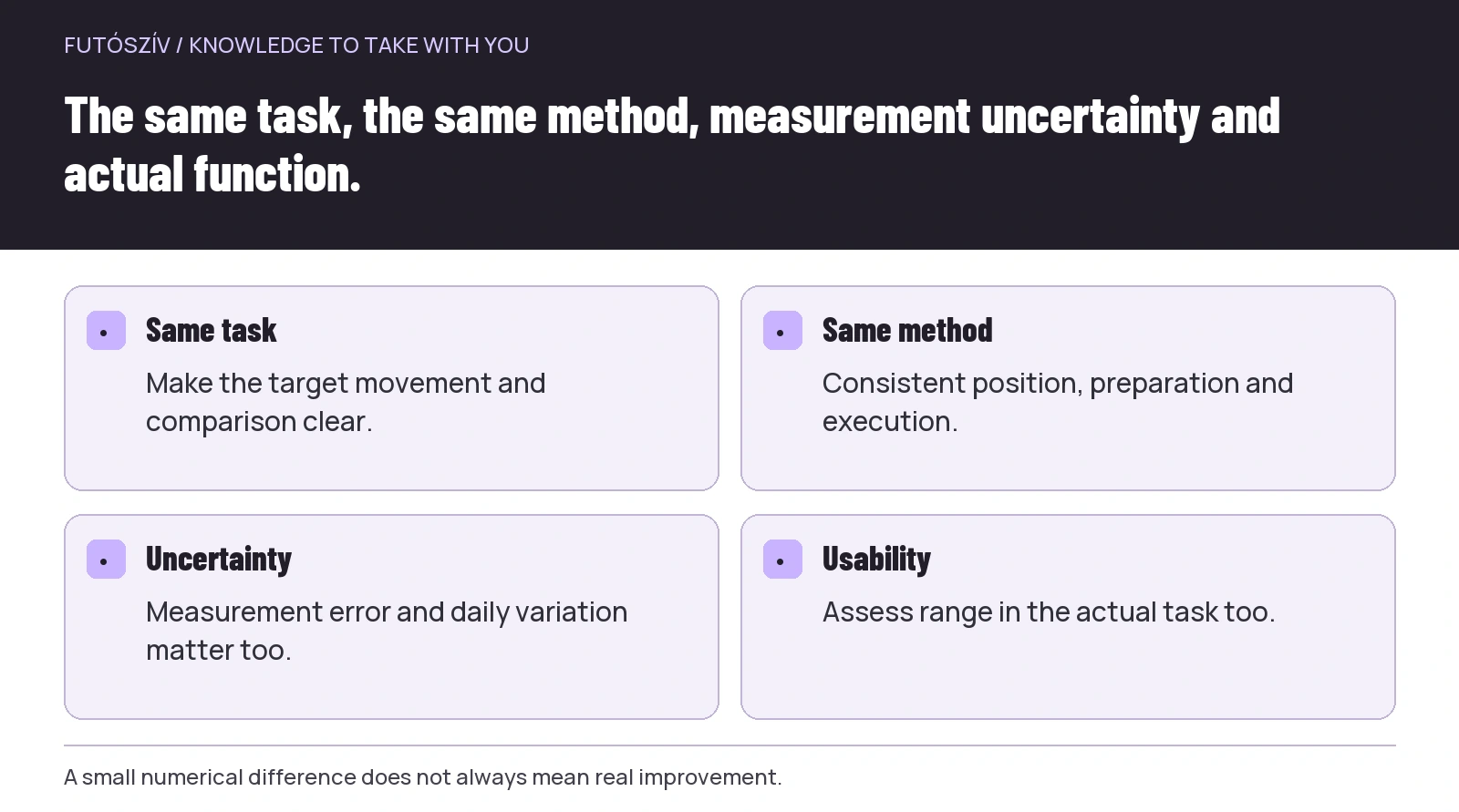
Text version of the illustration
- Same task
- Make the target movement and comparison clear.
- Same method
- Consistent position, preparation and execution.
- Uncertainty
- Measurement error and daily variation matter too.
- Usability
- Assess range in the actual task too.
How can you avoid jumping from video to video?
Choose one clear goal and a few related tasks. Allow time to understand and apply them consistently. Switching to a new impressive method every day makes it difficult to assess what changed movement or wellbeing.
Write down the reason for the choice. Why this exercise, how does it relate to running or an everyday task, and when will you reassess? Without answers, clarify the goal rather than expand the list.
A useful routine can be short. Time spent and the number of special tools do not define its value. What matters is a manageable, traceable response to the right question.
Mobility within a warm-up and as separate practice
Before running, the goal is transition into that day’s task. A few familiar, comfortable movements may contribute, but the entire range-development programme need not happen there. Overly long or demanding preparation can take time and attention from the main section.
A separate occasion may offer more room for learning and observation. Even then, maximum limits need not be sought in every repetition. Consistent execution suited to the goal is easier to evaluate than continual record attempts.
If prescribed an exercise as rehabilitation, it has its own dose and monitoring. General mobility advice cannot override it. Discuss changes with the professional involved in your individual care.
Transfer to running needs a separate check
If range increases in a test position, we still do not know for certain how running changed. Observe the actual target task too: is the session more comfortable, movement better controlled and the overall workload still manageable?
Video may help, but without matching speed and similar conditions, misinterpretation is easy. Slower running can look different even without a separate mobility change. Keep the task in view during comparison too.
Improvement can take several forms, not all immediately visible. An easier-to-follow routine, a more precisely described problem or dropping unnecessary exercises can also be valuable outcomes. Every change need not be justified through a larger joint angle.
When is a mobility list not what you need?
Sharp pain, numbness, unusual weakness, a recent injury or sudden movement restriction warrants individual healthcare assessment. Do not automatically try to solve every symptom with increasingly forceful mobilisation.
Record the history of recurring symptoms precisely: when they started, what changed in workload and which task is affected. This helps a professional more than declaring which muscle is short after watching ten videos.
Mobility work is a useful addition when it answers a real question. Targeted, controlled movement does not need an endless list. Appropriate range is what is usable in your personal task, rather than what creates the most impressive picture.
Sources
- Relation of anterior pelvic tilt during running to clinical and kinematic measures of hip extension.
- Intra-rater and inter-rater reliability of a weight-bearing lunge measure of ankle dorsiflexion.
- Reliability and Validity of a Weight-Bearing Measure of Ankle Dorsiflexion Range of Motion.
- Within-session reliability for inter-limb asymmetries in ankle dorsiflexion.
- Resistance training vs. static stretching: effects on flexibility and strength.
How Futószív articles are prepared: our editorial guidelines.