A cool-down is the transition between the main part of a run and rest. It can be a short routine of easy jogging, walking and bringing the day’s activity to an orderly close. You need not view it as compulsory cleansing of the body or add another substantial distance after every session.
Its benefits and expectations should be distinguished. Gradually slowing can provide a comfortable, considered finish; this does not prove that any cool-down run improves every recovery measure. The appropriate approach fits the preceding workload and your current condition.
What should the immediate purpose be?
After the main part, let effort decline and allow time for breathing and movement to settle. The American Heart Association information emphasises a gradual transition and notes that stopping too suddenly can cause dizziness.
This does not mean jogging on is compulsory when unwell. Symptoms are a separate situation where stopping safely and seeking help matter more. A cool-down is not a rule that keeps you moving despite symptoms.
A useful statement of purpose might be: I want to end today’s task with a comfortable transition. This distinguishes cooling down from collecting missing kilometres or adding another hard block.
Jog or walk?
After an easier session, a few calm minutes of running may feel good; at other times, walking is more comfortable. Do not let an app label decide. If even the supposedly easy jog feels strained, you do not need to maintain running steps at any cost.
Walking can be a perfectly sensible transitional activity. The main part of your run does not lose value because the watch shows a slow pace. Preserving an attractive average pace is not the cool-down’s purpose.
Adapt to the location too. On a track, the designated recovery area matters; on roads, a safe pavement section; on trails, a predictable return route. Continue travelling attentively after the main work ends.
Cool-down running is still workload
Easy intensity does not reduce time and step count to zero. If substantial fatigue has developed by the end of the main section, further running adds to the whole day. This matters particularly after a long or unusually demanding event.
Include it in training in your log. If you always add another longer loop, weekly total workload reflects that too. The label “just cooling down” does not create a separate load-free category.
Reverse the planning question: how much total running is manageable today, and how much of it is the main task? Avoid discovering afterwards that preparation and finishing have made the day substantially larger.
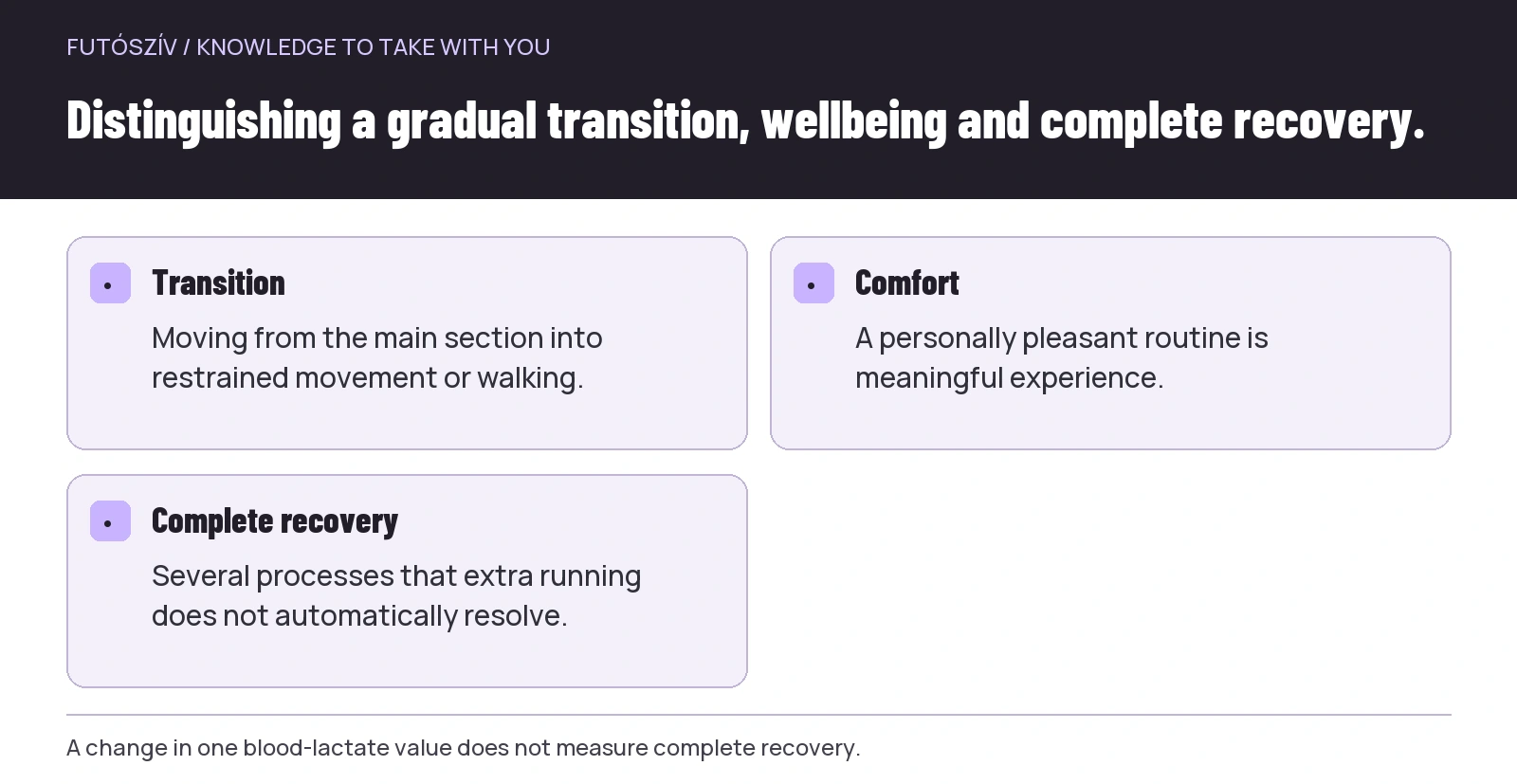
Lactate clearance is not the same as complete recovery
A study of active recovery after intense running analysed the decline in blood lactate and related its rate to recovery intensity. This concerns a change in a particular metabolic measure.
Lower blood lactate does not automatically mean muscle strength, next-day wellbeing, energy supply and everything else have recovered. Recovery involves several processes. Faster change in one measure is not the same as regaining full running readiness.
Do not therefore speed up the cool-down to supposedly remove acid faster. Post-exercise fatigue cannot be reduced to removing one substance. Faster jogging does not replace appropriate rest.
 Enlarge diagram
Text version of the illustration
- Transition
- Moving from the main section into restrained movement or walking.
- Comfort
- A personally pleasant routine is meaningful experience.
- Complete recovery
- Several processes that extra running does not automatically resolve.
Do not expect a guarantee against next-day soreness
Delayed-onset muscle soreness is not simply lactate left behind. An original study examining lactate and delayed-onset muscle soreness did not support this common explanation. The promise of an acid-clearing cool-down is therefore a misleading framework.
A randomised study comparing warming up and cooling down assessed soreness and strength after a specific leg-strengthening task. Its circumstances do not match every run, and it does not provide a general guaranteed recipe for preventing soreness.
Your own experience still matters: a short walk may feel a more pleasant ending. Simply distinguish a wellbeing benefit from a claim that you are guaranteed to avoid soreness tomorrow. The two require different evidence.
Another run is not compulsory after a long race
A controlled study after a half-marathon compared recovery strategies in recreational male runners. An active running cool-down did not generally improve the recovery measures examined and was less favourable for some outcomes.
The study does not mean every short walk is harmful or that jogging after an easy workout is forbidden. It examined a particular workload, intervention and measurement times. The direct lesson is that extra running after a large workload should not automatically be credited with a recovery benefit.
At the finish, let the organiser’s route, your condition and access to supplies guide the next step. You do not need to run a separate distance after receiving the medal simply because that is your usual training routine.
Choose the ending for the main task’s character
After a short easy run, a slower closing section may itself provide the transition. Adding a long, separately named block is not always necessary. After more intense work, you may need longer to feel comfortable, but keep the approach restrained.
After a demanding hilly or downhill day, do not necessarily cool down on another difficult route. A flatter, simpler section available at the end of the main task can support a calm finish. Technical ground remains technical despite a cool-down label.
If planning with a coach, include finishing volume in total daily workload. Ask the purpose of the prescribed section. Understanding the reason helps you adapt if the main part proved harder than expected.
Plan the route’s ending too
Do not finish a fast section where a road, fence or crowd forces a sudden stop. Leave space to slow down. This is particularly important after short accelerations and intervals.
When running home, the main part often continues to the door, immediately followed by another task. For a calmer ending, finish the main section earlier and build the final easy part or walk into the route beforehand.
In a gym, slow the treadmill according to its safe operating procedure. Jumping off a moving belt is not a necessary cool-down method. On a track, avoid blocking others’ path with a sudden stop.
Stretching, foam rolling and the long task list
Many people automatically attach several other routines to cooling down. Stretching, foam rolling and other methods may serve separate purposes; you need not make all of them a compulsory package after every run. First know what you want each element to achieve.
If a comfortable stretch feels good, do not turn it into a range-of-motion test performed into pain. New exercises or those chosen for symptoms may require appropriate individual guidance. A cool-down label does not make every exercise suitable in every situation.
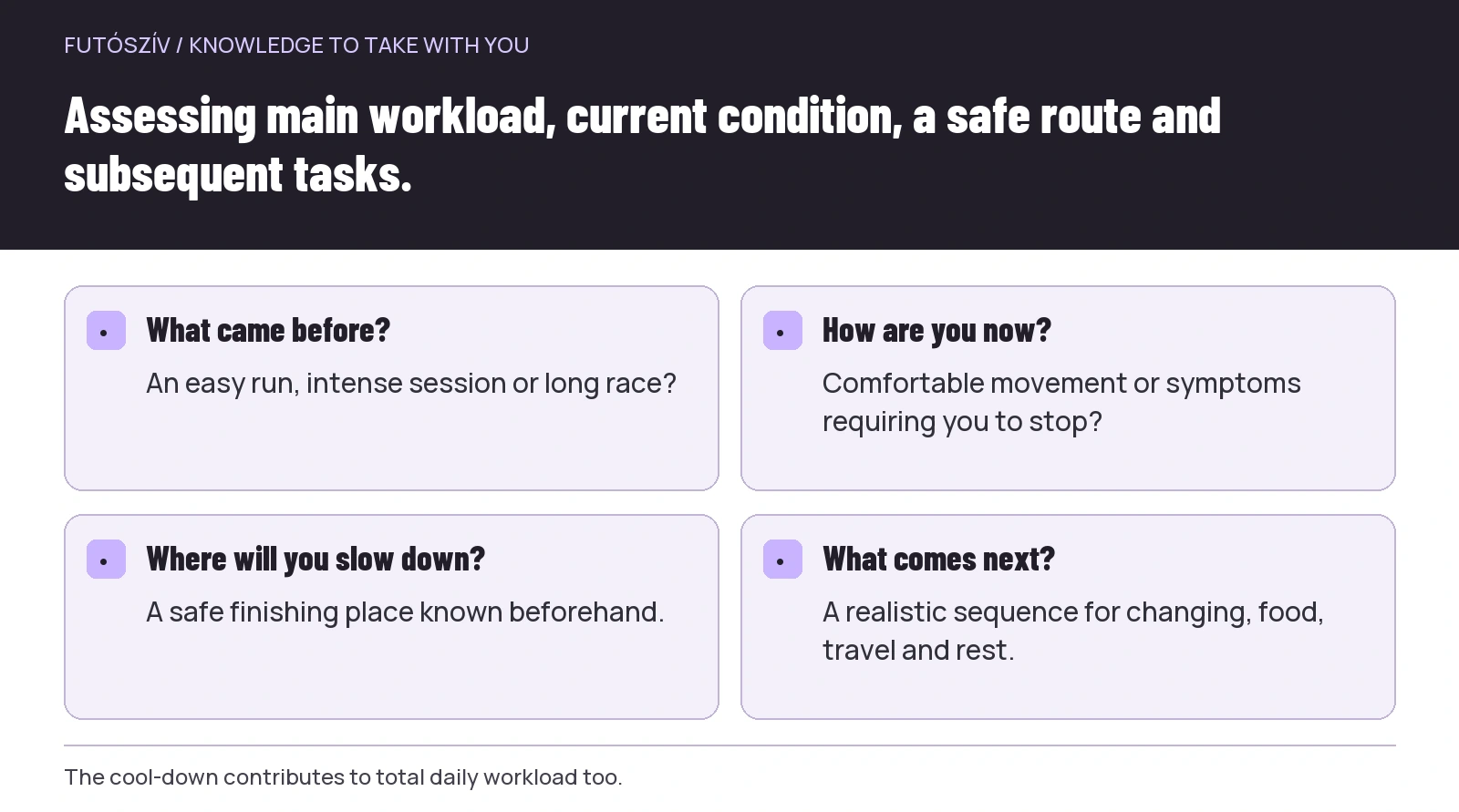
When time is scarce, basics matter too: a safe transition, changing, appropriate food and a realistic continuation of the day. An endless aftercare list can become a new obligation while sleep or meals are squeezed out.
 Enlarge diagram
Text version of the illustration
- What came before?
- An easy run, intense session or long race?
- How are you now?
- Comfortable movement or symptoms requiring you to stop?
- Where will you slow down?
- A safe finishing place known beforehand.
- What comes next?
- A realistic sequence for changing, food, travel and rest.
The rest of the day is part of the recovery environment
A few cool-down minutes are often followed by work, travel or family tasks. Count these as part of the running day too. Physical work is not automatically rest merely because the watch has finished recording.
Create a simple, manageable sequence: where will you change, when can you eat and drink, and how will you get home? Special recovery products are not needed for every occasion. Arranging everyday basics beforehand can prevent much unnecessary rushing.
Count the time needed to finish an evening run too. If the programme regularly extends at bedtime’s expense, reconsider the full workload framework. More post-run routines do not necessarily mean better recovery.
The personal role of settling down
For some people, an easy walk helps close the session and transition to the next task. This is meaningful personal experience in itself. Every pleasant habit need not receive a definite hormonal or muscle-repair explanation.
You can use the short transition to reflect in a sentence or two on the main section. What was the goal, what worked and what needs changing next time? Do not turn cooling down into an immediate, merciless performance review.
After a social run, a calm finish may also offer conversation. The shared rhythm should still reflect participants’ condition. The fastest runner’s recovery pace can remain hard work for somebody else.
When is it more than a simple cool-down question?
Fainting, chest symptoms, severe breathing difficulty, confusion or significant illness may require immediate help. Do not try to resolve symptoms by completing the prescribed cool-down kilometre. Stop safely and ask for help.
Recurring dizziness or unusual post-exercise symptoms also deserve assessment by a healthcare professional. A general article cannot determine the cause. With a known condition and individual exercise instructions, your own care plan guides you.
Jogging is not the only possible ending when pain occurs either. If movement changes or symptoms increase, stop running. A cool-down is not a necessary diagnostic test of whether a problem is real.
How can you observe what works for you?
After similar workouts, observe wellbeing, comfort moving and your condition the next day. Differences in daily circumstances mean one comparison cannot establish a certain conclusion. Feeling pleasant matters, but does not directly measure every recovery process.
Alongside the cool-down’s duration and nature, record the main workload too. This avoids attributing everything to the last few minutes when the preceding sessions differed completely. The whole story supports sound decisions.
A calm finish need not be long or impressive. It serves running when it provides a comfortable transition and leaves the whole day manageable. A useful routine starts with the current task rather than compulsory extra kilometres.
Sources
- American Heart Association: Warm Up, Cool Down.
- Blood lactate clearance during active recovery after an intense running bout.
- Is Lactic Acid Related to Delayed-Onset Muscle Soreness?
- The Effect of Warm-Up and Cool-Down Exercise on Delayed Onset Muscle Soreness.
- Effects of different recovery strategies following a half-marathon.
How Futószív articles are prepared: our editorial guidelines.