
A pacer can be a visible reference point in a large field: they run with a defined task and can help organise a run around a target time. The service is useful when you understand their role and it fits your realistic plan. The number on a flag is not a personalised suitability decision or a guarantee that you must follow that group in every circumstance.
Before lining up behind a pacer, clarify a few questions. From which starting point do they count time, what progress do they plan, how do they handle aid stations and where will you find them in the correct start zone? Pacers at different events may work within different organisational arrangements. Your own race’s current information and a brief pre-start conversation provide a reliable basis.
What does the pacer undertake at this event?
A pacer typically receives a pace or target-time task defined by the organiser. Specific goals, available groups and identifying signs may vary by event. Not every race has official pacers, and not every flag means the same service. Find the information for your event in the participant briefing.
The London Marathon Events page introducing its pacer team describes an officially organised team and its selection, for example. This shows that pacing can be a distinct organisational role. Target times or procedures experienced elsewhere still do not automatically transfer to your race.
Understanding the service’s limits matters too. The pacer does not know every follower’s complete preparation, health circumstances and personal plan. They carry out the group task within the stated framework. You still need to monitor your own situation, the course and organiser instructions. A flag does not take over responsibility for individual decisions.
Clarify your own goal first
Which way of completing the race and which realistic goal have you chosen? If preparing with a professional, you can discuss following a pacer beforehand too. The right group is not simply the number you would like to see at the finish. It should fit a plan based on your background, distance and conditions.
Even without a time goal today, a pacer can provide a reference point, but you need not rewrite the whole programme because of them. Company and orderly progress can be a useful experience if they suit your chosen approach. If you would continually need to adapt to an unsuitable rhythm, seek another option.
Your own goal can change before or during a race. Choosing a pacer earlier does not make that impossible. Make appropriate adjustments according to the current situation and personal needs. Health symptoms may require appropriate separate help; keeping the flag in sight is not the first task then.
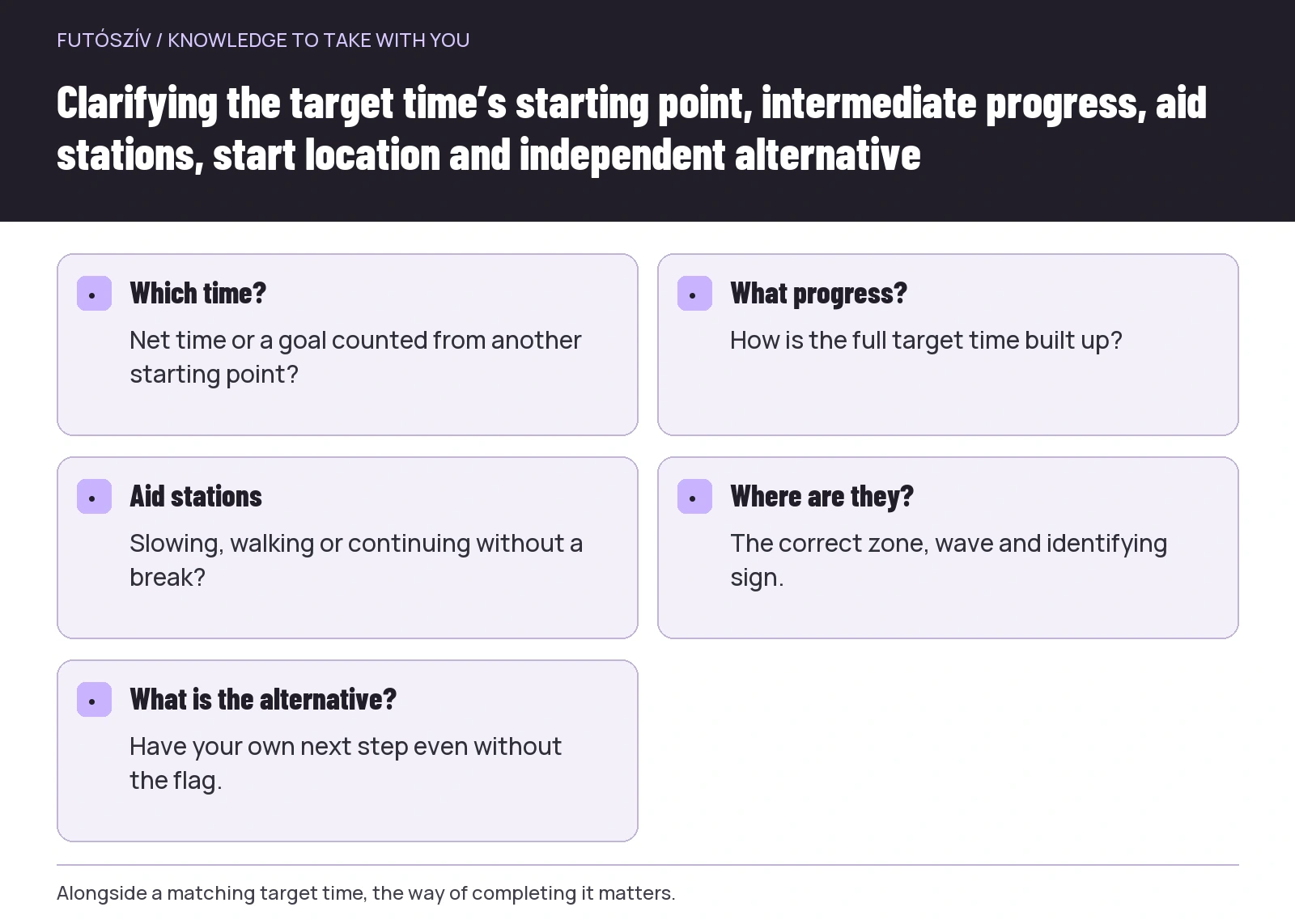 Enlarge diagram
Text version of the illustration
- Which time?
- Net time or a goal counted from another starting point?
- What progress?
- How is the full target time built up?
- Aid stations
- Slowing, walking or continuing without a break?
- Where are they?
- The correct zone, wave and identifying sign.
- What is the alternative?
- Have your own next step even without the flag.
Five questions worth clarifying in advance
| Question | Why does it matter? |
|---|---|
| Which time are you targeting? | Net, gross and your own departure’s starting point may differ |
| How is progress structured? | The overall target time does not describe every intermediate detail |
| What happens at aid stations? | Walking, slowing and continuous progress are different approaches |
| Where and when can the group be found? | Start zone, wave and identifying sign matter together |
| What is my plan if I fall behind or continue separately? | A personal alternative known beforehand remains available |
The pacer has tasks before the start too, so keep questions brief and specific. Read information already clearly supplied on the official page beforehand. The on-site conversation clarifies what you still need for your own decision. You do not need a long personal history to ask where net timing begins.
The flag’s number also has a starting point
A target time can be interpreted precisely only when you know where counting begins. With several waves, the pacer’s own start may differ from the first departure of the field. Net time may count from crossing the start line personally, while gross time may use another starting point. The particular event and pacer group’s information decides this.
If joining the pacer later, your own net time may not match the group’s target. You may have crossed the start line at different moments. This is a simple timing difference that need not be resolved with hurried acceleration. Understanding your own result requires knowing your starting point.
The London Marathon Events 2025 guide for The Big Half also explains its waves and pacers for that edition. As a year-specific example, it demonstrates why start format and group must be examined together. It cannot serve as an automatic rule for every later event.
The same target time can involve different intermediate plans
An average can be calculated mathematically from total time, but that does not mean the pacer runs exactly the same way between every point. The course, narrow sections and aid stations may form part of their prepared plan. Learn that approach before joining. The average alone is insufficient for imagining the whole experience.
In a simple illustrative example, seventy minutes over ten kilometres averages 7:00 minutes/km. This may include time stopped if the particular plan counts it that way. The running sections can then differ from the overall average. This is not a recommended pace, only an illustration of how the same summary can consist of different details.
If your own run–walk plan calls for something else, the pacer’s continuous progress may not suit you. The reverse is true too: planned group walking may create a different task from the one you prepared for. Beyond matching target times, the compatibility of completion approaches is a question. Clarifying this beforehand is simpler.
Finding the pacer does not override your start zone
Find which zone or wave contains the group of interest. If your bib belongs elsewhere, follow the organiser’s amendment or starting-area rules. Being near a flag grants no separate entry entitlement. Check the appropriate gate and time in your own participant information.
If reaching the group from a different position after the start, first assess your own plan and surroundings. You need not cut through the field at any cost to join them. Losing the group may be frustrating, but the independent alternative learned beforehand provides guidance for exactly this situation. A run can remain manageable outside sight of a flag.
Agree the shared goal with companions too. You may look at the same pacer while arriving with different personal plans. Following together should be an explicit commitment rather than one person’s unspoken expectation. If somebody continues separately, post-finish meeting arrangements should remain clear.
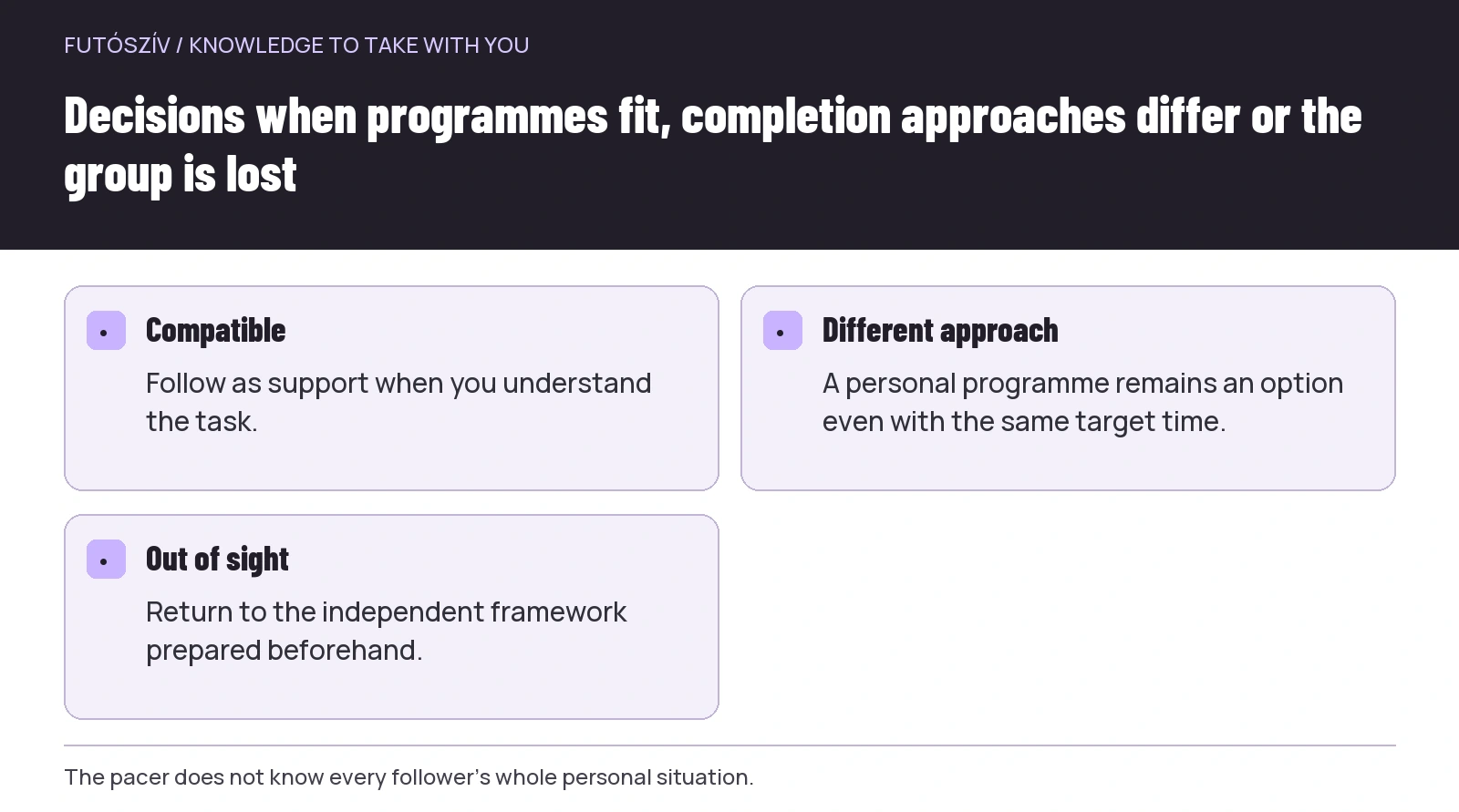 Enlarge diagram
Text version of the illustration
- Compatible
- Follow as support when you understand the task.
- Different approach
- A personal programme remains an option even with the same target time.
- Out of sight
- Return to the independent framework prepared beforehand.
Leave room for others in the group
Many people may gather around a pacer. You do not need to run on their heels or compete for space beneath the flag. Watch surroundings, bends and narrow sections. Move predictably and do not assume others will always notice a sudden change of direction.
Approaching an aid station, it is especially important to know the group’s plan and your own intentions. If stopping or slowing, do so appropriately for the location and with consideration for others. A familiar method practised beforehand can support cup or bottle use. Following a pacer does not replace your personal fuelling plan and needs.
Leaving the group need not involve a dramatic movement either. In a suitable place, watching the surroundings, transition to your own progress. You can briefly signal if needed for coordination with companions. The pacer does not require a long explanation for every separation to continue the group task.
Have your own plan for when the flag is no longer there
A bend, aid station or crowd can put the group out of sight. Your own watch, selected points and prepared programme can help with subsequent decisions. Interpret device data according to its meaning too. You need not make a major change because of one instantaneous pace value.
If the pacer must continue differently or you cannot see them, your own race does not become unintelligible. The designated course and organiser procedures remain. Follow your personal task adapted to your circumstances. The group is support alongside which basic independent orientation remains necessary.
Formulate the independent alternative before the start. For example, know which data to check at the next selected point and when to return to your previously agreed plan. This is not a general sporting recipe; the specifics belong to your programme. What matters is a next step without the flag too.
Three illustrative choices
A runner finds a target-time group fitting a realistic plan but does not yet know its aid-station approach. They ask and discover it matches what they have practised. They check their own zone too, then use the group as support. Meanwhile, they continue attending to personal needs.
Another runner wants the same target time but has planned walking sections differing from the group’s plan. They do not assume matching total times resolves everything. They follow their own programme and treat the pacer at most as a reference point. Compatibility of the completion approach guides the decision.
The third runner ends up farther from the flag after the start. Rather than suddenly chasing through the crowd, they return to the independent plan prepared earlier. In the post-finish review, they note where and why they separated. This helps choose a specific organisational or sporting task for the next event.
After finishing, review the pacer’s role too
Did the understood task, company and reference point help? Was there a detail that needed more precise clarification beforehand? Do not answer only from finishing time. The group may have supported your own plan well, or you may choose another approach next time.
Link the experience to the particular event and group. One occasion does not require a general judgement about all pacers. For the next choice, match the current task with your own goal again. A pacer is a useful companion on the course when the role is clear, programmes fit and your own ability to decide remains intact.
How Futószív articles are prepared: our editorial guidelines.