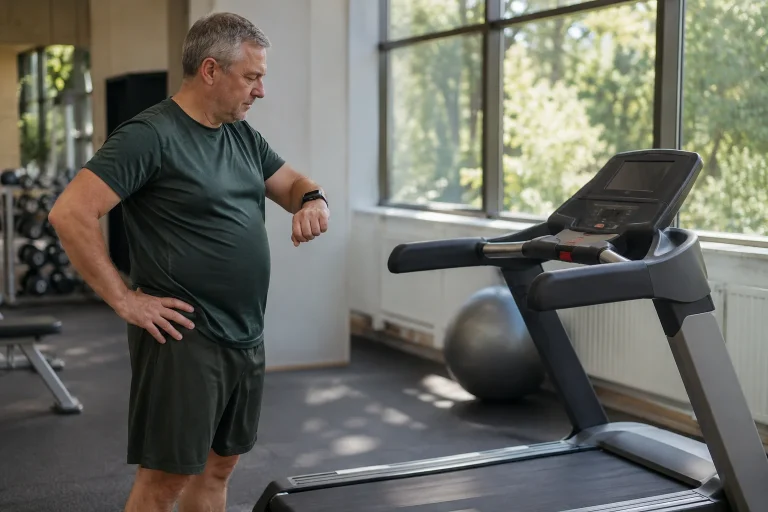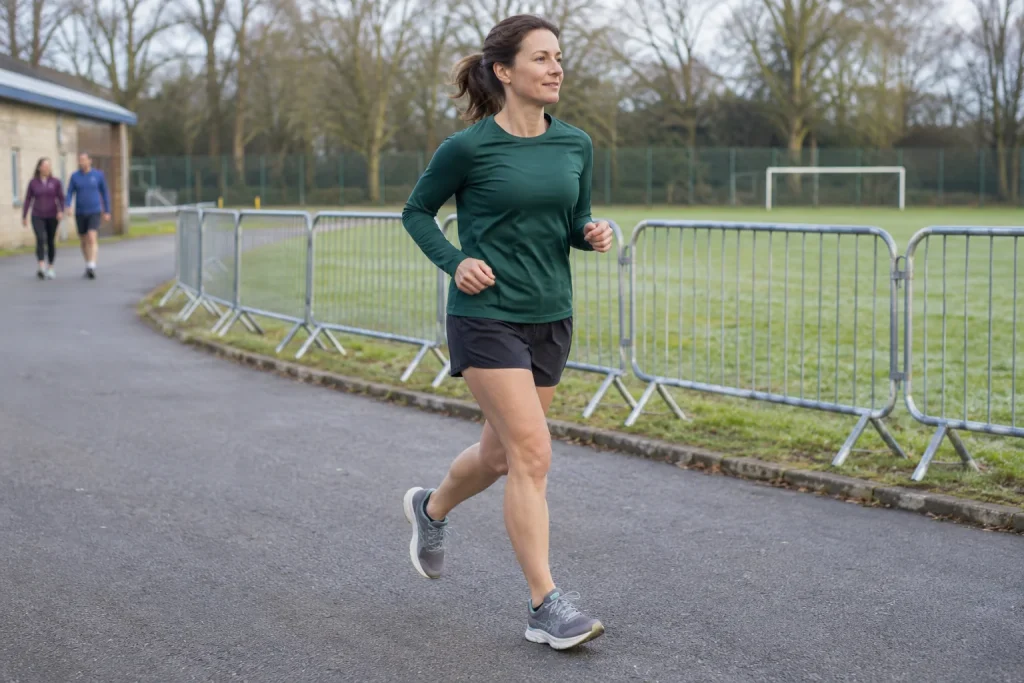
A pre-race warm-up is not a separate small race or one compulsory exercise sequence identical for every distance. Its purpose is to have you ready for the planned task at the start without unnecessarily tiring yourself. Alongside the movement itself, timing, weather and start organisation are part of this.
Preparation for a fast track race differs from preparation for comfortably completing a first longer road run. Start from your own experience. Race morning is a particularly poor time to introduce an impressive but unfamiliar routine.
Start with the race task
A shorter, more intense event may quickly require movement suited to higher speed. In a longer race, conserving energy, reaching the start and beginning under control may carry different weight. The same warm-up distance therefore does not mean the same suitability.
The participant’s goal matters too. The same five-thousand-metre event may be a maximal performance test or a first social run. Another person’s warm-up length does not automatically fit your task.
Describe the condition you want at the start: moving comfortably, breathing calmly and already familiar with the opening pace. Make the description more meaningful than having ticked every prescribed exercise. The sequence is a tool for reaching that state.
What do warm-up experiments show?
A study using an eight-hundred-metre running test compared two preparations in trained athletes. Its finding concerned a specific short, hard performance task. It does not provide an automatic recipe for every road-race distance.
A five-thousand-metre study with thirteen trained male runners found an average performance improvement after a higher-intensity warm-up compared with the easier version tested. Precise work bouts and a separate transition period belonged to the protocol.
The common lesson is not to warm up as hard as possible. Participant, race demand, workload and time remaining until the start matter together. An improvement in a research title is not a personal result guarantee or a reason to introduce maximal efforts on a first attempt.
Plan backwards from the start
First learn exactly how the start is organised. When must you enter the start zone, how long does bag drop take, where are the toilets and how far away is the warm-up area? The official start time alone is not enough to plan departure.
Build a flexible timetable backwards from the tasks needed before reaching the start. Leave room for small queues and uncertainty finding your way. You need not fill every minute with movement; avoiding haste also supports preparation.
An illustrative point: if the gate closes well before the start, fit the warm-up’s ending to that rather than a last-moment acceleration. Choose actual minutes from the event’s current information and your own tested routine.
From general movement towards a more race-specific task
The warm-up can begin with easy movement, gradually settling into running rhythm. The opening section should not immediately become a pace test for the day. Notice whether shoes are comfortable, clothing suitable and how you feel matches the planned task.
This can be followed by a few familiar, comfortably controlled movements and, where needed, short controlled accelerations. Not every participant before every race needs all elements in equal amounts. Simplicity suited to the goal is an advantage.
A sequence established in earlier training can be reassuring. If the venue requires changes, preserve the purpose: a gradual transition and an appropriate starting condition. Losing the exact choreography does not automatically make preparation useless.
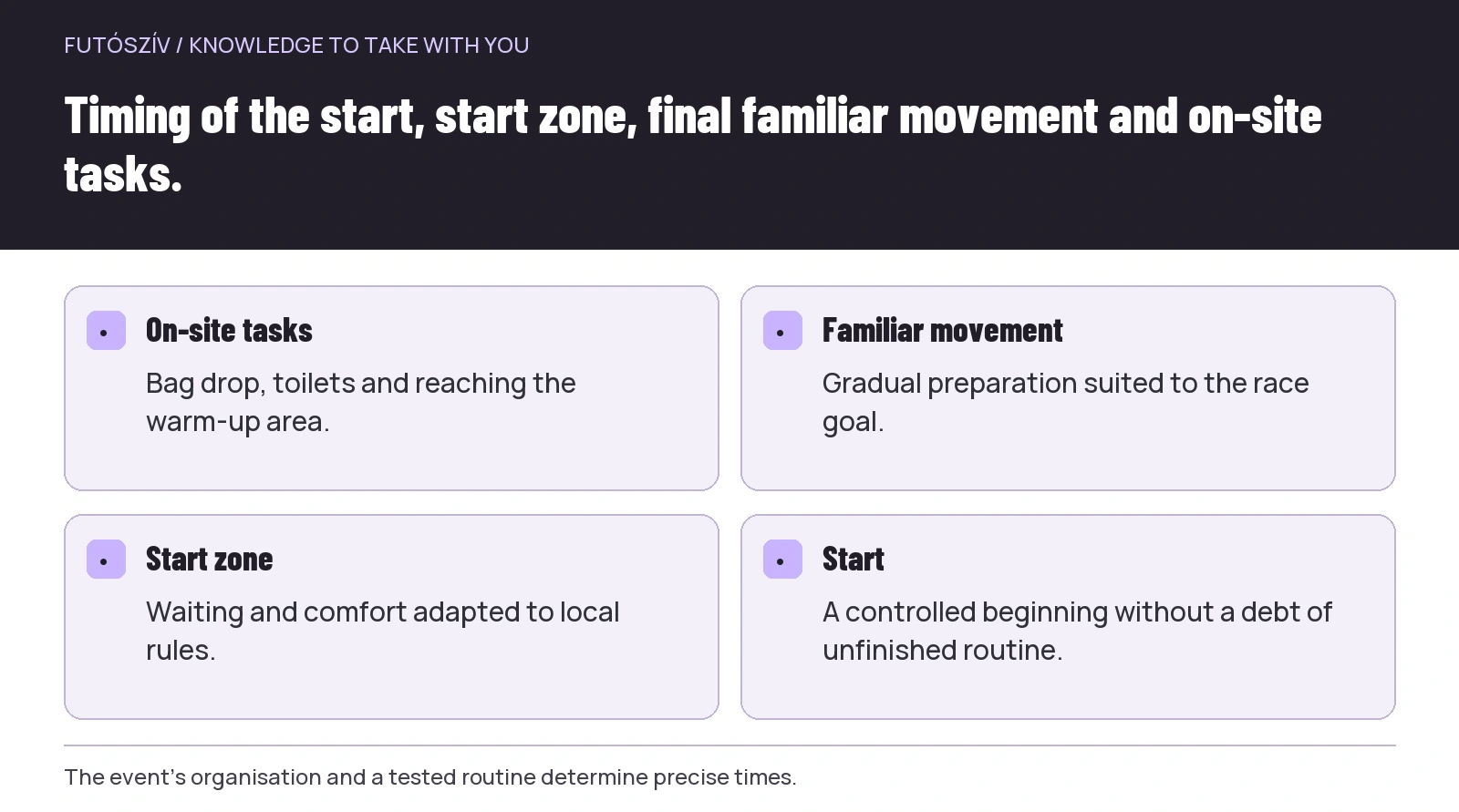 Enlarge diagram
Text version of the illustration
- On-site tasks
- Bag drop, toilets and reaching the warm-up area.
- Familiar movement
- Gradual preparation suited to the race goal.
- Start zone
- Waiting and comfort adapted to local rules.
- Start
- A controlled beginning without a debt of unfinished routine.
Dynamic exercise is not a magic term either
A running experiment comparing a general warm-up with dynamic stretching examined acute responses in eight trained men during a particular treadmill performance task. The specific task, volume and timing form part of the result.
Movement called dynamic may be easy, vigorous or distinctly tiring. The label alone does not show how suitable it is before your race. A long jumping sequence or forceful movements can add a new training load.
Choose exercises you know and can control comfortably. The warm-up area is not a range-of-motion contest. Sudden forcing or working into pain is not necessary to feel prepared.
The place and limits of short accelerations
If part of your routine, accelerations should help bridge easy movement and faster running. Allow space for gradually accelerating and slowing. A crowded start zone, kerb or bag-drop queue is not a suitable acceleration lane.
Finish the short section with control and allow sufficient rest for the next task. The aim is not to display the highest speed. If every repetition becomes more strained, the routine may be drifting away from preparation’s original purpose.
Do not let the neighbouring runner’s behaviour decide your accelerations. Your warm-up may be finished even if somebody else is still doing a set. Comparing yourself before the start often directs attention to the wrong place.
What should happen while waiting?
Time between warming up and starting is part of the real race. If a long wait is expected, adapt clothing and permitted light movement accordingly. Respect the organiser’s rules and the space of people around you.
You need not stay active at all costs by jumping or making large movements in the start zone. Limited space requires predictable small movements. Standing comfortably, settling your breathing and gathering attention can also form part of preparation.
If the start is delayed, do not automatically repeat the entire warm-up at full volume. A short adjustment suited to the new situation may make more sense. Your own experience helps identify the boundary between maintaining movement and unnecessary fatigue.
In cold weather, logistics help you stay warm too
Waiting a long time after jogging in wet or overly thin clothing creates a different situation from comfort during the main movement. Consider where and when you hand over the outer layer and what the start area permits.
Find a solution you do not have to invent at the last minute. Retrieving clothing after the start and the outfit needed at the finish are organisational tasks too. Race morning consists of more than minutes spent running.
Cold does not justify making the warm-up much harder than usual. Clothing, wind protection and the timing of waiting separately affect comfort. Excessively tiring preparation is not an automatic answer.
In heat, becoming even hotter should not be the goal
The World Athletics Beat the Heat guide recommends reducing unnecessary heat stress before the start and warming up in shade where possible. The term warm-up does not mean accumulating as much heat as possible in every environment.
A long routine that worked on a cool training day may need adjustment in heat. Unnecessary waiting in the sun and unjustified movement volume can be reduced. Do not try a new cooling method for the first time just before the race, however.
Feeling unwell is not a necessary part of the routine. For unusual dizziness, confusion or significant symptoms, ask for help and do not treat starting as the only option. A race’s importance does not override your health situation.
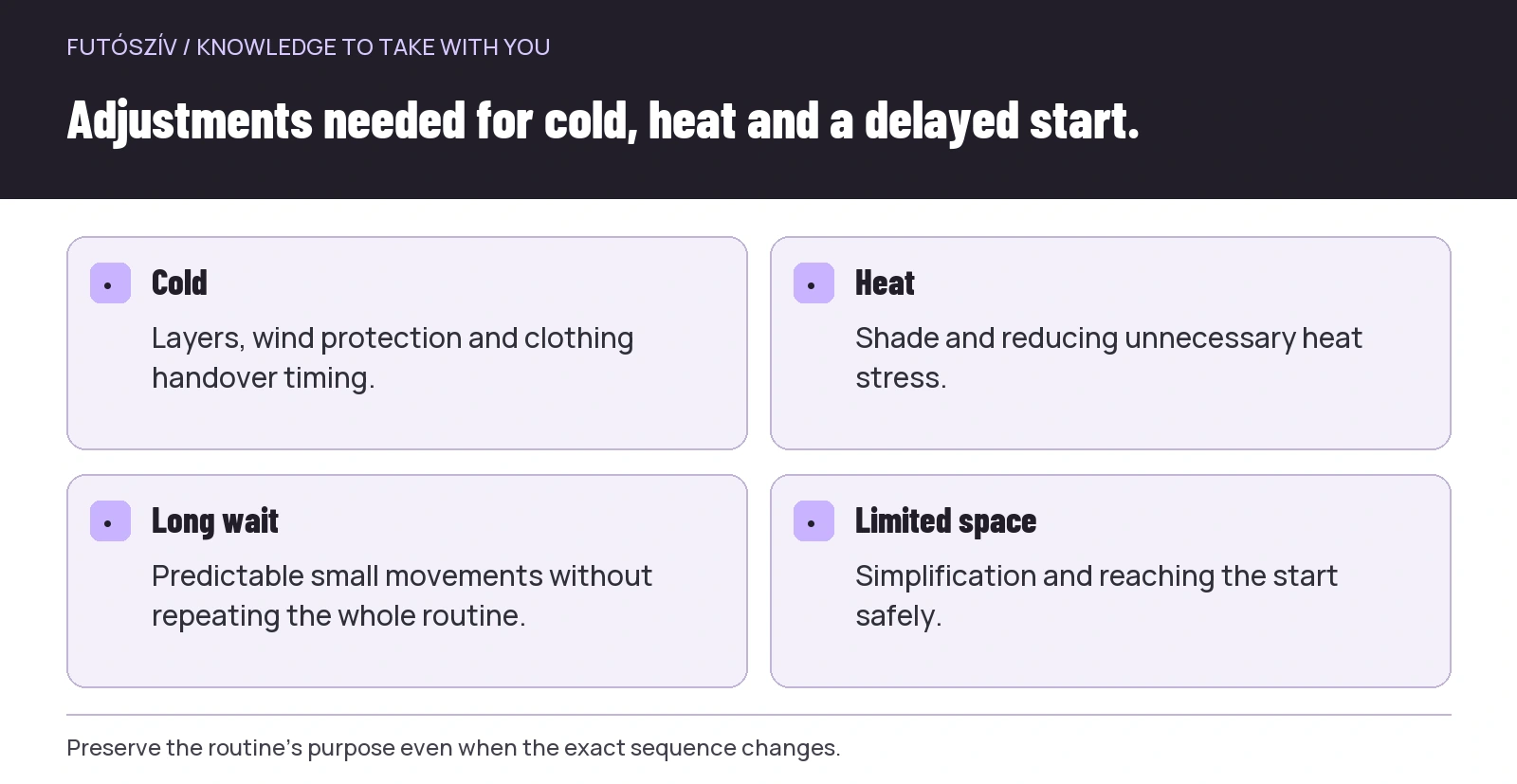 Enlarge diagram
Text version of the illustration
- Cold
- Layers, wind protection and clothing handover timing.
- Heat
- Shade and reducing unnecessary heat stress.
- Long wait
- Predictable small movements without repeating the whole routine.
- Limited space
- Simplification and reaching the start safely.
Choose fewer new elements before a first longer race
If the main goal is a comfortable finish, several kilometres of fast movement beforehand may add unnecessary workload. Adapt preparation to your own usual days and planned opening pace. You do not need to copy a professional track athlete’s routine.
Plan the opening section too. Excitement and the crowd can easily produce a faster start than intended. Warming up does not remove responsibility for pace choice, and feeling ready does not justify an unlimited opening effort.
Include the walk to the venue and on-site movement in the whole morning. They do not necessarily replace everything, but take time and add workload. Adapt the programme to your real arrival rather than an imagined empty start venue.
Practise the whole sequence in training
Before an important event, practise on an occasion allowing you to try the movement, changing, a shorter wait and the planned start. You do not need to simulate a whole race. The aim is to make the sequence familiar and discover what is excessive or hard to organise.
Note how much time was actually needed and when beginning felt appropriate. An exercise may be useful but misplaced in the sequence; another may have too many repetitions. Details can be adjusted when discovered before race day.
If working with a coach, describe how it felt too, not only the distance completed. Heavy legs after warming up and an overly long wait may call for different adjustments. A personal routine need not be a complicated one.
What should the backup plan look like?
In rain, with a closed warm-up area, late arrival or an unexpected queue, do not try to cram the complete sequence into a rush. Choose the most important familiar elements and preserve a safe approach to the start.
The event may begin even if your routine was imperfect. A controlled opening and a goal suited to the conditions then matter particularly. Missed warm-up minutes are not a debt to repay by accelerating in the race’s first kilometre.
With health symptoms, however, the backup plan may be not starting. Do not suppress sharp pain or unusual illness during the warm-up to see whether it disappears while racing.
Afterwards, assess your condition at the start
Many factors shape a race result, so a good or bad time cannot reliably isolate the warm-up’s full effect. A more useful question is whether you began feeling comfortable, organised and appropriately prepared for the task.
Describe whether timing worked, whether unnecessary rushing remained and whether a simpler plan was needed. You can learn from this for the next race. A good warm-up supports the start without taking the entire race’s energy in advance.
Sources
- Improvement of 800-m running performance with prior high-intensity exercise.
- Effects of High-Intensity Warm-Up on 5000-Meter Performance Time.
- Effect of General Warm-Up Plus Dynamic Stretching on Endurance Running Performance.
- World Athletics: Beat the Heat.
Research protocols concern specified participants and situations. The organisational examples presented are not personalised warm-up prescriptions.
How Futószív articles are prepared: our editorial guidelines.