At the end of a first running race, finishing time can easily take attention away from the whole story. One number goes into the message, beside the photograph and into the log. Yet much else happened: you organised the journey, learned how the start worked, made decisions on the course and experienced the post-finish situation. These can become specific knowledge for the next occasion.
The purpose of reviewing is to retain what worked and select what to change. Every first race need not become a performance examination. A good time can coexist with an organisational detail worth improving, while a slower-than-expected result can include many sound decisions. The following questions make the whole day visible.
Separate first impressions from the later review
Immediately after finishing, a few short observations may suffice. What stayed with you most strongly, what was surprising, and is there a specific detail you do not want to forget? Getting home and meeting your own needs may matter more then than lengthy analysis. You can leave the detailed review for a calmer time.
For the later review, take out your original plan, the official result and the notes actually available. If you cannot remember something, do not fill the gap with a certain story. A first race brings many new details; naturally, you may not have precise information about all of them. Naming a gap is more accurate than guessing afterwards.
A post-competition reflection guide published on Australian Athletics’ coaching platform also connects specific observations with the next action. Originally intended for coaches, its approach is adapted here through personal questions covering a recreational runner’s whole day. This is not a psychological diagnosis or a compulsory evaluation method.
Find the original goal first
What did you want before the race? A first finish, familiarity with a distance, a shared experience or a particular time? There may have been several goals, but naming the primary one is useful. Do not retroactively replace your original task with other people’s results seen afterwards. Another runner’s story starts elsewhere.
If you did not write down a goal beforehand, you can now clarify what you expected, but mark it as recollection. For the next event, you can record the commitment in one sentence beforehand. This makes evaluation more transparent: comparison is with the task chosen in advance, rather than a continually shifting retrospective benchmark.
The entry or race name alone does not define your personal goal. Over the same distance, one person seeks a fast result, another a first experience important to them. Your review needs to return to your own chosen task and circumstances. This does not diminish the race’s sporting value; it clarifies your question.
Review six areas separately
| Area | Useful question |
|---|---|
| Preparation | What was arranged in time and what remained until the last moment? |
| Venue | Did you find your own next point? |
| Course decisions | What actually happened, and how did you respond? |
| Equipment | What worked in your own use? |
| Coordination | Were meeting and help arrangements clear with companions? |
| Wrapping up | Were bags and the journey home arranged? |
One or two specific sentences about each area are enough. You do not need to find a fault in every field. Name what worked too, so you can retain it next time. A review is useful when you finish knowing what to build on and which one next change would make sense.
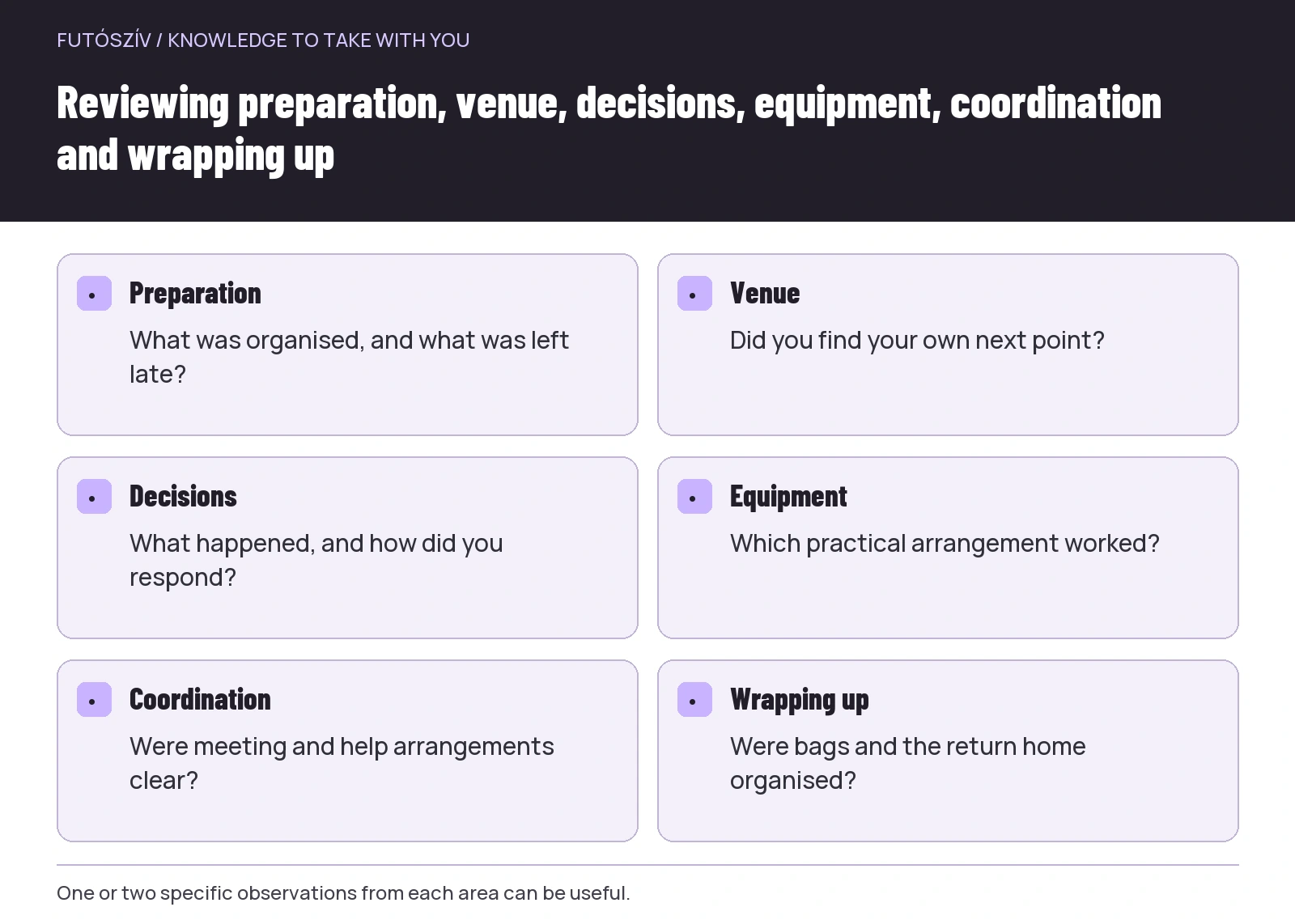 Enlarge diagram
Text version of the illustration
- Preparation
- What was organised, and what was left late?
- Venue
- Did you find your own next point?
- Decisions
- What happened, and how did you respond?
- Equipment
- Which practical arrangement worked?
- Coordination
- Were meeting and help arrangements clear?
- Wrapping up
- Were bags and the return home organised?
For preparation, assess actual time
When did preparations begin and how long were you away in total? Was the time allowed for travel and collection sufficient? If you rushed before the start, identify the specific point. Finding parking, a longer walk or a missing document each calls for a different improvement.
Do not label the whole day disorganised because of one blockage. Packing may have worked well while you misunderstood only the entrance. Recording that separately can produce a targeted change. For example, locate the actual gate beforehand on the next site plan, or put the required confirmation somewhere more accessible.
A suitable planned time frame is an achievement too. Note which preparation helped: earlier collection, coordinated travel, a familiar packing list or your own information sheet. These cannot be copied with unchanged data at every event, but the method remains useful. Naturally, check the next announcement’s details again.
On the course, distinguish the decision from the final result
Was there a point where you changed your plan? Did you stop, give way, follow different instructions or report something earlier? Describe why you made that decision in the situation known at the time. A finishing time viewed afterwards does not reveal all the information available on the course.
If you departed from your intended progress at the beginning, name the observation. “After the start I followed the others, then eased back later.” This is more specific than “I ruined everything”. You can seek professional help when shaping the next sporting task if needed, but can preserve the fact accurately now.
Do not treat a health complaint or unusual symptom simply as a racing-strategy error. These may require separate attention and appropriate professional help. Your review sheet is not a diagnostic tool. If a question arose, clarify your personal situation before choosing the next race too.
Write about equipment in relation to specific tasks
Was the phone secure, could you reach the necessary item, and had you attached the bib properly? Instead of the general statement “the equipment was good”, name the practical experience. If something bothered you, note when and how. This makes choosing a trial or adjustment easier.
Do not automatically infer from one successful race that the same clothes now suit every condition. Weather, distance and route can change. This experience comes from a particular situation. Adapt the next event’s bag using both that knowledge and the new conditions.
Before buying something new, check whether the problem genuinely involved missing equipment. A poorly adjusted belt, unread wearing instructions or an overcrowded pocket may have other solutions. Naming the problem precisely supports a more purposeful decision. First-race experience can thereby improve equipment use.
Coordination and help are part of the day too
Was the meeting point clear, did you report changes in time, and did your supporter know what help you expected? If somebody waited a long time or could not find the agreed place, more precise coordination may be needed next time. Specific information matters alongside good intentions. “Meet at the finish” may be insufficient at a large event.
Thank people for the help actually provided and discuss what worked. A supporter’s or teammate’s own experience may reveal logistical details you could not see from the course. You do not need to ask for an opinion on your whole sporting result to review travel and meeting arrangements.
If arriving with a club or group of friends, the shared day’s lessons can have a separate conversation. Who knew the latest information, how did changes spread, and where was searching unnecessary? A team review aims to simplify the next occasion. You need not assign blame for every difficulty when the process can be improved.
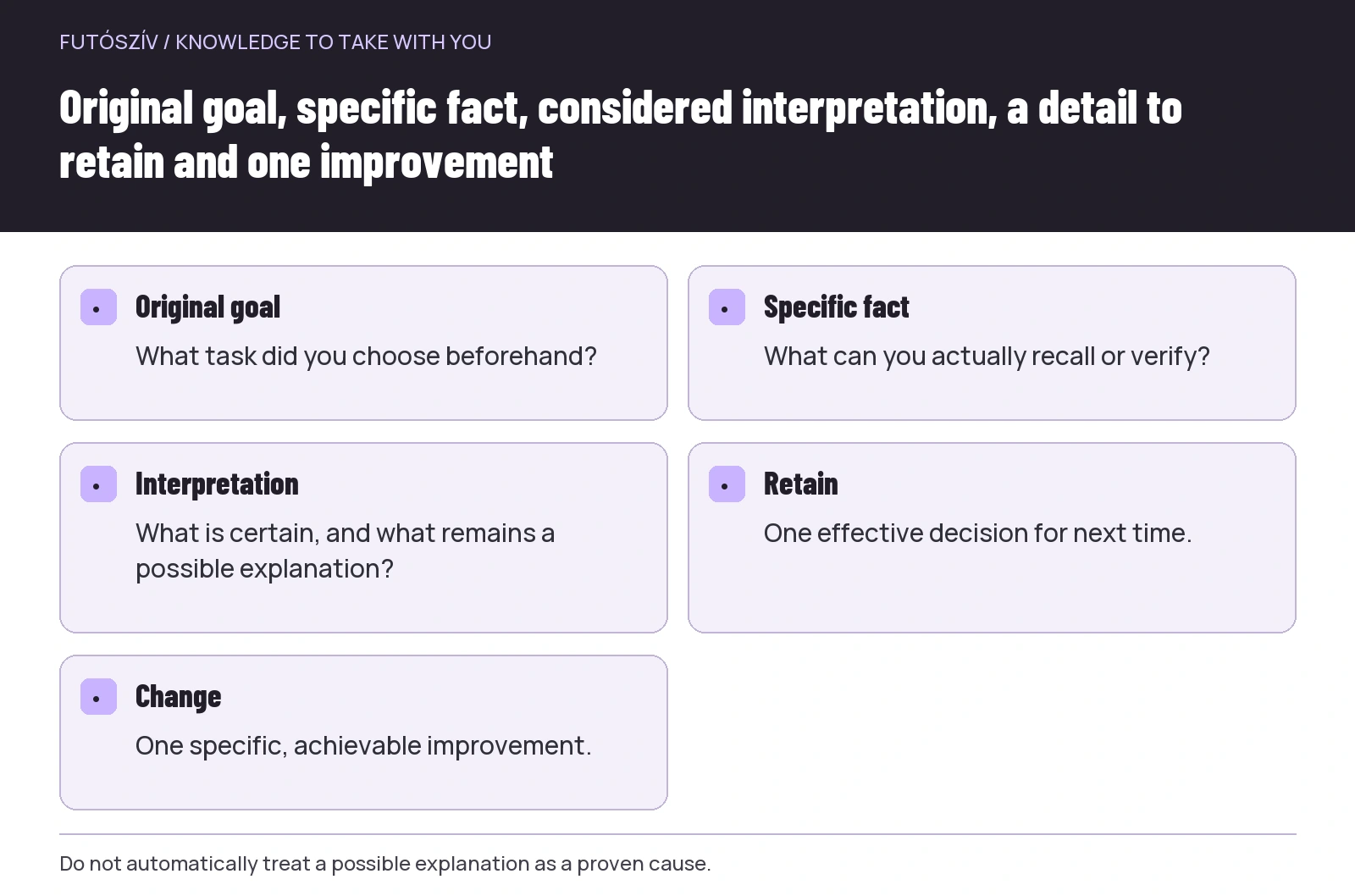 Enlarge diagram
Text version of the illustration
- Original goal
- What task did you choose beforehand?
- Specific fact
- What can you actually recall or verify?
- Interpretation
- What is certain, and what remains a possible explanation?
- Retain
- One effective decision for next time.
- Change
- One specific, achievable improvement.
Keep the time from the appropriate field
Net time, gross time and your own watch data may differ. Label the number with which you use and its source. If your result is on an official list, check the correct season and race category. For a missing result or discrepancy, find the organiser’s designated channel and deadline.
The result also belongs to a course and set of conditions. With another distance, terrain or task, the number alone does not answer the same question. A first race is particularly unsuitable for certainly predicting every later result. The number is useful information to interpret alongside other experiences.
The Copenhagen Marathon article on test races also distinguishes several purposes for gaining experience. The practical principle transferable to reviewing is to look back at the occasion’s task. The answer to the selected question matters more than turning every observation into one overall score.
Fact, interpretation, next step
| Observed fact | Possible interpretation | Specific next step |
|---|---|---|
| I spent a long time looking for the starting-area gate | I knew the central address but not the entrance | I will mark it on the site plan before next time |
| The pocket contents bothered me | I had not tried storage with the actual contents | A short practical trial at home and on a familiar loop |
| We could not find each other at the finish | We chose too broad a meeting location | A specific point and contact plan |
| I followed my own plan | The task was clear in advance | I will retain the short pre-event description of the goal |
The table contains illustrative examples. A possible interpretation is not a proven cause. If several explanations are plausible, say so. Make the next step something you can actually do or clarify with suitable help. A self-judging label rarely leads to such a precise task.
Keep one thing, change one thing
A first race may produce many ideas, but you need not rewrite everything for the next outing. Choose one effective detail to retain and one specific improvement. For example, keep the earlier bag check but choose a more precise meeting point. The effect of a small, identifiable change is easier to interpret later.
If considering a training change, fit it to your whole situation, with professional help where needed. One strong post-race impression does not require redesigning the entire training system. A factual account provides a good basis for discussion. Advice received should be used within the appropriate individual context.
You do not have to decide the next entry immediately either. First close out the day’s experiences and necessary follow-up tasks. If you want a new goal, lessons from this occasion and your real schedule can provide its basis together. Enthusiasm after the finish arch is valuable, but you can read another event’s conditions later too.
A short personal review sheet
Event and date. Original personal goal. Verified result with its type. Three specific observations. One decision to retain. One next change. An open question and the help needed for it. This can fit into a few paragraphs and be quickly reread later.
Reviewing a first race this way does not reduce the experience. It preserves details absent from photographs and results lists. At the end of the day, you have more than a number: you have personal knowledge of how you arrived, which decisions you made and what you want to handle more deliberately next time. Many different future goals can build on that experience.
How Futószív articles are prepared: our editorial guidelines.