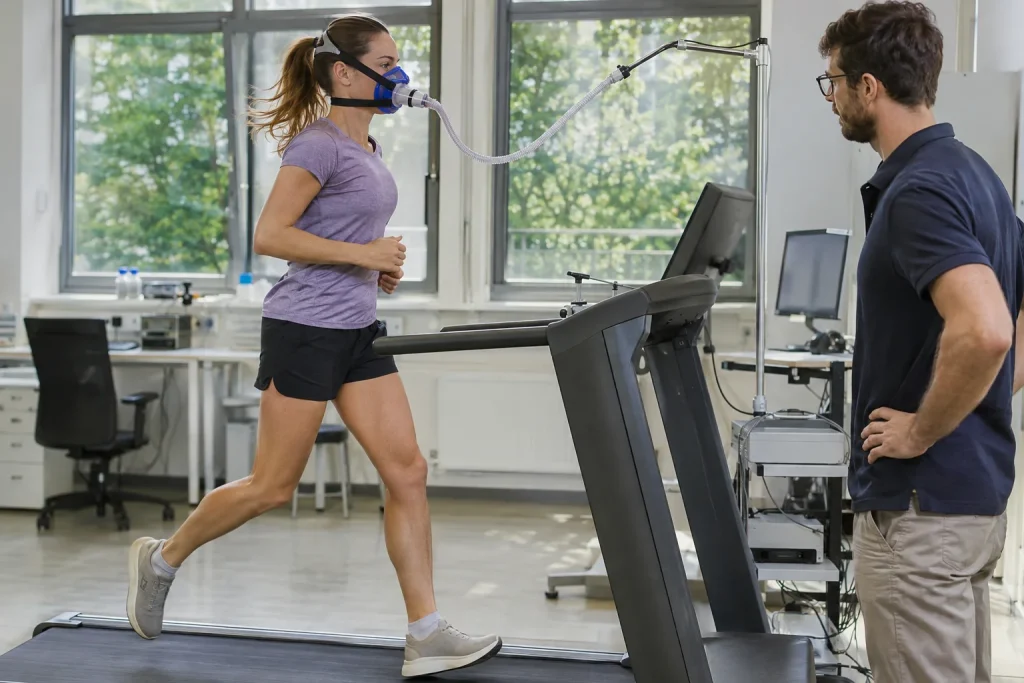
Two runners move at the same pace with similar maximal oxygen uptake, yet the task does not feel equally easy. Running economy may be one difference: the oxygen or energy cost of maintaining a defined speed. The question is not whose movement looks prettier, but the metabolic cost associated with the measurable task.
The concept is intriguing because it connects physiological capacity with usable running speed. Yet it easily becomes an oversimplified story: one technique trick, shoe or data point supposedly solves everything. Understanding economy instead supports thinking about several interacting factors.
What are we comparing?
First establish speed, environment and measurement method. At a given submaximal pace, oxygen uptake or energy cost estimated from it and other respiratory-gas data can be examined. A lower cost for the same task may mean better economy.
If one measurement occurs at a faster speed and another slower, you no longer compare the same thing directly. Flat treadmill running, outdoor wind, climbs and shoes matter similarly. Economy is not a circumstance-independent stamp bearing a runner’s name.
A primary study comparing oxygen cost and energy cost also highlighted the importance of interpreting different ways of expressing the result. Read the unit as carefully as the result itself.
Oxygen per minute or energy per kilometre?
Oxygen uptake per minute can show the demand of maintaining a particular speed. Cost per distance provides another perspective: how much one unit of travel requires. Speed is involved in the relationship between the two.
Energy estimated from oxygen is not entirely identical to oxygen quantity alone, because the mix of fuels used matters too. Do not automatically treat “oxygen cost” and “energy cost” in research as descriptions with identical detail.
For your own test, ask which unit reports the result, at what speed and under what conditions comparison is considered valid. You do not need to perform every calculation mentally, but the meaning should be clear.
Economy and mechanical efficiency
Everyday speech may call both efficient running. The scientific concepts are not entirely the same. Mechanical efficiency would require establishing mechanical work relative to energy input; running economy is often characterised by metabolic demand at a given speed.
This matters because less vertical movement, shorter ground contact or another visible variable does not itself prove lower total energy cost. Changing one movement component can change work elsewhere. Visually tidier movement and more economical laboratory running are not necessarily identical.
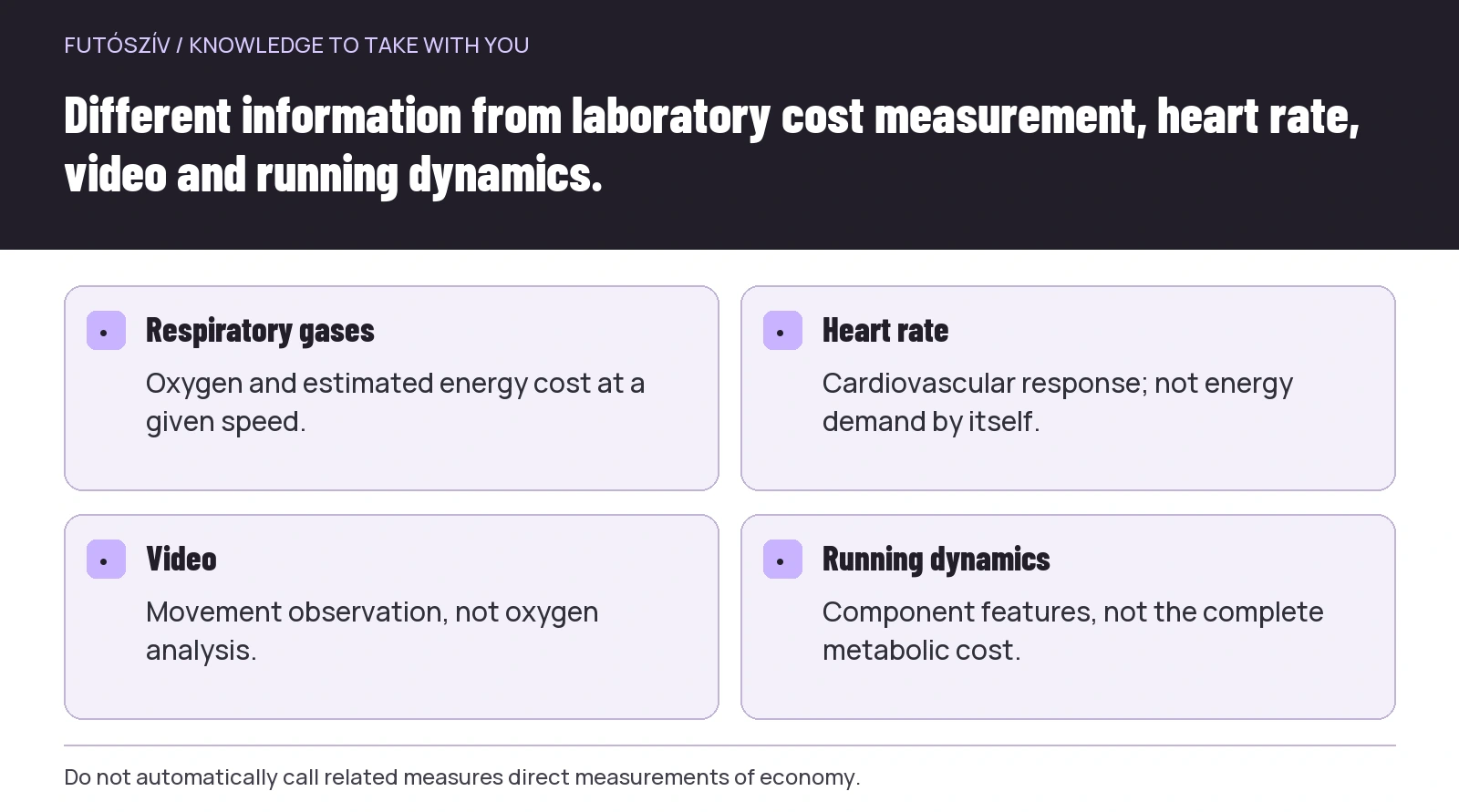
Video analysis may help choose an observation or task, but footage is not an oxygen analyser. Keep conclusions from external features proportionate to what you actually measured.
 Enlarge diagram
Text version of the diagram
- Respiratory gases
- Oxygen and estimated energy cost at a given speed.
- Heart rate
- Cardiovascular response; not energy demand by itself.
- Video
- Movement observation, not oxygen analysis.
- Running dynamics
- Component features, not the complete metabolic cost.
Why does it matter to endurance performance?
A lower cost of maintaining a speed can make it a different task relative to the same maximal capacity. This does not mean one laboratory value alone calculates a whole race time. Sustainable intensity and fatigue matter too.
The classic research on economy and running performance demonstrated this factor’s importance in highly trained athletes. Such a relationship is not a personal time prediction and does not establish that every economy difference translates equally into race advantage.
For a recreational runner, the practical question may be simpler: how can a task become more manageable and repeatable? Alongside laboratory data, actual training experience and the race environment belong to that question.
No single component works alone
Circulation, breathing, muscle work, force timing and movement organisation contribute together to running’s cost. The body is not a list of separate shoes, calf contraction and arm action. Changing one factor must be interpreted within the whole task.
This explains why claims that everyone needs the same cadence or foot strike to improve economy are questionable. Body dimensions, history, speed and individual movement patterns differ. Copying another runner’s appearance is not a measured result.
If considering change, define the problem and criterion. Do you want to reduce a sense of unnecessary strain, have pain assessed by a professional, or track laboratory-measured cost? These can relate but may require different assessments and approaches.
What can strength training do?
In an intervention study with trained runners , maximal strength training added to usual running improved the economy measure investigated. This was a specific programme’s result, not proof that any strengthening produces the same outcome.
Consider technique needed for the load, background and the whole programme too. A beginner should not copy heavy weights from a paper. Suitable exercise selection and gradual learning are tasks in their own right that may require qualified help.
Do not evaluate strength work only by how running feels that day. A new exercise may produce temporary fatigue while the longer programme serves another aim. Plan timing of running and strength together so every session does not struggle against the other’s after-effects.
Shoe effects are a real question, not a personal guarantee
In a laboratory comparison of marathon racing shoes , one model produced lower average energy cost than two comparators at defined speeds and in particular participants. An average effect does not mean everyone gains equally at any pace.
The shoe’s full design matters; the finding need not be attributed to one part, such as the plate alone. Foam, geometry, weight and their relationship with a runner coexist in the tested model. A retail label is not your own individual laboratory result.
Comfortable fit, movement you can handle stably and actual use matter to selection too. An economy promise does not solve rubbing, uncertain cornering or recurring symptoms. Do not use new shoes first at an important race.
Technique changes can have costs and learning time
Deliberately running differently may initially demand more attention and effort. A movement that looks like a striking improvement does not therefore establish an immediate economy benefit. Learning and lasting results are separate questions.
In a study of a programme teaching running movement , kinematic changes occurred without demonstrated improvement in running economy. This does not exclude benefits of every kind of technique learning, but clearly shows that a changed movement picture alone is insufficient evidence.
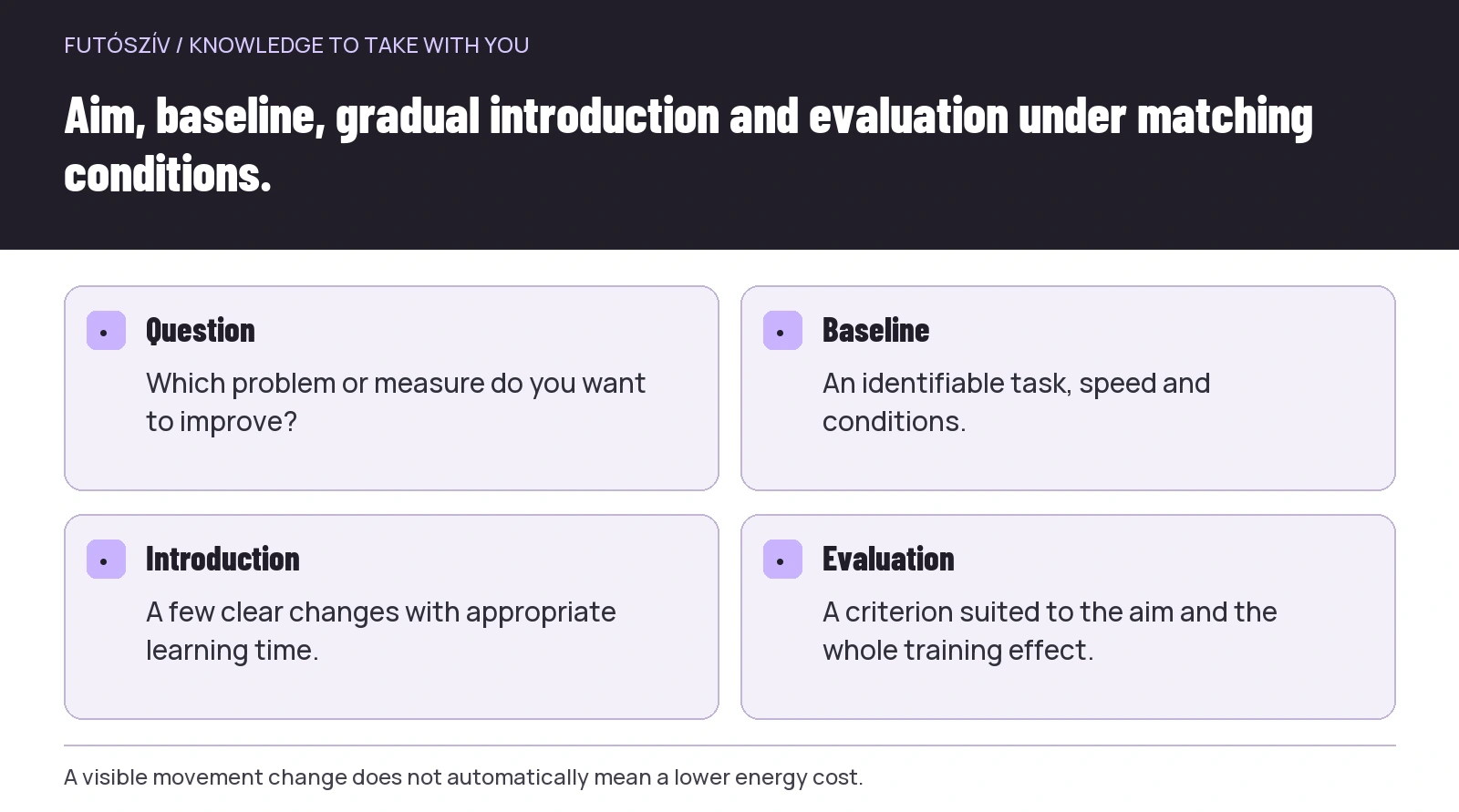
Many new instructions at once are particularly hard to evaluate. If changing for a professional reason, use a few clear tasks, time to adjust and appropriate feedback. With relearning prompted by pain, economy may be only one consideration alongside health.
 Enlarge diagram
Text version of the diagram
- Question
- Which problem or measure do you want to improve?
- Baseline
- An identifiable task, speed and conditions.
- Introduction
- A few clear changes with appropriate learning time.
- Evaluation
- A criterion suited to the aim and the whole training effect.
Fatigue can change the picture
Cost measured while fresh does not necessarily describe the end of a long run. As loading continues, sensation, muscle work and movement may change. For sustained performance, retaining earlier function is another question.
A randomised study examining strength training and economy during longer running specifically addressed durability in trained male runners. The research-purpose distinction matters: fresh-state measurement and measurement after longer loading do not ask precisely the same thing.
This should not lead you to test yourself to complete exhaustion every time. Observing fatigue can belong to a gradually built programme. Do not judge lasting changes in condition from one difficult day.
Why is heart rate alone not a good economy measure?
A lower heart rate at a particular pace is interesting training experience, but not direct measurement of energy or oxygen cost. Daily condition, surroundings and measurement accuracy affect it too. Do not automatically call favourable heart-rate data proven economy improvement.
Watch power and running-dynamics measures also arise from different procedures. A smaller vertical ratio or different ground-contact time alone does not replace respiratory-gas measurement. More data do not mean every important variable is measured directly.
Use them for observation, while distinguishing firm statements from assumptions. “It felt easier in similar conditions” is precise and useful. It need not be replaced with a label sounding more scientific.
How can you track it meaningfully?
Laboratory comparison ideally needs the same protocol, speed, equipment and well-documented prior conditions. The testing provider can explain which difference is meaningful relative to methodological uncertainty. Not every difference between nearby numbers means real progress.
Outside, follow several kinds of feedback together: familiar route, similar conditions, same type of task, sensations and actual performance. This is a practical training log, not a laboratory substitute. It can help formulate good questions even without measuring exact energy demand.
Use a meaningful observation timescale. One shoe trial or differences between consecutive days can easily receive too much importance. Repeatable experience related to the aim may say more than an occasional kilometre that feels particularly easy.
Where is attention best directed?
A sustainable running system, strength work suited to the goal, appropriately chosen equipment and restrained introduction of changes are meaningful decision areas. You do not need to modify everything together or chase movement that looks ideal from outside.
With pain or persistent unusual fatigue, do not diagnose yourself with an economy fault. Symptoms may need their own assessment. Laboratory data and technical ideas help when used alongside the health and training situation.
Economy is a useful thinking framework: capacity matters, but so does the cost of using it. Evaluating individual running nevertheless includes control, durability and the specific aim alongside cost.
Sources
- Economy of running: beyond the measurement of oxygen uptake.
- Running economy and distance running performance of highly trained athletes.
- Maximal strength training improves running economy in distance runners.
- A Comparison of the Energetic Cost of Running in Marathon Racing Shoes.
- A programme teaching running movement and economy: primary study.
- Strength Training Improves Running Economy Durability.
How Futószív articles are prepared: our editorial guidelines.