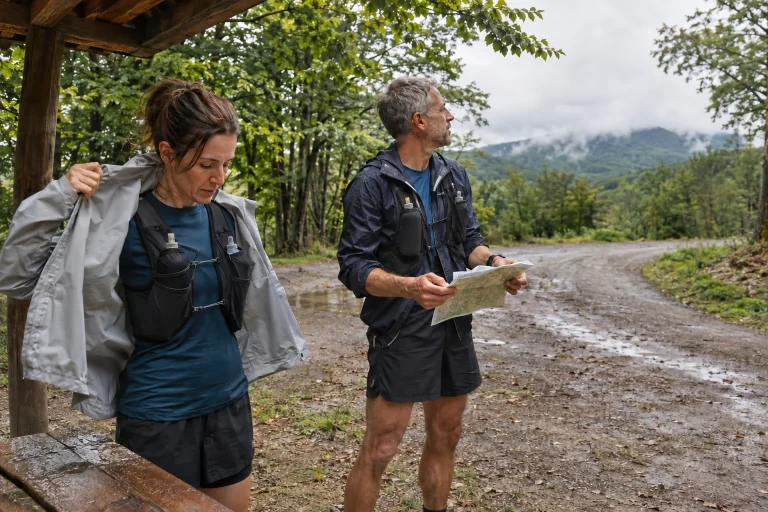
Losing your usual running venue can become a surprisingly large organisational task when the whole programme depends on one gate or route. Renovation, events, weather or temporary area restrictions mean even a familiar loop is not always available. A backup helps when it is thought through and genuinely usable; saying “I will manage somewhere” at departure is not yet a plan.
You do not need several complete alternatives for every area. Another nearby section already explored, a checked alternative time and a decision to move the outing under certain conditions may be enough. The aim is simple, compliant and clear organisation of the next programme. Preserving the familiar kilometre trace matters less.
First establish exactly what is unavailable
One locked gate differs from the whole area being unusable. An event may affect part of a route, or restrictions may apply during a specific period. Without precise geographic and time limits, it is easy to plan too large or too small a change. Find fresh information from the responsible source.
Check the announcement date, location and conditions. A previous year’s news is not automatically the current situation. A warning for another park does not establish anything certain about your route either. If details are unclear, the operator or manager is the appropriate contact.
The official parkrun guide to checking cancellations also asks participants to check their event’s own information before leaving. Cancellation of an organised activity and general usability of the area may be separate questions. Use the appropriate source for each; a cancelled event does not automatically imply either full closure or unrestricted use.
Separate the cause from the solution
If renovation closes one place, a nearby park may be a suitable alternative if you know it and it is usable. If dangerous weather affects the area, however, reaching the same place through another street does not address the cause. A backup needs to answer the obstacle’s real nature.
The same applies to forest restrictions. A neighbouring path does not necessarily lie outside the area named in the notice. The VERGA forest-visit information for 2026/2027 , for example, provides area and period details and separate information channels. For your departure, find the current announcement applying to that day; the example cannot establish one rule for every forest.
Describe the obstacle in one sentence: “The park is unavailable today because of an event.” Or: “Current access to the affected part of the route is unclear.” The precise sentence shows which information or change is needed. Frustration can then have a next step alongside it.
 Enlarge diagram
Text version of the diagram
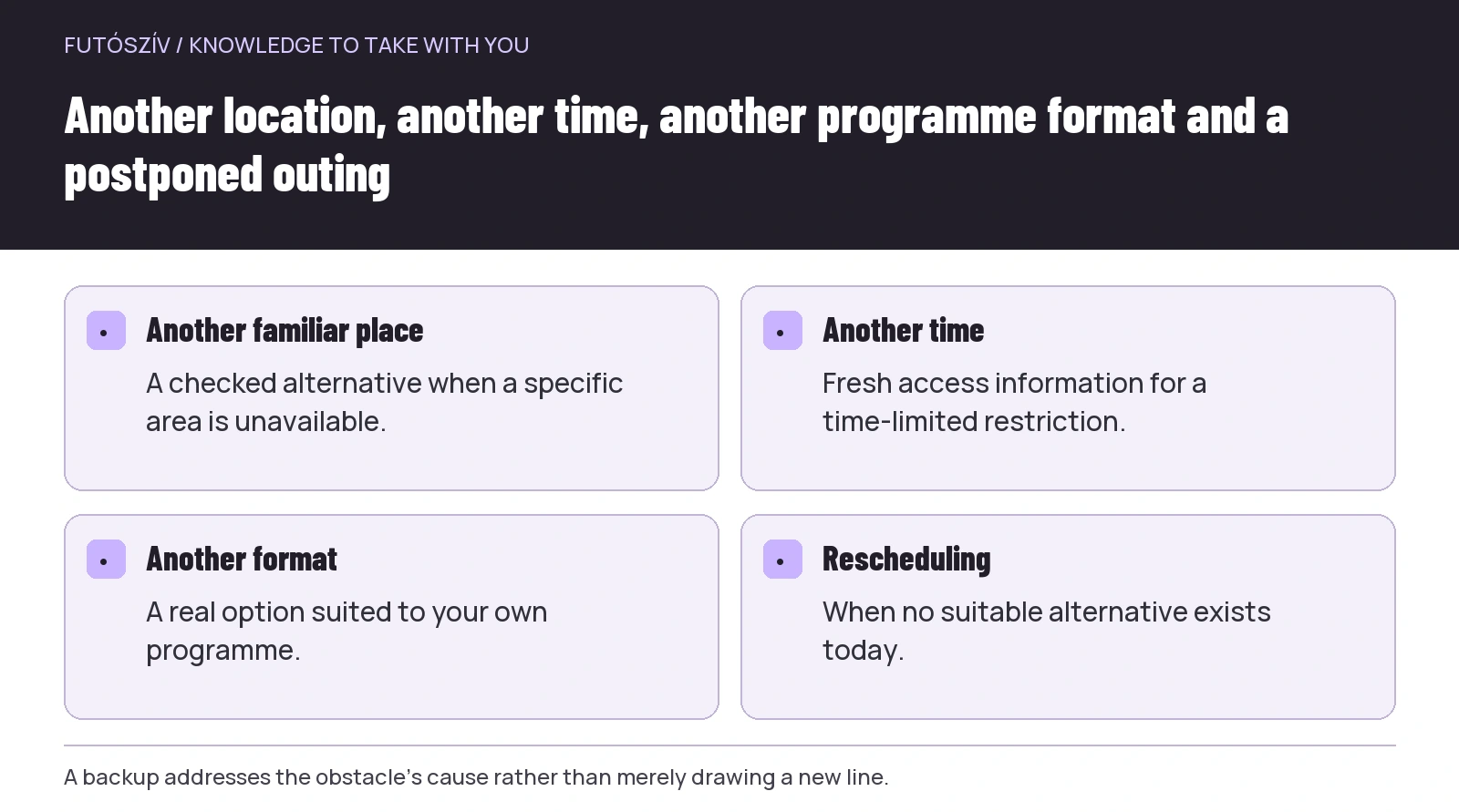
- Another familiar place
- A checked alternative when a specific area is unavailable.
- Another time
- Fresh access information for a time-limited restriction.
- Another format
- A real option suited to your own programme.
- Rescheduling
- When no suitable alternative exists today.
Four kinds of backup with different roles
| Backup | When may it fit? | What needs checking? |
|---|---|---|
| Another familiar location | The problem concerns a specific area | Today’s access and approach |
| Another time | The restriction is time-limited | Actual conditions for opening or lifting it |
| Another personal programme format | The location-dependent part can change | Fit with your personal programme and possibilities |
| A rescheduled outing | No suitable alternative exists today | The next real opportunity that can be agreed |
Backups are not automatic replacement workouts. If following an individual programme, adapt changes to it, with discussion when necessary. This table distinguishes organisational options. Another location’s terrain or route may also raise separate loading and experience questions.
Make the nearby B loop genuinely familiar
Walk through a backup route once in calm conditions. Inspect approach, main turns and return. If the usual park closes, you should not then have to search surrounding streets for pedestrian links for the first time. A short, straightforward version may be enough.
Give the B loop a known total time window too. Its on-site part may be short but farther from home. The backup may therefore not fit the same evening. Check usability door to door, including associated travel and arrival home.
Note basic access information: gate, opening hours, local usage rules and their source. Update this at departure if necessary. The backup venue is not guaranteed for ever either. Its value is that you know the details and what needs checking again for that day.
A weather backup should not be the same plan under another name
Check current forecasts and warnings for the appropriate area. The HungaroMet system explanation helps interpret forecasts of hazardous weather and alerts. A warning provides area information, not detailed conditions on every street. Consider the actual situation and your own programme too.
If the obstacle affects a wider area, another nearby park may not solve it. Another time or a genuinely available, suitable format may be the backup. Check the conditions for using an indoor option too. “There is surely a treadmill somewhere” is not specific enough.
Equipment does not make every condition appropriate either. A new garment or light has a defined task and manufacturer limits. If today’s location is unsuitable, modifying the programme is sensible. A backup aims for manageability, not unchanged execution of the original commitment at any cost.
For group running, share one common update
If several people are coming, decide beforehand where a venue change will be announced. One shared message channel may be simpler than several contradictory details. Include the new place, time, approach and who needs to confirm attendance. “We will meet elsewhere” provides too little information.
Set a realistic decision deadline. If someone is about to start a longer journey, late changes add a burden. You can agree when to check the current situation and when everyone receives a definite answer. Truly last-minute changes cannot be eliminated completely, but communication can still have a clear procedure.
If the backup is a different kind of programme, say so too. Different terrain, a longer approach or another time window is not the same outing at a new address. Participants should be able to decide whether it suits them. Declining is then a personal decision under changed conditions, not rejection of the community.
 Enlarge diagram
Text version of the diagram
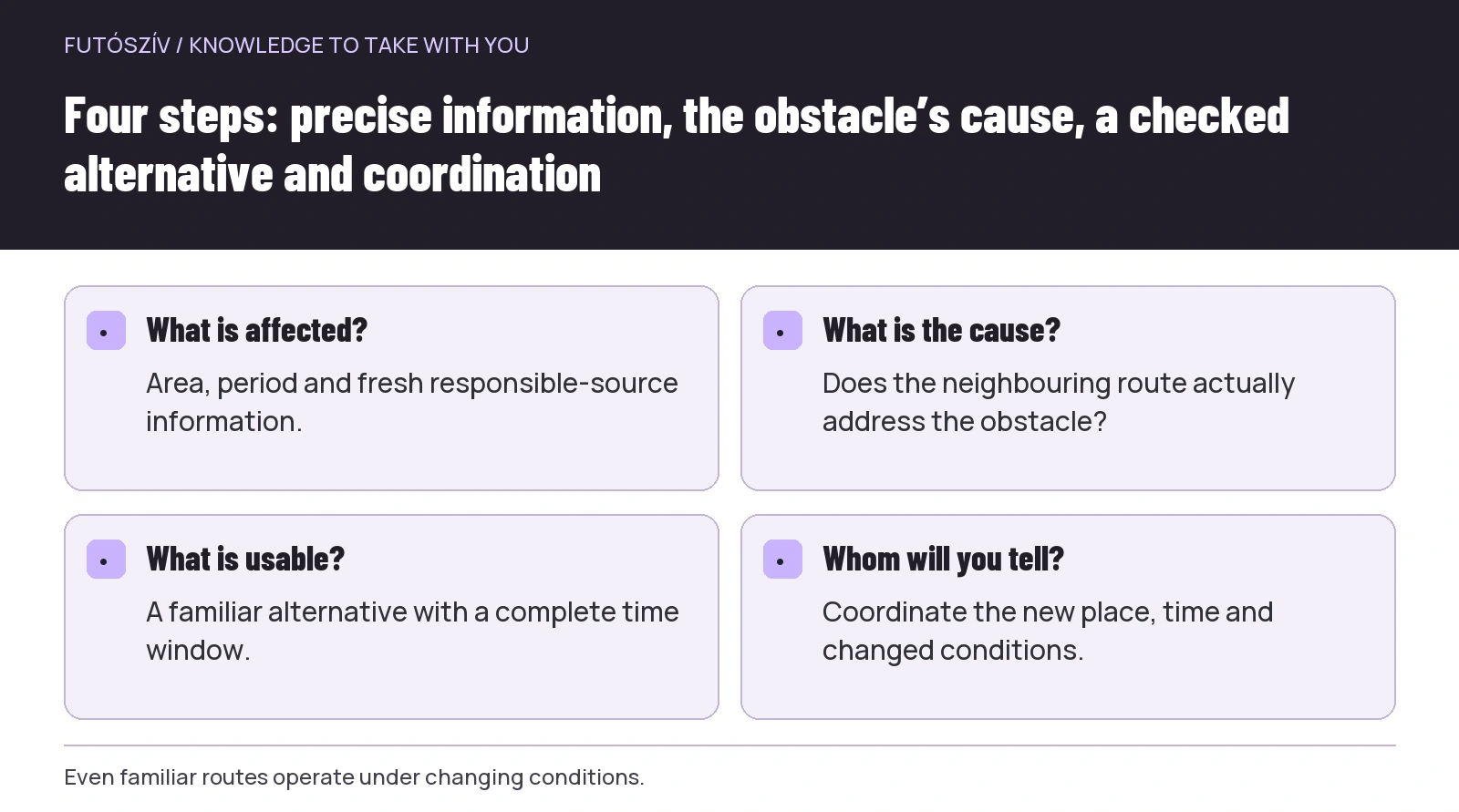
- What is affected?
- Area, period and fresh responsible-source information.
- What is the cause?
- Does the neighbouring route actually address the obstacle?
- What is usable?
- A familiar alternative with a complete time window.
- Whom will you tell?
- Coordinate the new place, time and changed conditions.
Five illustrative situations
An event occupies the park. You learn the affected day and area beforehand. Check whether the familiar nearby B loop is usable and fits the full time window. If so, agree the new meeting point with companions. Do not improvise a narrow, disruptive detour along the event boundary.
Renovation closes one gate. From the manager’s current information, check whether another permitted entrance exists. Add the approach’s distance and route to the plan too. If only the gate changed, the on-site loop may remain. If all access is uncertain, choose another option.
The forest route has a temporary restriction. Check the exact area and period with the appropriate manager. Do not build a backup from a neighbouring unknown path. Choose another route with clarified access and approach, or move the outing to another time.
The organised community run is cancelled. Read the organiser’s announcement and its reason. Decide separately about your own programme from the actual conditions. Account for the absence of tasks or services the organiser would have provided too. Do not automatically imagine identical conditions replacing the cancelled event.
You discover the change only on arrival. Stop, read the information and assess available time. If the B loop you explored earlier is not easily accessible, return or choose another time. The journey already made is disappointing, but does not justify taking on an unknown or unsuitable situation.
These examples are not specific current closures. They show the decision order: information, cause, checked alternative and coordination. Add today’s data for your own location.
Give the backup a small information card
Record the alternative’s name, approach, source to check and known total time frame. Mark when you visited and at what time of day. A summer daytime walk-through does not mean you know winter evening use too. Naming the limit makes the decision more accurate.
If plan B requires travel, check the return too. The alternative may look closer on the map yet be harder to get home from in the evening. A backup programme is a complete chain, not just another running line. Access to keys, clothing and equipment may change as well.
Keep the card short. It is useful when quickly reviewable before departure. You do not need a separate plan for every conceivable situation. One or two genuinely familiar options and the next coordination point are worth more than many uncertain alternatives never checked.
What should you tell yourself about a missed outing?
A venue closure changes an external condition. It does not grade your earlier commitment. It can still disappoint, particularly when free time is rare. Acknowledge the feeling while focusing on the next useful decision: what can be managed now and what needs postponing?
Do not automatically call the missed programme a debt. The next day has its own conditions, and your personal training programme needs adapting to those too. If working with a coach, report the change accurately. “I could not access the venue” is different information from having completed the original task.
If the venue remains unavailable, you can replan the running system too. Another nearby loop, a different time or a new community connection may become the default. A temporary backup can later become your own routine. Review approach and time window as you did when choosing the first route.
Check reopening too
After the originally stated period ends, check fresh announcements and the condition on site. Work or circumstances may change. The old message may not reveal every current detail. Returning to the familiar loop can itself become a new checking point.
After the first use, note changes to the entrance, surface, route or usage rules. Earlier local knowledge provides a valuable basis, complemented by fresh experience. You need not forget the backup: it can remain a second option for the next disruption. Running arrangements then depend less on one location and become easier to adapt.
How Futószív articles are prepared: our editorial guidelines.