On longer trail runs, you may see some runners with poles and others without on the same route. The choice does not follow solely from distance or experience. Terrain, your movement, learned use and where you carry poles when not needed all matter. Even a lightweight folding model can be cumbersome if you cannot store it safely; a well-chosen tool is useful only when you understand it in your own task. This guide focuses on equipment decisions. It does not replace practical technique instruction or prescribe poles for everyone running on trails.
Start with the task and route
Describe where and on which sections you want to use them. Walking on a long climb may present a different situation from a short route with frequent changes. If poles will stay packed for most of the run, the carrying system becomes more important to the decision. If you have never used them, a suitable, safe learning occasion and expert help can be valuable before purchase. Low weight felt in a shop does not reveal how you will integrate the poles into your own movement. Acquiring equipment and learning the skill are separate steps.
Terrain and proximity to other participants also affect use. A narrow, crowded trail differs from a wide, quiet climb. Poles do not entitle you to move tips unpredictably beside others or hold them pointing backwards. Learn safe handling in an easy place first. Where you cannot use them appropriately, you may need to pack them in the supported way. Consider the whole run, including flat sections, stops and encounters, rather than only the extended pole.
At races, check permission first
Organiser rules can restrict pole use and carrying. Permission may differ by distance, and you may be required to keep poles with you from start to finish. The current UTMB Mont-Blanc race regulations , for example, have specific provisions on carrying poles throughout the race. This is one event’s rule, not a condition transferable to every Hungarian or international race. Read the current document for your event and distance, then check fresh organiser announcements too. A companion’s previous experience does not replace this.
If rules require carrying poles throughout, the carrying system is not an optional afterthought. Leaving them at an aid station or handing them to another person may be prohibited, so do not plan on it without clarification. Particular course sections or protected environments may also impose separate conditions. Choosing a suitable product starts with understanding compliant use. Light weight does not remove organiser requirements. If a rule is uncertain, ask the organiser with the exact event and question rather than deciding through a general community vote.
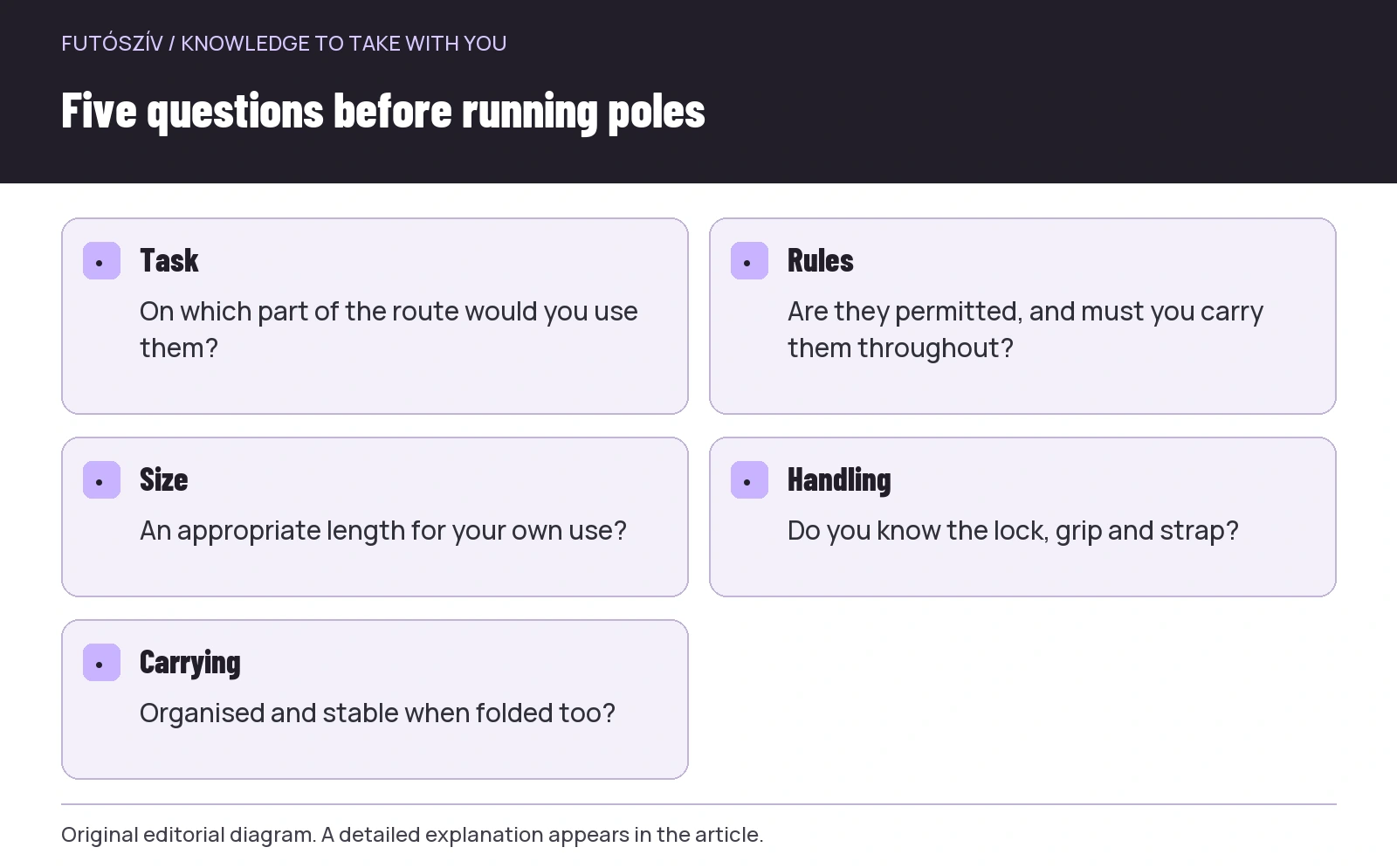 Enlarge diagram
Text version of the diagram
- Task
- On which part of the route would you use them?
- Rules
- Are they permitted, and must you carry them throughout?
- Size
- An appropriate length for your own use?
- Handling
- Do you know the lock, grip and strap?
- Carrying
- Organised and stable when folded too?
Fixed or adjustable length
Fixed length can provide a simple design, but you need to choose size correctly beforehand. Adjustable length can offer options for several situations while adding a locking mechanism and handling. Do not assume adjustable is better in every respect or fixed is simpler for everyone. Intended use, body proportions and learned technique matter. Manufacturer sizing guidance is a good starting point; a personal trial and suitable professional help can refine it. Do not treat one height multiplier as a final prescription for every product and movement situation.
The Black Diamond European product questions-and-answers page explains several construction and material options. These are manufacturer explanations, not personal fitting decisions made for you. When trying poles, adjust grip and strap properly too, and evaluate length in intended use. Standing in a shop is not a technique test. Particularly for a first choice, someone familiar with the product and trail use can help. With some fixed designs, an incorrect size cannot be corrected later.
Folding and telescopic construction
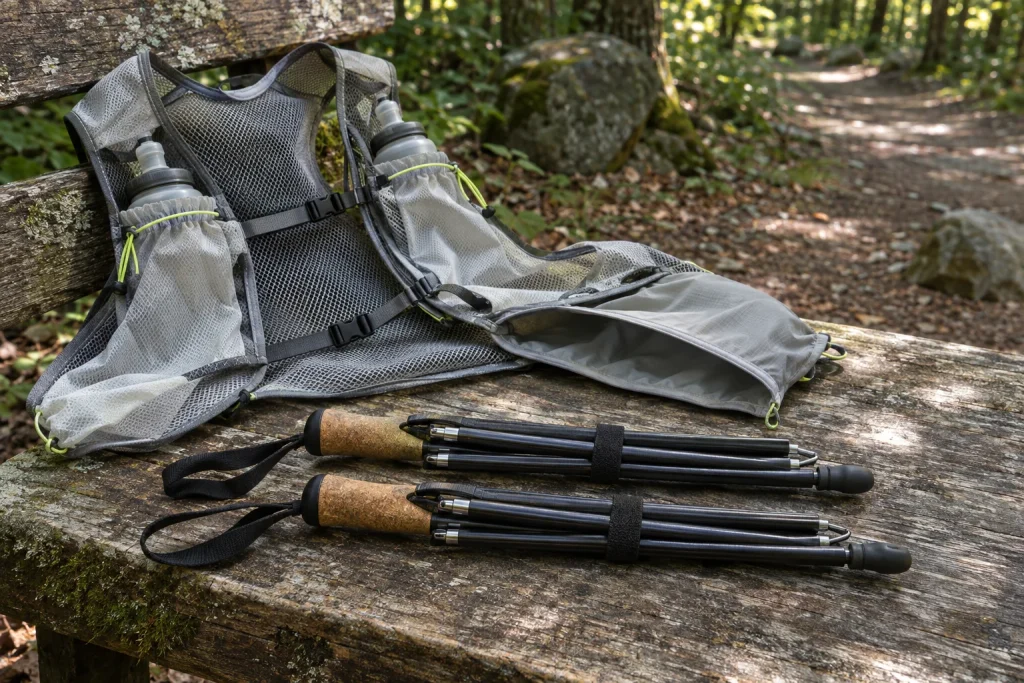
A folding system divided into several sections and a telescopic design assemble and pack down with different actions. Among Black Diamond running-pole designs are fast-folding systems too. Check the exact model’s instructions for correct opening, closing, locking and permitted adjustment range. Similar-looking poles may operate differently. Do not replace a properly locked mechanism with guesswork or forceful pulling. Understanding the mechanism is fundamental to safe first use.
At home, in good light, calmly practise the manufacturer’s procedure. Notice the indication that the system is assembled correctly. Do not try to force a dirty or misaligned part into position with more strength. Ask for help if operation is uncertain. Outdoors, cold hands, gloves and fatigue can create different handling conditions, so become familiar with these in safe surroundings beforehand too. The aim is a consistently correct, calm action, not record-speed opening. Speed only becomes a meaningful consideration after reliable operation.
Material and weight: examine the complete product
The labels carbon and aluminium do not constitute a complete quality ranking. Construction, size, lock, grip and intended use shape properties together. Read the manufacturer’s stated limits and care requirements. Lower weight may be pleasant when carrying, but does not override appropriate size and manageability. A more expensive, lighter pole is not automatically better if it cannot attach suitably to your vest or you cannot operate the mechanism comfortably. Evaluate the choice within the whole system.
Do not judge durability by one material name or perform dangerous home bending tests. Damage, cracks, loose joints or an uncertain lock need appropriate inspection under manufacturer instructions. With used poles, history matters too: what damage, repairs or component replacements occurred? A clean exterior does not reveal everything. If proper working condition is uncertain, seek expert or manufacturer help. The equipment decision is not about declaring a product “indestructible”, but choosing equipment in suitable condition for the appropriate task.
Try grips and straps with your own hands
Grip shape, material and the strap system affect comfort and handling. Gloves can change grip compared with bare hands, while connecting and disconnecting may vary by product. Learn use according to your own system’s instructions. Do not confuse straps with webbing or safety equipment serving other functions. The tool is not intended to hold you in every situation when attached to your body in an unknown way. Intended use and learned technique are particularly important here. A calm, easy trial reveals where material bothers you or an action is difficult.
If a grip feels secure only when squeezed hard, check size and correct use. Tight gripping does not solve every problem. The strap or glove system should work according to its design, and you should know how to disengage properly. Besides comfort, access to important actions matters: how do you handle a bottle, zip, refreshments or another necessary item alongside the poles? You do not need to do everything while running, but learn the stopping and packing routine. Poles are part of the whole equipment process.
| Selection factor | Specific trial question | Source |
|---|---|---|
| Length | Is the size appropriate for your own use? | Manufacturer guidance and personal assistance |
| Locking mechanism | Can you reliably recognise correct locking? | The exact model’s manual |
| Grip and strap | Can you operate them appropriately with gloves too? | Your own trial with intended use |
| Carrying | Do they fit stably when folded, with tips organised? | Compatibility between poles and carrying equipment |
| Race | Are they permitted, and under which conditions? | Current organiser regulations |
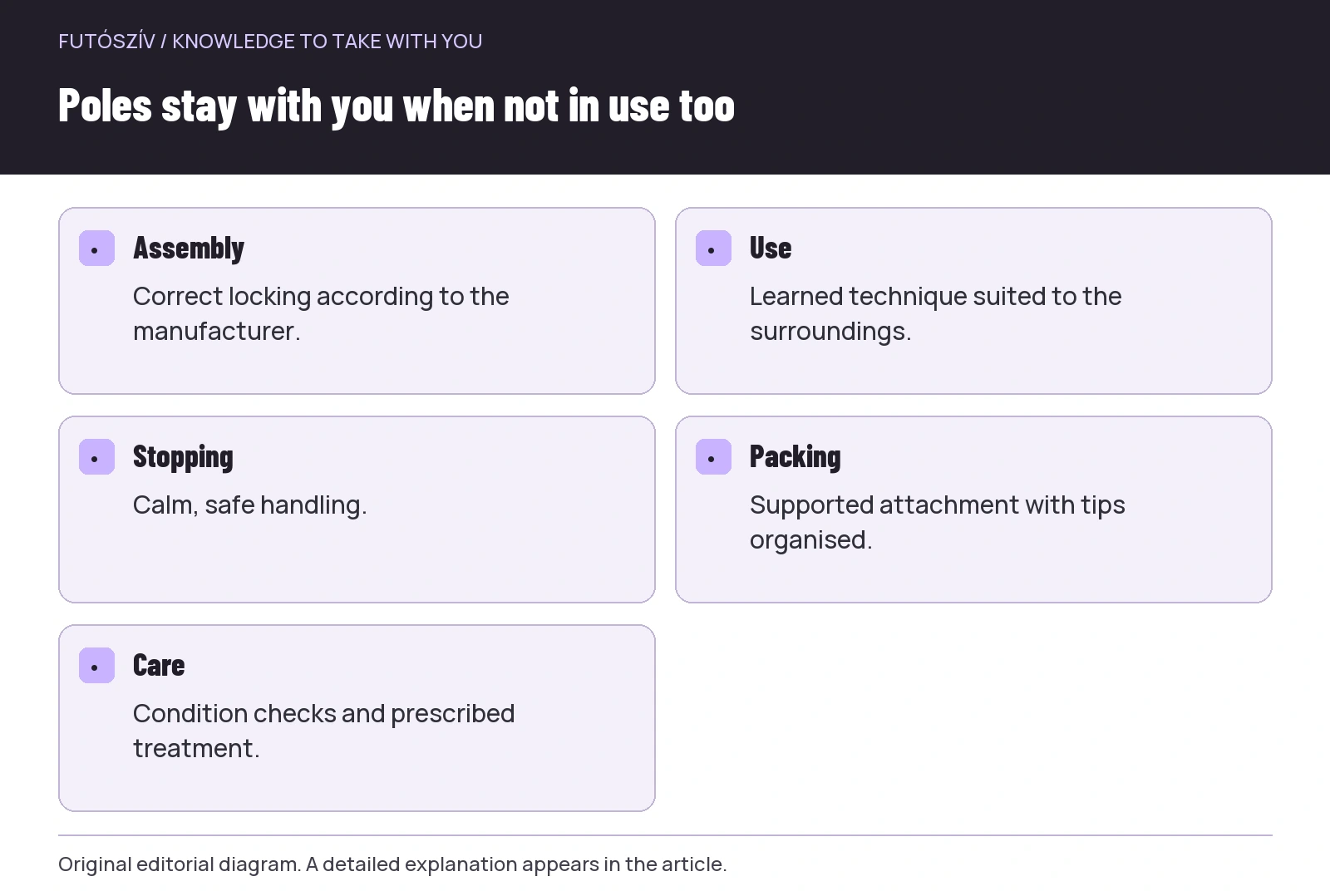 Enlarge diagram
Text version of the diagram
- Assembly
- Correct locking according to the manufacturer.
- Use
- Learned technique suited to the surroundings.
- Stopping
- Calm, safe handling.
- Packing
- Supported attachment with tips organised.
- Care
- Condition checks and prescribed treatment.
Test carrying as thoroughly as use
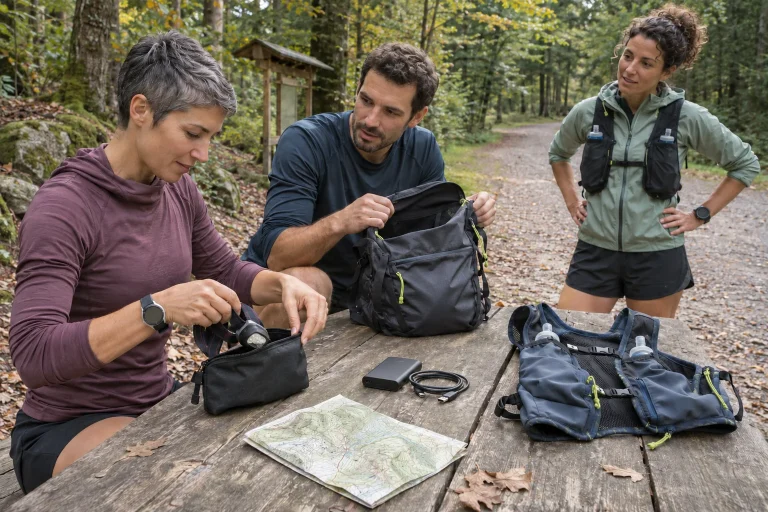
You handle poles not only when leaning on them. They may stay with you on flat sections, at aid stations, in crowds and while travelling. Use a manufacturer-supported solution for attaching them to a vest or belt, and check compatibility. Folded length, tip position and attachment points all matter. There should be no loose part flailing around, nor should poles cover a necessary pocket, bib or visibility panel. Being physically able to tie an object onto a vest does not prove it can be carried there appropriately.
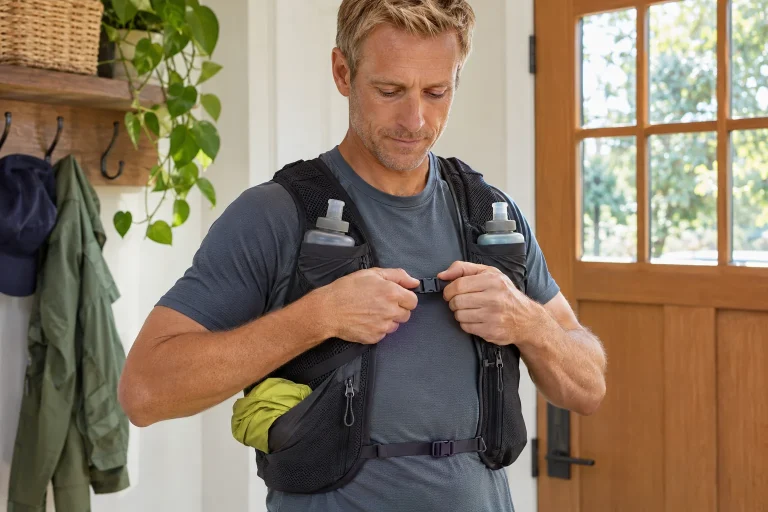
Try the complete vest loaded. The added weight and position of poles can change the arrangement, contact points against your back and access to bottles. Practise packing while stationary, then check support with easy movement. Tips should not sit where they could create uncomfortable or dangerous contact with your own or another person’s movement. Exact handling needs to fit product instructions and circumstances. If the arrangement only works with improvised knots and constant adjustment, find a more appropriate carrying system. Stable storage is a main condition of the choice.
Do not make an important race your learning trial
On the first occasion, learn the system somewhere easy, familiar and uncrowded, with appropriate technical help as needed. Buying does not mean you already have the skill to integrate poles into movement. You can practise opening, closing, carrying and handling in the hands separately in calm surroundings. You do not need a harder or longer run for the new equipment. The aim is safe, recognisable learning. A completely new system introduced in the final days before a race may create more uncertainty than the benefit you hope for.
After the trial, note which sections suited meaningful use, where poles got in the way and how they worked when packed. Evaluate more than the first impression. If they create more handling tasks than they solve on your route, they may not be needed every time. They may work well for another task with appropriate skill and compliant use. Equipment’s role is not a permanent label on the runner. It follows from particular circumstances. A good decision also permits leaving a useful tool at home for some runs.
Condition checks and care
After use, clean and dry poles according to your own manufacturer’s instructions. Dirt in locks and joints, a damaged strap or a worn tip may need separate attention. Replace interchangeable parts only with supported, suitable versions. If a component operates uncertainly, do not test whether it “still takes the weight” on the next steep section. Appropriate inspection and support are the aim. With fully folding construction, packing and storage are also part of care: components should not receive unnecessary load at the bottom of a bag.
A good order for choosing running poles is therefore task, rules, size and handling, then testing the whole carrying system. Material and weight can be important data but are not independent decisions. Properly understood equipment needs to fit your own movement and route, both in use and packed away. Safe technique must be learned and organiser conditions checked currently. Poles can then be a targeted accessory rather than another item you feel obliged to own and carry uncertainly for most of the run.
Sources and further reading
- Black Diamond Europe: manufacturer questions and answers on materials and construction
- Black Diamond: folding running-pole designs
- UTMB Mont-Blanc: current race regulations, an example of pole-carrying rules
How Futószív articles are prepared: our editorial guidelines.