Pre-race packing can easily fall between two extremes. One bag contains everything anyone ever called useful; the other leaves out important things to save weight. Sensible minimalist race packing is neither. It covers the necessary tasks precisely, removes needless duplication and gives every object a known place. The first question is not how small the race bag is, but what you will actually need during travel, the start, the run and getting home. A good pack contains what your situation justifies and is arranged so you can use it.
The organiser’s race pack and your own bag are different
Contents of the race pack supplied by an organiser vary by event. It may include a number, chip, baggage label and other items; you may not receive the same things as at a previous run. Your own bag is what you travel with and will use. Do not automatically count on something simply because another race provided it. The official London Marathon Events information also describes supplied pack contents by event. Read it as an example; your own entry confirmation and current organiser’s guide are the primary sources.
List separately what you collect on site, what is sent beforehand and what you must supply yourself. Collection time and location are part of packing: preparation differs if everything is already with you the day before versus queuing in the morning. Prepare documents requested for identification or collection under current conditions. An unnecessary pile of paper does not help, but missing required information can cause delay. A good list names the task rather than dropping generic “race documents” into a folder.
Turn four tasks into an item list
Start with travel: what is needed to reach the venue and return home? Second, the pre-start period: what do you wear, where do you wait and what do you hand in? Third, the run: what stays on you and what must you access? Fourth, the post-finish stage: how do you collect the bag and what do you need first? These four views can involve the same item more than once, but you do not need to pack it repeatedly. That is the advantage of task-based thinking: you can see what works in several situations and what is unjustified repetition in the bag.
Write a short sentence beside each item: “I need this because…”. If you cannot name a specific situation, review whether it is necessary. Do not always solve uncertainty with another spare; sometimes information is missing. For example, you may need to know the baggage size limit rather than need another bag. At other times, a real personal requirement justifies an item absent from someone else’s list. Minimising is not copying others’ supplies. It is fulfilling your own tasks with fewer unnecessary objects and more clarification in advance.
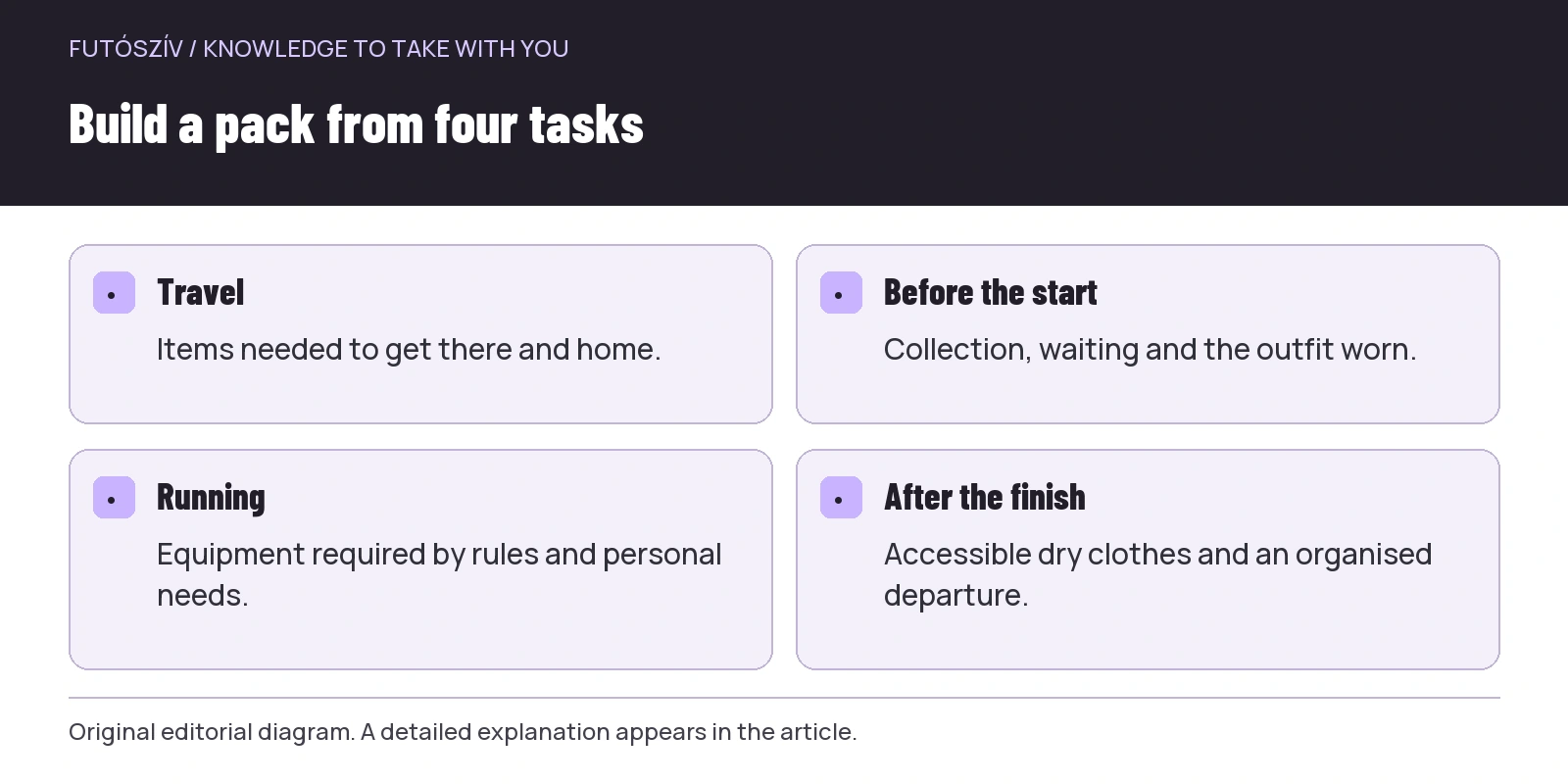 Enlarge diagram
Text version of the diagram
- Travel
- Items needed to get there and home.
- Before the start
- Collection, waiting and the outfit worn.
- Running
- Equipment required by rules and personal needs.
- After the finish
- Accessible dry clothes and an organised departure.
Mandatory minimum and individual needs
On trail and longer races, the current mandatory and conditional equipment list is particularly important. The equipment page for one UTMB event also treats required kit as a minimum that runners must adapt to their own circumstances. This is not a universal equipment list for every event. Use the document for your distance, weather-related decision and organiser announcement. A small pack has no value if a required or necessary item for safe use is missing. Choose capacity for the task.
Address individual needs precisely too. Some personal items, prescribed aids or other important elements cannot be replaced with general internet ideas. This article does not advise leaving them out or modifying them. Plan according to your own professional requirements and organiser procedures. If you have a specific need, coordinate early about how it fits the event system. A minimalist outlook reduces excess rather than denying needs. A precisely named personal requirement is as valid a part of the list as shoes or keys.
Do not search deep in the bag for what you will wear
Separate the outfit you wear to the start from baggage to hand in or use after finishing. Shoes, socks, top, bottoms, number and your previously tested carrying system should be clearly prepared. Mixing them at the bottom with spare clothes and food creates unnecessary searching at departure. The list can follow dressing order; it does not need a complex category system. Test important fastenings and pockets in the complete setup. Everything fitting separately into the bag does not prove usability while running.
Mark separately the items used until the last moment: phone, keys, glasses or other personal belongings. It is easy to accidentally hand them in with baggage you cannot access again before the start. Decide their places in advance and keep pre-start rearranging brief. Do not spend the final minutes moving keys between pockets three times. A familiar layout reduces mistakes and makes the necessary item easier to find later while running too. Packing succeeds when moving into use stays simple.
Checked baggage is not unlimited storage
Check baggage conditions: size, type, labelling, hand-in time and return. The FAQs for one London Marathon Events event , for example, specify a particular bag size. Do not apply that number to another event; find your own organiser’s current requirement. Not every backpack or separate item is accepted in the same way. Do not assume a valuables service that has not been promised. Baggage logistics and safekeeping of valuables are separate questions.
Put the first post-finish clothing you need in the appropriate place, and designate separation for wet equipment beforehand. You do not need every possible garment, but a dry layer suitable for weather and the journey home should be usable. Attach the baggage label as instructed by the organiser, not with a quick idea that damages the bag or detaches easily. A simple system recognisable even when more tired at the finish matters. One labelled internal unit or considered sequence may help more than many small identical-looking pouches.
Keep confirmations and codes organised
Prepare the confirmation or code requested by the event in a form the organiser accepts. Do not assume digital and printed options are identical everywhere. The official parkrun barcode information , for example, describes the role of a usable personal code in its own system. This is not a requirement for another race. The lesson is to check identification information using a current source, then prepare it for easy access. Handling codes and numbers is part of registration, not decoration on the bag.
Save important phone information in a way you have tried beforehand. If connectivity may be uncertain on site, do not rely solely on an email that is difficult to open. At the same time, do not unnecessarily place personal data on a public screenshot or bag label. The aim is to provide requested information to the right person in the right place. Preparation can be simplified to a few necessary, clearly named documents. Searching dozens of saved screens is as disorganised as retrieving the wrong confirmation from a pile of papers.
| Item or unit | When is it needed? | Where should it be? |
|---|---|---|
| Collection information | At organiser collection | Easily accessible in an accepted form |
| The outfit worn to the start | Before departure | Prepared separately and tested together |
| Necessary items during the run | On the course | In a familiar, appropriate carrying position |
| Dry post-finish layer | After baggage collection | Protected and arranged in order of use |
| Journey-home items | When leaving the finish area | Not buried in damp clothing |
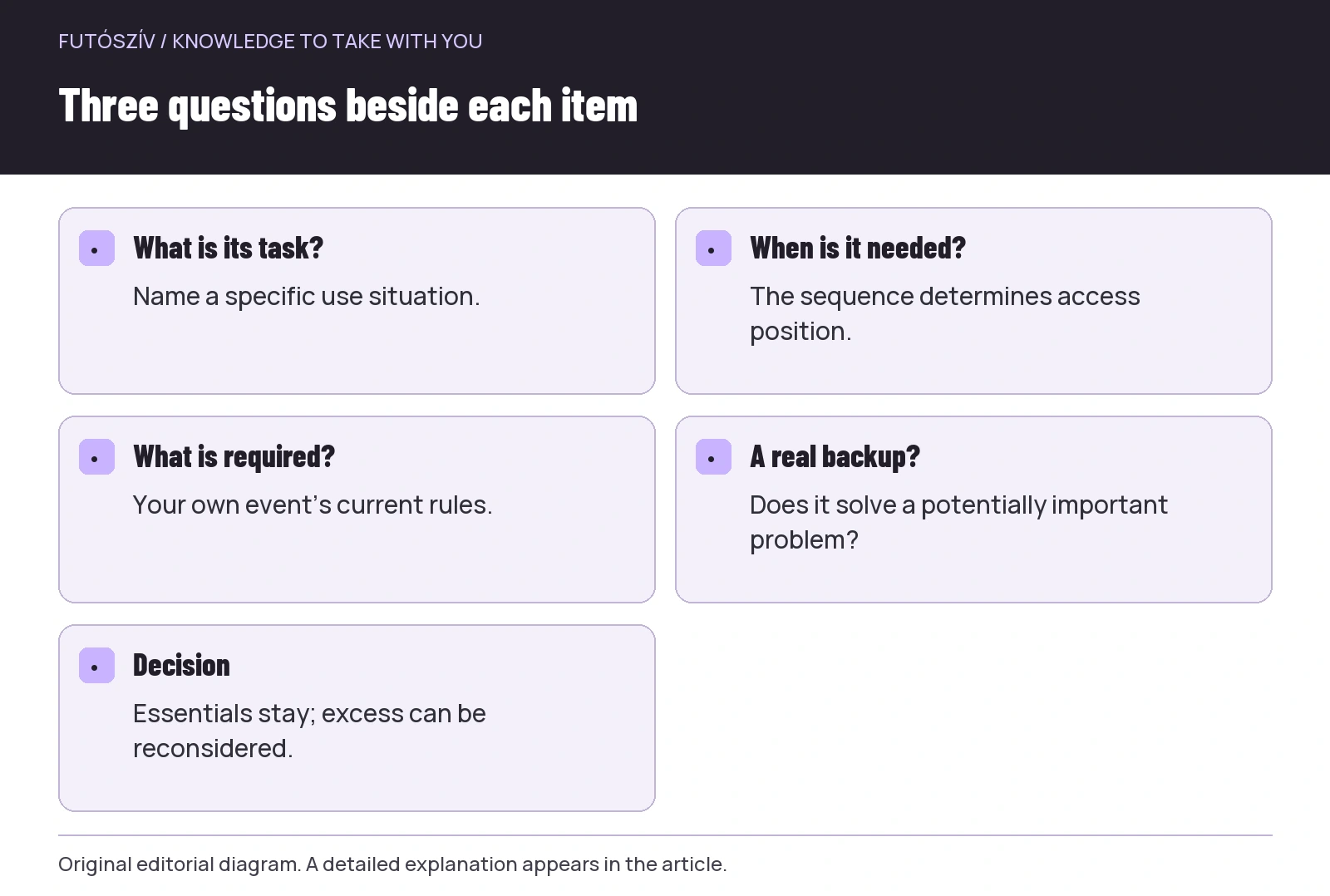 Enlarge diagram
Text version of the diagram
- What is its task?
- Name a specific use situation.
- When is it needed?
- The sequence determines access position.
- What is required?
- Your own event’s current rules.
- A real backup?
- Does it solve a potentially important problem?
- Decision
- Essentials stay; excess can be reconsidered.
Examine duplication by task
Two similar items are not always unnecessary, but their roles should be clear. An appropriate spare may be justified when the task or organiser requires it; two identical-function items randomly thrown in are different. Ask: if the first is unavailable or fails, does the second actually solve the necessary problem? If not, the spare may be only extra weight. A reliable alternative is not necessarily the same type of object. Sometimes better information, another way home or help agreed beforehand provides it. Name this specifically in the list.
Do not let competition over grams guide final packing. Preserve necessary clothing, access to fluids, personal requirements and compliant equipment. If the chosen bag is insufficient, change the carrying system or logistics. Every run or race does not need to fit the same bag. Minimising aims for simpler, clearer use. An excessively small pack that spills other items whenever you retrieve something is not simple in practice. Maintaining access and protecting items’ condition are valuable too.
A packing rehearsal before departure
Once the list is ready, try dressing, closing the bag and accessing important items once. You do not need another workout for this. Calmly work through the main steps with real clothing, pockets and load. Check that the number does not cover a necessary buckle, the jacket fits its intended place, and nothing you still need remains in baggage to be handed in. Consider the sequence of use alongside the site plan and schedule. This reveals specific details you can improve.
On the final evening before the race, focus more on checking than completely redesigning the system. Review fresh organiser announcements and weather, make the resulting changes, then keep the finished pack together. An unfamiliar product thrown in at the last moment is often a new question rather than a backup. Know device condition and necessary charging too. Use the list according to your own experience instead of measuring it against others’ perfect-looking photographs. A good pack solves your task at your event.
After finishing, evaluate what actually worked
At home, do more than empty the bag: note the lessons. Which item was necessary, what was badly placed and what was genuinely missing? Do not generally ban unnecessary pieces from every future pack; tie the experience to the event and conditions. A short summer run list is not a winter trail-race list. Keep a successful arrangement, however. The next packing then starts from known tasks and real experience, rather than fresh uncertainty. A minimalist race bag is not an empty bag: it is a precisely justified, usable pack.
Sources and further reading
- London Marathon Events: event pack and collection information
- London Marathon Events: an example of event-specific baggage procedures
- UTMB Bariloche: mandatory equipment as a minimum
- parkrun: using a personal barcode
How Futószív articles are prepared: our editorial guidelines.