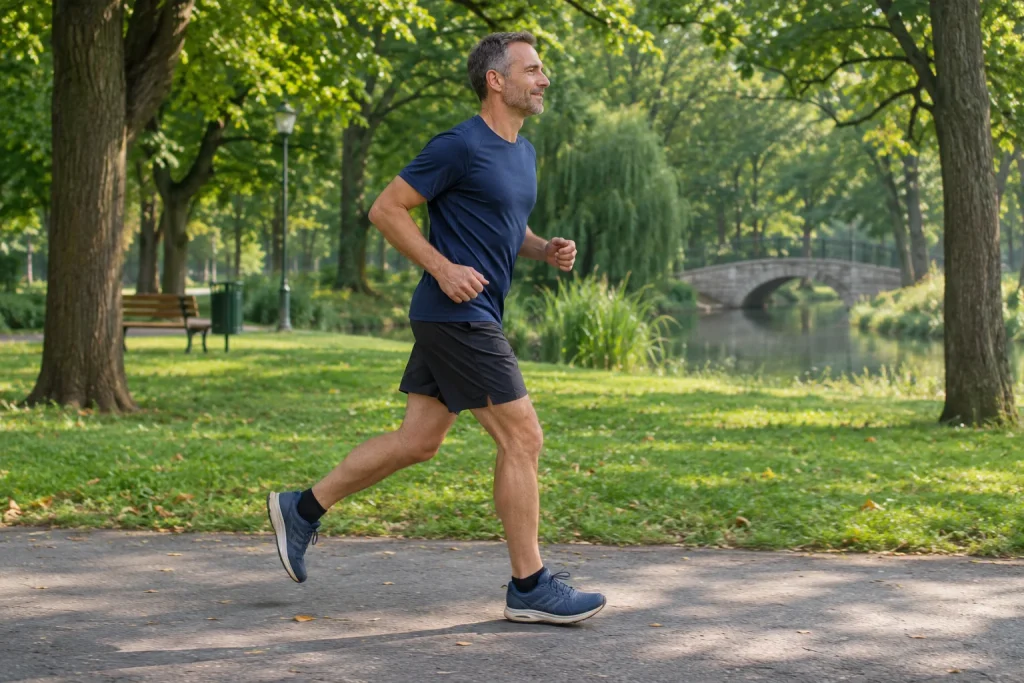
Run tall, lean forwards, brace your core, look far ahead: advice on running posture often delivers several hard-to-reconcile instructions at once. But you are not trying to hold a statue while moving. Your trunk and head positions constantly adapt to speed, terrain and the task. The useful question is whether your chosen position supports comfortable, controlled running.
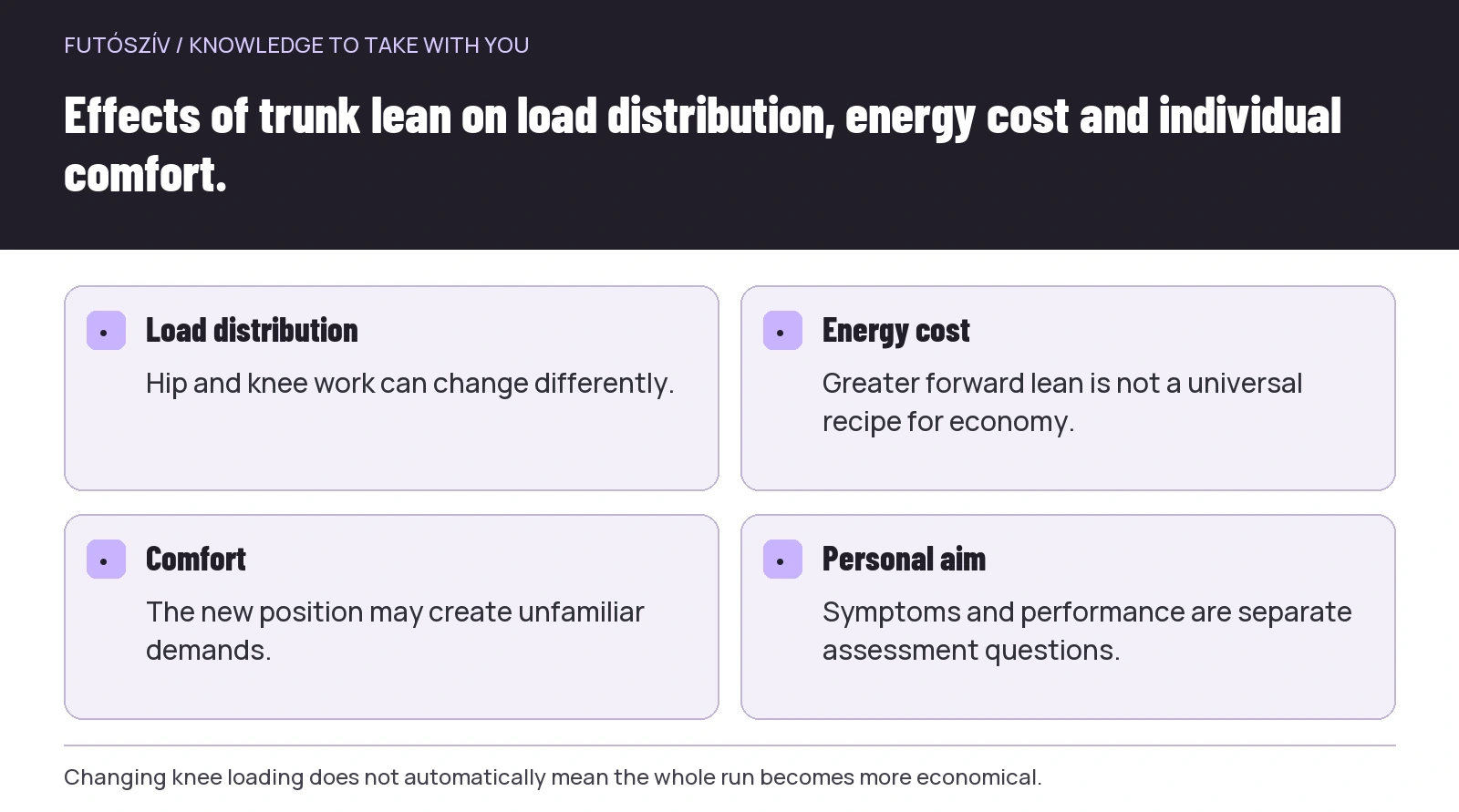
Rather than one ideal angle, consider load distribution, energy cost, the visual task and individual comfort separately. They are related, but do not always change in the same direction. A technique modification can have both benefits and costs.
Posture is movement, not a still image
During running, trunk position changes within the step cycle too. Climbing, descending, accelerating and turning may require further adaptations. A moment in a photograph does not therefore describe your entire movement.
The phrase “straight back” can also mislead. You do not need to rigidly fix the spine’s natural movement or keep the chest constantly pushed high. The aim is control suited to the task, not maintaining a stationary position unchanged while running.
If watching video of yourself, compare sections with similar speed and terrain. Do not unconditionally compare a picture from a hard climb with a flat, easy loop. Circumstances are part of interpretation.
Trunk lean can redistribute work
Research by Teng and Powers examined the relationship between forward–backward trunk position and hip and knee energetics. Greater forward flexion was accompanied by different hip and knee work. The point is not that one position improved everything, but that the distribution of work changed.
This may matter for a clinical or technical question, but is not a complete explanation for every symptom. Reducing the load on one area may increase another area’s task. The whole system needs assessment, particularly if pain is prompting a change.
“Lean forwards and it will be solved” is therefore insufficient advice. Ask exactly what the modification aims to do, to what extent and with what follow-up. The personal background to load distribution is not visible in a general drawing.
Economy is a different question from one joint’s work
Running economy concerns the energy required at a particular speed. It cannot be established merely from posture looking fast or athletic. Even apparently tidier movement may be unusually demanding.
A 2024 experiment found higher energy cost with deliberately increased forward lean in the conditions investigated. It does not prove every forward lean is bad, but contradicts the simple idea that greater lean automatically makes running more economical.
If technical advice promises energy savings, ask what supports the claim. An angle visible on video and oxygen consumption measured in a laboratory are different data. Do not infer a performance promise from appearance.
 Enlarge diagram
Text version of the diagram
- Load distribution
- Hip and knee work can change differently.
- Energy cost
- Greater forward lean is not a universal recipe for economy.
- Comfort
- The new position may create unfamiliar demands.
- Personal aim
- Symptoms and performance are separate assessment questions.
From the ankles or the waist: the label alone is not enough
It is often said that you should lean only from the ankles. Real running movement, however, involves coordinated changes at several joints. Such a short instruction can be a learning cue, but does not replace observing what actually happens.
If looking for lean makes you fold over, become rigid or speed up unintentionally, simplify the task. Do not try to transform movement at all costs through a single word. Personal feedback can again matter more than the slogan.
With symptoms, the extent of the change and new loading need assessment with a professional. Modifying body position may have a role in some situations, but a targeted solution differs from following a general technique fashion.
A new position may bring new demands
Research analysing the relationship between trunk lean and cumulative joint loading showed different changes at the hip and knee. The authors also considered hip-muscle work, stability and the trade-off related to energy cost important.
The practical lesson is that technique is not a load-free software update. If you learn another movement pattern, the body has to adapt to that too. Do not change posture, shoes, pace and weekly volume all at once.
Do not automatically treat a new sensation as proof of correct technique. Unfamiliarity is neither good nor bad on its own. Comfort, completing the task and the following days’ responses together may give a more useful picture.
Your gaze gathers information
Looking while running is not merely about holding your head attractively. You need to gather information about the ground, obstacles, people and route. Viewing distance therefore changes with the situation.
An eye-movement study in a natural urban environment analysed how runners gather visual information and plan stepping over obstacles. Such findings mean gaze cannot be described by one compulsory forward-looking distance for every setting.
On a flat, familiar path, more attention may be available for the farther surroundings. On rocks and roots, recognising upcoming steps matters too. The aim is to have time to decide, rather than reacting only at the last moment.
Head stability and the visual task are connected
Research examining head and gaze stability discusses adaptations between running movement and the visual task. The body may use several small changes to help provide a useful view of the surroundings.
This does not require prescribing a rigid head position. Looking sideways or closer from time to time is not, by itself, a technical fault. Traffic, a junction or a person moving beside you may naturally require a shift of attention.
Looking at a phone downwards or sideways for a long time, however, can draw attention away from the environment. Check data somewhere safe, stopping if necessary. Observing running posture should not reduce safety while travelling.
On trails, match speed to how far you can see too
If you cannot see the next surface in time, reduce pace. Darkness, fog or dense vegetation leave less information for planning movement. A light and local knowledge may help, but do not make daytime speed appropriate in every situation.
On descents and bends, it is particularly important not to stare at a fixed distant point. Both the route and the immediate ground require attention. Gaze movement serves to handle the situation.
If you constantly have to scramble, the issue is not necessarily poor posture. Speed may be too high for visibility and terrain. Slowing down is then often the simplest adjustment.
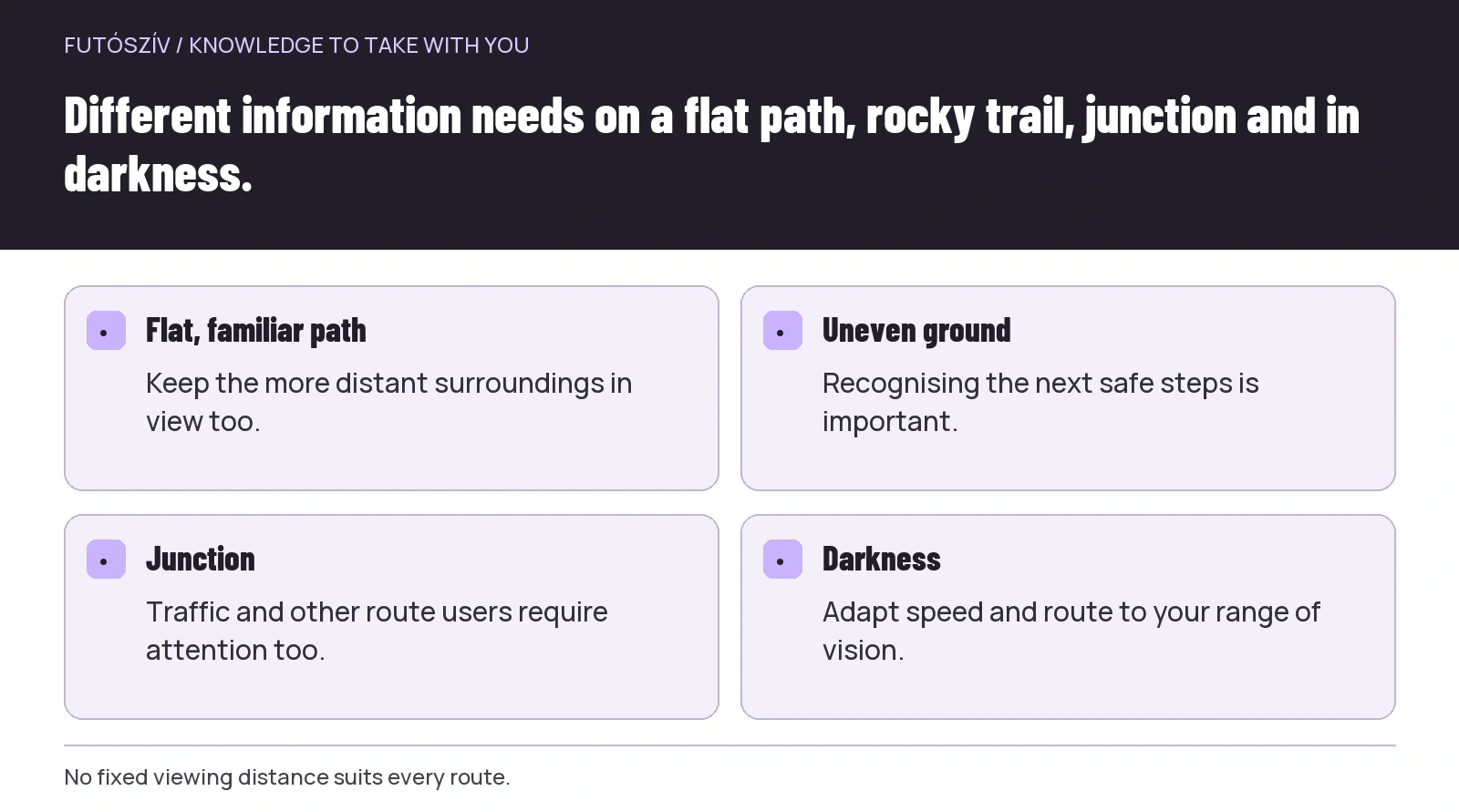 Enlarge diagram
Text version of the diagram
- Flat, familiar path
- Keep the more distant surroundings in view too.
- Uneven ground
- Recognising the next safe steps is important.
- Junction
- Traffic and other route users require attention too.
- Darkness
- Adapt speed and route to your range of vision.
You do not need to hold your chest pushed out constantly
The cue “run proudly” may help some people but create excessive stiffness in others. Do not sacrifice comfortable ribcage and shoulder-girdle movement for a permanent pose. Breathing and arm action also need room within the whole movement.
Constantly bracing the trunk as hard as possible can similarly mislead. Running requires control, but not the sensation of a static strength exercise every second. If the cue makes breathing or movement harder, discuss how to use it.
A technical instruction is good when understandable and usable for the task. Naming many body parts does not make it professional. A single clear observation, appropriately tested, may offer more.
Equipment and daily loading
A backpack, vest or handheld item can affect how your upper body feels. Check fit and fastening first. You do not need to interpret every change as a fault in your body when equipment is moving distractingly.
How you feel after prolonged sitting, physical work or another sport is also part of your starting state. If your neck or lower back feels tired, one running movement does not explain the entire situation. Consider the day as a whole.
Seek appropriate help for new, persistent or severe pain, numbness and weakness. General posture advice is not individual treatment and does not justify ignoring symptoms.
When fatigued, look at the task first
A changing posture at the end of training may be one visible sign of fatigue, but the image alone does not establish the cause. Consider whether the load still suits the day’s aim. At the end of a run intended to be comfortable, you do not need to maintain the same pace at any cost.
Do not introduce several new instructions at your most fatigued moment. A simpler, more controllable situation often provides a better observation for learning technique. Video from the end of a long run may offer information, but is not a compulsory fault-correction session.
Note in your log when and during what task the difficulty appeared. If the pattern recurs, a coach or appropriate professional may help interpret it. One bad frame does not require replacing your entire movement system.
A short observation plan
Choose a familiar, flat and safe route. During easy running, focus on one question: is your upper body comfortable, and can you see your surroundings adequately? Do not try to change every angle at once.
If working with a coach, ask for a specific purpose behind a cue. What do you want to change, why, and what response will you observe? Make before-and-after recordings at similar speeds and from the same view, showing several steps.
Success does not necessarily mean a dramatic visual difference. It may mean movement became simpler, comfort improved, or you discovered no major change was needed. Learning need not become constant self-monitoring.
If conscious attention makes the whole run rigid, return to your natural movement and try a simpler question later. Learning posture is not a task of permanent vigilance. Leave room in the outing for enjoying the surroundings, company and comfortable progress too.
Sources and editorial note
This article cites research examining relationships between trunk position, joint work, energy cost and visual control. No ideal angle or viewing distance for every runner has been derived from them. Observation examples are original editorial tools; symptoms may require individual assessment. Sources checked: 18 November 2026.
How Futószív articles are prepared: our editorial guidelines.