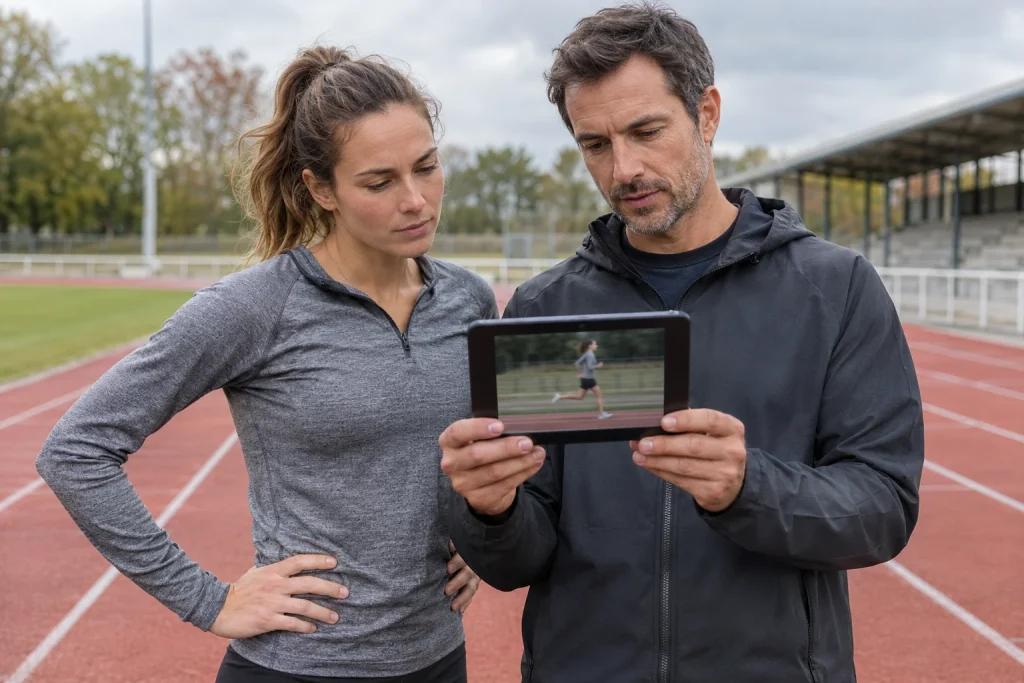
You pause a running video and see your foot landing ahead of your body. A short piece of advice says this is overstriding and needs immediate correction. Reality is more nuanced. Running is a continuous, three-dimensional movement, while the frame captures only one moment. Footage can be a good starting point when you use it to ask questions; it is far less useful if you want to draw a ready-made diagnosis onto it.
The term overstriding is often used for a reaching step. It does not simply mean that the foot moves in front of the pelvis at any time. Precise interpretation depends on the phase of movement, speed, position relative to the body and the question you are investigating.
Visible movement and loading are different information
Kinematics describes movement: positions, angles and velocities. Kinetics examines forces and moments. A video directly shows the former, but internal tissue loading is not visible in the same way as the position of a shoe.
Research examining relationships between movement characteristics and loading measures showed that several variables play a role together. Speed, step length and the foot’s position relative to the body could all contribute to the measured relationships. One sign cannot therefore establish the entire load.
Pain is a third kind of information. With the same visual pattern, one person may have no symptoms while another runs with pain. Health background, changes in loading and an individual assessment may all matter when interpreting symptoms.
Braking force is not a fault in every situation
During running, contact with the ground generates forces in different directions. Part of the movement can involve braking and another part propulsion. “Eliminating braking completely” is therefore too simple an aim for a complex movement.
The question is rather how the particular runner’s movement pattern relates to the task, energy cost and any symptoms. Descending, turning and slowing down may inherently require different force relationships from steady running on the flat.
Forward foot reach and braking may be related, but the distance visible on video is not, by itself, a precise force measurement. Do not treat phone footage as though it were a force platform and a complete motion-analysis system.
Why does speed matter?
Faster running changes step length, flight phase and body position. Comparing a sprint frame with an easy jog may therefore mislead. If you want to track your own movement, look at sections run at similar speeds.
Camera distance and the background can also affect the impression of speed on video. It helps to know the pace or task during which the footage was recorded. Appearance alone is not enough to decide whether someone was running easily or hard relative to their own level.
If you unintentionally accelerate while making a technique change, the new movement picture is not purely the result of that modification. Plan the trial under simple, easy-to-monitor conditions, with a professional if necessary.
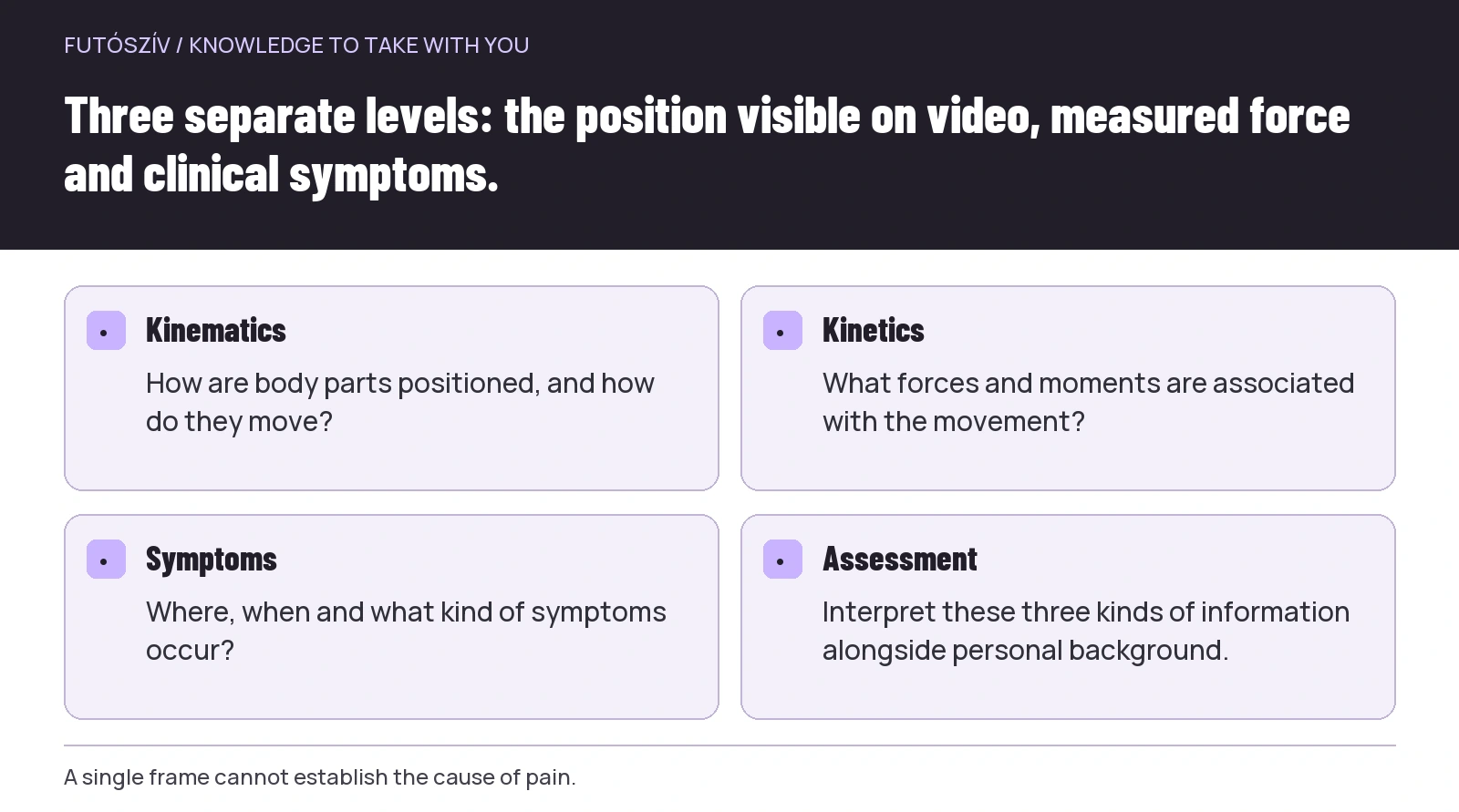 Enlarge diagram
Text version of the diagram
- Kinematics
- How are body parts positioned, and how do they move?
- Kinetics
- What forces and moments are associated with the movement?
- Symptoms
- Where, when and what kind of symptoms occur?
- Assessment
- Interpret these three kinds of information alongside personal background.
Which moment of ground contact are you watching?
Initial contact, taking the load and the later part of stance produce different images. If you compare different moments from two videos, part of the apparent difference may come from that. Running is not one iconic position.
Souza’s guide to video-based biomechanical analysis discusses observation methods and several running characteristics in detail. In systematic analysis, matching the phase and choosing an appropriate view matter more than an arbitrarily selected, striking frame.
Watch several consecutive steps. A single awkward contact may result from a pebble, a bend or a momentary shift of attention. A recurring pattern is more interpretable, but still not a diagnosis on its own.
Camera angle: an oblique view can distort
Side-view assessment requires a camera appropriately positioned relative to the direction of movement. If you view the runner from far towards the front or rear, distances and angles appear differently. A wide-angle lens and positioning near the edge of the image may add distortion.
Frame the recording so that the whole body and several steps are visible, without filming in a way that endangers route users. Do not ask someone to run on a busy road or uncertain surface for the sake of analysis.
Clothing and a bag can hide important landmarks. The footage may still be a useful conversation starter, but precise angle assessment may be limited. Do not produce confident conclusions from an uncertain image.
Two-dimensional footage can be consistent without seeing everything
A study examining the repeatability of two-dimensional running video found that certain movement characteristics can be tracked reliably with an appropriate method. Repeatability does not, however, mean the footage accurately describes every three-dimensional movement or load.
If you consistently repeat the same measurement error, the numbers may be similar without giving a complete picture. Recording quality, the chosen measurement point and professional interpretation therefore all matter together in assessment.
Slow motion may reveal more detail, but slowing the footage does not in itself make the video diagnostic. A precise question and appropriate comparison are still needed.
Step length and rhythm are linked variables
At the same running speed, a higher cadence goes with a shorter average step. It is therefore unhelpful to treat the two variables as entirely separate. If someone asks for a shorter step, clarify the rhythm and speed they mean.
An experiment involving fourteen runners analysed different changes in cadence and foot-strike position while measuring energy cost and forces. The study adds nuance to precisely the question of how the same step length can arise from different movement strategies.
“Shorten everything” is therefore not a complete programme. A change may help with a particular task, but effort, comfort and any symptoms need monitoring too. The aim is not to make your foot match a drawn vertical line at all costs.
Heel striking is not the same as overstriding
Foot-strike type describes which part of the foot contacts the ground first. The foot’s position relative to the body is another characteristic. They can be related, but do not mean the same thing, and neither should be turned into a good-or-bad rating on its own.
If a video says every heel-striking runner moves incorrectly, that is too broad a claim. A technique change can also alter the distribution of loading. Forcing a new foot strike does not automatically follow from your step looking long.
When pain is present, the aim of assessment is to understand the symptoms and the whole loading situation. A striking label for foot contact does not replace this. Suitable solutions can vary and may require individual assessment.
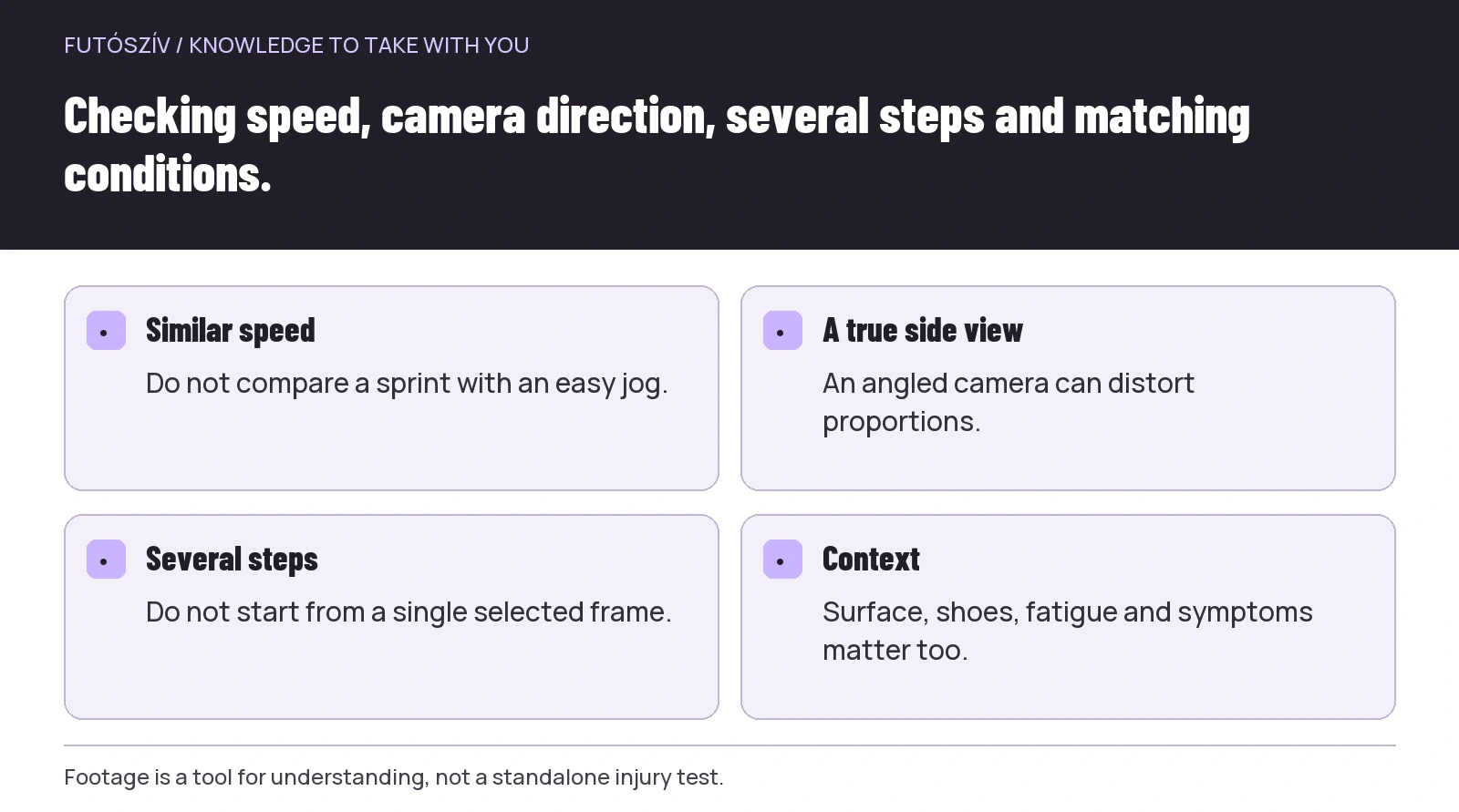 Enlarge diagram
Text version of the diagram
- Similar speed
- Do not compare a sprint with an easy jog.
- A true side view
- An angled camera can distort proportions.
- Several steps
- Do not start from a single selected frame.
- Context
- Surface, shoes, fatigue and symptoms matter too.
What can you describe, and what can you not conclude?
| Observation | A useful question | What does not automatically follow |
|---|---|---|
| The foot appears far ahead of the pelvis | Are we seeing the same phase and a true side view? | This is definitely the cause of pain |
| The knee bends little at contact | At what speed and during what task did this occur? | One instruction can correct every aspect of loading |
| Cadence increased in the second recording | Did running speed change too? | The change itself prevents injury |
| Right and left sides look different | Is it recurring, and are there symptoms or relevant history? | Every difference must be eliminated |
Descriptive language helps avoid premature judgements. “This is what I see in this recording” is more precise than “your technique is bad”. Questions and context are needed for the next step.
How to prepare for professional movement analysis
Bring information about your running week, recent changes and any symptoms. When do symptoms appear, on what surface and after how much running? Video is more useful when it does not arrive alone.
Explain what you want to find out. Is it a performance question, an attempt to understand recurring pain, or simply learning technique? The aim influences which assessment and professional are appropriate.
Ask why the particular change is proposed, how you will try it and what will show whether it is useful. A good explanation provides more than a new body position: it also clarifies monitoring and adjustment.
Make a brief note before comparing two recordings
The surface, shoes, running speed and camera view should be the same, or at least known. Note whether the footage was taken at the start of the session or in a more fatigued section. If these differ, several possible explanations for a changed movement picture remain.
Do not choose the best old frame and the worst new one for comparison. Watch several consecutive steps and look for the same movement phase. A small angular difference may result from selecting the measurement point or the camera position, rather than a genuine technical change.
Respect the privacy of other people in the footage too. On a group run, agree beforehand whether video will be recorded, who may see it and whether it may be shared. Material made for personal analysis does not automatically become public content. Tracking your own progress does not require publishing images of other participants.
Keep independent observation simple
If you have no symptoms and simply want to learn, a short, safely recorded video may be enough to discuss rhythm or body position. You do not need to film and draw angles in every session. This attention should not take over all of running.
Do not give yourself several interacting instructions at once. New shoes, a new rhythm, a new foot strike and a new posture together can become an uninterpretable trial. Small-scale learning you can follow may yield more useful experience.
If a change causes anxiety, stiffness or symptoms, do not force it simply for a prettier image. Comfortable, controlled running and completing the particular task give movement its purpose, rather than an idealised frame.
Sources and editorial note
This article cites a professional guide to video-based analysis, a repeatability study and research measuring relationships between movement and loading. The observation table is an original editorial tool. Footage is not a standalone diagnosis, and technique change is not a general injury-prevention guarantee. Sources checked: 18 November 2026.
How Futószív articles are prepared: our editorial guidelines.