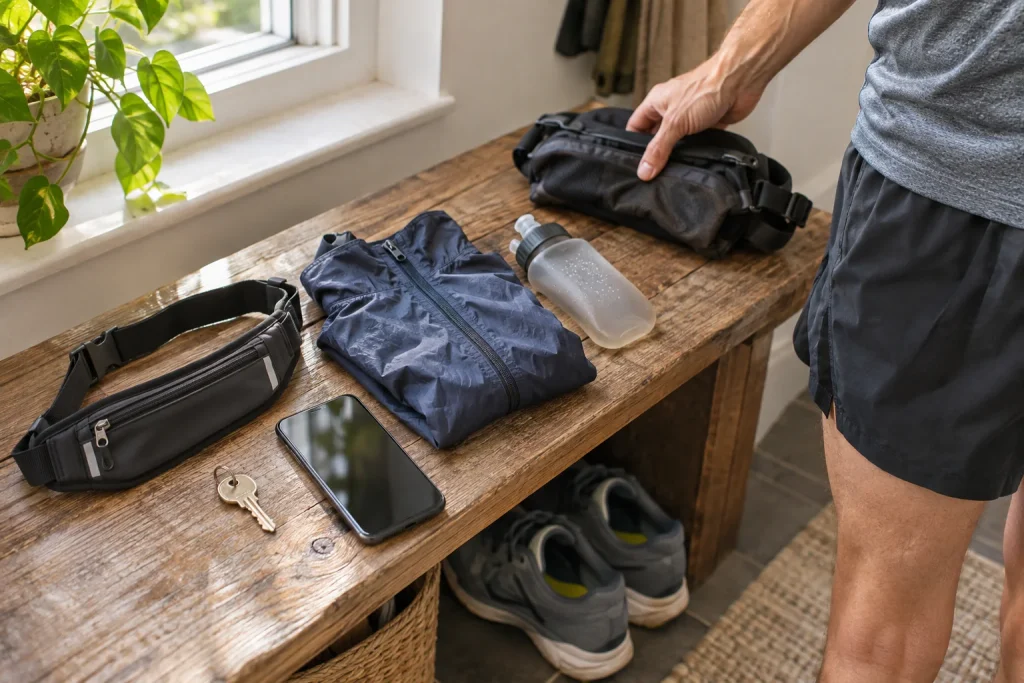
Packing for a short run works well when every item you carry has a role today. You do not need to take the whole cupboard, but empty pockets are not a sporting achievement in themselves either. The question is what you need for this particular route, weather and total time away, and how to place those things so that they remain manageable while moving.
Short duration alone provides too little information. A small loop near home, a park reached by public transport and a winter forest section may call for different kits even when you exercise for the same time. Instead of a universal shopping list, develop a decision-making system. Describe today’s situation first, then choose the items that belong with it.
Four questions before filling your pockets
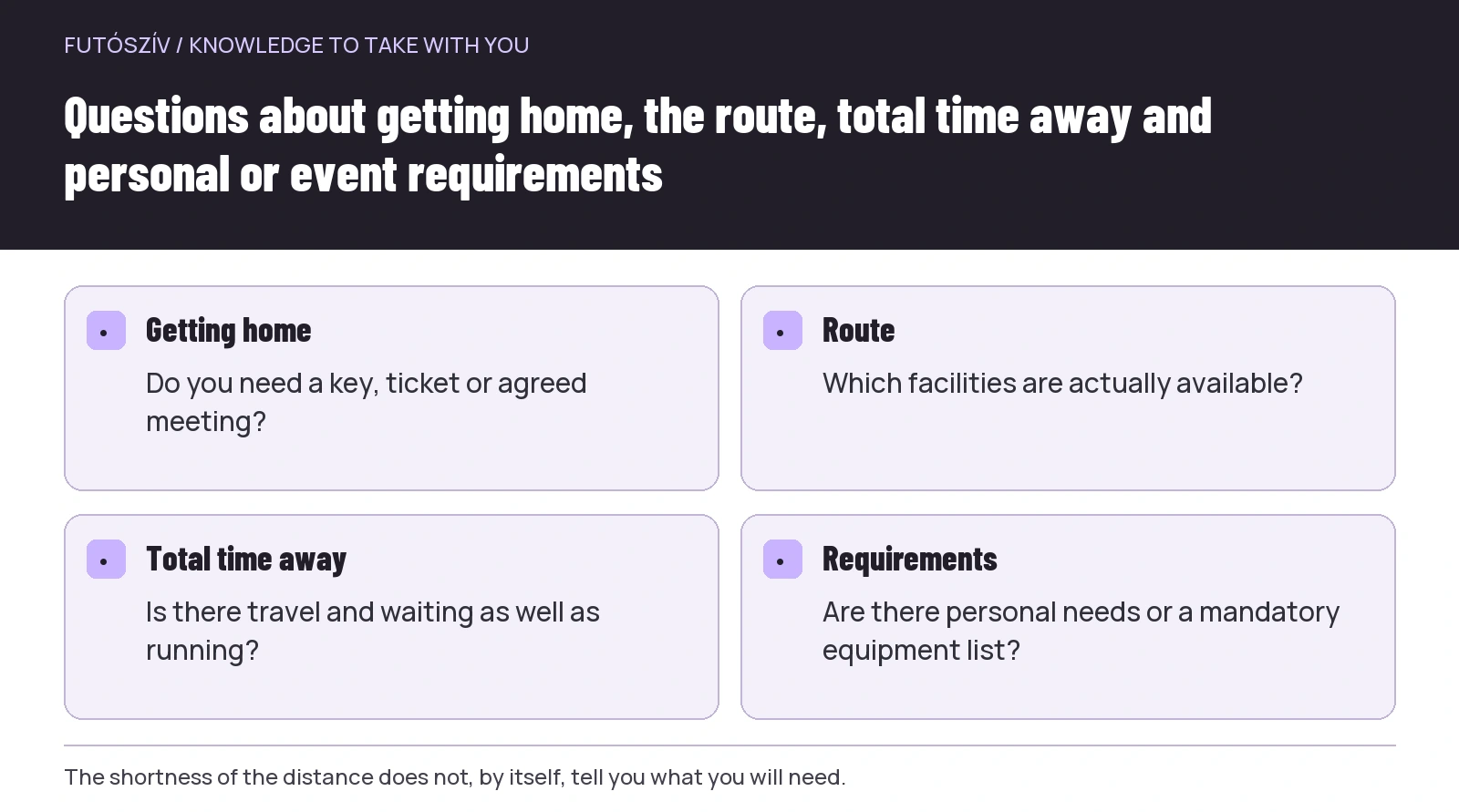
Where and how will you get home? If you start and finish at home, your key has an important role. If you use transport, your ticket or pass and your means of getting home are part of the plan too. If someone drives you, agree beforehand where to meet and what happens if you are late.
What can you expect on the route? Access to facilities differs between a familiar small loop and a rarely used forest path. Treat a working drinking fountain, toilet or covered place as available only if you have actually checked. A map symbol and operation on the ground do not always coincide.
How long will you be away altogether? Your planned twenty minutes in the park may also involve travel, waiting and walking. Decide on clothing, fluids or phone charge based on the complete outing. The section recorded by your running watch is only one part of your time away from home.
Are there personal or organiser requirements? A general article does not override needs in an individual healthcare plan. At an organised event, the current mandatory equipment list applies. Your own park practice and a race are different situations; the same kit is not automatically appropriate for both.
Give your key a secure place
Choose which keys you need from departure to arriving home. Sometimes fewer keys can replace the whole bunch, but simplify only if you can definitely get back through every necessary door. The building entrance key may differ from your front-door key; do not leave the test until the end of the run.
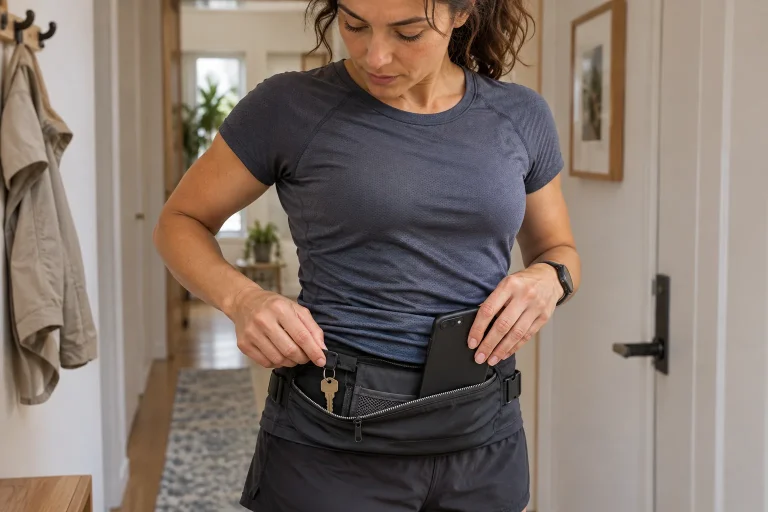
Check the pocket’s closure and how the item moves. Even a zipped pocket may be awkwardly placed, and a small internal pocket does not suit every key size. A few movements at home may reveal whether the contents bounce, press or rotate. Keeping items in separate places can prevent them tangling together.
Do not leave a key in a public, easily found hiding place to avoid carrying it. A flowerpot or ledge beside the gate is not a planned storage solution. If someone stays home, agree specifically about letting you in: will they definitely be there when you return? An assumption can easily become an uncomfortable wait.
 Enlarge diagram
Text version of the diagram
- Getting home
- Do you need a key, ticket or agreed meeting?
- Route
- Which facilities are actually available?
- Total time away
- Is there travel and waiting as well as running?
- Requirements
- Are there personal needs or a mandatory equipment list?
Decide what role your phone will play
A phone can provide contact, audio guidance, a map, tickets and payment. List which of these you will rely on today. If navigation, the journey home and every contact depend on one device, its functioning and battery level become more important. This does not necessarily justify more devices; it calls for thoughtful preparation.
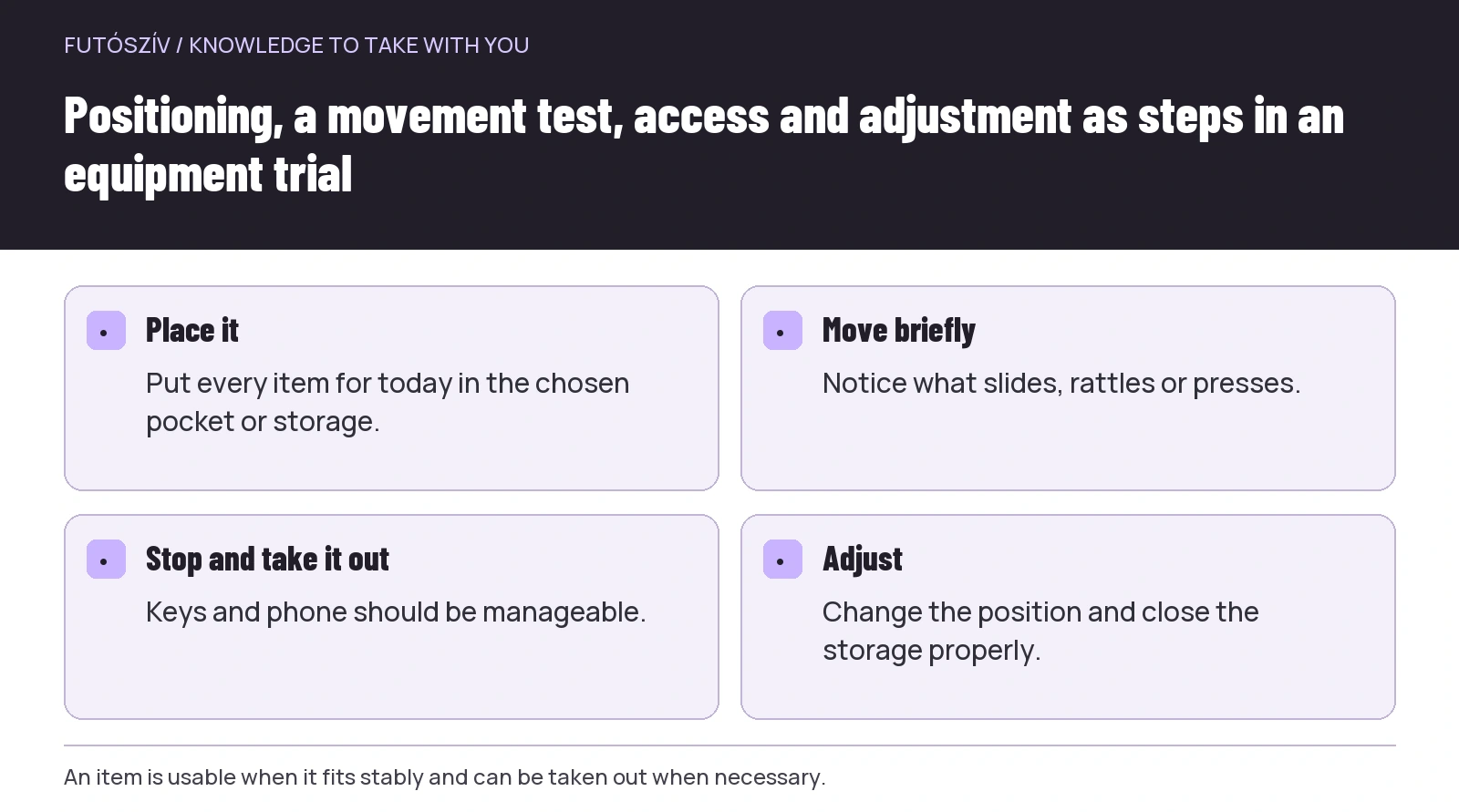
The NHS introduction to its beginner programme mentions where to carry your phone when using audio guidance. Keep the practical trial simple: put the device in your chosen place, move a few steps, then stop and take it out. Stable carrying and access both matter.
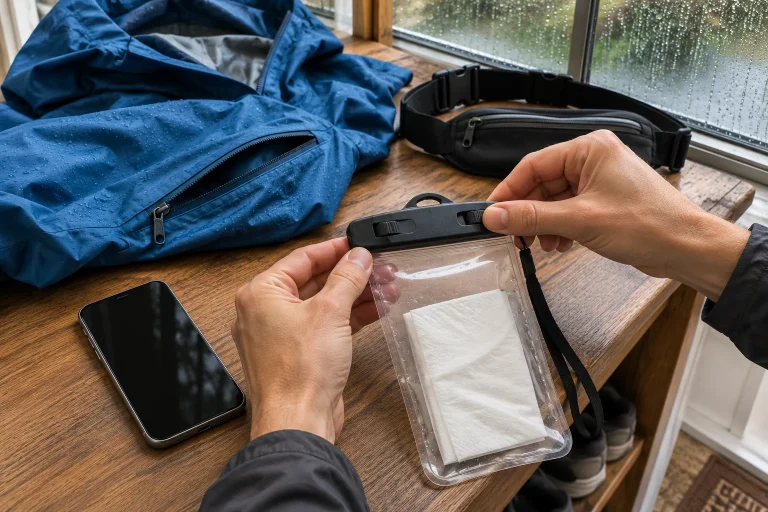
In rain, use the device manufacturer’s requirements as your basis. A pocket or bag described as sporty does not prove water resistance, and previous trouble-free use of your phone does not mean unlimited protection. If rain is expected, the chosen storage needs to suit it too. Prepare the solution at home rather than searching for it in the first shower.
Fluids: start with the circumstances
“You never need a drink for a short run” and “everyone needs a bottle of this size” are both too rigid. The detailed NHS beginner plan mentions carrying water particularly in hot weather or for longer outings. For your own situation, take account of the entire time away, the conditions and individual needs.
If you take a bottle, test its position just as you would the phone’s. An item that only just fits in a pocket may be cumbersome in motion. Think beforehand about handling a handheld bottle too: where will you stop, where will you put it, and how will your attention remain free for the surroundings? A simple solution that is comfortable to use is worth more than an impressive accessory you do not yet know.
If you rely on water available along the route, check that the particular point works at that time of year. A winter closure or temporary fault can change the plan. On a short local loop, the option to return home is part of the decision too. For a more distant route, uncertainty about access needs resolving before departure.
Some clothing is worn, and some can wait at the destination
Choose what you wear at departure for the movement and conditions. Waiting after the run is a separate situation. If you finish directly at home, a change of clothes is available there. If you take a bus home or wait for a meeting, decide beforehand what happens after the programme ends. Do not treat the journey home as empty time when considering clothing.
You can separate what you carry from what stays in a safely accessible place. For example, keys and phone may stay with you during the run while spare clothes await you at an agreed destination. That requires reliable access, however. A jacket left in a locked car is no help if someone else has the key.
As darkness falls, both seeing and being seen become tasks. The NHS beginner guide mentions well-lit routes and reflective clothing. If you do not know the lighting situation on today’s loop, choosing a daylight version or another route may be wiser. A new item alone does not make every environment suitable.
Think payment and the journey home through to the end
If the route involves public transport, check that you have a valid, usable ticket or pass. With a phone-based solution, device access, battery level and the particular service’s conditions matter. Follow the transport provider’s current information. Memories of an earlier journey do not replace checking when you use a new system.
You may need a means of payment even if you do not plan to buy anything during the run. Consider realistic changes that could require it: another way home, a planned meeting or an errand at the end of the route. You do not need a full wallet for every imaginable situation, but do not overlook today’s specific tasks.
When choosing documents, the current situation and requirements applying to you matter too. A full wallet may contain many unnecessary cards, but a short absence does not replace a required document or proof of entitlement. If an event requires a check, find out which form the organiser accepts.
 Enlarge diagram
Text version of the diagram
- Place it
- Put every item for today in the chosen pocket or storage.
- Move briefly
- Notice what slides, rattles or presses.
- Stop and take it out
- Keys and phone should be manageable.
- Adjust
- Change the position and close the storage properly.
Three kits based on one principle
| Situation | The main decision | What to check beforehand |
|---|---|---|
| A local loop starting at home | Getting back in and making contact | Key, phone, weather and personal needs |
| An urban park reached by transport | Total time away and the journey home | Ticket or pass, return journey and access to post-run clothing |
| An organised trail event | The event’s own requirements | Current mandatory list, functioning equipment and organiser updates |
The table is not a complete mandatory list. It shows why a short distance cannot determine one single kit. The official Tajga Trail race information , for example, specifies its own mandatory equipment. Check such requirements on the event’s current page even if you normally use far fewer items for a run from home.
What can stay at home?
Items that have no role in today’s outing and whose absence does not conflict with personal or event requirements. A second set of headphones, the whole key bunch, every membership card in a large wallet, or several untested accessories often only complicate handling. Decide item by item rather than deriving the choice from a general minimalist rule.
Testing new equipment can be a purpose in itself, but name it as such. If you want to test a belt, it may make sense to start on a familiar loop you can shorten, where adjustment and positioning issues become clear easily. Do not test everything at once: if several items change, it will be harder to identify what caused discomfort.
Do not take energy products merely because they appear in running photographs. A personalised nutrition plan is a different question; a packing article does not replace it. For an everyday short outing, clarify whether there is a specific need or prior professional guidance. Buying something does not, by itself, make the outing better planned.
A one-minute pocket test can show a lot
Put on your chosen clothing, position every item for today and take a few easy steps. Notice what moves, rattles or gets compressed. Then stop, take out the phone and key, and put them back. A good kit does more than fit: the necessary items can be retrieved too.
If two items interfere with one another in a pocket, change their positions. A heavier item will not necessarily remain where you put it while standing. Check the closure too. A half-closed zip or overloaded pocket does not become more reliable because you are hurrying to leave.
Do not start searching for your phone or key at the edge of the road. If you need an adjustment on the way, find a suitable stopping place and do it while keeping the travel space clear. Kit comfort and awareness of the surroundings are connected: something that constantly needs adjustment also repeatedly takes your attention.
A five-minute tidy-up after the run
On arrival, return your key and necessary documents to their usual places. Charge your phone, empty and clean the storage you used according to the manufacturer’s guidance, and do not forget damp items packed away. The next departure will be easier if today’s outing is properly closed.
Finally, note one observation: which item was missing, or which did you carry unnecessarily? If nothing was missing and the kit was comfortable, there is no need to seek another accessory. Your own short-run kit can develop gradually through specific experience. That is what makes it simple: a working setup suited to today’s route, weather and return home.
How Futószív articles are prepared: our editorial guidelines.