Your watch shows a cadence of 164, but a video says good runners run at 180. It is easy to conclude that you are doing something wrong. Yet step rate is not a standalone quality score. Your speed, step length, build, terrain and familiar movement all shape it together. A change makes sense when it answers a clear question, rather than merely pursuing a round number.
Cadence can indeed affect some mechanical features of running. This does not mean that every runner needs to switch to the same value, or that a new rhythm solves every pain. It is worth keeping research findings and personal decisions separate.
First clarify what the displayed number means
Cadence usually means the total number of steps taken in one minute. It includes the ground contacts of both feet together. A complete stride cycle, in which the same foot contacts the ground again, is a different concept. If two devices show different figures, check the unit and calculation method too.
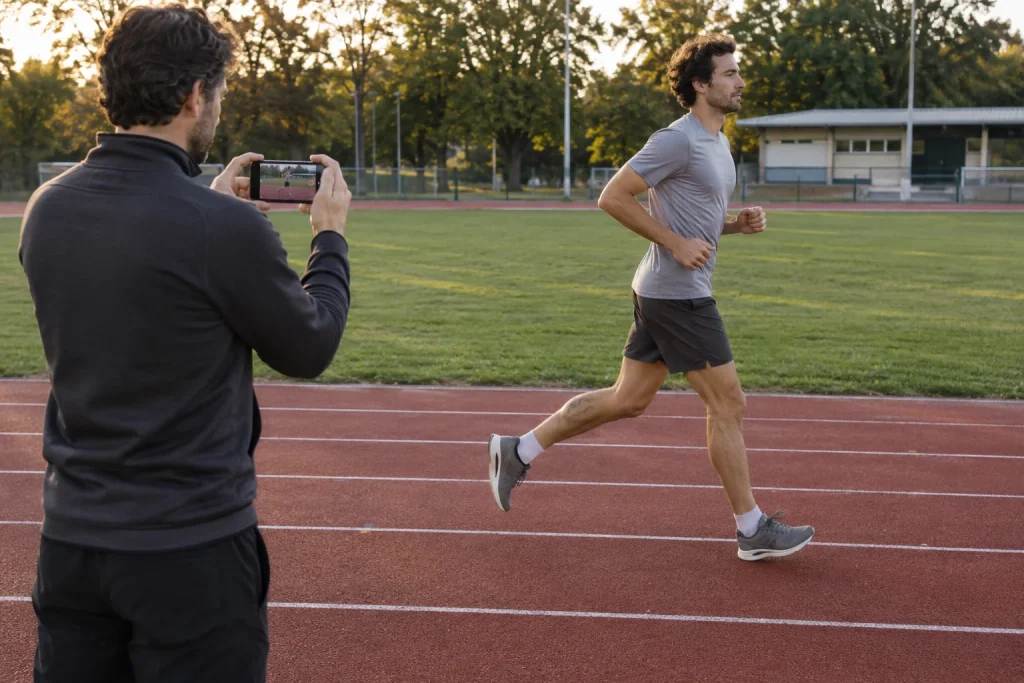
For a manual observation, you can count all steps during a set period, or count one foot’s contacts and convert appropriately. This is only an approximate measurement, to be made in a safe, simple environment. In traffic, do not let counting take away your attention.
The average for a whole session can hide differences between running, walking and stopping. To understand your rhythm, examine similar, steady sections. Do not compare an average combining warm-up and walking recoveries with a fast section of a race.
Speed and step length provide meaning together
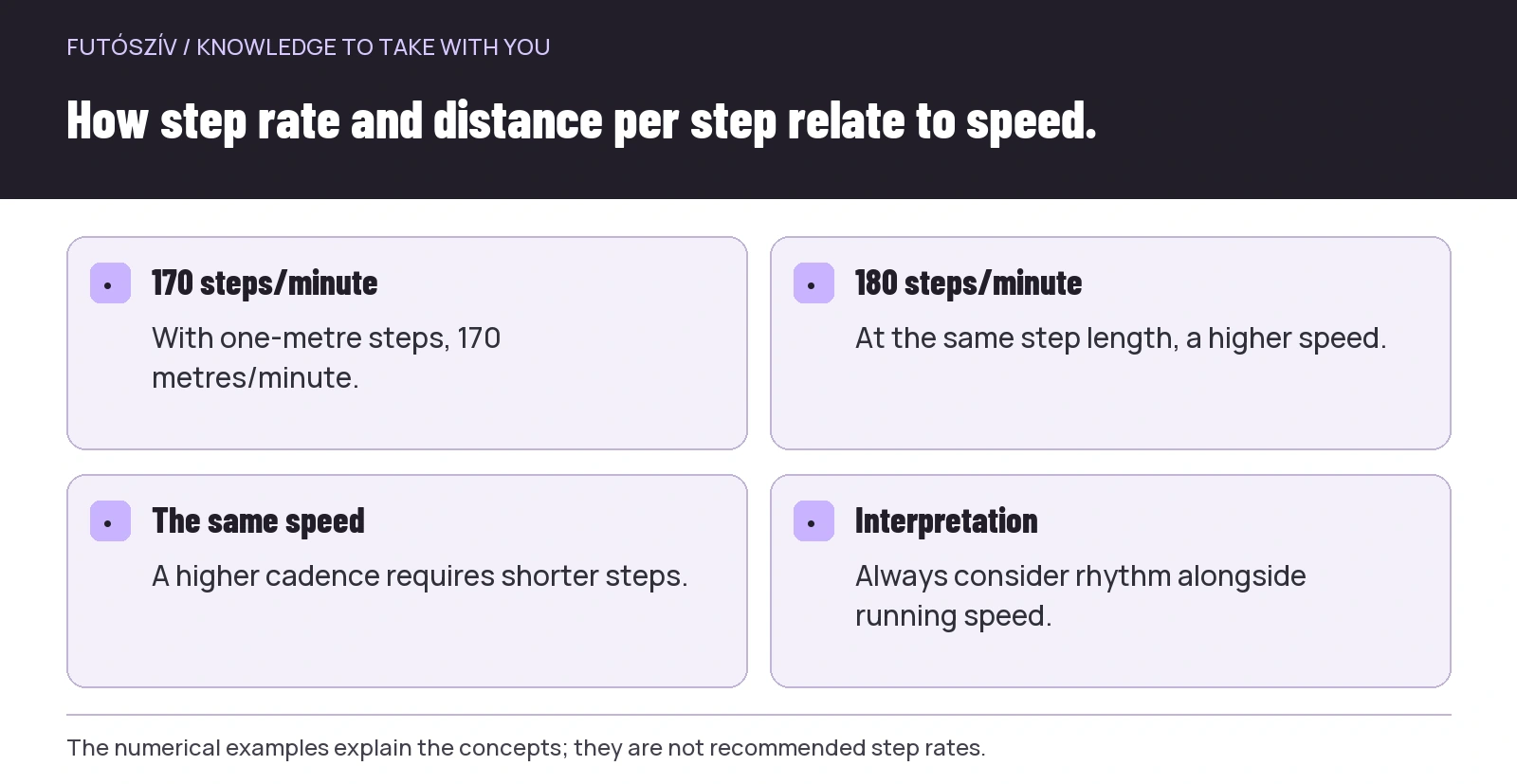
Forward speed combines step rate and the distance covered per step. If you take 170 steps per minute and each step averages one metre, you travel 170 metres per minute. This is a simple numerical example, not an ideal technique or recommended pace.
If cadence increases to 180 while step length stays the same, you move faster. If speed is held constant, however, the higher step count goes with shorter steps. This is why watching only how quickly feet move in a video, without considering forward speed, is misleading.
When changing rhythm, you can easily speed up without noticing. Pay particular attention if you want to observe what happens at the same easy speed. Otherwise, you cannot tell whether a different sensation came from cadence or simply running faster.
What does an elite average near 180 show?
In a study of an elite 100-kilometre field , average cadence was indeed around 182, but individual values varied widely. The average therefore does not mean every successful participant ran with the same rhythm.
The study also discussed the relationship with speed. An elite measurement at race pace should not therefore be adopted unchanged as a target for a slower, easy session. An observed pattern and a prescribed technique are different things.
Online, it is often precisely this distinction that disappears. An average observed in a particular group becomes a rule, and the rule then becomes a personal error signal. Understanding your own movement requires more context.
 Enlarge diagram
Text version of the diagram
- 170 steps/minute
- With one-metre steps, 170 metres/minute.
- 180 steps/minute
- At the same step length, a higher speed.
- The same speed
- A higher cadence requires shorter steps.
- Interpretation
- Always consider rhythm alongside running speed.
Habitual and energetically favourable rhythm
Runners typically develop a self-selected cadence. This may relate to how they move comfortably, but it is not necessarily identical to the lowest-energy value under every experimental condition. The concept of an optimal rhythm is itself tied to the particular measurement task.
An outdoor study compared self-selected and energetically favourable step rates at different speeds. Such research helps explain individual differences, but does not mean you can establish your own perfect number at home from a single run.
“It feels comfortable” and “it was measured as more economical in a laboratory” are not always the same claim. A new rhythm can feel unfamiliar initially. Yet unfamiliarity alone does not prove a useful adaptation, just as familiarity is no guarantee of performance.
What can increasing cadence change?
An experiment by Heiderscheit and colleagues in healthy runners changed step rate at a constant speed and examined changes in joint mechanics. Some loading characteristics changed favourably. This is an important biomechanical finding, but not the same as long-term proof of injury prevention.
A mechanical measure is not, by itself, a clinical outcome. A lower estimated loading value at one joint may still be accompanied by changes in the work of other areas. The whole movement and individual background need interpretation.
The meta-analysis on changing step rate examines evidence concerning performance, biomechanics and injury together. Available data are limited in several areas. The method can be a tool, but is not a compulsory correction for everyone.
Pain calls for a different question
The study by Bramah and colleagues evaluated a specific cadence increase and follow-up in runners with patellofemoral pain. The findings do not mean every runner with knee pain should independently make the same change.
First, the nature of the symptoms, the condition and the loading need assessment. Modifying rhythm can be one element of a personal rehabilitation plan. A percentage lifted from a study title does not replace assessment and follow-up.
If pain appears with a new rhythm or another area starts causing symptoms, do not treat it as a compulsory price of transition. Stop and consult an appropriate professional as needed. The aim is not to achieve a number regardless of your body’s response.
Why does the relative change matter?
A fixed target can mean very different jumps for different people. Going from 160 to 180 is a much larger proportional change than going from 178 to the same value. This is simple mathematics, but often omitted from practical advice.
As an illustrative calculation, increasing a cadence of 160 by five per cent gives 168. This is not a personal recommendation; it simply shows how percentages work. The reason for and size of an appropriate change depend on the particular aim and situation.
If a professional recommends a cadence change, ask what the baseline is, at what speed it was measured, and how you will monitor your response. Without these details, even a percentage can easily become an empty instruction.
Metronomes and music: tools to support attention
An audio cue or musical rhythm can help you follow a task, but can easily absorb all your attention. Try it first in a simple, safe place, rather than during every minute of every run. Awareness of the surroundings matters more than perfect beat matching.
Do not confuse the music’s beats per minute with assigning one or two steps to each beat. Clarify your chosen method beforehand. If the cue makes you speed up unintentionally or become tense, stop and simplify.
Technology is not compulsory. A brief observation and a single clear instruction may be enough for learning. The aim is to understand your movement better, not to turn every run into a rhythm exam.
 Enlarge diagram
Text version of the diagram
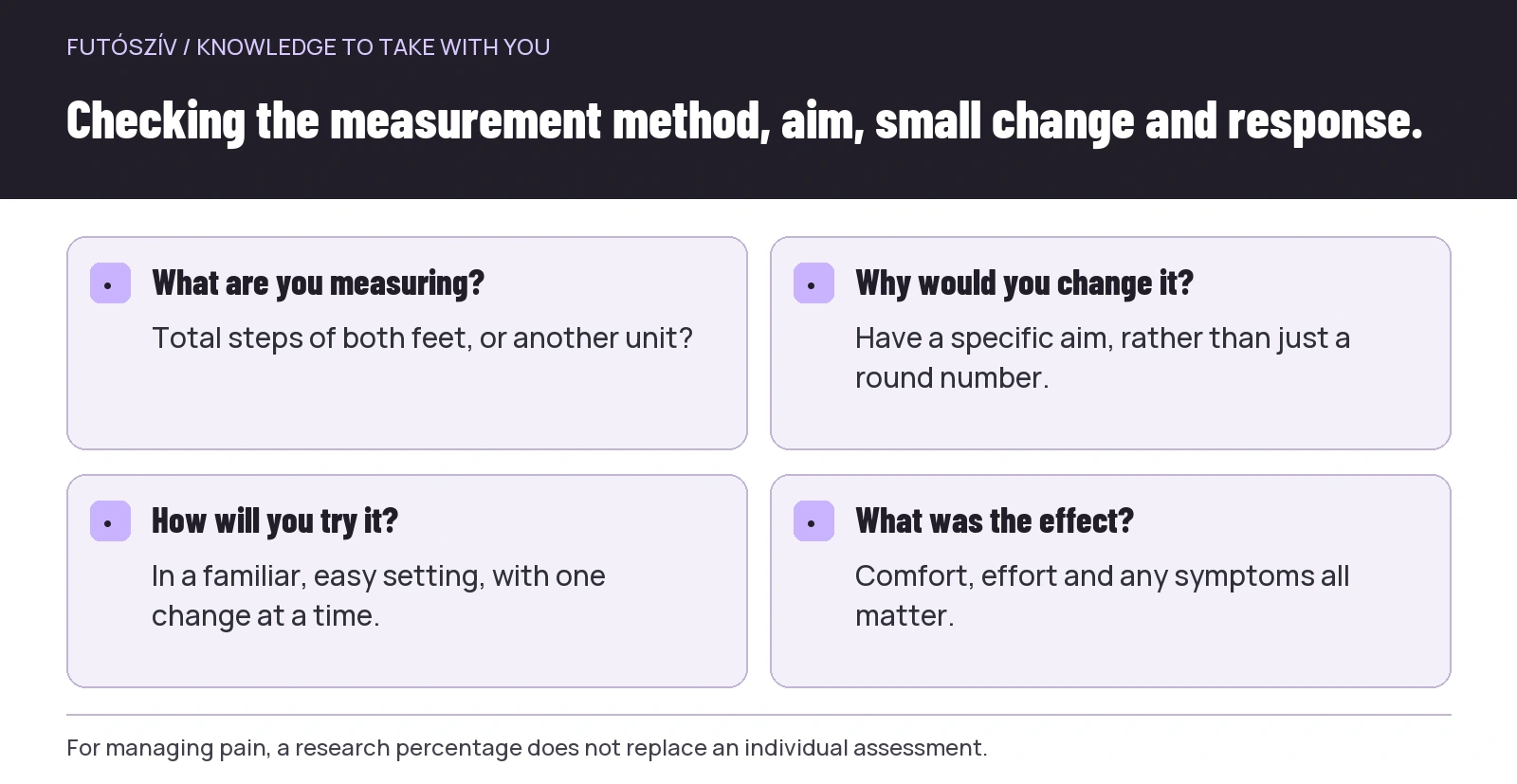
- What are you measuring?
- Total steps of both feet, or another unit?
- Why would you change it?
- Have a specific aim, rather than just a round number.
- How will you try it?
- In a familiar, easy setting, with one change at a time.
- What was the effect?
- Comfort, effort and any symptoms all matter.
Rhythm can change with terrain and speed
An uphill, downhill, bend or rocky surface may call for different step choices. Do not try to hold the same cadence number throughout a varied loop. Safe progress and the day’s aim take priority.
If you want to compare your own data, choose sections with similar speed and surface. A difference between the averages of a fast race and a comfortable jog home is not in itself a technical fault. Change linked to pace is an understandable part of running.
Treat the effects of fatigue cautiously too. At the end of a long event, speed and terrain may change as well as rhythm. Do not attribute every difference to one cause.
What should you record during a deliberate trial?
Note the speed or effort, route, chosen cue and how comfortable the task felt. Record any unusual sensations the following day too. A good log contains more than the step rate eventually reached.
Do not change shoes, foot strike, posture and rhythm at the same time. With several changes, it is hard to decide what the outcome relates to. An observation you can follow is more valuable than a dramatic but uninterpretable transition.
If you have no specific problem or aim, observation alone may be enough. Not every measurable quality needs immediate modification. Learning about your movement does not oblige you to transform it.
Loading per step and the total number of steps are different
Changing rhythm also changes the number of ground contacts. As an illustrative calculation, forty-five minutes at a cadence of 170 means 7,650 steps, while at 180 it means 8,100, if the value stays constant throughout. The two situations therefore do not involve the same number of contacts.
This alone cannot calculate injury risk. The mechanical characteristics of one step, the number of contacts and a person’s adaptation are separate questions. A more favourable laboratory measure per contact does not automatically mean that every complete session has become easier by the same proportion.
This is another reason to identify the aim of an intervention precisely. A professional may choose a rhythm change for particular symptoms while also monitoring total running time and other loads. A personal plan is more than setting a metronome. During your own trial, record your experience over the following days as well as the number reached.
The useful question is not whether you reached 180
Instead, ask: is it clear why you are focusing on rhythm? Are you observing it under the same conditions? Did it help with the chosen task, and did comfort remain appropriate? These questions can lead to a much more useful decision.
Cadence can be important information, but one number does not describe running technique, health and performance. A value of 180 is not an entry ticket to being a good runner. What matters is a change suited to your aim, one you can monitor and evaluate with a professional when needed.
Sources and verification
This article refers to a biomechanical experiment, monitoring of an elite road race, an outdoor energetics study, clinical research and a meta-analysis. The numerical examples are not prescribed targets. Changing cadence is neither a general injury-prevention guarantee nor personal treatment. Sources checked: 18 November 2026.
How Futószív articles are prepared: our editorial guidelines.