
You move easily in one direction, then the same pace becomes hard after turning. On windy days, watch numbers and personal effort can diverge. The sound decision is not necessarily holding tighter to prescribed kilometre times. First clarify the day’s purpose, actual weather and a route on which the outing remains manageable.
Wind can be a normal training condition or, in storms, a safety issue. Do not confuse them. Falling branches, flying objects and strong sideways gusts are not technical challenges solved by more determined running.
Why does a headwind require more work?
You move relative to air as well as ground. A headwind can increase air resistance, requiring more effort for the same ground speed. The pace then arises in different surroundings from a calm day.
Pugh’s classic physiological research examined energy demands of walking and running against wind. Resistance is therefore more than sensation, but laboratory measurements do not establish one pace correction for every runner and street.
Speed, body position, clothes and surroundings shape the effect. Buildings, trees and terrain change wind around the route. An app’s average does not necessarily describe the whole loop.
A tailwind is not a simple refund
On an out-and-back, expecting all headwind time back is tempting. Air-resistance and energy relationships prevent a simple symmetrical correction. Fatigue and selected effort can change meanwhile.
Davies’s study examined wind assistance and resistance in running. Do not judge training solely by the favourable stretch. A tailwind record section need not indicate the same improvement as repeated running in similar conditions.
This does not devalue the pleasant experience. It changes the data’s meaning. Note directions and stronger gusts when important to interpreting the run.
Preserve effort on easy days
If comfortable running is the task, slowing into wind is not necessarily failure. Actual demands make it easy, not displayed pace. If a familiar kilometre time now requires much more effort, ease the speed.
Observe breathing and perceived difficulty. Heart rate can inform too, with measurement and individual-response limitations. Every windy run need not be precisely converted to a “calm-weather pace”.
If surroundings continually disrupt rhythm, choose a shorter or sheltered stretch. Less time in the most exposed area can preserve an easy day. Give changes clear reasons rather than only retrospective explanations.
 Enlarge diagram
Text version of the illustration
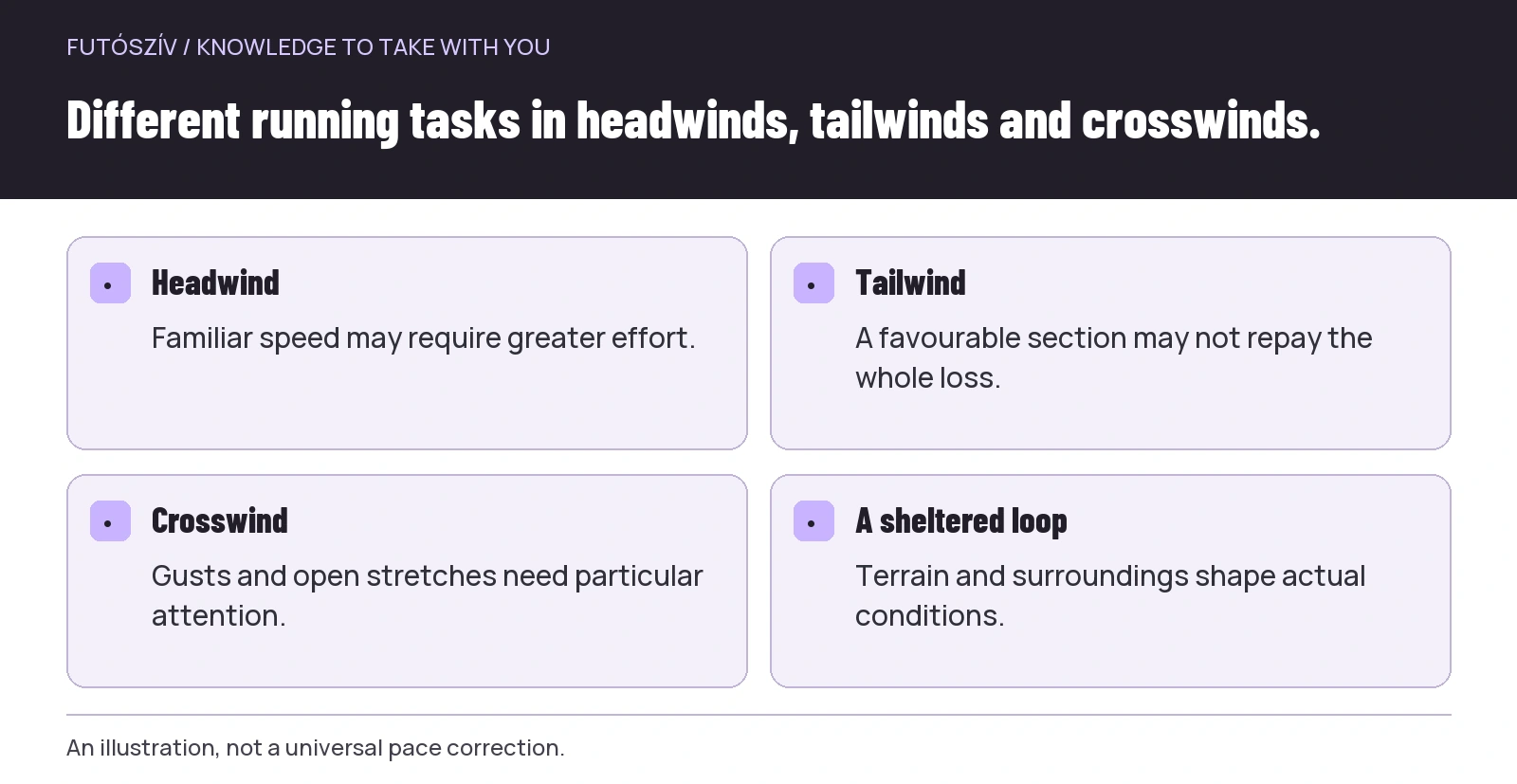
- Headwind
- Familiar speed may require greater effort.
- Tailwind
- A favourable section may not repay the whole loss.
- Crosswind
- Gusts and open stretches need particular attention.
- A sheltered loop
- Terrain and surroundings shape actual conditions.
For faster work, clarify what you are practising
A session might aim to maintain effort or learn exact pace awareness. Wind may require different approaches for those purposes. Speed can vary if effort is primary; another location or indoors may suit exact pace.
For short sections, avoid using only one direction as the reference. Alternating directions reveals sensations without automatically equalising total load. Turns and rests belong to the session too.
Agree a windy option with your coach beforehand: what stays and what can change? Without agreement, do not turn controlled work into an exhausting test through rigid pace adherence.
Choose the route with wind direction in mind
A long open embankment or field-edge road differs from a short urban loop turning several ways. Identify sustained headwind and crosswind stretches. The aim is understanding the task, not eliminating all wind.
On an out-and-back, consider returning too. Effortless outward progress is no automatic estimate of reserves. A long harder section can follow turning. A shorter turnaround leaves more options.
Shelter is not necessarily safe in storms. Trees can shed branches and buildings objects. Strong warnings do not mean choosing the densest tree cover for running.
What does the forecast show?
Mean wind speed and gusts differ. Moderate sustained airflow can contain stronger bursts. Direction, changes over time and accompanying rain affect decisions too.
The HungaroMet severe-weather system provides official warnings and alerts. Check the current area and period before running. A morning screenshot may not describe evening conditions.
Do not rely on one app’s attractive icon. Worse conditions on site require adapting to what you experience. Change the plan at departure rather than waiting until halfway.
Safety takes priority in storm-force wind
The Hungarian disaster-management guidance also addressing pedestrians warns about objects and branches blown down from above. Seek a stable, protected place in storms. Completing the route becomes secondary.
The National Weather Service wind-safety materials also emphasise avoiding dangerous surroundings and changing plans as needed. Running in wind is not required. Indoor activity or postponement can be fully valid planning decisions.
Thunderstorms add lightning as a separate hazard. Do not assess the situation as though it concerned only pace-affecting resistance. Follow official weather and on-site guidance.
Predictability matters in crosswinds
A strong gust on open ground can disturb progress. Leave more room on shared surfaces and avoid insisting on a straight line beside pavement or road edges. Choose position for the setting.
Airflow changes around bridges, corners and gaps between buildings. Do not watch a phone when surroundings demand attention. If movement becomes uncertain, walking or stopping are options.
Light equipment with large surface areas can interfere too. Check caps, flapping layers and bag attachment. Adjust standing somewhere protected, not in the middle of a busy route.
 Enlarge diagram
Text version of the illustration
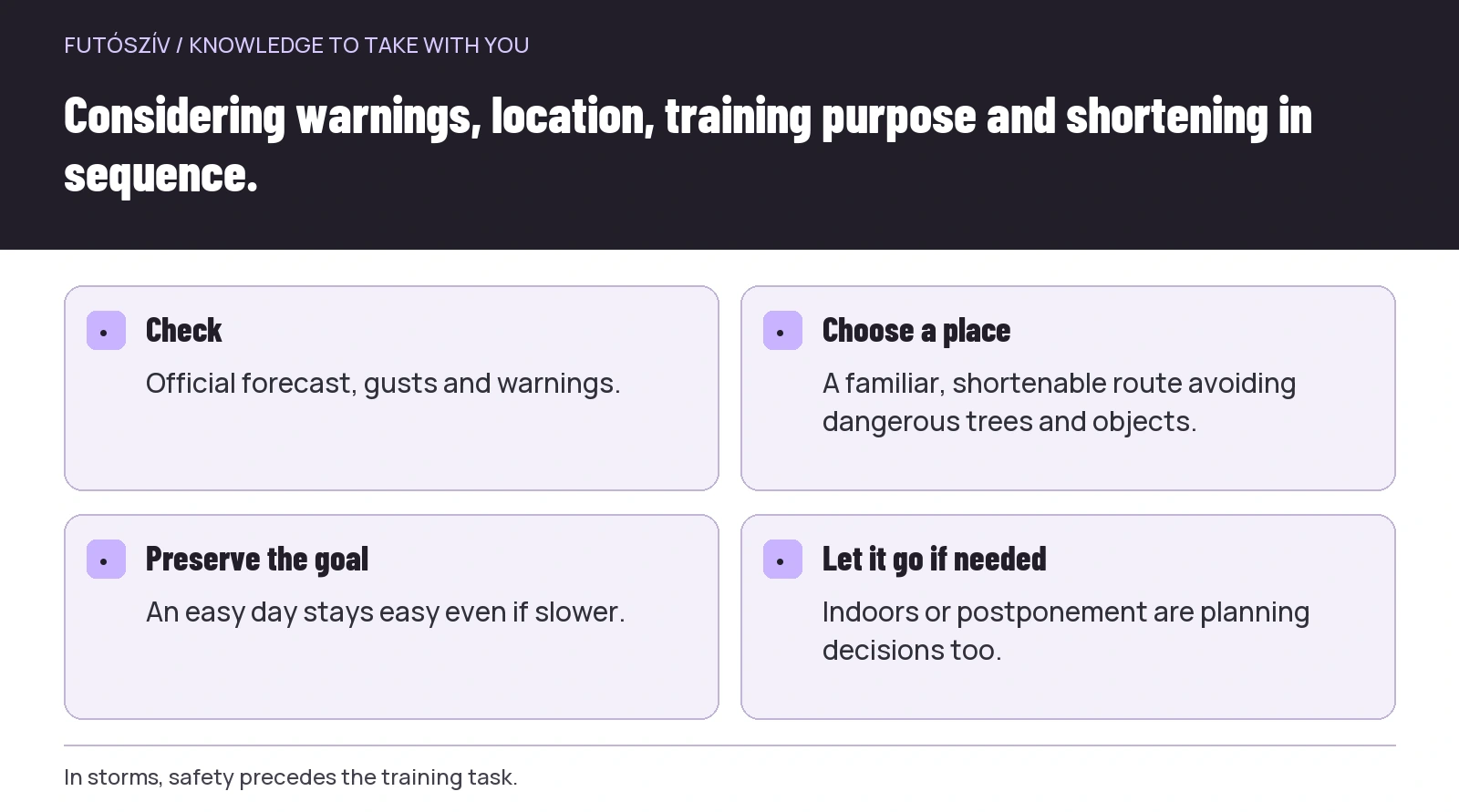
- Check
- Official forecast, gusts and warnings.
- Choose a place
- A familiar, shortenable route avoiding dangerous trees and objects.
- Preserve the goal
- An easy day stays easy even if slower.
- Let it go if needed
- Indoors or postponement are planning decisions too.
Do not improvise by sticking to another runner’s back
Groups can alter wind exposure, but close running requires attention and consent. Avoid cutting in or following so closely that stopping or turning becomes dangerous. Discuss pace and overtaking.
If changing the front runner, make transitions predictable. This is group organisation, not compulsory tactics. Consider less comfortable runners in mixed-ability groups; headwinds can widen differences.
Event rules govern races. An article cannot decide permission for companions, equipment or other assistance. Group positioning must not override others’ safety.
Wind and cold together: plan stops too
In cool wet conditions, waiting afterwards can feel different from continuous movement. Consider route end, dry clothes and return journey together. Warm outward progress does not establish comfort while stopped.
Choose adjustable layers allowing movement. Test zips, hood and pockets on a short outing. Headwind posture need not become rigid tension; comfort and control matter more than an imagined ideal pose.
If cold, soaked or facing deteriorating weather, shortening may be appropriate. Distance does not outrank a safe return.
How to review the run afterwards
Record wind, harder directions and changing effort. A slower whole-loop average cannot be compared unconditionally with calm weather, nor a fast tailwind section alone prove fitness.
Review route choice too: easy shortening options and suitable clothing? Such experience helps on similar days. Speed is not the only sign of a good training decision.
If the goal was comfortable movement and easing pace preserved it, the outing did its job. An online correction calculator need not justify that you “really” ran faster.
A short route trial can teach too
In safe moderate wind, observe a nearby small loop turning several ways. No pace test is needed: notice open stretches, wind changes and stopping places. Local knowledge supports later modifications.
The trial is not creating a personal wind-correction formula. Tomorrow can bring different gusts and condition. Instead, build a usable map of manageable, shortenable running when long exposed stretches are unsuitable.
Sources and editorial note
For air resistance we cite two physiological studies; for weather decisions, primary HungaroMet, Hungarian disaster-management and National Weather Service guidance. Scenarios are our own editorial suggestions. We give no universal pace formula or clearance for dangerous weather. Sources checked: 18 November 2026.
How Futószív articles are prepared: our editorial guidelines.