
The race approaches, the plan contains less running and you worry that fitness is slipping away at exactly the wrong moment. Tapering, reducing training before the start, creates this uncertainty for many runners. Its purpose is not abandoning earlier work, but allowing preparation to become usable race performance. That generally also requires reducing accumulated fatigue.
A taper is not identical for every distance and runner. Previous volume, the race, recovery and individual response matter together. This article explains decision elements rather than providing a personal race-week programme.
What is a taper for?
Preparation produces training stimuli and fatigue. Easing before a race aims to reduce the latter without unnecessarily losing important skills and familiar rhythm. This differs from stopping running completely because of illness or injury.
The goal is not perfectly light legs every day beforehand. Sensations vary, and less training can leave more attention for small bodily signals. One sluggish short loop does not establish failed preparation.
A useful taper builds on work already completed. It is not for replacing missed preparation in the final week. Substantial interruption may require reconsidering the goal and participation.
What did research syntheses find?
The meta-analysis by Bosquet and colleagues examined taper components separately in competitive athletes. Findings support performance benefits from an appropriate taper, while combining different sports and protocols.
A 2023 endurance meta-analysis also found favourable time-trial outcomes with several taper approaches. Reduced volume and appropriate retention of intensity and frequency were important examined elements. Pooled percentages do not replace individual planning.
Extracting only “reduce by this amount” loses participants’ histories and programme context. A taper is relative to preceding demands. A low-volume recreational runner and high-volume competitor ease from different starting points.
Four variables, four decisions
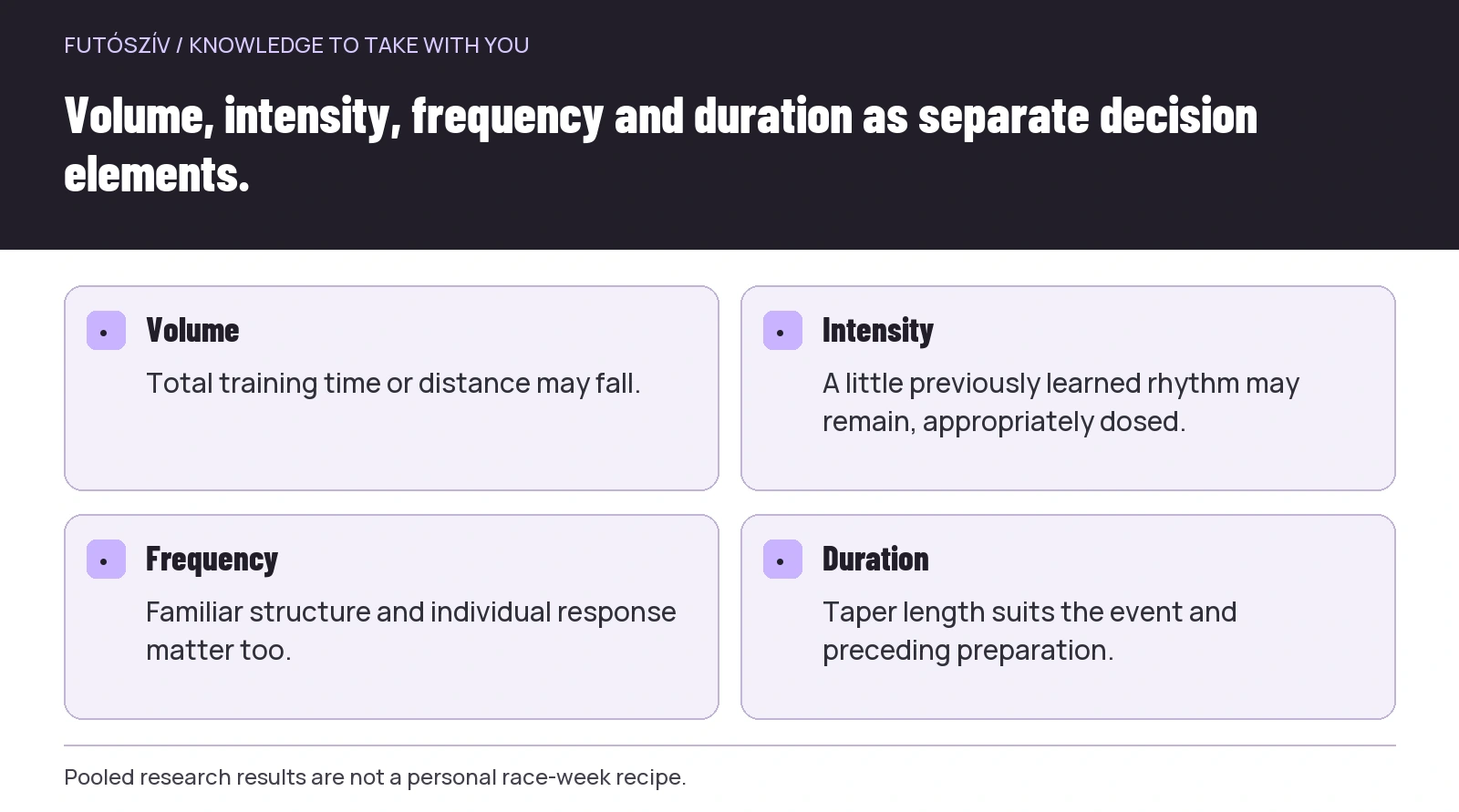
Volume describes remaining total time or distance. Intensity concerns difficulty within sections. Frequency means session count. Taper length describes how long demands change before the start.
Do not alter them together without understanding. Less running with every outing fast differs from considered volume reduction. Omitting all running differs from shorter versions of a familiar rhythm too.
Ask your coach which variables change and why. Understanding supports sensible adjustments after unexpected travel or poor sleep rather than arbitrary session swaps.
 Enlarge diagram
Text version of the illustration
- Volume
- Total training time or distance may fall.
- Intensity
- A little previously learned rhythm may remain, appropriately dosed.
- Frequency
- Familiar structure and individual response matter too.
- Duration
- Taper length suits the event and preceding preparation.
Retaining intensity does not mean hard running every day
Research references to maintaining intensity can mislead. They do not require complete additional hard sessions before a race. A small amount of familiar, goal-appropriate rhythm may remain while overall work falls.
The study by Shepley and colleagues compared short taper approaches in nine well-trained male middle-distance runners. An important experimental example, its small sample and specific participants prevent direct copying into a first-marathon week.
Do not learn a new fast task or running technique in the final days. Preserving familiar race rhythm differs from testing capacity. Discuss uncertain or unfamiliar tasks beforehand.
Understand the taper’s start from preceding weeks
First review accumulated demands. Longer, tiring preparation may require different easing from a stable lower-volume routine. Distance alone does not describe your starting condition.
A taper is more than the running list. Heavy strength work, long hikes or hours of standing in the final week may leave total demands unchanged. Other movement need not all be prohibited, but review the full calendar.
Travel needs real time too. Very early departure, late arrival and extensive venue walking can affect wellbeing. Pair sport planning with a simple travel and rest plan.
Missed training does not automatically move before the start
A missed long run can create pressure to complete it quickly before race day. Catching up changes the original taper. Decide from current condition rather than an old unticked row.
Distinguish a small change from major preparation gaps. One missed session differs from weeks of illness. The latter may require reviewing goals, distance or participation, with professional help where needed.
A race date creates no extra adaptation time. If the final days require frantic efforts to “be ready”, discuss honestly what is manageable. Responsible decisions do not always mean following the unchanged plan.
Do not check freshness through constant testing
Many runners inspect pace, heart rate and readiness scores more during tapering. Turning every short run into a fitness test can obscure easing’s purpose. One good-feeling day and another poorer one do not reveal the whole race-day picture.
Choose simple observations beforehand: manageable everyday movement, adequate sleep and no new symptoms. Perform short planned tasks for their own purpose. A maximal finishing sprint is not needed for reassurance.
If uncertainty is strong, ask your coach about expected sensations and what genuinely requires change. An agreed decision process often helps more than rereading daily algorithmic judgements.
Equipment and eating: time for tested approaches
Less running may create time for shopping and advice searches. The final days are poor for introducing new shoes, socks, gels and breakfast together. Begin from earlier training experience.
List what has worked in similar circumstances: number placement, carrying fuel and the journey home. Reduce unnecessary decisions rather than solve every detail with a special product.
Do not let panic drive food and fluid choices. Particular nutrition or health questions may require personal advice. A last-minute extreme method does not become suitable because someone raced successfully with it.
 Enlarge diagram
Text version of the illustration
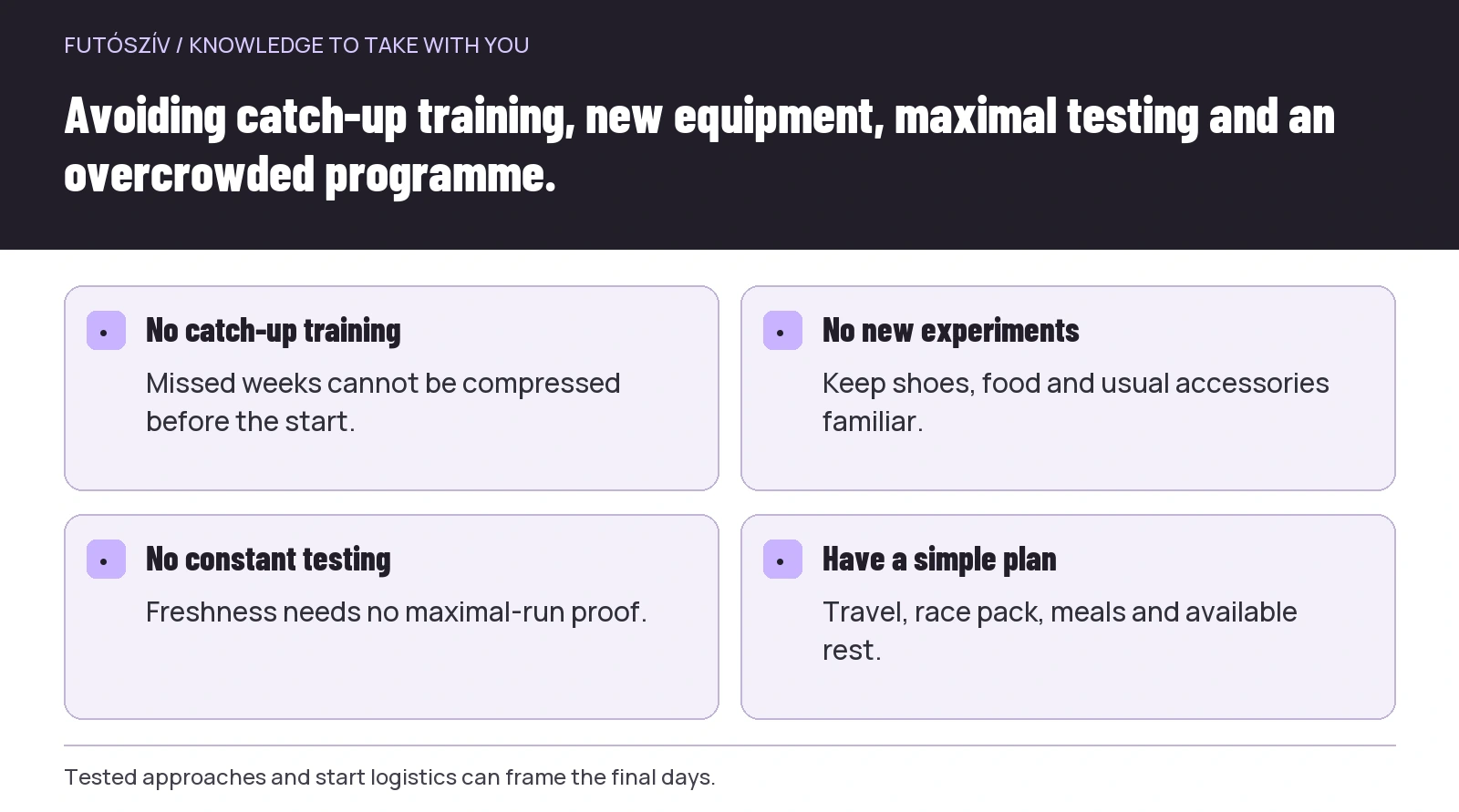
- No catch-up training
- Missed weeks cannot be compressed before the start.
- No new experiments
- Keep shoes, food and usual accessories familiar.
- No constant testing
- Freshness needs no maximal-run proof.
- Have a simple plan
- Travel, race pack, meals and available rest.
Race logistics can use the easier days
Check pack collection, venue access and expected walking. Know toilets, bag storage and starting area. Use current organiser information because earlier arrangements may change.
Simplify arrival where possible. Unnecessarily early queuing and frantic final travel can both be tiring. Base time allowances on the venue rather than another runner’s routine.
Agree basics with companions too: meeting place, contact and changes if you finish later. Clear arrangements reduce race-day decisions and leave attention for running.
When a new symptom appears
Tapering does not justify dismissing every symptom as nerves. New, worsening or movement-changing pain needs appropriate assessment. Illness, fever or general malaise require separate consideration of participation and effort.
Chest pain, fainting or severe breathlessness can be urgent. Health action then matters more than race plans. This general article does not replace individual assessment or clearance to start.
Do not postpone uncertainty until the starting area. Earlier discussion creates more options than on-site pressure. Withdrawal or changing the goal can be responsible sporting decisions.
Not every start needs the same easing
Main target races and preparation events have different annual roles. Fully peaking for every weekend changes continuing preparation. Decide which event deserves your best possible performance and which remains practice or social participation.
A practice-race label is useful only when effort follows it. If you raced all-out, adapt following days to actual demands. Treat the real run, not pre-entry intentions, as the diary’s history.
Learn from personal experience
After racing, record the taper briefly: running amount, logistical calm, sleep and start-line sensations. Add weather and race unfolding beside finishing time.
Do not attribute one good or bad result solely to tapering. Many factors shape performance. Several preparation cycles can reveal suitable organisation, while uncertainty remains.
Carry one or two changes forward rather than overturn everything for one day. A good taper need not be dramatic. Often it works by leaving more room for familiar, reliable things.
Sources and checking
This article cites two meta-analyses and one small experimental runner study. Syntheses are not converted into universal percentage prescriptions. Logistics and diary examples are our own editorial suggestions. Health questions require individual professional advice. Sources checked: 18 November 2026.
How Futószív articles are prepared: our editorial guidelines.