It is easy to think of a running shoe as a battery that runs out after a precisely defined amount of use. Reality is less regular. Asphalt, gravel, mud, everyday walking and individual runners wear the same model at different rates. Watch-recorded kilometres help memory but do not inspect the shoe for us. Rotation is useful when it solves real tasks; more pairs lining the hallway do not automatically make training more considered. The goal is usable, comfortable equipment suited to the task.
Rotation is not a compulsory equipment level
Shoe rotation means deliberately alternating several pairs. Its simplest reason is different ground: a road pair and a trail pair do different jobs. A second trainer can also help when the first is regularly soaked and still wet before the next outing. Alternating is then an organisational solution, not a fitness badge. One suitable shoe may be enough for a few easy weekly runs. If the existing pair serves well and is dry for the next departure, the word “rotation” alone is no reason to shop.
Another runner uses varied sessions and surfaces, choosing separate everyday, trail and race shoes. Give each pair a one-sentence task here too. If two models serve almost identical purposes, ask whether both are genuinely needed. A comfort preference can also justify a choice, but call it that. Budget, storage and attention available for care belong in the decision alongside technical features. More pairs mean more items to inspect and more easily forgotten runs in the diary.
What does research say about multiple shoes?
A prospective study by Malisoux and colleagues found an association between using multiple shoes in parallel and lower running-injury risk. This is interesting, but does not establish that buying a second pair by itself prevents injury. In observational research, runners using different shoes may differ in other habits too. The finding suggests a practical possibility: variety can form part of a considered system. It does not prescribe an individual purchase.
Understanding that limitation simplifies everyday decisions too. First examine running load, recovery, persistent symptoms and shoe fit. Multiple pairs do not compensate for increasing load too quickly or justify an uncomfortable model. If a shoe repeatedly causes problems, do not keep it in rotation solely because “a different stimulus is good”. Variety does not mean every sensation is desirable. A well-designed system gives switching an understandable purpose and observable result.
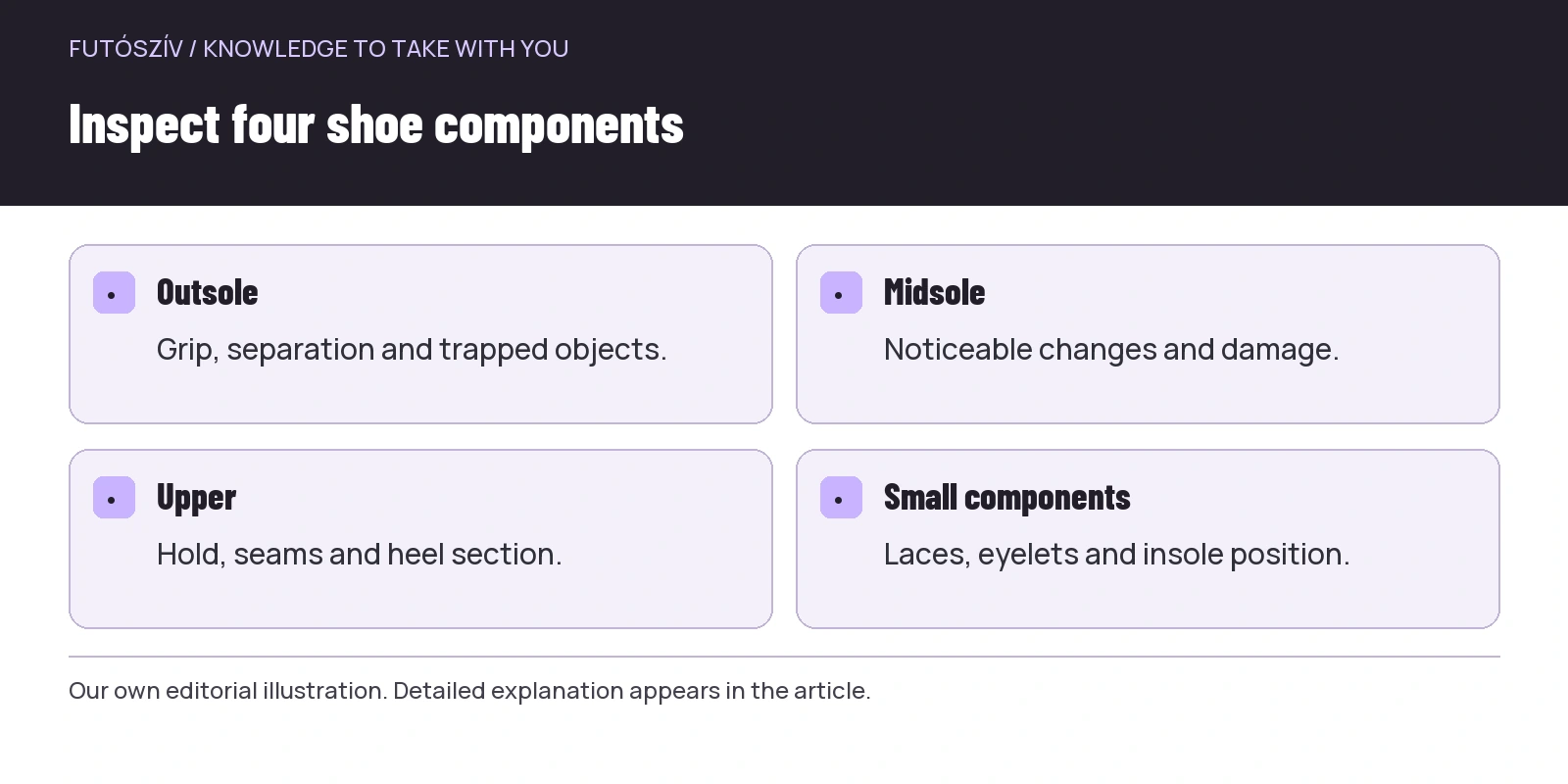 Enlarge diagram
Text version of the illustration
- Outsole
- Grip, separation and trapped objects.
- Midsole
- Noticeable changes and damage.
- Upper
- Hold, seams and heel section.
- Small components
- Laces, eyelets and insole position.
Why is there no universal kilometre limit?
Distance does not tell the full load history. Surfaces, time spent standing or walking in the shoes, storage and materials all matter. A clean upper can conceal worn components, while a dusty shoe may remain usable. Manufacturer mileage recommendations are reference points; they cannot see your pair’s condition. The original Brooks guidance also mentions use and storage among factors affecting durability.
This does not make mileage irrelevant. On the contrary, it is a good reminder of when to inspect more often. A diary shows which pair has been heavily used and when its feel changed. Let the number prompt inspection rather than become an automatic discard button. A single prescribed figure can mislead in two ways: throwing away a usable pair too early or persisting with a damaged one because it has not reached the supposed limit. Condition and use experience together provide a stronger basis.
Inspect four separate layers
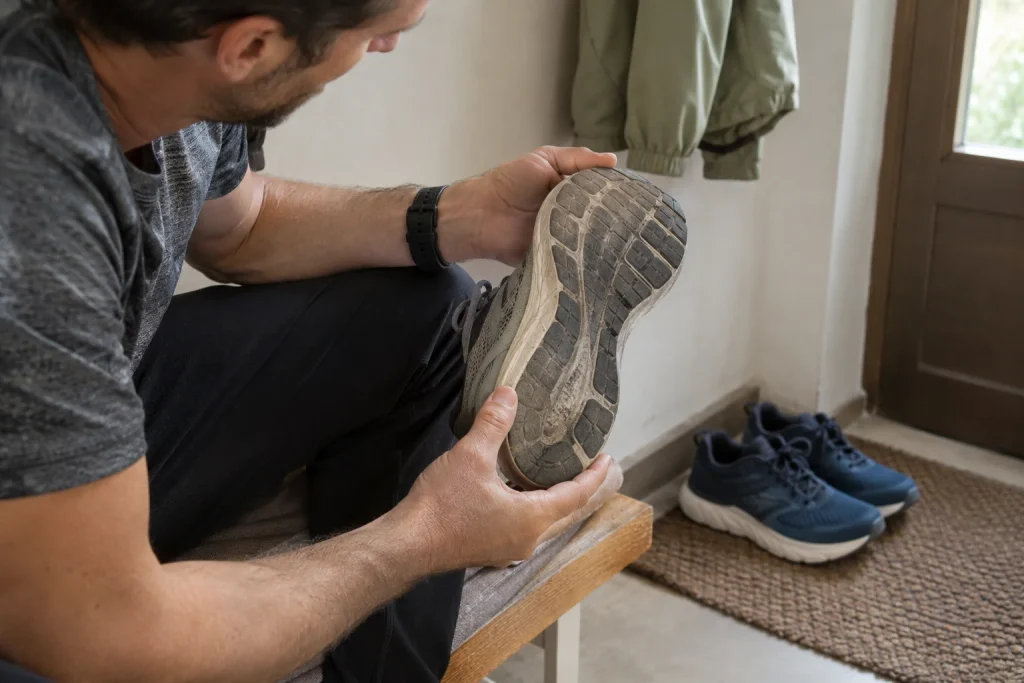
On the outsole, check that enough gripping surface remains for the task, no part has separated and no sharp object is trapped. On the midsole, look for marked asymmetry, cracks or changes affecting behaviour. The upper should secure the foot: an open seam or stretched heel is more than cosmetic if it causes slipping. Finally check laces, eyelets and insole position. The manufacturer wear guidance also examines several components separately; one sole photograph does not tell everything.
Do not try to produce laboratory findings by squeezing with your fingers. Comparing different foams and sole constructions this way can easily mislead. Creasing alone does not mean unusable, and an attractive exterior does not certify flawless function. Following the same pair over time is more useful: it used to feel like this and now holds or behaves differently. If uncertain about a component, seek manufacturer or specialist-shop help. Do not “test” a broken structure through dangerous bending at home.
| Observation | Why it matters | Next step |
|---|---|---|
| A separating sole section | It can catch or change contact with the ground | Do not experiment while running; have it inspected |
| A stretched heel or tearing upper | Foot security may deteriorate | Check whether it can be repaired safely |
| A smooth sole in an important grip area | Grip may be inadequate for the intended task | Replace appropriately or change its use |
| A new, different discomfort | The shoe can be a factor, but not the only one | Review the whole situation; seek help for persistent symptoms |
New pain is not a shoe diagnosis
After an uncomfortable run, blaming old shoes with high mileage is common. They may indeed have changed, but recent load, a new route or other factors may contribute. Feeling better in new shoes does not establish the cause alone either. Do not test symptoms through repeated painful runs. Persistent, recurring or substantial symptoms need appropriate professional help. Equipment checks and health assessment may be related, but do not replace one another.
A diary can help here too. Record route, session type, pair used and unusual circumstances. You need not build a medical system: a few factual notes can show whether the problem always related to the same shoe. Memory tends to generalise from one striking occasion. Documented experience gives a professional more precise questions too. The goal is not to “acquit” or “convict” the shoe, but to separate uncertainties sensibly.
Introducing a new pair: keep the session recognisable
When starting new shoes, avoid changing everything else that week. A new model, terrain, longer distance and faster session together obscure what changed the experience. First try an easy, familiar run you can shorten if needed. Observe security, pressure points and next-day impressions. Every shoe need not have the same introductory mileage, but do not confuse getting accustomed with enduring pain. Discomfort is not a compulsory entry ticket to new technology.
If the old pair remains suitable, use it alongside the new one temporarily for comparison. This should not become forced extension of a damaged shoe’s life. Interpret model differences cautiously: a new pair with different construction naturally feels different. A “fresher” feeling is not a measurement by itself. Note instead where each worked for you: an easy longer run, short urban loop, gravel road or muddy trail. This gives rotation real everyday meaning.
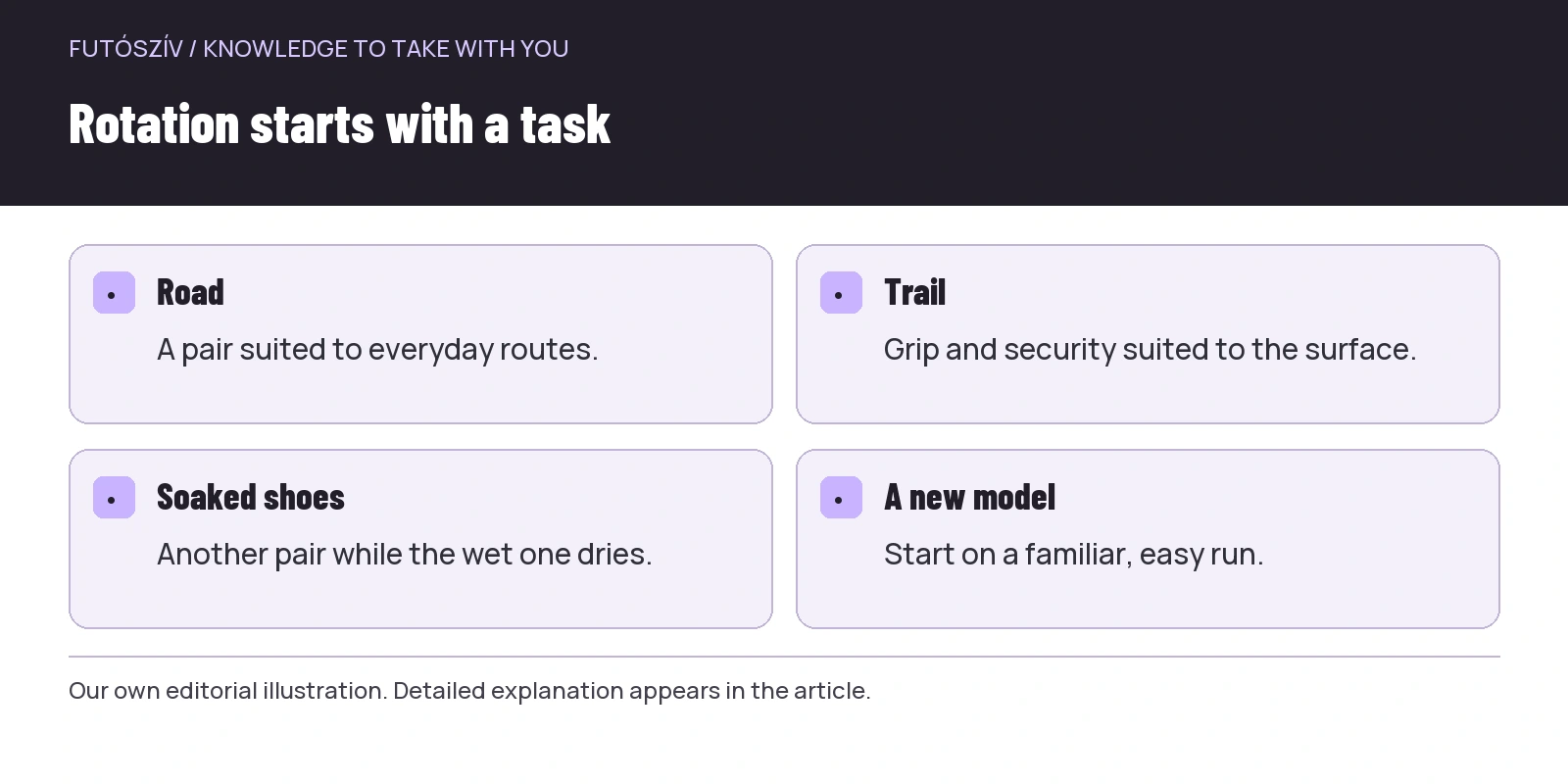 Enlarge diagram
Text version of the illustration
- Road
- A pair suited to everyday routes.
- Trail
- Grip and security suited to the surface.
- Soaked shoes
- Another pair while the wet one dries.
- A new model
- Start on a familiar, easy run.
Care that does not cause more damage
After running, open the shoe and let it air. Do not leave a wet pair closed in a sports bag for days or put it on a hot radiator. Base cleaning on your own manufacturer’s instructions. The Brooks cleaning guidance describes gentle hand cleaning, for example, and advises against machine washing or drying. This does not mean every product needs identical care; it means a general online washing trick should not take priority over material-specific instructions.
If material guidance permits, let mud dry enough to remove gently first. Carefully remove stones from sole grooves and inspect for damage. Insoles and the interior may need separate drying time. More detergent does not mean better care: residue can be uncomfortable and harsh chemicals can damage materials. Clean, dry, ventilated storage is simpler and more reliable than regular heating or experiments with unfamiliar disinfectants.
A different use or goodbye?
A shoe no longer suitable for running may sometimes serve a less demanding task, but condition decides that too. Do not automatically call a separating, unstable or uncomfortable shoe a good walking shoe. “It will be useful for something” does not repair the fault. If changing its use, update the diary and avoid accidentally choosing it for an important run. Collection, repair and recycling options vary locally; check the provider’s current conditions and do not assume every collection point accepts every condition.
Selling or giving away is fair when you clearly explain usage history and visible faults. A cleaned upper does not make shoes new. Assessing used running shoes is especially uncertain without knowing how and how much they were used. Consider predictability alongside price. The second-hand logic that works for clothing cannot always be transferred unchanged to equipment that wears under load.
Five minutes a month, not constant worry
Keep a simple inspection routine: bring out regular pairs, examine soles and uppers, compare sides, check laces and read recent run notes. If all is well, there is no need to analyse shoes continually while running. If something differs, ask how it affects the task. Secure fit and grip matter more than looking new in a photo. Care aims to preserve usability, not erase every trace of use.
A workable approach may consist of two clearly different pairs, or one carefully chosen shoe with deliberate drying arrangements. Do not make replacement a contest towards either maximum mileage or the newest model. Three questions suffice: does it hold well, is it still suitable for the chosen ground and can it be used comfortably? If unsure, investigate further. If clearly not, do not seek permission to continue in the diary. Shoes serve running; rotation should organise their use.
Sources and further reading
- Malisoux and colleagues: parallel shoe use and injury risk
- Brooks: when to replace shoes
- Brooks: cleaning shoes
- ASICS: running-shoe wear
How Futószív articles are prepared: our editorial guidelines.