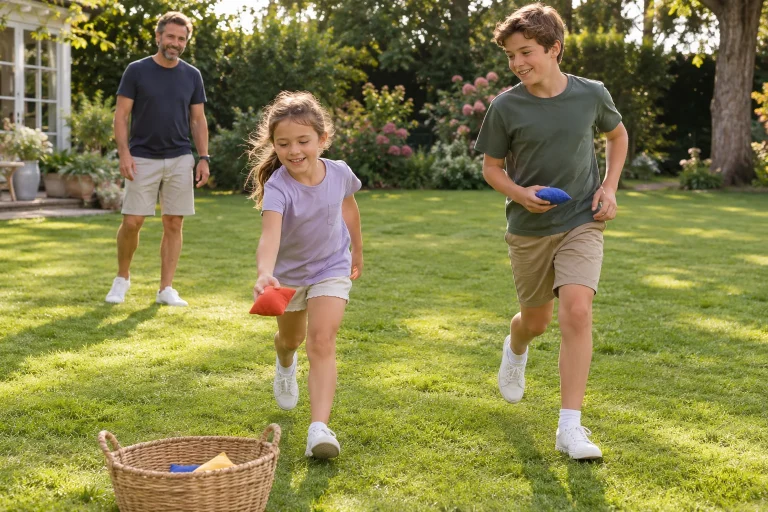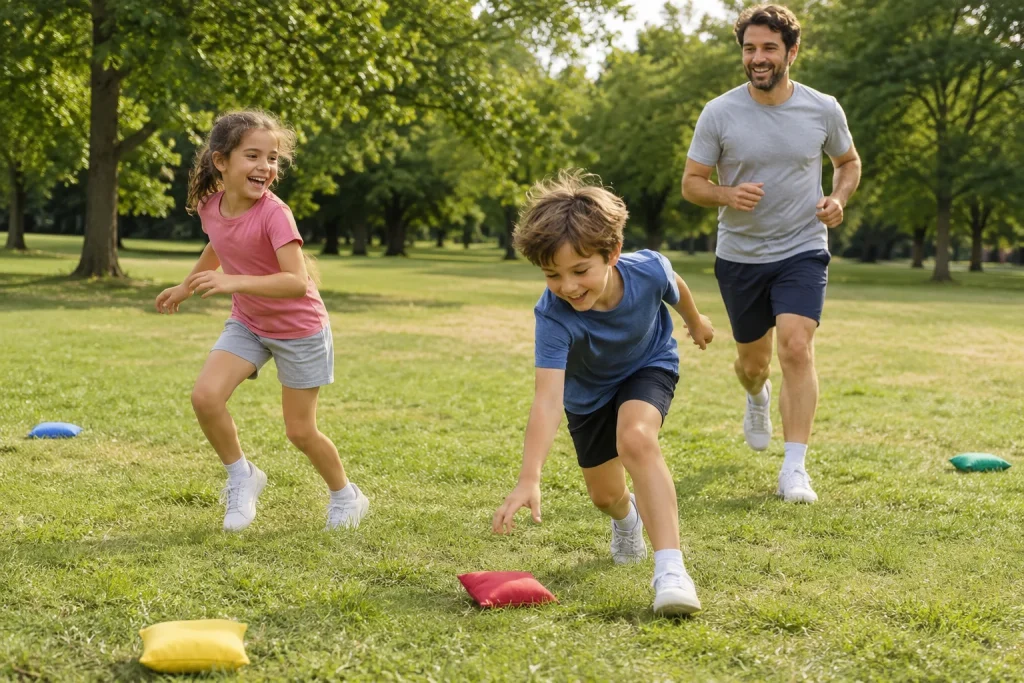
One of the best forms of family running barely resembles training from a distance. Short bursts, walking, laughter, swapping roles and an unexpected stop beside an interesting leaf. For a child, movement is not necessarily measured in kilometres, nor does it need to be. A shared outing can become a recurring pleasure when the adult avoids fitting a smaller, slower version of their own workout onto it.
This guide offers adaptable game ideas, not compulsory running distances by age. Children differ in health, movement development and individual needs; persistent symptoms, uncertain capacity or specific needs may call for help from an appropriate professional. Success here means participants moving safely and willingly together, with opportunities to stop or choose another role.
Activity recommendations are not a family running quota
The WHO recommendations refer to at least sixty minutes a day of moderate-to-vigorous activity on average across the week for ages five to seventeen. Many activities can contribute; this does not mean a child must run for an hour or automatically provide a race-entry goal. Different age guidance applies to younger children. Do not use the number for bargaining or demands during play.
The World Athletics Kids’ Athletics programme provides a framework for flexible, accessible and enjoyable movement. In family practice, this means choosing among different ways to move and different tasks. Observing, giving signals or designing the route can also be valuable roles in a running game. Participating together need not mean running at the same speed every moment.
 Enlarge diagram
Text version of the illustration
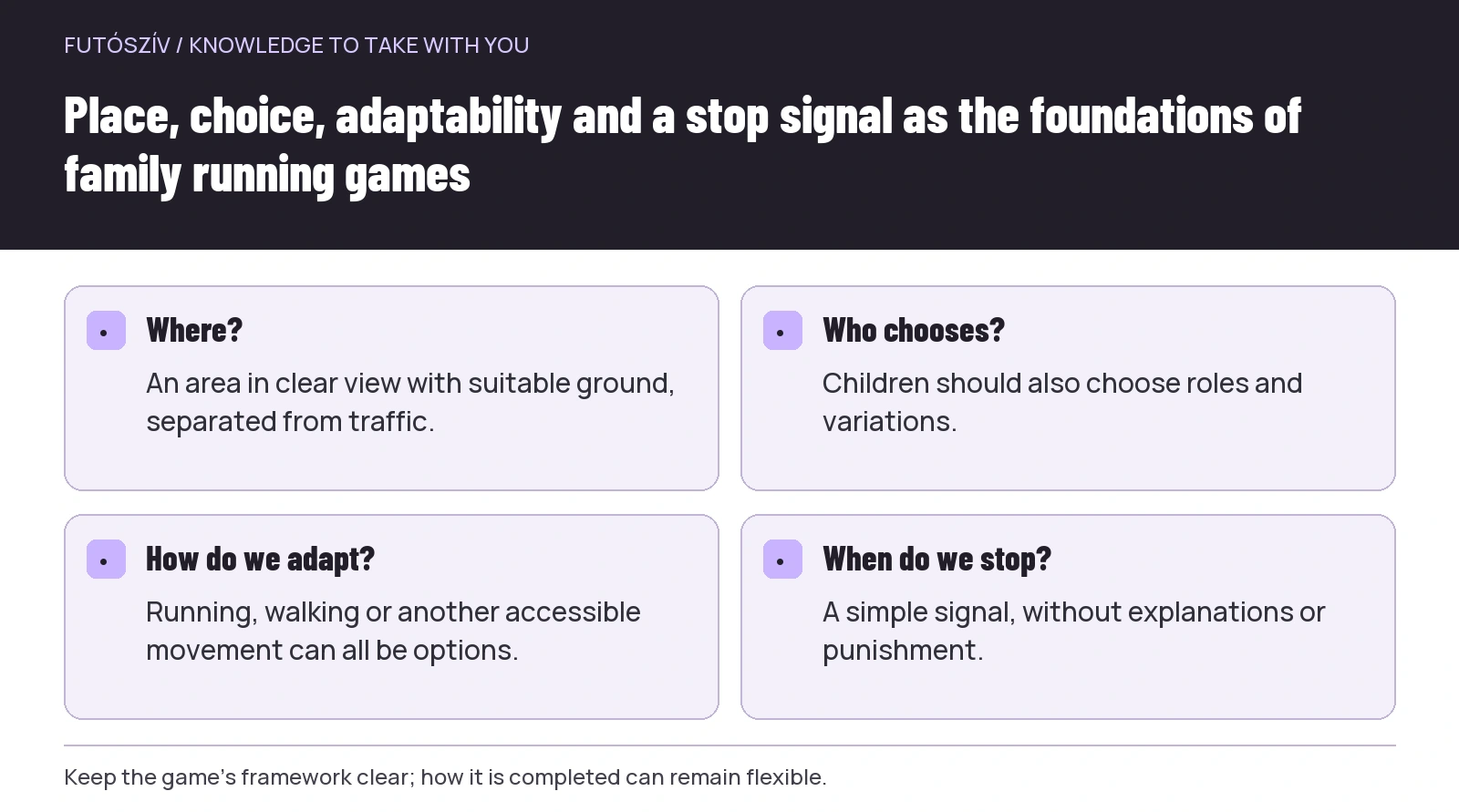
- Where?
- An area in clear view with suitable ground, separated from traffic.
- Who chooses?
- Children should also choose roles and variations.
- How do we adapt?
- Running, walking or another accessible movement can all be options.
- When do we stop?
- A simple signal, without explanations or punishment.
Choose the place before the game
A good place is visible, has boundaries participants understand and avoids constant traffic conflicts. A busy cycle path or car park is unsuitable for tag even with smooth surfacing. Check the ground, gates, corners and places where a child can easily disappear from the adult’s view. The location determines which movements make sense.
Agree a return point and simple stopping signal. Demonstrate them before playing rather than shouting them for the first time while everyone runs. If several adults attend, agree who watches the play area and who accompanies someone needing the toilet or rest. “Everyone will keep an eye out” can easily leave no one considering a specific task their responsibility.
Keep rules short and choices real
A good opening rule is often one sentence: move between the chosen tree and bench, stop at the signal and swap roles after every round. Too many exceptions make explanation dominate before play begins. Add a variation after the first simple round instead. Include children’s ideas where they suit the location and shared framework.
Choice should mean more than two performances pre-approved by adults. Walking, asking for another role or missing a round should be possible. Someone wanting to watch for now does not ruin the family outing. Enthusiasm for movement does not arrive simultaneously for everyone. A calm way to join is much more useful than forcing participation.
Ten games to adapt to your group
1. Colour-finding run
Choose a few colours genuinely visible in the play area. A caller names a colour; the others walk or run to a corresponding point. Nothing needs picking, bringing back or even touching: pointing to the chosen object is enough. The natural setting does not become a collecting course, and participants can choose different distances.
For a variation, seek a shape or sound instead of a colour. One round might involve a round object, another a place where birds can be heard. Swap the caller too, and do not let return order decide whose idea was good. Observation is the central task; running is only one way to explore.
2. A story with stations
Choose three or four nearby stations and invent part of a story at each. The first might be a spaceport, the second a secret library, the third the return home. The story determines movement between them: quiet walking, easy jogging or careful manoeuvring. The task is a story shaped together, not the longest possible route.
If someone tires, they can invent the next chapter at the central point while someone else brings back another idea. Rest then does not mean missing the shared experience. The story can end the game too, rather than a lap still missing on an adult’s watch.
3. Mirror movement
In pairs, one participant shows a slow, simple movement and the other follows. It could be walking, swinging arms, a few easy steps or changing direction inside the area. The leader chooses something followable rather than trying to lose their partner. Swap after short rounds, allowing the child to lead the adult too.
This adapts well to different ways of moving. Partners need not execute exactly the same action; rhythm or direction can be the shared element. Instead of “I will show you properly”, ask how the other person wants to interpret the task. Connection and attention are the goals, not scoring movements.
4. Running post
Carry an imaginary or light, safely portable message between two nearby points. Each round can change what the recipient hears: an animal name, a kind sentence or an invented password. Choose a distance suited to participants without crossing a road. Recipient and messenger roles can swap.
There is no need to find the fastest messenger. The goal might be delivering every message accurately or making a story from them together. Anyone not wanting to travel can invent or receive messages. The group solves a shared task rather than producing one speed ranking.
5. Design your own course
In an area in clear view, plan a simple route together between existing landmarks. The child can choose the next bench or tree. The adult maintains safe use of the location rather than deciding every detail. Do not use markers or objects that obstruct others, or alter a protected environment.
The route can have several versions: a shorter loop, walking or moving in pairs. With a child’s own plan, navigation and discussion become experiences alongside completing it. Afterwards ask which part was best and what they would change. The next outing remains something to shape together.
6. Quiet explorers
After a short movement, stop to notice something you would miss while running. It might be a shadow, bark pattern, distant sound or cloud shape. Stopping is the task, not an interruption. Everyone need not find the same thing, and discoveries need not be compared.
This can suit days when the group wants less excitement too. The adult’s own training belongs on another occasion. A slower rhythm does not reduce the shared outing’s value. Attention and time outdoors can be worthwhile even if few running steps accumulate.
7. A shared treasure map
Draw a simple map of the play area with a few identifiable points. The treasure can be solving a jointly invented puzzle; sweets or rewards need not be hidden. Each station contributes a letter or picture as you follow the route. An observation-based version instead of hidden objects leaves nothing behind.
Make maps at different difficulty levels. Someone may follow the drawing, another use picture cues, while younger children choose directions with an adult. The point is that every participant contributes something. Running speed should not determine access to the next clue.
8. Signal-change loop
Invent three clear signals, for example walking, easy running and stopping. The caller alternates them while others respond within the area. Before starting, check that everyone understands and can perceive the signal. If a visual cue is easier than sound, use a large, recognisable movement or card.
The caller should not deliberately trick people or force mistakes through excessively rapid changes. The game is finding a shared rhythm. Different response times should not cause elimination. If someone needs longer, the group’s rhythm can adapt; it remains play rather than an obedience test.
9. A friendly relay without rankings
On a short, visible section, everyone contributes a journey to a shared completion. No winning team is needed. You might move a symbolic package between stations or let everyone try a manageable role. Section lengths can differ between participants while still forming the common task.
The adult’s job is not to run their section impressively fast. They can demonstrate attentive waiting, making space and enjoying another person’s attempt. Community behaviour can be learned just like a running movement. A good game leaves a slower participant without feeling responsible for spoiling everything.
10. Reverse leadership
The child now chooses among two or three routes the adult has already assessed as safe. They decide when to stop or look around, and the adult follows. This does not surrender boundaries: route-use rules and the shared return point still apply. What changes is that the parent’s watch no longer exclusively determines the rhythm.
On returning, ask what they would keep for next time. The answer may be a place discovered along the way rather than running itself. This is valuable information for the next outing. Family movement often gains a longer-term foundation when the child has their own reason to return.
 Enlarge diagram
Text version of the illustration
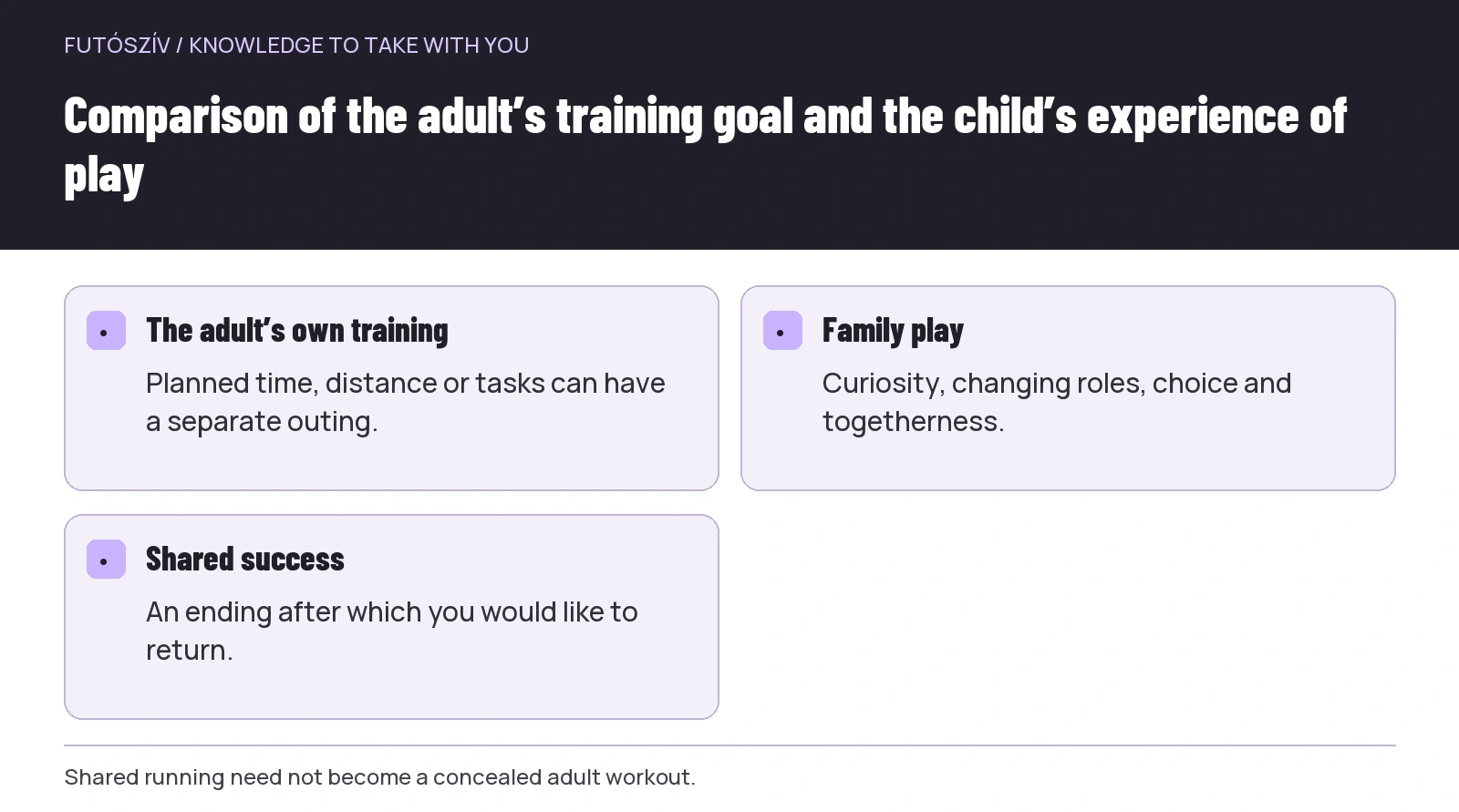
- The adult’s own training
- Planned time, distance or tasks can have a separate outing.
- Family play
- Curiosity, changing roles, choice and togetherness.
- Shared success
- An ending after which you would like to return.
Adapt the game instead of squeezing the child into it
| If this happens | What you can change | What to let go |
|---|---|---|
| Large speed differences | Different section lengths or another role | The same timed lap for everyone |
| Someone dislikes tag | A searching or station-based variation | Forcing participation |
| Too much stimulation | A quieter place, fewer signals and a smaller group | Amplification and constant encouragement |
| A different movement is needed | Several ways to reach the goal | A single “correct” execution |
| The group becomes tired | A shorter loop, changing roles or rest | The distance an adult expected beforehand |
The approach in inclusive athletics guidance also supports adapting the environment, task and communication in family games. You do not need to collect labels for everyone. Ask what would feel good and what is difficult, then adapt to the real answer. A good solution need not be spectacular; it simply makes participation clearer and more accessible.
What to praise instead of a finishing time
Notice something specific: someone waited for a partner, invented a route, asked for rest or helped tidy. Instead of “you are the best”, “choosing a shorter loop was a good idea; it let you go together” shows what you value. Every movement need not be judged aloud; attentive shared time is feedback too.
Competition can have a place if a child wants it, but discuss the shared framework. Every game need not end in rankings, and losing need not prompt a moral lesson. The Kids’ Athletics introductory materials offer activities adaptable to many interests. For a family, the useful one becomes their own outing that they willingly choose again.
A good ending is part of the game
You need not wait until everyone is overtired and irritable. A known ending, tidying together and brief conversation can create a transition. Ask which game they would choose next time, without treating the answer as a binding promise. Mood, weather and company may differ on another day.
Running less than expected can still mean a successful outing. Children’s enthusiasm for movement is not decided in one afternoon, and a parent’s training diary need not turn every shared activity into a numerical target. A family running game works when it leaves personal ideas, good memories and willingness to choose what comes next.
How Futószív articles are prepared: our editorial guidelines.