At a running race, much happens before you start your watch. A late bus, the wrong bag-drop queue or a misunderstood start time will not rewrite your preparation, but can easily distract you from why you came. Good logistics are not a rigid minute-by-minute timetable. They are a few decisions clarified beforehand and some usable backups that leave room for the day to change.
This article concerns organising race day. The food and fluid section is not a personalised diet: specific needs also depend on distance, weather and individual circumstances. The guiding principle is to use tested solutions. The London Marathon Events pre-race guide also recommends practising race-day eating and timing beforehand. It is worth rehearsing the organisation in the same way.
Create a single information sheet early in race week
Do not try to piece the day together from ten screenshots on the tram. Keep the event name, date, your start, number collection and starting-area closing time in one place. Add the exact address and organiser’s current information page. The festival opening, first race start and your own start are not necessarily the same time. Selecting the wrong race invalidates every later calculation.
Write down when you checked the race information too. Schedules, access and bag storage may change; a screenshot saved last year is not a reliable reference. Find the current organiser information once more before the race. A tip in a community group can help but does not replace the official rules for your own event.
Work backwards from the start
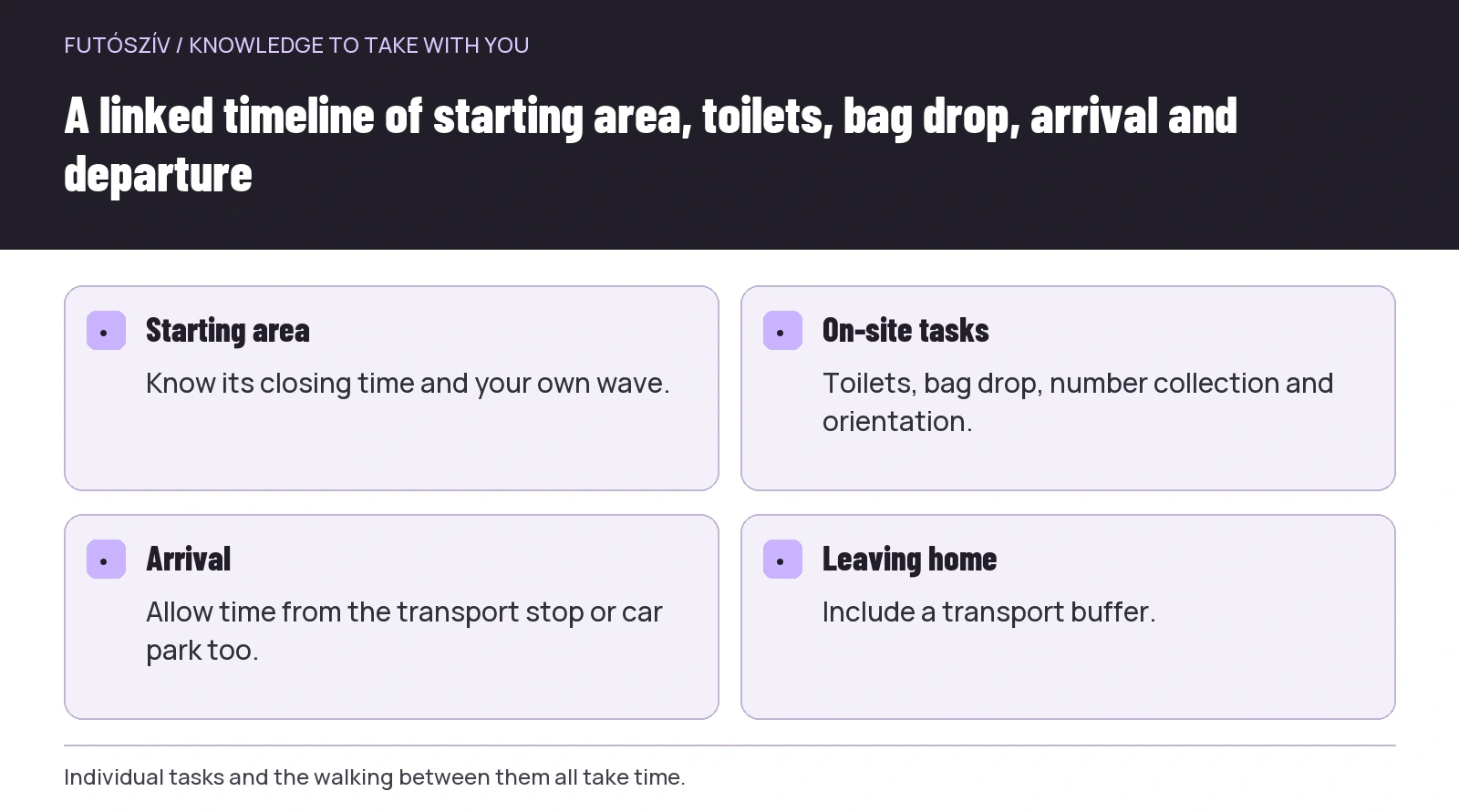
First know when you must be in your place. Working back, allow for walking to the starting area, toilets, bag drop, number collection and arrival at the venue. Finally add travel and getting ready at home. At an event with thousands of participants, even a walk that looks short on a map can take longer among closures and checkpoints.
The timeline below deliberately does not give everyone the same minutes. Fill in your own requirements according to the venue and organiser deadlines. Do not use up your buffer before even leaving; save it for things you genuinely did not anticipate. Arriving early makes finding a calm place easier than catching up with a closed starting area.
| Stage | What do you need to know? | What could be the backup? |
|---|---|---|
| Getting ready at home | Is every piece of equipment in its designated place? | A simpler bag without unnecessary items |
| Travel | Current service, journey time and closures | Another stop or an earlier departure |
| Arrival | How can you approach the race centre? | Another designated pedestrian entrance |
| Race number | Which confirmation and collection window are required? | Collection the previous day, if permitted |
| Bag storage | What size and kind of bag is accepted? | Fewer items or arrangements with a companion |
| Toilets | Where are they, and where do you go next? | Finding your way around the venue earlier |
| Starting area | Your own wave and entry point | Organiser assistance if placement is uncertain |
| After the finish | Where will you get your clothes and meet? | A second meeting place with a separate time |
Breakfast should continue the rehearsal
Race morning is not a kitchen experiment. Choose food and timing already tested before a similar start. If the race starts early, model this with the early alarm once too. Not every weekend run needs a precise race rehearsal, but it helps to know how waking, eating, leaving and later running feel in the same rhythm.
At a guesthouse or hotel, find out beforehand when breakfast is served and whether your familiar food is available. A buffet’s large selection is not necessarily an advantage if everything would be new. If bringing food, consider storage and preparation too. Your own tolerance should guide usual coffee, drinks and food; there is no universal pre-start breakfast for everyone.
 Enlarge diagram
Text version of the illustration
- Starting area
- Know its closing time and your own wave.
- On-site tasks
- Toilets, bag drop, number collection and orientation.
- Arrival
- Allow time from the transport stop or car park too.
- Leaving home
- Include a transport buffer.
Think in three places of use rather than two bags
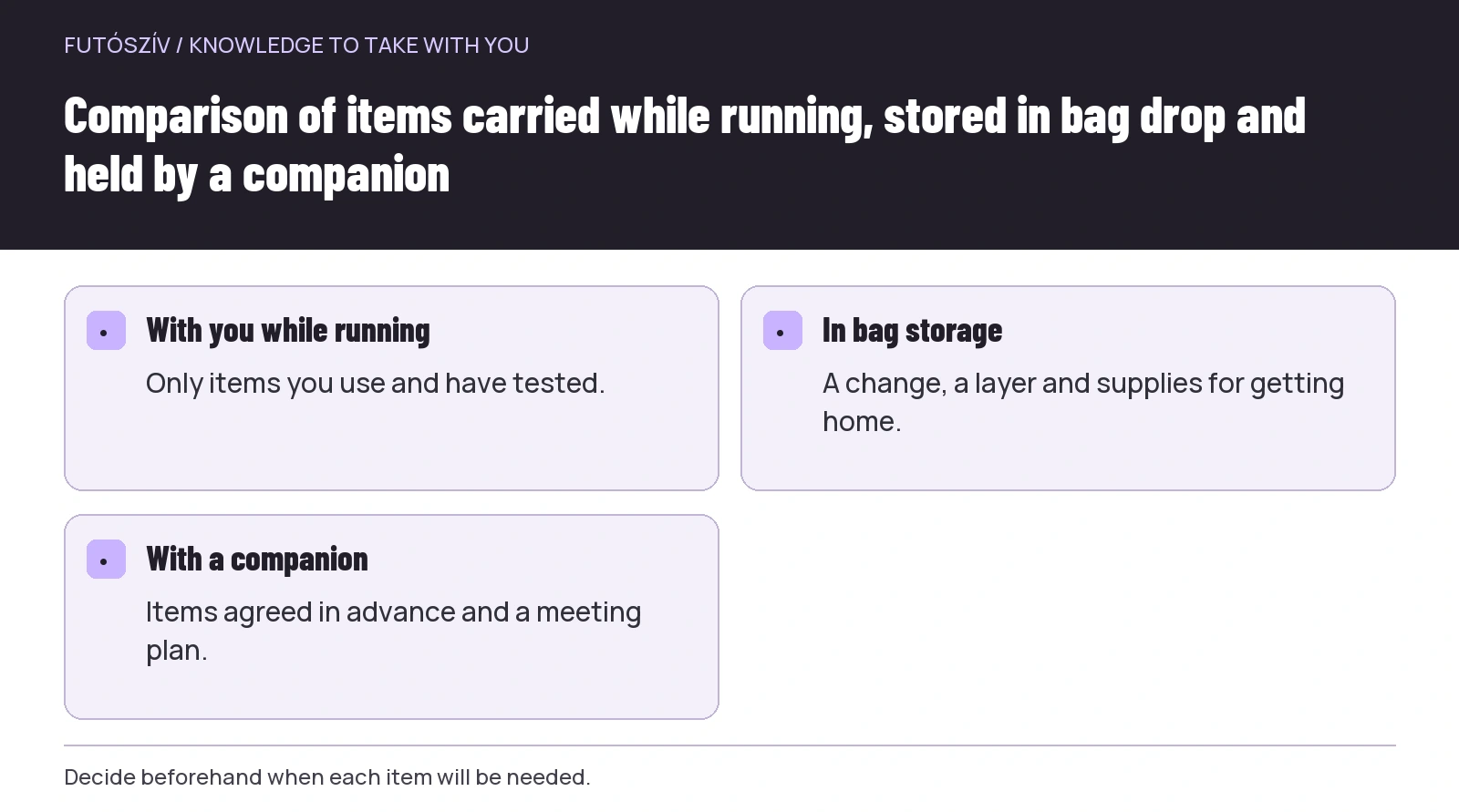
Consider what stays with you while running, what goes into bag storage and what you give a companion. Wear the equipment you carry together in training too. A belt comfortable on a short test can behave differently over hours, while a phone, bottle and fuelling supplies together add different weight. Something needed only after finishing should not occupy unnecessary space during the run.
Pack the stored bag with the journey home in mind too. A dry top, a weather-appropriate layer and a separate bag for wet clothing can help. The organiser’s rules determine bag size, labelling and collection times. The official Vivicittá distance information discusses, for example, race numbers, bag storage and on-site services separately; look for the same sections for your own event.
A car is not always the simplest door-to-door option
On race day, even a nearby car park may be hard to reach, paid, full or on the other side of a closure. Consider more than arrival: can you drive out afterwards, and how far is the walk back? If a companion follows the race elsewhere, agree where the car keys will be too. It seems a small detail until someone needs clothes locked in the boot.
For public transport, check event diversions, transfers and the walk from the stop too. In Budapest, the official BudapestGO information provides a starting point for route planning, but check current service information on the day as well. Plan the return separately: the same service or entrance may not be the most convenient.
Treat race-number collection as a separate task
Check the collection requirements beforehand: confirmation, a QR code, identification or a separate declaration may feature. Saved phone documents should be easy to retrieve; do not search months back through emails at the front of the queue. If a printed copy is required, a screenshot may be insufficient. Prepare according to the wording of the race information.
If someone else will collect for you, check authorisation rules. Some events allow it; others require personal checks. Do not assume it works because it did at another race last year. For a relay team, specify who carries the team number and chip, and who travels to which changeover. A task list recorded in a shared message prevents many misunderstandings.
Toilets, bag drop and warm-up: think in routes
Do not treat these as independent points. If bag storage is far from the start, do not plan to return to it after dropping your bag. If toilets are across the starting area, know how to reach them. The ideal order changes by event, so actually read the venue map. Understanding a few main routes is enough; you need not memorise the whole site.
Pre-start movement should suit the distance and your established routine. A communal warm-up to music does not necessarily serve the same purpose as your own routine before a short race. If there is a long wait in the starting area, arrange a weather-appropriate waiting layer within the rules. Do not guess what to do with discarded clothing: check whether organisers collect it and where it may be left.
 Enlarge diagram
Text version of the illustration
- With you while running
- Only items you use and have tested.
- In bag storage
- A change, a layer and supplies for getting home.
- With a companion
- Items agreed in advance and a meeting plan.
Supporters need a plan too
“We will meet at the finish” is often too vague. Beyond the gantry there may be a fenced finish corridor, medals, refreshments and areas closed to companions. Choose an unmistakable point beyond the exit that is identifiable on a map. A striking sponsor arch may be unhelpful if several identical ones stand nearby. A fixed building entrance or specific landmark is easier to recognise.
Discuss what happens if you arrive outside the expected time. Should a ten-minute difference cause concern, or do wave starts and your own pace already imply a wider range? Which channel will you use if the mobile network is overloaded? Have a later second meeting time and place. This is not a disaster scenario, just a simple answer to taking the wrong exit or a dead phone.
Four common logistical mistakes and how to fix them
You bring too many things. Spare equipment helps, but with something in every pocket it is harder to find what you really need. At the end of packing, say when you will use each item. Anything without an answer can stay at home or your accommodation. A smaller, well-organised bag can bring more calm than a heavy one full of uncertain possibilities.
You take the map’s travel time as guaranteed. Barriers, a closed underpass or crowds can alter walking. Look for the official entrance, not simply the start’s straight-line location. If uncertain, ask an official in good time. A crowd you happen to follow may be heading to another race; do not rely solely on everyone going one way.
The runner handles every task. If arriving with a companion, you can hand over some tasks, but make clear which ones. A companion should not guess which clothing size or fuelling supplies to bring. Specify what you expect and what remains your responsibility. Arriving together is not an automatic logistics agreement.
You forget the period after finishing. At the end of the run, you still need your clothes, companion and transport. Keep moving through the finish in the designated direction rather than stopping there to send messages. If unwell, seek on-site medical help rather than trying to disappear into the crowd alone. An orderly finish also makes celebration more comfortable.
A rehearsal day for two different situations
A short local race. You lay out equipment the night before, prepare at your usual rhythm and choose an earlier service. You do not bring a large stored bag because your companion has the dry top. You mark the meeting point in advance. Reaching the starting area is the day’s main organisational feature; arrange details around it. There is no need to copy all the logistics of an all-day marathon event.
A half marathon involving travel. When booking accommodation, you already check start access, food options and collection times. You avoid filling the previous day with uncertain travel. For race morning, you have a local walking route and leave time after finishing to change before the train home. Your companion supports elsewhere, making the post-finish meeting a separate step agreed beforehand.
A final check that fits on one page
- I checked my own race and start, not the event’s general opening.
- I have the required collection documents and current collection window.
- I know how to get from bag storage to my starting area.
- Food, drink, clothing and carrying arrangements have been tested.
- I planned outward and return journeys separately and checked closures.
- My companion and I agreed a specific place, expected time range and backup meeting.
- Things needed after finishing will be accessible.
- I know where to ask for organiser or medical help if needed.
Race-day organisation works when you barely need to think about it during the run. Not because everything follows the plan precisely, but because important decisions are ready and smaller changes have room. The day’s story can then be shaped more by the route, community and your own running than by a lost bag or misunderstood stop.
How Futószív articles are prepared: our editorial guidelines.