
When entering a first half marathon, the most tempting evidence is usually a successful long run. Once you have covered a substantial distance, it is easy to feel that only a few kilometres remain before race readiness. Actual preparation, however, is not one outing. How you reached that point, what happened over the following days and what your chosen course requires also matter.
The standard half-marathon distance is 21.0975 kilometres. The World Athletics introduction emphasises gradually developing the endurance needed for longer runs. This does not establish a universal entry threshold. No single session, number of hours or app reading can reliably determine that every condition for your first half marathon has been met.
Do not let the race date write the training plan alone
Starting alongside friends or earning a special medal can provide strong motivation. A deadline still does not replace a missing foundation. Look at how much genuinely usable time remains before the race. Subtract longer trips, busy periods at work, uncertain family commitments and the fact that the final days are not for catching up on major gaps. This does not make the plan less ambitious; it makes it more accurate.
Think with two dates: the race you have in mind and a later backup. Not every decision then has to rescue the first start. If progress is slower than expected, the goal can remain while its date changes. This is especially useful before a first longer race, when you have less personal experience from which to plan.
Look for the recent pattern
The question is not how long your longest run was, but whether your recent routine was repeatable. Did manageable weeks follow one another? Could you leave easy days easy? Was there room around longer outings? If your weekly summary regularly shows two entirely missed days followed by a forced big run, change that structure first.
Kilometres alone do not tell the whole story. The same distance can mean different work on flat roads or with substantial climbing, when rested or after a night shift. Preserve the circumstances of the effort in your diary too. Do not turn them into a complicated score unless it helps. A few consistent notes can reveal what you respond to well and what regularly costs too much.
Assess recovery through everyday life too
A long run can look successful on the screen while the rest of the week falls apart afterwards. Consider sleep, how you feel about the next activity and how much fatigue interferes with work or everyday travel. These are not diagnostic tests, but signals the distance reading does not show. Repeated or unusual symptoms need professional assessment.
The aim is not for a long run to leave no trace whatsoever. The useful question is whether its consequences are predictable and manageable. If you repeatedly get through them only with coffee, pain relief or skipping the next session, it is not simply a willpower problem. The plan may need changing. Do not start solving the remaining time before race day by adding more work.
 Enlarge diagram
Text version of the illustration
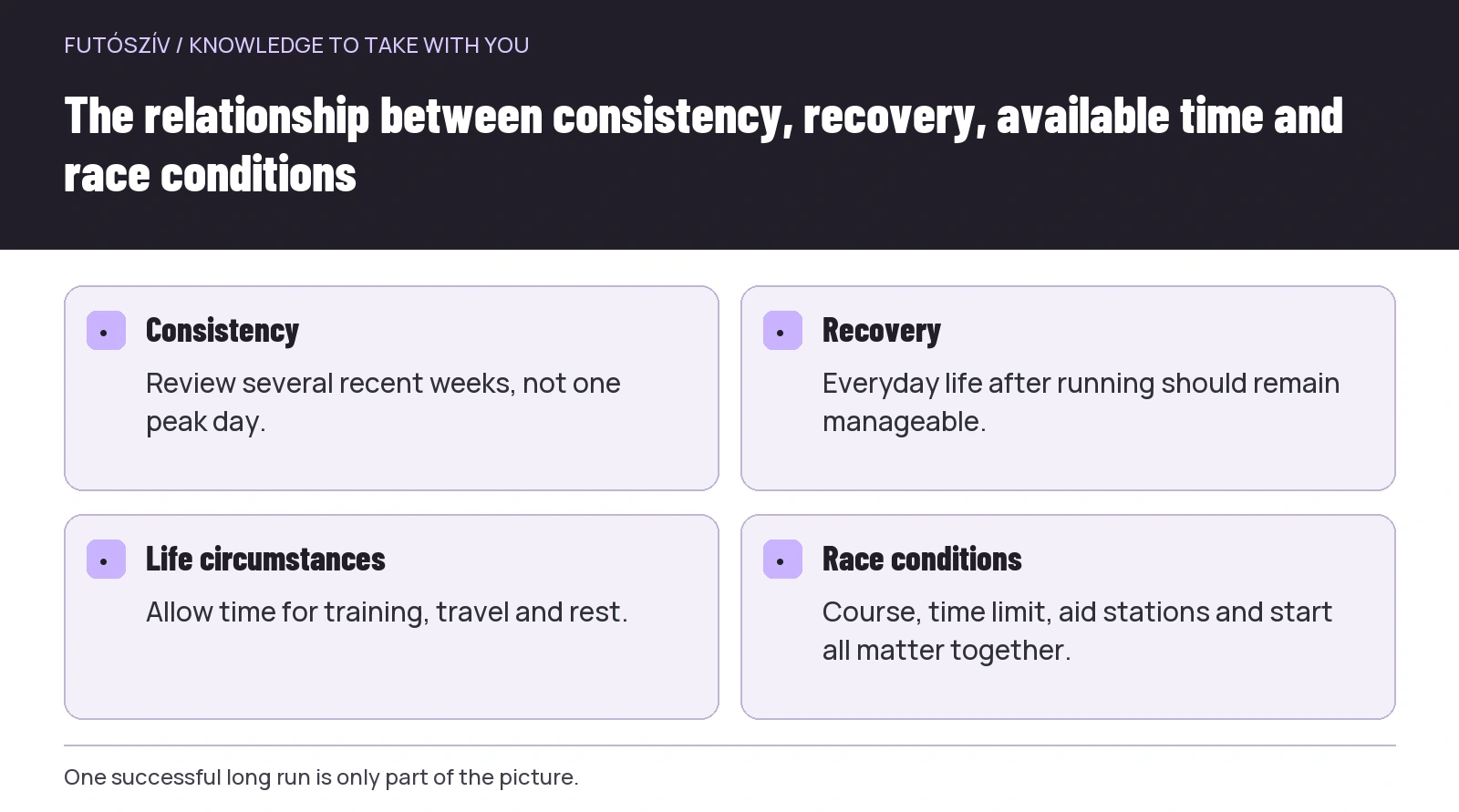
- Consistency
- Review several recent weeks, not one peak day.
- Recovery
- Everyday life after running should remain manageable.
- Life circumstances
- Allow time for training, travel and rest.
- Race conditions
- Course, time limit, aid stations and start all matter together.
A readiness map: twelve questions instead of one magic number
| Consideration | A useful sign | A situation to clarify |
|---|---|---|
| Training rhythm | A repeatable structure followed for several weeks | Frequent gaps and rushed attempts to catch up |
| Easy runs | You can exercise with restraint | Every outing has become a performance test |
| Longer activity | You have gradually built personal experience | You draw conclusions from one large jump |
| Next-day condition | The effort fits into the week | Fatigue regularly disrupts everything |
| Symptoms | You know the limits discussed with a professional | You try to suppress new or recurring symptoms |
| Fuelling and hydration | You have practised carrying and consuming supplies | Everything will be with you for the first time on race day |
| Equipment | Chosen shoes and clothes have worked on longer outings | You are saving new kit for the race |
| Course | You know the elevation, surfaces and turnarounds | You have checked only the distance |
| Time limit | You have compared it with your expected time | You assume everyone will be waited for |
| Travel | You have a manageable arrival and return plan | Even the night before the start is uncertain |
| Social support | You have agreed on your own pace and meeting arrangements | You feel bound to other people’s results |
| Backup goal | There is a later start or shorter event | Starting at any cost is the only acceptable option |
This table is not a medical fitness assessment or a points-based permission to start. It makes uncertain areas visible. Three unanswered questions might become three achievable tasks: reading the race information, visiting the starting area or discussing exercise demands with a professional. A specific question is easier to manage than the vague feeling that “perhaps I am not good enough”.
Completing the distance and meeting the time limit are separate questions
You may be able to keep moving for a long time at your own rhythm, yet that rhythm may not fit a race’s closure time. The information for one BSI half marathon specifies, for example, a net time limit and starting areas. Always check the exact value for your own current event rather than carrying it over from another year or distance. Intermediate checkpoint deadlines may matter too.
Calculate the full average of your planned run–walk strategy, not only the speed of running sections. Regular walking, aid-station stops and photos all take time. Walking before the start and after the finish may add to time on the route. When choosing an event, a supportive time allowance can matter as much as the entry fee or medal.
Fuelling: practise the process before choosing the product
Before your first half marathon, ask more than which gel to buy. Fuelling involves several actions: how you carry supplies, where you reach them, whether you can open them, how you consume them and where the packaging goes. Time on course, weather and your own tolerance matter too. A sports dietitian can help with an individual quantity plan; this article provides no universal dosage.
Test the particular approach during preparation. If carrying a bottle in a belt, does it chafe over longer periods? If relying on an organiser’s product, do you know exactly what stations will provide? If you cannot tolerate something, do you have your own alternative? A usable plan works beyond normal circumstances: a slower kilometre or awkward handover should not require improvising everything.
Look beyond the course’s name to the actual task
An urban half marathon may include a bridge, riverside wind, many bends or a long sun-exposed stretch. A trail half-marathon distance may represent a very different time commitment because of climbing and technical sections. If you have run only in a flat, shaded park, the race’s different surroundings are a separate preparation task. Do not discover in the final week that the intended course is unlike your usual running.
Read the map as a story. Where can supporters see the field again? After which bridge is an aid station? Where do you turn if two distances start together? You do not need every street name. A few important points can stop the half marathon feeling like an endless, unknown task. Knowing the route can also turn anxiety into specific questions.
 Enlarge diagram
Text version of the illustration
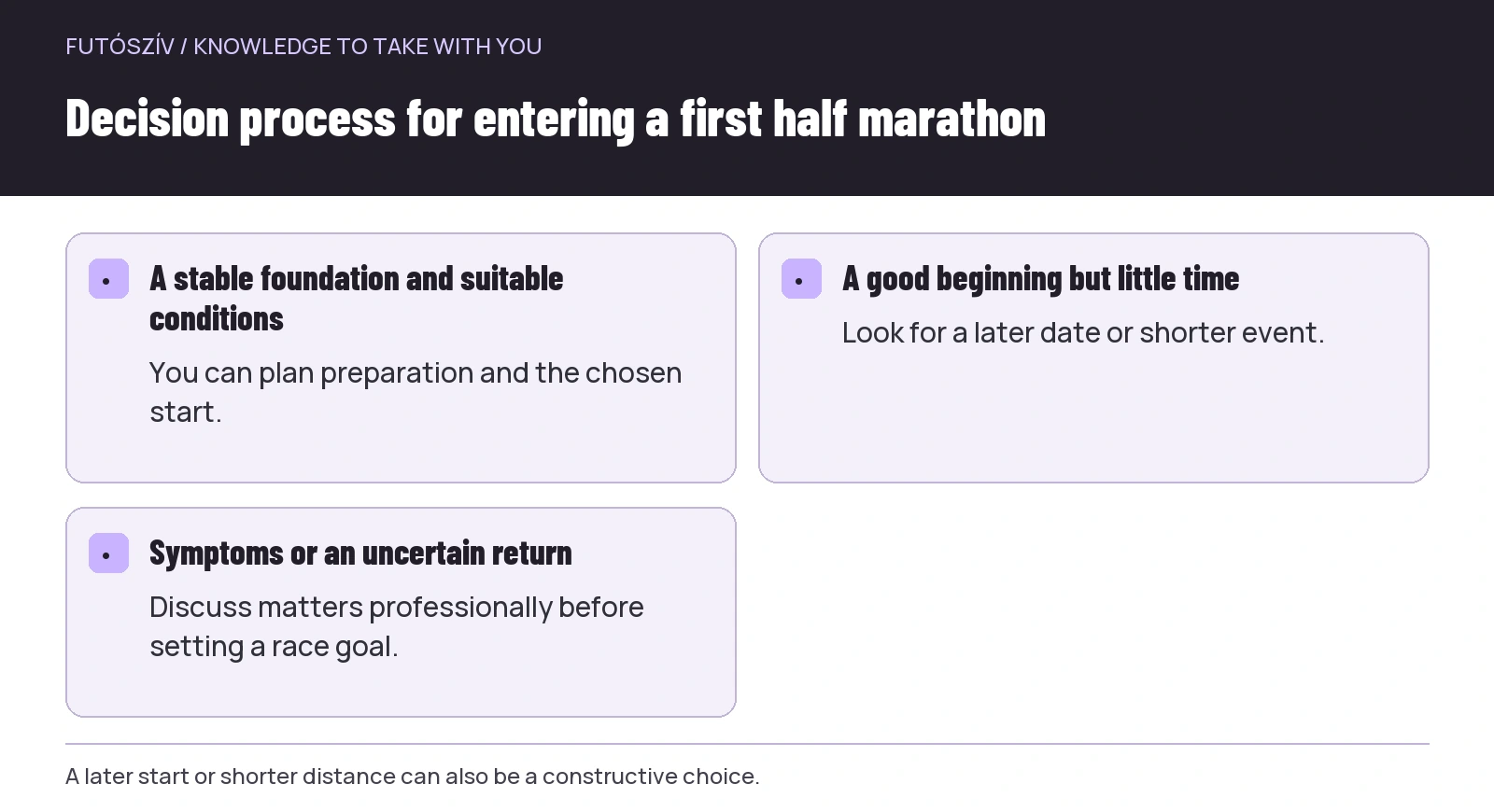
- A stable foundation and suitable conditions
- You can plan preparation and the chosen start.
- A good beginning but little time
- Look for a later date or shorter event.
- Symptoms or an uncertain return
- Discuss matters professionally before setting a race goal.
Three entrants, three different sound decisions
The regular runner with little time. Ten-kilometre runs go well, but the next month is full of work and travel. A half-marathon goal may be realistic later; at present there is no room for preparation. Staying with the shorter event and choosing a date that does not require temporarily setting everything else aside is a good decision. You can build your existing foundation rather than use it up.
The enthusiastic beginner who went far once. A friendly running excursion covered almost a half marathon, but included long breaks. This is a valuable experience, yet different from a race with a time limit. First broaden your experience of regular weeks and an outing treated as a complete period of activity. Entry can remain a later goal while you interpret the present experience accurately.
The returning runner. You have completed long races before but now want to return after injury or illness. An old medal does not establish current capacity. Clarifying the return with a professional matters more than approaching an old result. The task may be rebuilding stable, easy activity, with a half-marathon date set later.
What if you miss several sessions?
A missed outing is not a debt to repay with interest in extra running. The London Marathon medical guide specifically advises against making up miles lost through illness. Although written for a marathon setting, its message matters here too: squeezing more running into less time does not make a planned load safe.
After missed training, reassess why it happened, how long the gap lasted and how you feel now. A busy weekend differs from an illness with symptoms. Choose the next step accordingly, with a coach or healthcare professional where needed. Keeping, changing or letting go of the target race can all be well-founded outcomes.
A short worksheet before entering
Write the chosen event’s name, date and the day you checked its information. Add the course type, time limit, your planned way of completing it and the few everyday conditions preparation needs. For example, do you need childcare for longer outings, can you sleep adequately before travelling and is there room to test clothing or fuelling?
Then choose the next three achievable tasks. These might include reading the race information, a professional discussion, observing an easy run on a familiar route or planning race-day travel. Do not write twenty new obligations at once. Readiness becomes tangible when you can see which missing conditions you can create and which suggest changing the date.
The aim of a good first half marathon
For a first attempt, choosing a day with room to learn can be especially valuable. Discover how long pre-start waiting feels, how fuelling sits and what the second half of the distance feels like. Alongside the time result, these experiences lay the foundation for the next race. Everything need not fit into a single debut.
Realistic readiness does not mean perfection. It means having answers from personal experience to the main questions, recognising uncertain areas and keeping flexibility in your decisions. If the appropriate next step is a later half marathon or a calmer ten-kilometre event, your long-term goal has not become smaller. The route towards it has become better grounded.
How Futószív articles are prepared: our editorial guidelines.