Before your first five kilometres, it is easy to look for answers to the wrong questions. How fast do I need to be? How many weeks should it take? What will people think if I walk? Instead, clarify what kind of outing you would still consider a good decision the following day. Your first completion does not require matching an imaginary middle of the field. You need a process that fits your life and helps you get to know your own movement.
This guide focuses on completing five kilometres without a time target. The practical examples are planning models, not a personalised training plan. If you have a health question before starting, are returning from injury or develop symptoms with activity, discuss it with a professional. Not everyone starts with the same balance of comfortable walking and short jogging.
First, define what completing it means to you
“I will run five kilometres” can mean different commitments. It might mean continuous jogging, planned run–walk alternation or completing an event while deciding how to move from beginning to end. Choose one at the start of your preparation. Discovering only at the start line that you regard walking as failure puts unnecessary pressure on a day that could otherwise go well.
Write a sentence with no speed requirement. For example: “I want to cover five kilometres on a familiar route, walking when needed.” Then add a second goal: leaving without rushing, finding comfortable clothing or learning to start steadily. Your goal becomes more than a number on an app screen while remaining clearly assessable.
Thirty minutes and five kilometres are different things
The NHS beginner programme starts by alternating running and walking, uses three weekly sessions with rest days between them and allows its nine-week programme to take longer. Its later goal is thirty minutes of continuous running. This does not mean everyone must complete five kilometres in half an hour. Programme duration and race distance are separate measures.
For example, someone averaging eight minutes per kilometre takes forty minutes for five kilometres. If running and walking together average ten-minute kilometres, five kilometres takes fifty minutes. These are simple calculations, not recommended paces. They help you avoid feeling behind simply because half an hour of activity covers a shorter distance. Plan the time needed from your own experience.
| What you observe | What does it tell you? | What does it not tell you? |
|---|---|---|
| Time spent moving | Does the outing fit into your day? | How fast must you be compared with others? |
| Distance covered | Are you approaching the end of your chosen route? | Did the effort feel good? |
| Run–walk ratio | How can you keep moving? | What is your achievement worth? |
| How you feel the next day | How manageable was the outing? | Is there a definite diagnosis behind any symptom? |
Choose a route that works with you
For your first practice location, predictability matters more than a spectacular elevation profile. Look for a clear surface, few road crossings and an option to finish early. A short park loop is convenient because you do not have far to return if you tire or rain starts. On an out-and-back route, know your turning point before leaving; otherwise an easy outward stretch can leave a long walk home.
Try walking the location at the time you will actually run. A pavement quiet on Sunday morning may be crowded before school on weekdays. A pleasant after-work park may be dark in winter. Check toilets, drinking water and your journey home too, without turning a short session into an equipment expedition. A good beginner location is easy to reach, understandable and does not force you to race.
 Enlarge diagram
Text version of the illustration
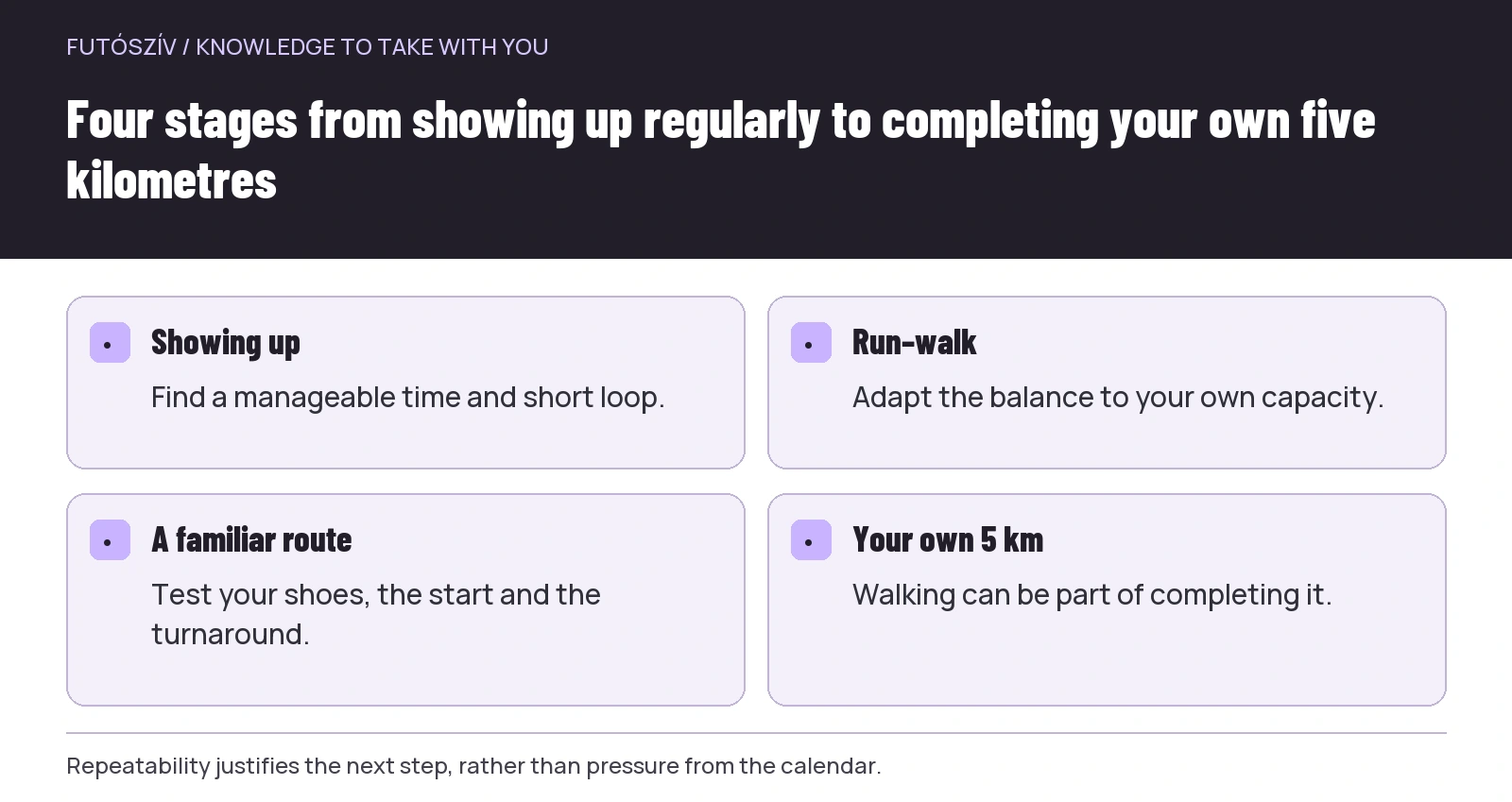
- Showing up
- Find a manageable time and short loop.
- Run–walk
- Adapt the balance to your own capacity.
- A familiar route
- Test your shoes, the start and the turnaround.
- Your own 5 km
- Walking can be part of completing it.
Run–walk is a tool chosen in advance
If you allow yourself to walk only when completely exhausted, it can easily feel like punishment. It is different when you decide at the start that comfortable walks will separate short jogs. Switching then becomes part of the task. You do not need to prove your determination, solve your breathing and win an imaginary race simultaneously.
Choose an easy-to-follow cue. It might be a watch beep, a familiar landmark or a beginner programme’s audio. Exact metres should not be the first priority. Adjusting a walking section for a narrow pavement, crossing or hill does not ruin the session. Adapting to your surroundings is part of running knowledge just as much as knowing when to start again.
Sections intended to be easy should leave room for comfortable communication. The CDC intensity guidance uses the talk test as a simple reference. This is not a laboratory measurement and does not replace health assessment. For beginners, it is a useful reminder not to let a watch number force ever harder work while the sensation of moving tells a different story.
In the first weeks, consistency is also a planning matter
Look at your calendar before choosing the number of sessions. If you have only two predictable slots, do not spend every week guiltily squeezing in a three-session programme’s third day. Seek a structure you can actually follow, with a coach’s help if needed. Fatigue from work, caring responsibilities, little sleep and travel is also part of the week in which you want to run.
Sort out the details that help you leave the night before: accessible shoes, a charged phone, a simple clothing choice and somewhere for your keys. Ten minutes of preparation easily becomes half an hour when something is always missing. Establishing a habit does not require an athlete’s ready-for-anything identity. It is enough to reach a specific place on a specific day and afterwards note how it went.
| Everyday obstacle | A useful response | What usually complicates it further |
|---|---|---|
| You arrive home late | A short, lit loop chosen in advance | Reorganising the entire session in a late-evening rush |
| You miss an outing | Returning at the next manageable opportunity | Combining two sessions as punishment |
| You are uncertain on a new route | Walking it first | Trying an unfamiliar dark section when tired |
| The watch says you are slow | Checking how movement feels and the route conditions | Speeding up solely because of the display |
| You do not know whether you are progressing | Comparing experiences of the same easy session | Turning every run into a maximal test |
When does the next step make sense?
At the end of the first few weeks, do not ask whether you could squeeze out a bigger performance. Ask whether the current task is repeatable. Can you finish without the next outing feeling daunting? Can you start with restraint? Do you know which hill is worth walking? These answers are more useful than a single heroic kilometre.
Where possible, change one decision at a time. On a new route, do not insist on a new distance and faster pace as well. When increasing time spent moving, the terrain can remain simple and familiar. This is a planning principle, not a universal training-load formula. No percentage rule automatically answers correctly for every person and every week.
Three common situations, three different plans
The enthusiastic returner. You used to run, so the first outing feels surprisingly easy. However, past results do not describe your present capacity precisely. Spend a few outings observing repeatability rather than immediately returning to your old race pace. A good first day can be encouraging without needing new goals built on it straight away.
The beginner who walks a lot. You are used to long walks, yet jogging soon feels hard. This is not a contradiction: you are learning a different activity. Keep walking as a valuable element and treat running sections as a new skill. If you already walk five kilometres comfortably, organising completion of the route is familiar; what changes now is how you move.
The person joining for company. Your friends have entered an event and you want to be with them. Agree whether you will run together or simply arrive together and meet at the finish. Both can work equally well. Misunderstandings arise when they call something conversational pace that is hard work throughout for you, and you stay silent out of politeness.
 Enlarge diagram
Text version of the illustration
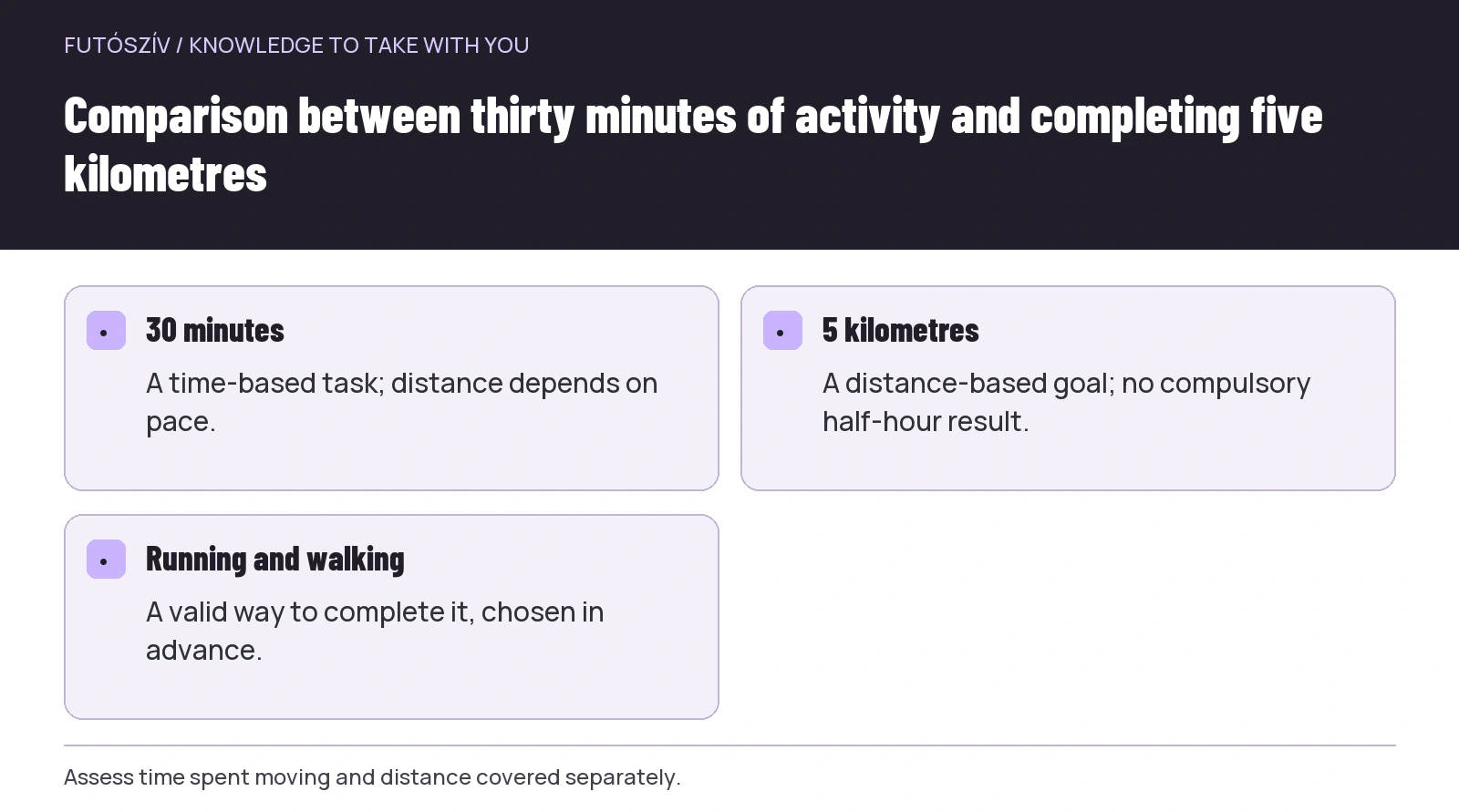
- 30 minutes
- A time-based task; distance depends on pace.
- 5 kilometres
- A distance-based goal; no compulsory half-hour result.
- Running and walking
- A valid way to complete it, chosen in advance.
Choosing your first event
If you want to complete five kilometres at an organised event, read the race information as well as watching the appealing video. Is there a time limit? Is walking accepted? What are the surface and elevation gain? Where is the start, and how far must you walk from bag storage? “Beginner-friendly” is useful only when supported by specific conditions.
Choose a start area based on your current expected progress, not a dream pace. If you cannot estimate your time, ask the organiser for guidance on placement. You do not need to stand at the very front to be a full participant. A calmer start leaves more room to settle into your own movement, with less overtaking around you.
A race-day practice checklist
- The day before: find your race number, safety pins or holder, travel plan and post-finish clothing. Testing new equipment belongs on another occasion.
- On arrival: find your own race, the toilets and bag storage. In a crowd, even short distances can take longer.
- Before the start: have a simple sentence for the opening section, such as “I will start easily and keep the planned walks.” Do not invent a new strategy now.
- On the course: look around before switching to walking and move predictably to the side. Do not stop suddenly in the middle of the running corridor.
- After the finish: keep moving to the exit, meet companions at an agreed place and only then look for photos or check your watch.
What to put in your diary instead of kilometres
Three short sentences often preserve more lessons than many data fields. What helped you leave? Where did moving become harder? What would you change next time? For example: “Having clothes laid out helped. I went too fast with the group on the first loop. Next time I will choose a separate pace from the start.” This is a specific observation that leads to a useful decision.
Break a bad day into details too. Uncomfortable breathing, an overcrowded route and simply not wanting to run with others are different issues. The verdict “this is not for me” offers the same answer to every problem: stop. An accurate description may instead reveal a smaller adjustment. Of course, do not try to diagnose symptoms through journalling; assessment is a separate task.
Do not rush what follows your first five kilometres
Completing the distance does not make a ten-kilometre entry compulsory. First, repeat the same distance, find another route or simply keep the weekly rhythm that has worked so far. Running can be a regular half-hour outdoors, a social meeting or an independent outing. A new distance is a good goal only if you want it and the work leading there has room in your life.
The most important result of your first five kilometres is not a hidden classification of what kind of runner you are. It is a few reliable answers: how to get started, how to choose effort, when to walk, where you feel comfortable and whom you enjoy moving with. You can take these experiences to the next outing even if the watch shows a completely different number.
How Futószív articles are prepared: our editorial guidelines.