Sometimes the same running loop feels easy one week and unusually difficult the next. If disrupted sleep, hot flushes, a changing cycle or new physical symptoms come with it, a stricter training plan is not necessarily the next useful step. Around perimenopause, both structure and flexibility matter: take changes seriously while preserving the enjoyment of movement.
This article provides general health information, not an individual diagnosis. Menopause is not the cause of every episode of tiredness, palpitations, abnormal bleeding or pain. New, severe or persistent symptoms need medical attention; treatment choices and personal exercise demands depend on your health background.
First, clarify the terms
Perimenopause is the transition leading up to menopause, during which your cycle and symptoms can change. Menopause is generally defined by twelve consecutive months without a period, although hormonal contraception or certain treatments can make this harder to assess. The NHS information emphasises that experiences can vary considerably.
For running, this leads to two important planning principles. First, the same training prescription should not be applied to every woman of a similar age. Second, a calendar previously organised around a predictable cycle may become less reliable. Observing current symptoms and demands may help more than rigidly assigning “good” and “bad” weeks in advance.
Social media often presents a few catchy rules as a complete lifestyle programme. Examine the source of a claim, whom it is intended for and whether it can genuinely be tailored to an individual. Your sporting history, work, sleep and any health conditions cannot fit into a single short video.
Treat sleep as real planning information
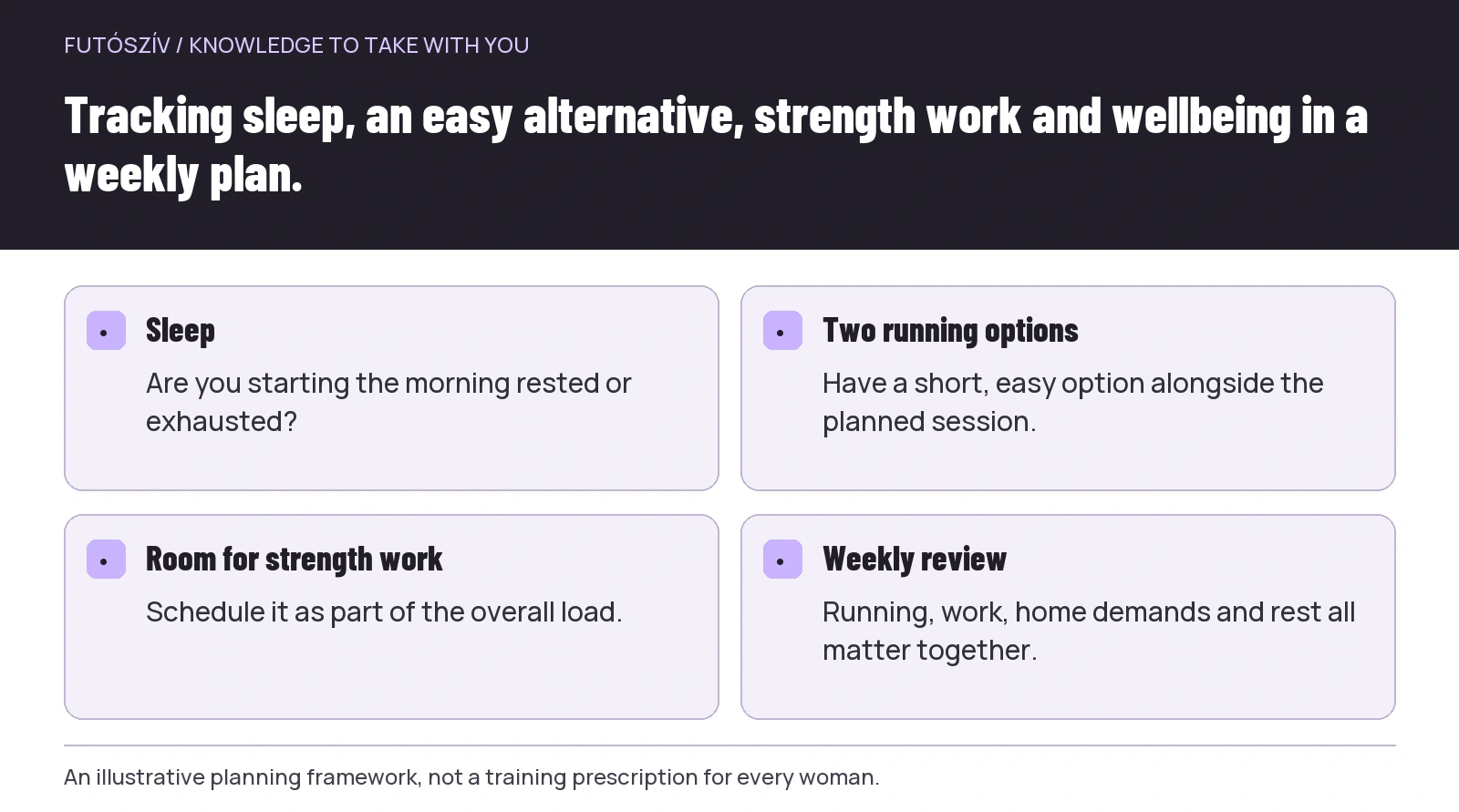
If nights are fragmented, you arrive at morning exercise with a different starting point. You do not need an elaborate sleep score in your diary: simply note whether you woke feeling rested, somewhere in between or exhausted. If your sports watch’s assessment differs greatly from how you feel, do not believe only the display.
Prepare two versions of the more important running days. One is the planned session, the other a short, easy alternative. After a poor night’s sleep, the choice is already prepared. You do not need to decide while putting on your shoes whether to do everything or consider the entire week a failure. Options in between make the routine more flexible.
The NHS lifestyle guidance also highlights regular rest and sleep habits. Seek help if sleep problems persistently affect your days. Running can be a supportive habit, but it is not a compulsory tool for “fixing” every bad night by yourself.
Why give strength work a place in your calendar?
Running programmes often fill every free time slot with kilometres. Around the menopause years, it is also worth making room for activity that targets muscular strength. The NHS considers weight-bearing and resistance exercise important for bones too, while the WHO general recommendations also include strengthening the major muscle groups.
This does not automatically mean a jumping or heavy-weight programme for everyone. With a previous fracture, known osteoporosis, pain or another health circumstance, choose exercises and loads with a professional. An appropriate starting level can be very simple and focused on learning technique.
As a practical starting point, even a short, easy-to-follow session can help establish the habit. Choose a place and equipment you will actually use. If you work with a coach, describe your running week too: view strength work and running as the total demands on the same person rather than as separate programmes.
 Enlarge diagram
Text version of the illustration
- Sleep
- Are you starting the morning rested or exhausted?
- Two running options
- Have a short, easy option alongside the planned session.
- Room for strength work
- Schedule it as part of the overall load.
- Weekly review
- Running, work, home demands and rest all matter together.
Hot flushes and hot weather are different, but can coincide
Hot flushes can be unpredictable, making adjustable clothing a practical advantage. Choose a layer you can easily open or put away, and consider where you can stop. Shade, water and the option to shorten the outing also contribute to a comfortable route.
You can schedule running for the time when you generally feel better. This is a planning decision based on observation, not a universal hormonal rule. If an early start takes too much away from sleep, another time may work better. If evening running feels uncomfortable, try a shorter or earlier version.
The RCOG patient information describes several treatment and lifestyle options for symptoms. You do not have to assume that changing exercise is the only way to address hot flushes. If symptoms interfere with everyday life, ask about your individual options.
Make an easy day genuinely easy
An easy run does not need to match your old “good day” pace. You can choose a flat loop, a shorter duration or planned walking breaks. If every session is judged against a past record, it becomes difficult to recognise what currently works well.
In a flexible weekly plan, harder tasks can move. If you are exhausted on Monday, you do not have to run more on Tuesday as punishment. Look at the whole week: the amount of running and strength work, workplace and home demands, and where room remains for rest. One missed task rarely tells the whole story of preparation.
Tell a running group what you need without having to share your entire health history. Saying that you want a comfortable loop with an option to cut it short today may be enough. In a good group, changing pace does not require a personal explanation.
Nutrition: eating less should not be the automatic response
When your body changes, it is easy to respond with more exercise and stricter eating. Yet the energy demands of running and strength work do not disappear because you have reached a new life stage. The IOC summary on REDs warns about the health and performance consequences of persistently inadequate energy availability, in women and men alike.
In practical terms, check whether you eat regularly, have food around sessions and avoid postponing the first substantial meal of the day too long. If eating has become constant calculation, anxiety or guilt, seek dietetic and, where needed, psychological support that considers sport and health together.
Do not choose supplements on the strength of catchy promises to “balance hormones”. Assessing deficiencies, necessary tests and appropriate supplementation are individual matters. Do not start iron or a high-dose product simply because your running pace has declined. Fatigue can have several causes.
Pelvic floor: common symptoms still deserve help
Urine leakage, pressure or pelvic pain while running need not be accepted as the inevitable price of sport. The NHS treatment information describes pelvic-floor training based on individual assessment and other treatment options. The appropriate approach depends on the type of symptom.
A loop close to toilets may temporarily make running more comfortable, but it does not replace assessment. Do not use excessive fluid restriction as a self-directed “solution” either. Ask for specific advice on suitable activity, exercises and progression for you.
Tell the physiotherapist when the symptom occurs: at the start of running, after longer periods, downhill, when coughing or in another situation. Accurate observation is more useful than the general explanation “my core is weak”. Do not diagnose yourself from social media videos.
 Enlarge diagram
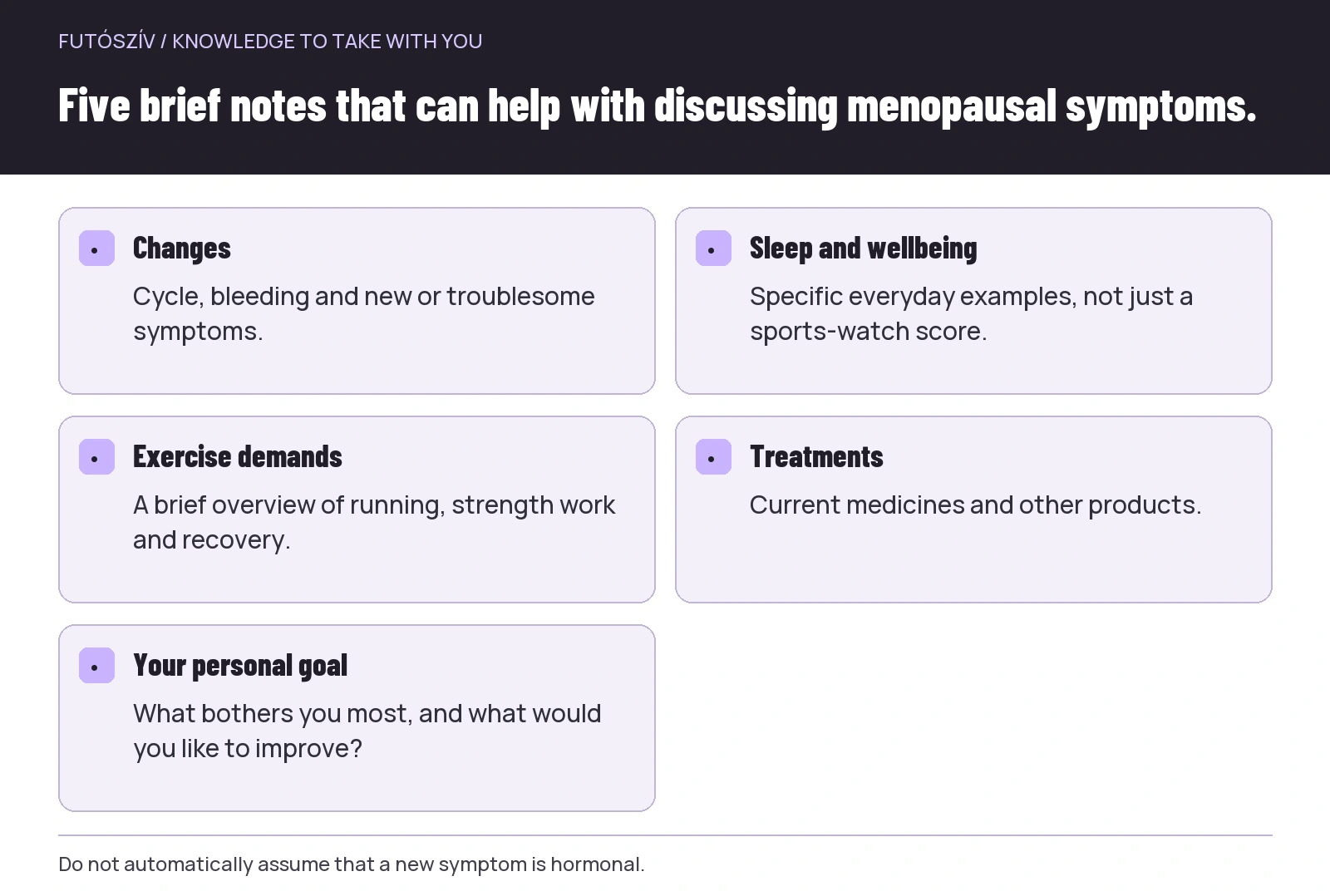
Text version of the illustration
- Changes
- Cycle, bleeding and new or troublesome symptoms.
- Sleep and wellbeing
- Specific everyday examples, not just a sports-watch score.
- Exercise demands
- A brief overview of running, strength work and recovery.
- Treatments
- Current medicines and other products.
- Your personal goal
- What bothers you most, and what would you like to improve?
What not to attribute automatically to menopause
According to the NHS , vaginal bleeding after menopause must be checked even if there is only a little or it happens just once. Unexpected bleeding is not training data. Similarly, new chest pain, fainting or severe breathlessness may be an urgent medical situation; call 112 in immediate danger.
Speak to a doctor if bleeding is unusually heavy or changes, if you are persistently exhausted or if you develop new palpitations. The NHS symptom information also advises a consultation for these changes. The aim is not to treat every small performance fluctuation as illness, but to avoid overlooking an important new sign.
How to prepare for a consultation
Bring brief notes covering a few weeks. They can include changes in your cycle or bleeding, sleep, troublesome symptoms, the amount of running and strength work, and current medicines. Describe what bothers you most in everyday life. “I do not feel like my old self” is an important experience, but specific examples make it easier to plan a next step together.
The NICE menopause guideline emphasises individual, shared decisions about treatment options. The benefits and risks of hormone therapy need discussion in the context of your own background. The hope of improving running performance alone is not a reason to start or stop treatment by yourself.
Ask when follow-up is expected, what to observe and which changes mean getting in touch sooner. Follow-up helps ensure that symptom management and sport do not become two isolated stories.
A week with room to adapt
As an editorial example, you might consider two easy runs, a longer outing adaptable to how you feel and time reserved for strength work. This is not a personal training plan: adjust the number of days and the demands to your own history. Have a shorter, easier version beside every more important day.
At the end of the week, total more than kilometres. Review how manageable the routine was, which time of day helped and which symptoms need further attention. Progress can also mean recognising your capacity better, making strength work more regular or seeking timely help for a problem that can be addressed.
Before follow-up, describe what you would like to regain: more settled sleep, more comfortable everyday life or more predictable exercise. The discussion then concerns the situations that matter to you, rather than a single running pace.
Sources and editorial note
This article draws on the primary information from the NHS, RCOG, NICE, IOC and WHO linked above. The weekly planning and diary examples are our own editorial suggestions. We do not promise that running will eliminate menopausal symptoms, and we do not replace individual care. Sources checked: 18 November 2026.
How Futószív articles are prepared: our editorial guidelines.