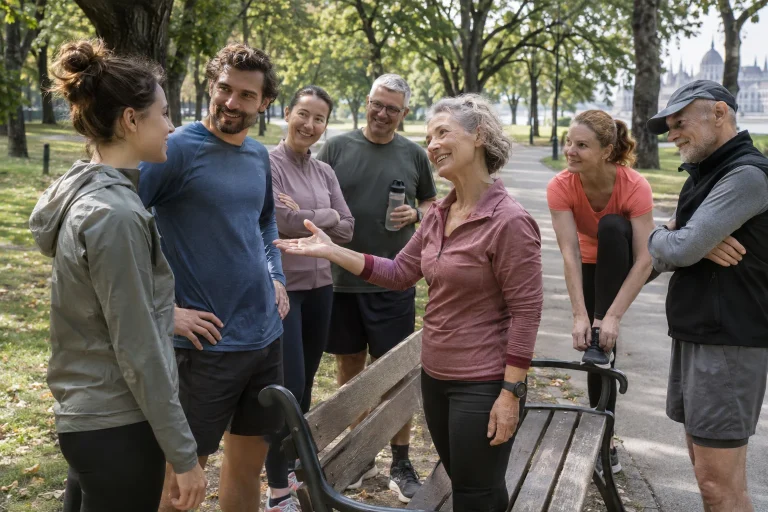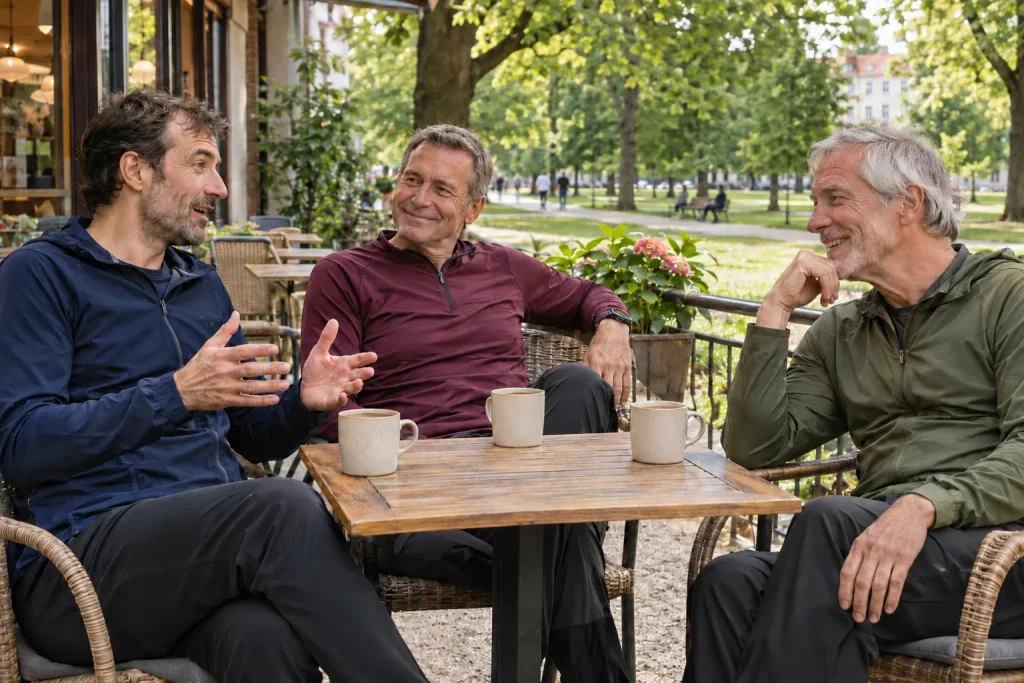
At first you simply stop at the same bench; later you know one another’s first names. A few weeks on, someone asks about the trip you mentioned last time. A shared run can create a connection without an explicitly advertised aim of making friends. The meeting already has a time and a topic; personal closeness becomes a possibility rather than a compulsory task.
Accounts of men’s running friendships are interesting when we avoid looking for one single type of man in them. Some enjoy long conversations, others value casual acquaintances, and others choose quiet company. An Irish interview study described several such social experiences. The original examples below help explore their meaning; they are not interview quotations and do not promise friendship or a health change after a specified number of runs.
A shared occasion makes arranging to meet simpler
As an adult, initiating contact can sometimes be difficult: when is the other person free, how well do you know them, and is suggesting a separate outing too much to ask? Recurring shared activity partly establishes that framework in advance. The place and time are known, so a new invitation does not have to be arranged each time. Personal conversation is still not automatic, but joining an existing programme may be a smaller decision.
Running also provides shared points of reference. You can talk about the route, yesterday’s wind or which entrance is best for meeting. These remarks may initially seem unimportant, yet they leave room for another conversation. You do not have to begin with a question about private life to connect attentively with someone. A light topic is not necessarily superficial; it can be an appropriate first step for that relationship.
Running together does not mean talking throughout the route for everyone. Two people moving at different paces can meet before starting and at the finish. The social occasion need not become a compromise on pace in which one person keeps trying to prove themselves. Separate the shared framework of meeting from each person’s choice of activity that day.
What were the Irish men asked?
Dunne and colleagues’ 2024 qualitative study drew on online interviews conducted in 2022–2023 with thirty-nine men aged 45–64 who attended Irish parkrun events. Reflexive thematic analysis described a supportive environment, optional social closeness and participation changing over time. Participants ran or walked, and some also volunteered. Interpreting their accounts does not provide experimental evidence that a given programme causes the same outcome for everyone.
All but one had already attended more than ten events. Their stories therefore do not establish how someone who ultimately does not return experiences their first visit. Both looser and stronger connections described in the interviews could be valuable to the speakers. The study did not examine an event organised exclusively for men and does not establish that all men need the same social arrangement.
A familiar face and a close friend can each have value
A familiar face is someone you recognise, exchange a few words with and then carry on with your day. You may also keep in touch with a close friend outside running and share more personal things. There is no compulsory series of steps between these forms. Not every regular acquaintance has to deepen, and a casual connection is not an unfinished friendship someone urgently needs to fix.
An imagined example: Gábor greets one participant every Sunday, but they have never exchanged phone numbers. He can still enjoy someone knowing his name. Tamás later arranges a separate outing with another running companion; their connection has taken a different direction. These are original illustrative characters, not the Irish interviewees. Neither relationship needs to be graded against the depth of the other.
The distinction also helps when approaching someone. Offering the next shared lap may be enough for a casual acquaintance, while more personal questions may feel natural with a close friend. Closeness depends on a mutually developed relationship, rather than just the number of meetings. Learning another person’s boundaries can be as much a part of friendship as hearing an important story.
 Enlarge image
What can happen before, during and after the start?
A running occasion can have several social stages. Time is short before setting off, and practical questions often dominate. During activity, the scope for conversation changes. Afterwards some stay, while others have to leave straight away. Accepting this in advance means a hurried departure need not feel like rejection of the group. Different life circumstances are less likely to become personal misunderstandings.
| Part of the meeting | Possible approach | A boundary to respect |
|---|---|---|
| Before setting off | Greeting and a short, specific question showing interest. | Do not ask for a long account while the person is getting ready. |
| Along the shared route | Conversation or quiet company suited to the chosen activity. | Neither answering nor keeping pace should become a test. |
| At the finish | An invitation to stay briefly, with a clear location. | Going home should remain an acceptable choice. |
| Between occasions | A message with mutual agreement. | Do not expect a quick reply or constant availability. |
This table is an editorial example, not a social protocol tested in the research. Its aim is to avoid tying the possibility of friendship solely to talking during exercise. A shared finishing point can preserve the sense of meeting even if you ran separately. The connection need not depend on one training format or equal sporting performance.
Repetition creates opportunities without prescribing a schedule
On a first visit, many things are new: faces, the place and its customs. Later, some practical uncertainty may disappear, leaving more attention for the other person. Remembering a small detail mentioned earlier can give a conversation continuity. That differs from a prescribed friendship programme: some people relax quickly, others attend less often or remain at the greeting stage longer.
Do not turn interview accounts of repeated participation into a deadline. Concluding ‘I have been three times and still have no friend’ would create a standard the study did not establish. It is more useful to notice specifically whether the place feels comfortable, whether people are receptive and whether you want to return. If not, that community may not offer the social arrangement you seek.
An absence does not automatically break every connection either. A simple greeting on returning can help without demanding an explanation for being away. If someone explains what happened, you can listen; if not, there is no need to speculate. Being able to return without a detailed justification can itself be a practical form of continuity.
Social identity and a particular friendship are different things
Belonging to a community may matter to you while you know only a few people well. Stevens, Rees and Polman examined this as a separate question in their parkrun study. They linked questionnaires from 289 participants with objective attendance data; stronger group identification was associated with greater participation and more positive evaluations of community and experience. Their model of associations was not a randomised friendship-formation experiment and provides no recipe for an individual’s relationships.
In everyday life, a sense of belonging might mean knowing shared customs, enjoying helping at the venue or being pleased when others return. Personal friendships develop alongside this in separate relationships. You do not need close contact with everyone to feel at home in the group. Commitment to a community does not automatically mean agreeing to every shared programme either.
This distinction also matters when someone arrives with a sporting goal and only later becomes interested in the social side. They need not adopt a running-community identity in advance. Equally, belonging cannot be measured by who shares more photographs or stays the longest. Visible activity is one form of participation, not a complete account of personal attachment.
Do not turn accounts about men into rules for men
Saying ‘men can only talk while doing an activity’ would create too narrow a framework. Some men specifically seek personal conversation, others feel at home with friends of other genders, and some prefer exercising alone. The Irish research interpreted accounts from men of a specified age taking part in a particular programme. It does not prove an innate social pattern or identical relationship needs in every country.
A running-group organiser can therefore ask questions rather than assign a ready-made type to a newcomer. Would they like to start with someone? Would they rather first look around? Would they like to stay and talk afterwards? The same person may answer differently on different days. Offering choice is often a simple organisational detail: a clearly visible meeting point and an invitation that can be declined without explanation.
Receptiveness matters in a group’s humour too. Teasing familiar to old friends can feel excluding to a newcomer, especially when aimed at their body, age or private life. You do not have to wait for a public objection before speaking respectfully. Sharing a sporting topic does not entitle anyone to test another person’s personal boundaries.
Attentive interest does not require interrogation
If an acquaintance is quieter, you can offer a conversation without deciding the reason for them. An original example: ‘If you would like to talk about it, I am happy to listen; if you would rather just walk now, that is fine too.’ This is not a research quotation or a treatment method. The point is choice: acquiring as much information as possible is not what makes closeness attentive.
Someone who shares something does not necessarily need immediate advice. Ask whether they want listening or practical help. Replanning a shared route, arranging a later meeting or simply being present are different offers from solving someone’s life. Do not pass on a personal story within the group because you are worried with good intentions; boundaries around information are part of trust too.
Friendship has limits. A running companion does not become a professional by knowing someone for a long time, and a shared programme cannot replace necessary professional help. Equally, every difficult conversation need not become a clinical situation. Everyday attentiveness can matter in its own right without being credited with a therapeutic effect.
 Enlarge image
How can an established circle of friends stay open?
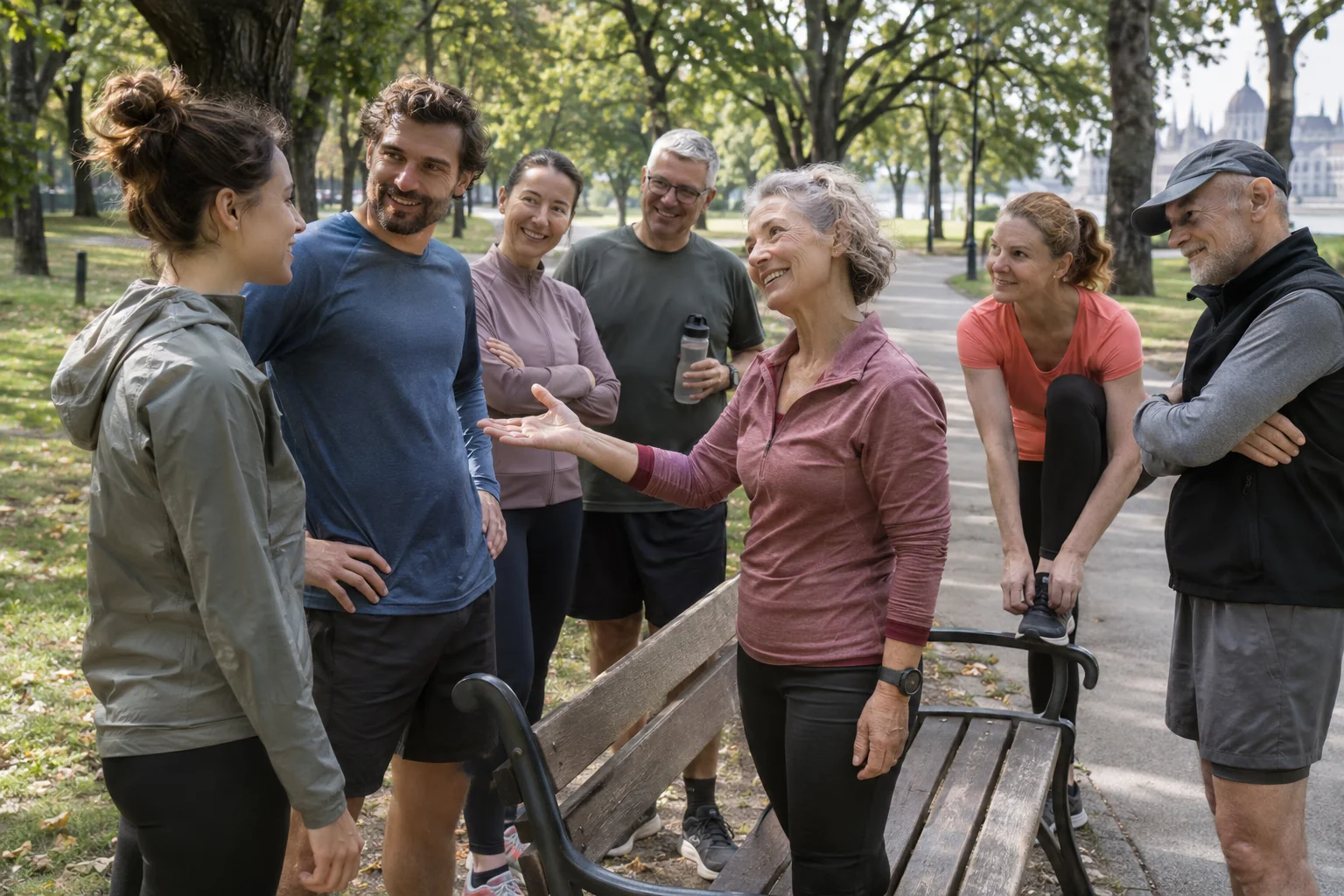
An established group understands many things from half a sentence: who parks where, what a route’s nickname means and which bench they visit afterwards. Newcomers lack that knowledge. A few sentences of guidance and a personal introduction may help more than a general claim that ‘everyone here is friendly’. Inclusion becomes visible through small, observable actions.
- Introduce the newcomer to a few people without asking for a public life story.
- Explain customs that established members already take for granted.
- Offer the post-run meeting with a location and an approximate outline.
- Accept someone moving separately, staying briefly or joining only later.
- Leave room alongside old friendships for someone who does not yet know anyone well.
Openness does not require everyone to be close friends with everyone else. It means basic information and respect are not privileges of a closed circle. If the social activity costs extra, explain that well in advance and allow people to skip it. Community meetings should not be possible only for those who can afford every associated activity.
Your own preferred connection is a good starting point
If you are looking for a social running occasion, you do not have to decide in advance whether you want friendship, a community role or simply familiar company. Notice which kind of meeting would make you happy to return. Did a brief greeting feel good? Could you continue the programme separately? Could you keep your own choices without feeling an outsider? These are personal orientation questions, not a relationship scoring scale.
A shared run can provide a framework for friendship, or remain a casual, regular acquaintance. The strength of the Irish interviews is that they reveal several kinds of experienced connection. You need not imitate the study participants in your own day: you can seek a social form combining interest, reciprocity and free choice. A greeting by name can have a place in that without a larger story.
Sources
- Dunne, Quirk, Bullas and Haake: My parkrun friends, 2024, accepted author manuscript
- Stevens, Rees and Polman: Social identification, exercise participation, and positive exercise experiences, author manuscript
How Futószív articles are prepared: our editorial guidelines.