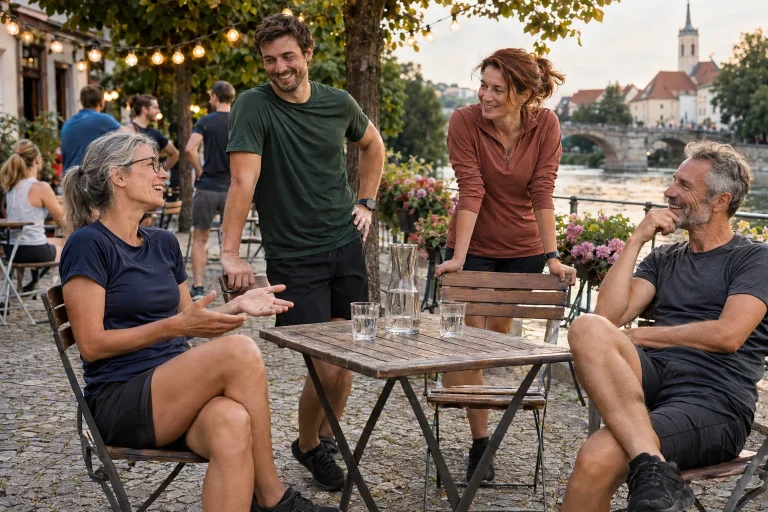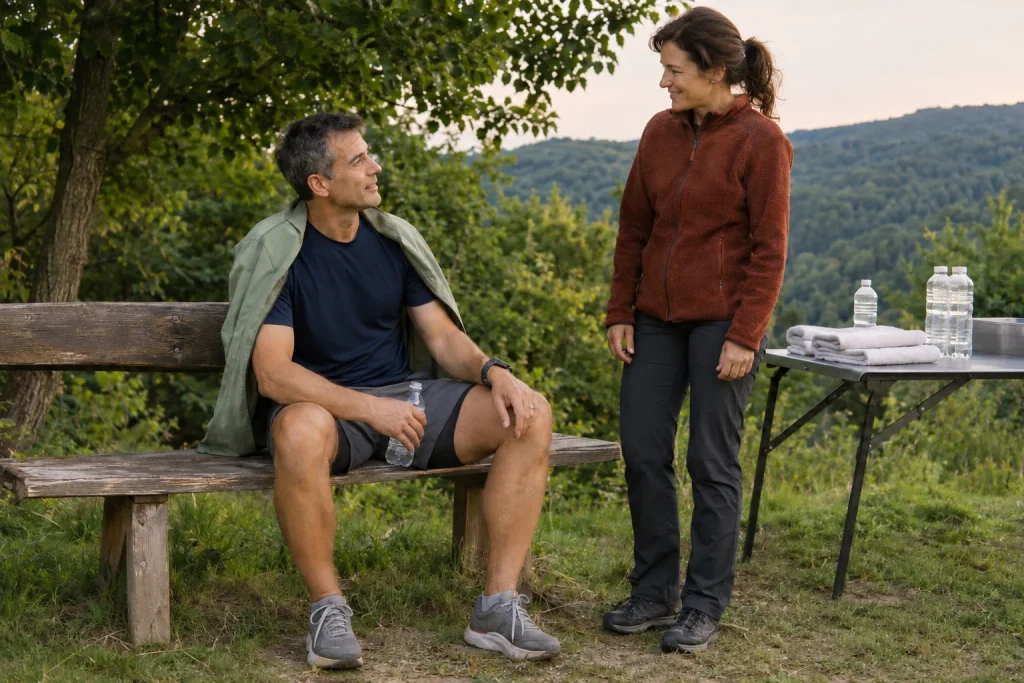
Relief, tiredness, pride and discomfort can coexist at a long running event. A runner sitting at the finish is not necessarily simply “happier” than before starting: they may be less nervous while their body hurts more, and only later find words for the whole day. Moving from a short laboratory programme to a marathon or ultra is therefore a major shift in runner’s high research. It does not merely extend the same line. A different timescale, different participants and a real event’s many circumstances enter the question.
The laboratory follows a session; a long race follows a changing story
In a controlled laboratory programme, researchers can record relatively precisely when activity begins, what exertion a participant performs and when they answer a question about their experience. At a long outdoor event, the situation continually changes. Scenery changes, you reach an aid station, meet your supporter, and progress may differ from your plan. These are easy to imagine as personal examples. Field research is interesting precisely because measurement enters a real sporting situation. Researchers must nevertheless say which details of that story they could follow.
The experience’s timeline need not match the kilometres either. Pre-start tension differs from pleasant feeling during exertion or relief after finishing. Comparing only start and finish misses intermediate states. Measuring on the way reveals more detail, but still does not record every moment of the whole day. Read the study as observations at specified points rather than a continuous emotional recording of the event.
A runner’s account can still be richer than a questionnaire. They may describe a particular section as the day’s high point, or say that only sitting down after the finish revealed what participation meant. Research has another task: collecting comparable data for a selected question. This difference in description is not an error. One is a personal story; the other is a part examined from a defined perspective. These multiple times and meanings make long-run research questions distinctive.
What question did the shorter human experiment ask?
In the study published by Siebers and colleagues in 2021, 63 people’s moderate, 45-minute treadmill running and walking were examined. A randomised, double-blind, placebo-controlled design also tested opioid blockade. The blockade did not prevent increased euphoria and reduced anxiety after running; blood endocannabinoids were also measured. This addressed well-defined components of human experience and a selected mechanistic question. Programme duration was a study condition rather than a representation of every possible endurance situation.
One value of a controlled session is allowing a focused comparison. Running and walking, and intervention and control, stood in a defined relationship. When comparing this with a several-hour sporting event, saying people ran there too is insufficient. We need to ask whether the same experience was measured at the same time in the same kind of design. The shorter study does not become insignificant because ultras exist; it supplies data for another question.
For runners, a useful distinction is that an experiment investigating a molecular mechanism and observation of a long event are not interchangeable. The latter can reveal a new temporal phenomenon; the former may isolate a selected comparison more readily. Connecting these forms of knowledge requires further research. Improvement in a self-rated state after a shorter session does not imply that the same feeling strengthens evenly with every additional hour.
 Enlarge image
The 2026 field study opened two separate long-distance situations
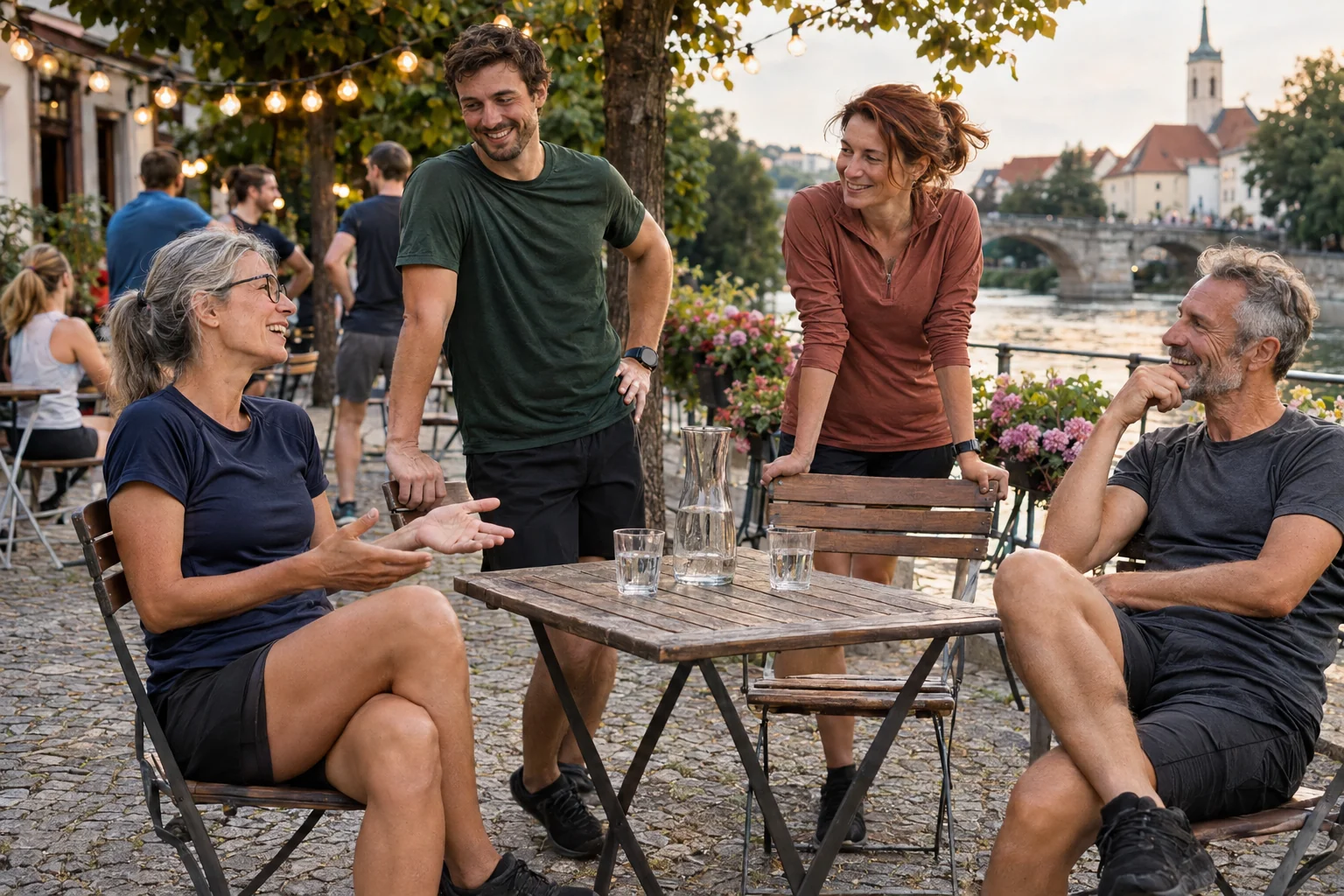
In Siebers and colleagues’ 2026 paper, the marathon component examined running and duration-matched walking in 19 trained runners, with repeated blood samples and post-finish sampling. In the ultramarathon component, 36 participants provided samples before and after events of 100, 160 or 230 kilometres. Euphoria, anxiety and pain were assessed separately alongside circulating endocannabinoids. AEA and 2-AG followed different time courses during the marathon. After the ultras, pain increased and anxiety decreased, while the change in euphoria was not significant. This is not a simple pleasure curve rising with distance.
The difference between the two designs is instructive in itself. Repeated samples along the way can answer temporal questions; pre- and post-race samples compare two selected states. The latter cannot reliably reconstruct the entire change en route. An article presenting a finish-line sample as direct proof of a feeling experienced hours earlier fills a missing link with assumption. The field study’s real value lies in what its actual sampling points and experience ratings show together.
Marathon and ultramarathon participants are not simply groups identical in every other way completing programmes of different lengths. Research context and participation conditions matter too. Differences between distances therefore cannot automatically be called effects of kilometres alone. The longer situation opens a new research window, but is not an experiment sequentially “dosing” the same person with increasing distances while holding every other condition unchanged.
Pre-start tension can be a separate chapter
Burgum and Smith’s 2021 ultrarunning study recorded participants’ mood at several points in a trail event of around one hundred kilometres, also comparing data from the week beforehand. Tension near the start, later changes and fatigue produced different patterns. Mood variability was associated with finishing time. The study was observational: it does not imply that forcibly regulating a selected feeling will reliably improve results. The main lesson here is that even the comparison’s starting point matters.
A calmer moment in the days before a race differs from the few minutes before the start. Comparing the post-finish state with the latter can give reduced tension a different meaning than comparison with an ordinary day. Imagine, for your own example, nervousness before an important event and relief after completing it. This does not make the experience less real. It shows that “compared with what?” matters as much to researchers as the change itself.
Distance research therefore needs to see more than a longer course. Anticipation before the event and the period afterwards can belong to the story. A paper can specify its chosen baseline, but readers must retain that framework too. Post-race relief does not automatically become a general personality change or an effect spanning every ordinary day. Naming feelings during and after a long run precisely helps more than one overall “it was good” label.
Who provides data, and whose story is missing?
An ultrarunning study includes people who reached a particular event, agreed to take part in the research and could provide data needed for analysis. This is not a random sample of everyone. Complete records matter too: who has every sample or questionnaire? Missing data need not have only one cause. Interpretation should follow the paper’s description rather than automatically form a general statement that “ultrarunners are like this”.
Another human study, published in 2022 and concerning a winter ultra, distinguished finishers, non-finishers and control participants while following hormonal and mood variables. Separating groups showed that a race’s story is not solely that of those crossing the finish line. Those findings also do not permit a single experienced state to be named as the cause of finishing without further evidence. Selection and follow-up influence which human situations research can address.
For a reader, this does not mean a sporting group’s data are not worth knowing. It means seeing precisely which people a title names. Results from a trained group prepared for a long event may interest exercise physiology without becoming personal exertion guidance for beginners. Sample selection is more than a footnote: it tells us whose actual observation produced the story. You need not fit your situation to their group average.
Pain, euphoria and calm can change separately
A practical reading aid is to imagine at least three separate columns in a long-run finding. One concerns pleasant, elevated feeling; another tension or anxiety; the third pain. They need not move in the same direction for the data to make sense. Someone can be relieved while tired or in pain. The umbrella term “runner’s high” can conceal this difference, although separating the parts gives more information about a long event.
| Aspect examined | What question does it ask? | What should it not automatically be equated with? |
|---|---|---|
| Euphoria | How elevated and pleasant did the participant feel? | It is not the absence of pain. |
| Anxiety or tension | How did the state experienced at that time change? | It is not lasting resolution of every everyday concern. |
| Pain | What discomfort was reported at measurement? | It cannot be relabelled as the necessary psychological reward for finishing. |
Naming these components can also help conversations with a supporter or coach. Alongside “I feel unwell” or “everything is fine”, more precise words may be needed. An emotional report, however, does not replace assessment of a physical symptom or acute illness. A research pain scale does not make running through pain a method to follow. Studying experience and deciding about an athlete’s safety are separate tasks with separate professional questions.
 Enlarge image
Longer distance is not an emotional hierarchy
Research across timescales should not create a hierarchy in which shorter running gives lesser pleasure and an ultra a higher form. Studies may use different situations, participants and outcomes. A pleasant short loop is no less real because it does not accompany hours of exertion. Long-running research matters for its distinctive temporal and environmental questions, not because everyone should reach the same point in their sporting life.
When reading an event account, you can separately appreciate what the day meant to that person. For scientific data, look for the sample, measurement points and comparison. These reading approaches coexist well. One reveals an individual story; the other shows the observations from which broader questions arose. Leaving the laboratory does not give running-pleasure research a simpler answer, but brings it to a richer human situation. Your own running’s value still does not require proof through ever-longer distances.
Sources
- Siebers and colleagues, 2026: Endocannabinoid dynamics across marathon and ultramarathon running
- Siebers and colleagues, 2021: Exercise-induced euphoria and anxiolysis
- Burgum and Smith, 2021: Reduced mood variability during ultrarunning
- Kienast and colleagues, 2022: Hormones and mood in a winter ultramarathon
How Futószív articles are prepared: our editorial guidelines.