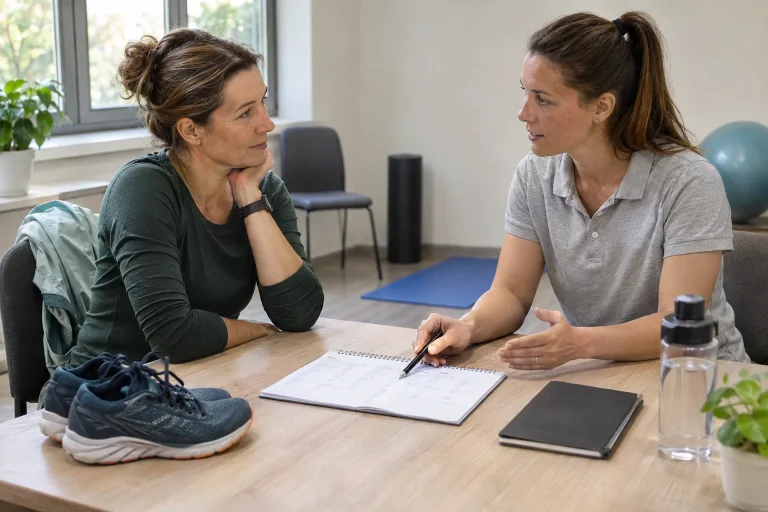
With fibromyalgia, ‘how far should I run?’ is often too narrow a question to produce a useful answer. A short activity may have felt good last week, while poor sleep, pain and everyday tasks together change your possibilities now. Movement can have a place in treatment, but its form and support do not follow from a running blog’s general mileage plan.
You do not need to quantify every day perfectly for a specific discussion. Show how the combination of symptoms affects function instead: what you can do, what gets left out, where you would like to move and which help is available. The running goal remains, but decisions do not revolve solely around distance or pace. This article offers questions, everyday examples and considerations for interpreting activity recommendations.
Pain, sleep and fatigue: why discuss them together?
Fibromyalgia is a condition involving persistent widespread pain and tenderness, which can be accompanied by fatigue and sleep difficulties. NIAMS explains that altered pain processing is an important part of current scientific understanding. This does not mean symptoms are imagined or should be suppressed through willpower. The precise causes are not understood in every detail, and care may combine several approaches.
The NHS also highlights variability in symptoms. One selected day may therefore not show how you live with the condition. Reporting only your best week’s sporting activity may omit what happens during a worse period. Showing only the worst day may conceal available possibilities and goals important to you. Bring a few specific examples from both sides.
Discuss sleep and fatigue alongside pain. You need not make an independent sleep diagnosis: say if falling asleep is difficult, you wake frequently or usual rest does not leave you refreshed. Difficulty concentrating or organising tasks is separate information too. Activity decisions depend on more than how a particular muscle group feels when you set off.
A general activity recommendation is not a personal running plan
The EULAR fibromyalgia guideline strongly supports exercise among treatment options and emphasises shared decision-making. This matters: a diagnosis need not be viewed as automatically removing every possibility of movement. However, the recommendation does not say everyone needs the same amount of running or the same training progression. General findings from studies need application within individual care.
The NHS self-help page describes a personalised programme and referral to a professional. Planned activity may be aerobic, strengthening or a combination. This does not establish a universal ranking of sports. The chosen form should fit your condition, goal and circumstances, with an opportunity to evaluate the plan. ‘Being regularly active’ and ‘returning to race preparation’ are tasks requiring different levels of detail.
CDC’s general guidance for chronic conditions also recommends professional discussion of suitable activity types and amounts. Minutes in public-health recommendations are therefore not automatic weekly running quotas. A different manageable load now does not mean you are failing at a healthy lifestyle. A personal plan needs to start where you actually are, rather than where a general table says you should be.
 Enlarge image
Let your daily task list show what needs energy reserved
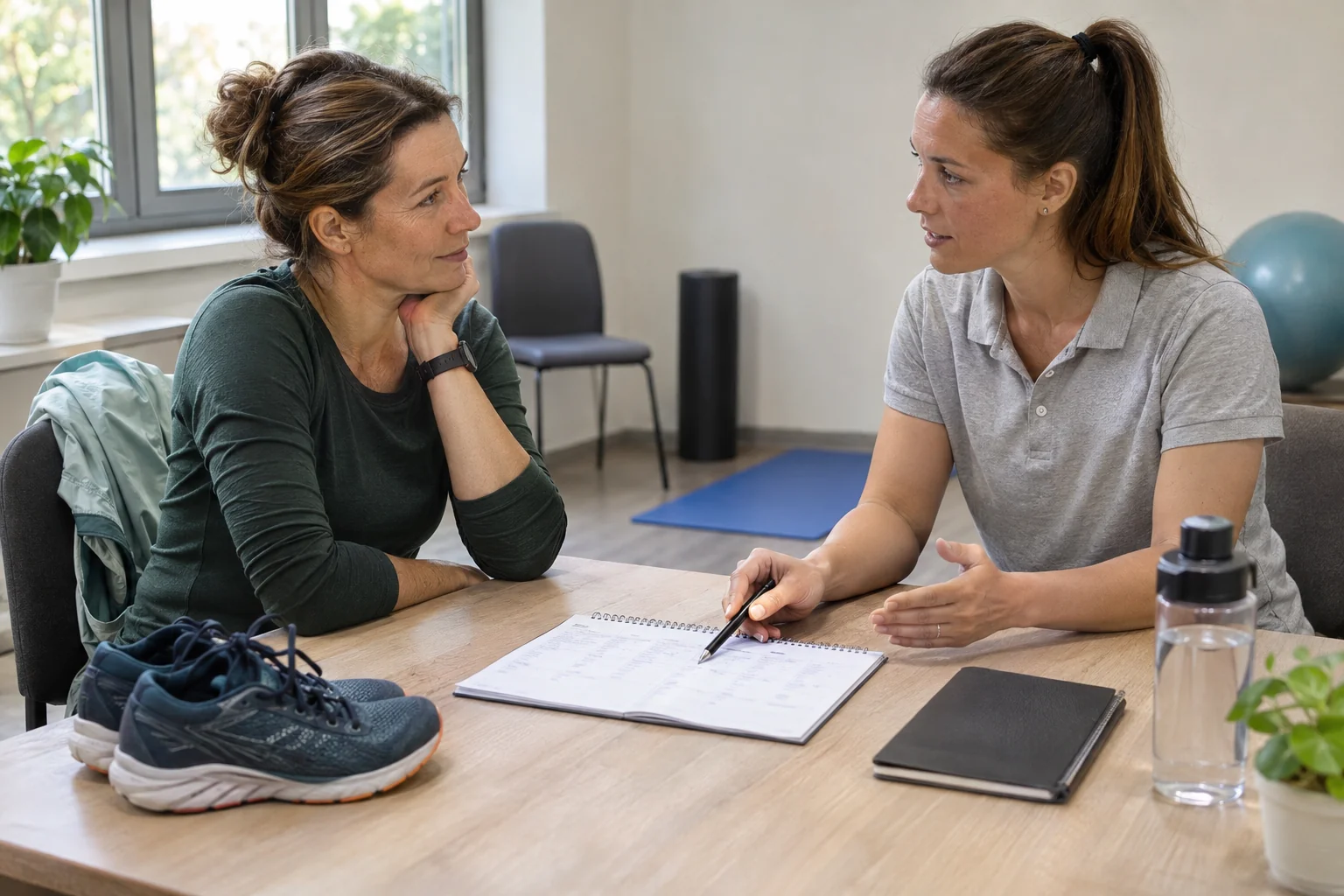
List an ordinary working day without classifying its tasks as training. Getting up, preparing, travelling, seated or standing work, shopping, housework and caring for others all form the setting in which you seek room for exercise. The list is not for accounting for every minute, but for making function outside sport visible during the consultation.
Choose a few activities that matter to you. Perhaps you want to reach work while keeping the rest of the day manageable, or participate in a family outing. These goals are not less valuable than a race. In an activity discussion, they help express what you would consider a meaningful result in your own life. Kilometres are one possible datum; daily function is more than that.
NIAMS practical information also mentions pacing activities and avoiding taking on too much at once. This is not one timetable for everyone. Bring your own example of which task regularly gets missed after a longer activity and what support would be needed. Mention obligations that cannot be freely chosen, such as getting to work. Real constraints belong in planning.
| A general statement | A more specific account | A question to discuss |
|---|---|---|
| ‘I had a good day.’ | ‘I could do my work and the short shared outing too.’ | Which elements supported function, and what can realistically be repeated? |
| ‘The activity was too much.’ | ‘These two important everyday tasks were left undone afterwards.’ | How should the personal plan and evaluation change? |
| ‘I cannot be consistent.’ | ‘Symptoms and my work schedule change together.’ | Which flexible framework and assistance are needed? |
| ‘I want to return.’ | ‘I would like to enjoy shared movement again without performance pressure.’ | Which form and setting would support that now? |
Surroundings matter when choosing activity too
The same form of movement can demand different organisation in different circumstances. Group sessions may involve travel, changing and a fixed start; a home programme may lack professional feedback or suitable space. There is no need to declare a general winner. Bring the option genuinely available and the obstacles to participation into the consultation.
A noisy gym, crowded changing room, distant venue or fixed work schedule can affect feasibility. These do not need to be renamed medical symptoms. Clearly explain why the format is difficult. If learning a task requires an in-person appointment but later support could be arranged differently, discuss that separately. Details determine a plan’s usability.
An inclusive running club can be valuable, but does not replace individual rehabilitation assessment. If the coach or leader does not know your personal plan, explain practical participation limits as far as you wish. Perhaps you will not follow the group’s distance now, or increase loading without prior discussion. You do not need to share your full medical history before requesting adaptations.
Evaluate change through more than a pain number
The NICE chronic-pain guideline calls for discussing personal priorities, abilities and goals in the care plan. It also interprets symptom changes within everyday life rather than solely through a test result. This is a useful framework for discussing activity with fibromyalgia too. You need not invent a clinical score to make important changes in your life visible.
If the professional asks for a particular observation, record it according to their guidance. As additional information, describe the experience, how feasible the programme was and what changed day to day. An enjoyable session can be an important positive experience without distance increasing. Conversely, a longer route does not necessarily mean a good result if indispensable activities repeatedly go undone afterwards.
Include circumstances when comparing occasions. A calm day off and a working day full of travel do not provide the same background. You need not isolate every factor’s effect, but indicate the difference. ‘It went better last time’ then does not automatically become an expectation for next time. The log supports discussion of your situation rather than assigning one immediate cause to every change.
Sleep and psychological support can be part of care
Several professionals may contribute to fibromyalgia care. NIAMS describes medical, physiotherapy, pain-management, psychological and sleep-related support. This does not mean everyone needs the same team, but that the symptom picture can be addressed from several directions. Ask whom to consult in your situation and how the recommendations connect.
EULAR also identifies quality of life and balancing treatment benefits and risks as goals. Psychological support may belong here without questioning the reality of pain. If losing sport, unpredictability or comparisons with others feel burdensome, report this just as you would a sleep complaint. You do not have to perform well first to receive support.
The practical question is what happens until the next discussion. Is a separate sleep assessment needed, what help is available for understanding the activity plan and whom should you tell if different recommendations do not fit together? Do not alter medicines according to enthusiasm for running or an online account. Discuss existing treatment and new symptoms with the appropriate clinician alongside activity questions.
 Enlarge image
A reviewable plan is specific even without a mileage promise
At the end of the appointment, ask for a clear framework: which activity may be appropriate now, who helps teach it, what to observe and when to review the plan. You should not have to infer adaptations for good and bad days from a performance programme. You do not need to run through worsening to complete a predefined step. The option to modify should belong to the personal plan.
Do not automatically attribute changed or new symptoms to known fibromyalgia either. NICE considers reassessment appropriate when the symptom picture changes. Tell the clinician separately about something significantly different. A diagnosis can help explain existing symptoms, but should not close every later health question without assessment. Discuss distinguishing an ordinary worse day from a new symptom too.
Your own summary can ultimately be a few sentences: your most important daily goal, what currently makes it difficult, the supported activity agreed and when feedback will happen. Interest in running can remain while the next step takes another form or emphasis. A specific discussion need not produce a new training number, but a plan that considers your whole life alongside symptoms.
Sources
- NIAMS: fibromyalgia, symptoms and background
- NIAMS: diagnosis, treatment and everyday management
- NHS: fibromyalgia
- NHS: personalised self-help and exercise
- EULAR: accessible summary of the fibromyalgia guideline
- NICE NG193: chronic pain and a shared care plan
- CDC: activity with chronic conditions
How Futószív articles are prepared: our editorial guidelines.