You have entered, booked accommodation and your friends are counting on you. Meanwhile, a joint injury has changed your preparation, and the race is getting closer. It is easy to ask how recovery can fit into the remaining days. But the calendar shows an organisational deadline, not an assessment of your personal condition. A return decision needs to relate to the particular injury, current function and planned sporting task.
Seek healthcare assessment promptly if a new injury causes severe pain, significant swelling or bruising, visible deformity or inability to bear weight. The NIAMS information on sports injuries treats these as distinct warning signs. An approaching start does not turn them into a question to settle with a test workout, and masking pain cannot check whether the conditions for returning are met.
Separate an important event from the current sporting task
A race can mean more than a distance. It may be a shared weekend, a long-awaited meeting, a personal goal or a planned way to mark the end of a difficult period. These meanings need not be dismissed. But the event’s significance is a different question from which activity is currently advised. Separating them clarifies the decision rather than questioning your motivation.
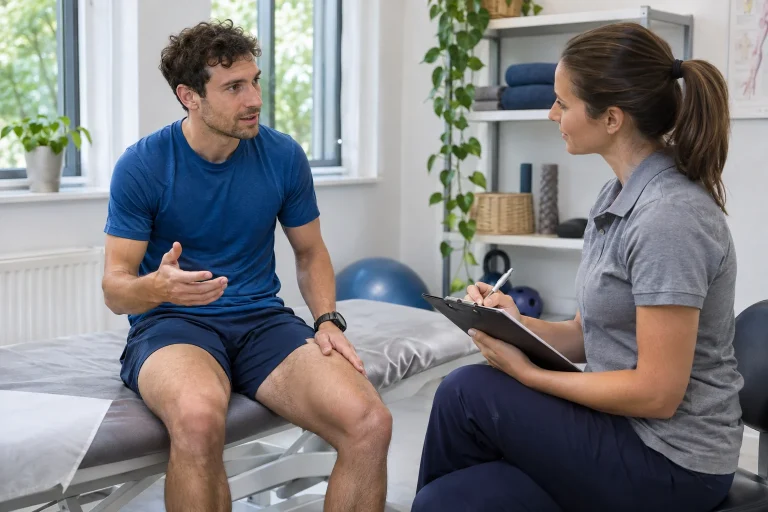
Tell your clinician why the occasion matters. Simply saying ‘I would like to do sport soon’ can omit the distance, terrain, social expectations and pressure of the deadline. The professional may not know the event. A precise goal helps avoid stretching general activity advice to cover a specific race.
Break down your own priorities too. Starting, finishing, achieving a result and spending a weekend with friends are not identical goals. Bundling them into ‘I have to be there’ makes the options harder to see. Naming them separately can reveal which element actually involves running load and which might have another organisational solution.
Returning has several meanings
The 2016 Bern sports consensus discusses return as a process, distinguishing return to participation, return to sport and return to the desired performance. This is a professional conceptual framework, not a fitness test for readers to tick off independently. It highlights that ‘I can move again’ and ‘I can race for my previous goal’ are not necessarily the same.
If you are already performing certain tasks within personal rehabilitation, that alone does not mean the original race programme is achievable. The task may be modified, supervised or intended for another purpose. Likewise, someone who has returned to a sport has not necessarily reached the desired performance level. Always clarify the meaning within your own care.
The consensus does not impose the same deadline for every joint injury. Personal decisions involve the particular injury and relevant clinical assessment, rather than a sequence of days that applies to everyone. This article therefore gives no universal jumping, strength or running test. What matters is sharing the same understanding of ‘return’ with your clinician.
The history of the particular injury and treatment cannot be reduced to a label
‘Knee injury’ or ‘joint problem’ is a very broad description. A personal plan can differ with a recent injury, surgery or an ongoing condition. The AAOS patient summary for acute isolated meniscal injury, for example, concerns a specific condition. Its return information is not a universal timetable for every knee complaint.
If you discuss the race with someone other than your original clinician, bring precise documentation. Describe the procedure, instructions so far and changes since then. You do not need to translate a report into sports clearance yourself. Knowledge of the condition helps identify which tasks and checks belong to your personal return process.
Another runner’s recovery time is not your deadline. Even with a similar name, the injury, treatment and sporting goal may differ. Someone starting after a particular interval does not tell you what happened before or afterwards. A community story can be interesting on a human level without replacing assessment of your condition.
 Enlarge image
A race is a complete task, not just the distance from start to finish
An event also involves travel, moving luggage, number collection, waiting and getting home. Discussing only running kilometres may omit the rest of the day. Compared with your recent everyday function, these can also be new demands. Describe the complete programme, rather than only the part you can record as exercise.
Describe the course’s actual characteristics too. A flat city loop, long descent, uneven trail or several crossings create different environments. You do not need to calculate a separate medical risk for every detail. The aim is to avoid attaching personal advice to a simplified phrase such as ‘a short race’ when the real route is more complex.
Only current information from the organiser can establish event conditions accurately. This article does not claim the same cut-off, transfer or withdrawal options for every event. If these matter to your arrangements, check the rules for your own entry. Administrative possibilities and medically appropriate activity remain two separate questions.
Missed preparation cannot be fast-forwarded with one compressed week
If preparation was interrupted, squeezing missed sessions into the remaining time can be tempting. That does not automatically make your personal return plan more complete. The original training plan was built for an earlier situation, while your current condition may differ. Link the next task to the present assessment, rather than erasing empty spaces in the log.
‘Just one final long test’ can also easily become an exam. Success becomes permission; failure may make you want a second attempt. But a self-selected test does not replace personal clinical follow-up. If the recommended activity is unclear, clarify it before the next major load, rather than after the experiment.
Do not treat injury rehabilitation as merely an obstacle beside the race plan either. NIAMS describes how return may require a personal programme targeting strength and movement in the affected area. That is a different goal from completing an entered distance. Discuss the connection with a professional who knows your condition.
Walking or a shorter distance is not an automatic fallback
A common idea is to walk the event if running is inadvisable. Walking may suit some situations, but not every injury or any duration. Prolonged time on your feet, terrain and the journey home still belong to the task. The name of the activity does not replace personal advice.
The organiser’s option to switch to a shorter distance also needs a separate check and does not establish health suitability. If considering it, describe the task precisely to your clinician. The aim should not be to find any form of participation that can be called something other than the original race. The chosen programme must relate to your actual condition.
Other roles might be considered: meeting companions, attending as a spectator or undertaking an agreed task. These are not necessarily appropriate for everyone either, as they can involve travel and standing. Consider them as organisational possibilities, not medical clearance. Missing the event entirely this time is also an acceptable decision.
Treat costs as an organisational question, not a sports-medicine argument
Entry and accommodation are real expenses, so the difficulty of the decision is understandable. Yet they do not reveal the appropriate load for the affected joint. Seek a separate answer for financial and administrative matters: which cancellation, transfer or modification rules apply to your booking? Clarify these with the organiser or provider, rather than by reinterpreting your health complaint.
Look into options early so you do not have to decide everything on the final evening. This article promises no refund and states no universal Hungarian race rule. Knowing your own terms can reduce organisational uncertainty. This can also keep the healthcare discussion clearer about which question concerns loading.
You do not need a perfect medical explanation when communicating with companions either. You can say you are following your personal return plan and your participation will differ this time. You need not convince everyone how painful or serious the situation is. Your condition and care are not matters for a community vote.
 Enlarge image
What information should you bring to the next discussion?
Place your current function and programme so far beside the specific race goal. What can you do according to the agreement, what response occurred and what has changed since? ‘It is better now’ alone does not describe the task you managed. Likewise, wanting to participate does not show the condition of the affected joint.
| Topic | Useful detail |
|---|---|
| Personal goal | Taking part, finishing or a result: what do you actually want? |
| Current programme | Which parts of the plan did you complete, and with what response? |
| The full event day | Travel, waiting, the course and getting home together. |
| Decision point | When will you discuss it, and which new changes require earlier contact? |
The table is not a race-clearance checklist. The professional assesses according to their own clinical and follow-up criteria. Your task is to describe your goal and actual experience clearly. You do not need to complete a particular workout in advance to make your question legitimate.
Allow time for the decision and name the next step
If the race question remains open, agree when and on what basis you will revisit it. This is a follow-up point, not a promised start. A new symptom in the meantime naturally need not wait for the scheduled appointment. A personal plan is understandable when both the possibility of continuing and reasons for modification can be stated.
A useful sentence is: ‘This event matters to me, but I want to understand which current conditions guide the decision and which other option fits my plan.’ That leaves room for motivation and uncertainty. You are not asking the professional to fit your condition to the calendar; you are seeking an understandable, personal answer for your goal.
The race date can remain an important day without deciding your return after a joint injury. Starting, connecting with the sport and reaching a desired performance can be treated as separate goals. The particular injury, actual function and personal professional plan together determine the appropriate next step, rather than the entry confirmation.
Sources
- NIAMS: assessment and rehabilitation of sports injuries
- AAOS: patient summary of acute isolated meniscal injury
- 2016 Bern consensus on return to sport
How Futószív articles are prepared: our editorial guidelines.