A slow-motion video seems to show you overstriding or landing differently from the demonstration runner. Your knee hurts, so connecting them feels obvious: correct the image and the pain will disappear. Modifying running movement can belong in individual care, but is more than cosmetic correction. Changing load in one area can alter other structures’ demands, so an internet model does not provide a technical treatment for everyone.
New injury, severe pain, substantial swelling, visible deformity or inability to bear weight needs medical assessment. Do not try new strides to find a way to keep running. The NIAMS information on sports injuries emphasises assessment rather than continuing a painful activity. Movement analysis does not replace that step.
First know which symptoms you want to address
Pain at the front of the knee does not identify one condition by itself. The IASP information on patellofemoral pain describes clinical assessment and considering several possible factors. Loading around the kneecap may matter, but not every symptom there is identical. A feature found in movement footage is not a ready-made diagnosis.
Describe movement and symptom timelines separately. When did pain begin, during which task, and did training or daily activity change? The video may be new while you previously ran the same way. That establishes neither that movement has no role nor that the observed detail caused pain. The filming date does not prove the connection.
Make the personal goal clear too. Do you want less pain, a rehabilitation adjustment or movement you generally consider better-looking? These are different questions. If symptoms prompted it, advice should relate to them and assessment, not an aesthetic ideal. You need not first label yourself a faulty runner to ask for help.
Load does not simply disappear with a new foot strike
An original 2013 biomechanics study compared female athletes who naturally used a forefoot strike with a matched rearfoot-striking group. Laboratory results showed different patellofemoral and Achilles loading patterns. Lower patellofemoral loading but greater Achilles tendon force was estimated in the forefoot group. This concerns load distribution, not one runner moving wrongly overall.
The study did not follow every reader with knee pain switching to forefoot tomorrow. Comparing two existing groups differs from a long-term treatment trial. The measured difference cannot automatically become an injury-prevention or healing guarantee. This article does not use it to prescribe a universal foot strike.
The practical lesson is to discuss knee and Achilles history together. Earlier symptoms above the heel matter when considering a change for the knee. ‘Joint-friendly’ is too general to replace this judgement. Clarify which loading characteristic, body area and situation are involved.
 Enlarge image
Cadence, step length and speed belong together
Steps per minute are often reduced to one desirable number. But cadence describes movement together with speed and distance per step. At the same speed, more frequent steps mean a shorter average step; speeding up simultaneously creates another situation. Two watch-screen values alone cannot explain exactly what changed.
Foot strike and cadence are different characteristics too. One instruction may concern landing location, another rhythm and another movement sensation. A video requesting all at once may leave each change’s purpose unclear. ‘Run correctly’ is less useful than a personally justified, followable task.
Watch data can support conversation, not judge your knee. Reaching an internet-recommended cadence does not establish that the cause of symptoms has resolved. Interpret it with speed, surroundings and task. The aim is not conforming to a measure demanding identical rhythm from everyone.
What did the laboratory study of runners with knee pain show?
In original research published in 2023, 68 runners with patellofemoral pain performed several gait modifications on a treadmill. Some participants had immediate symptom reduction with certain versions, but responses were not uniform. The forefoot modification also increased estimated peak Achilles tendon loading. This shows why symptom responses and loading measures need examining together.
This was a short-term laboratory comparison, not proof that an instruction gives everyone long-term recovery or fewer injuries. Researchers selected participants under defined conditions, excluding other simultaneous injuries, for example. Results cannot simply transfer to every post-injury knee complaint. A detail selected from an article does not replace the research setting.
A better immediate feeling can therefore be useful data without closing follow-up. When trying a change in individual assessment, clarify what later feedback the professional needs. You do not have to copy the conditions alone, particularly by running through several painful versions to place yourself in a laboratory category.
A video helps when it is not made decisive evidence
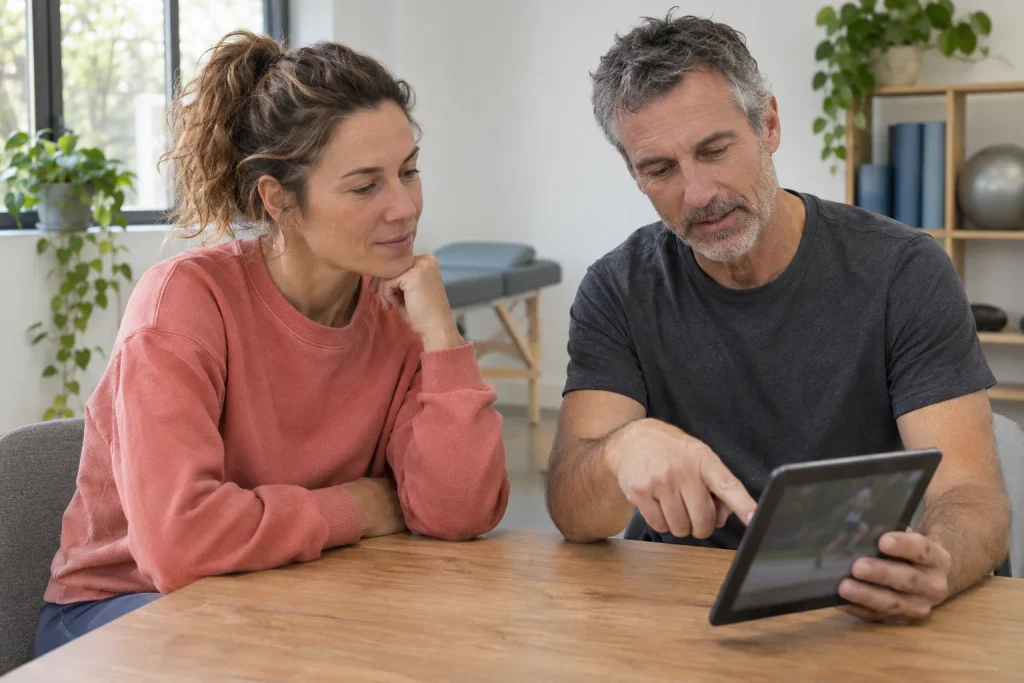
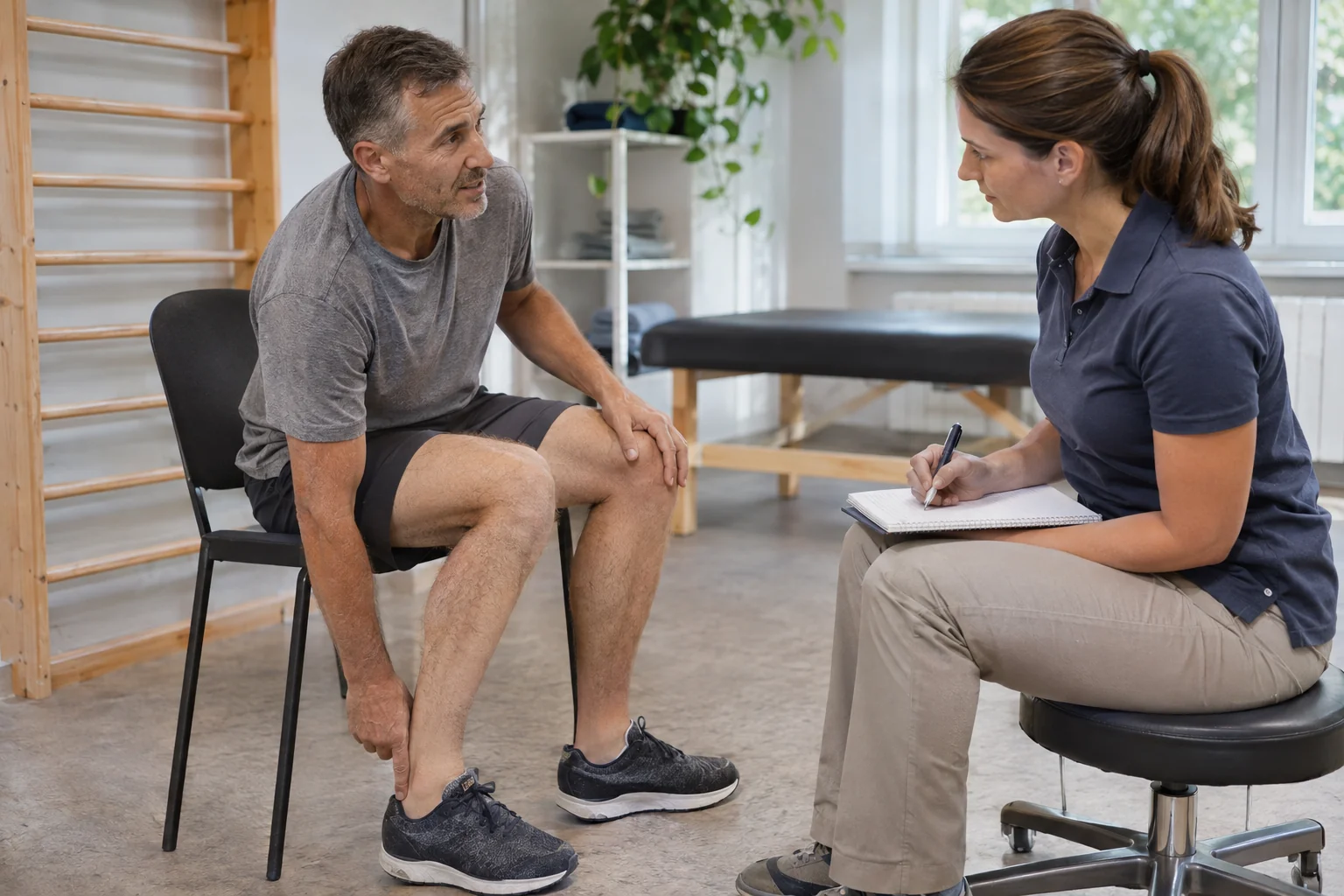
Footage can show a movement detail, but camera position, visible section and environment affect interpretation. One side view does not reveal the entire run. If a professional requests a recording, agree its purpose and conditions. You do not need a painful situation to make the material more dramatic.
Include when and where it was filmed, on which route or machine and whether it shows usual movement. Say if you were already consciously adjusting stride. Instructed movement may differ from earlier running. Precise context adds value, not making footage resemble a demonstration video as closely as possible.
A drawn arrow or angle is not a clinical explanation by itself. Ask what the observation means, how it relates to symptoms and what other information supports advice. Meaningful analysis is not necessarily detailed because of many markings. It helps by connecting observation, condition and an understandable next step.
Many simultaneous changes make feedback harder
Imagine buying new shoes, switching to forefoot, increasing cadence and extending training at once. A new symptom elsewhere the next day will be difficult to relate to one change. This does not mean organising your whole life experimentally. It means seeing changes separately and not losing a therapeutic goal among independent ideas.
For an individual task, clarify what stays unchanged, what is modified and which feedback informs review. Readers should not select rhythm, percentage or practice duration from an article. Specific dosage belongs to assessment and condition. A technical instruction is not a complete programme even if immediately understandable.
Extra practice is activity too. Adding ‘just technique drills’ to a usual programme still adds movement. Mention this to the clinician, not just the main watch-recorded workouts. Rehabilitation and sport together create the situation you report. A label does not subtract practice from daily load.
 Enlarge image
Useful feedback: task, circumstances and response
You do not need conscious control of every step. Agreed observation points can prevent running becoming constant self-judgement. Include the instruction, actual surroundings and changes in symptoms or everyday function. Reporting something you could not do matters more than retrospectively claiming perfect completion.
| Question | What information does it clarify? |
|---|---|
| What was the individual goal? | The reason related to pain or function. |
| What did you actually change? | Distinguishes the assigned task from further independent ideas. |
| Under which conditions? | Identifies shoes, surface and programme context. |
| What response followed? | Allows symptoms and everyday function to be described separately. |
Do not automatically call symptoms in a new body area necessary adaptation. The goal is not exchanging one pain for another. Clarify when to adjust or seek reassessment in your plan. General encouragement cannot replace this, and an internet exclusion list cannot determine what suits the condition either.
A well-explained change also has boundaries
Professional advice should explain why technique modification arose, its relation to symptoms and follow-up. It needs neither an ideal flawless runner nor an app scoring every step. Another part of care may eventually take priority. Technique is one possible tool, not compulsory proof you take the problem seriously.
Take this question to consultation: ‘What does the movement detail mean for me, which load do we want to change, and which feedback will guide continuing?’ It connects video with real symptoms. The aim is not a different landing at all costs, but an understandable, manageable plan suited to your condition.
The studies do not reveal one stride for everyone. They show instead that movement can alter load distribution and symptom responses vary. That makes individual assessment and follow-up valuable. One successful video frame may be interesting, but pain decisions also require your full history.
Sources
- IASP: patellofemoral pain
- Esculier and colleagues, 2023: laboratory study of immediate gait-modification effects
- Kulmala and colleagues, 2013: biomechanical comparison of groups with different foot strikes
- NIAMS: sports injury assessment
How Futószív articles are prepared: our editorial guidelines.