
An emergency plan matters even when you feel well, know the route and intend only a friendly run. With a known anaphylaxis risk, medical guidance existing somewhere is not enough: you and the companion you have briefed need to know how to access necessary equipment and help. This need not turn every outing into a hospital drill. A short, precise advance conversation can be part of organisation.
This article concerns making an individual action plan supplied by a professional usable. It does not teach injection technique, give doses or independently clear you to return to running. Clarify running conditions, your own triggers and actions within care. These questions help keep an agreed plan from remaining in a locked bag or hard-to-find phone file when needed.
An individual plan is more than a general first-aid poster
According to the British Society for Allergy and Clinical Immunology statement on adult action plans, a plan provides clear guidance for recognising and treating anaphylaxis. Their document is completed by a qualified healthcare professional; later changes also require professional decisions. This is a UK professional example of personalisation, not a Hungarian care form or self-completed diagnostic sheet.
Your plan should explain the condition or situation it covers, what to recognise and which device you were taught to use. Ask again if a sentence has several possible meanings. ‘Take the necessary action if symptoms occur’ may be too vague under stress. You do not need to assemble a detailed treatment protocol from internet sources: current guidance for you is the starting point.
Share the necessary, agreed information with your running partner. They do not need every previous test result. Access to the plan, emergency equipment location and calling for help differ from knowing the entire medical history. Ask what remains unclear to them too. A quiet nod does not always mean you understood the same thing.
What should you actually show your companion?
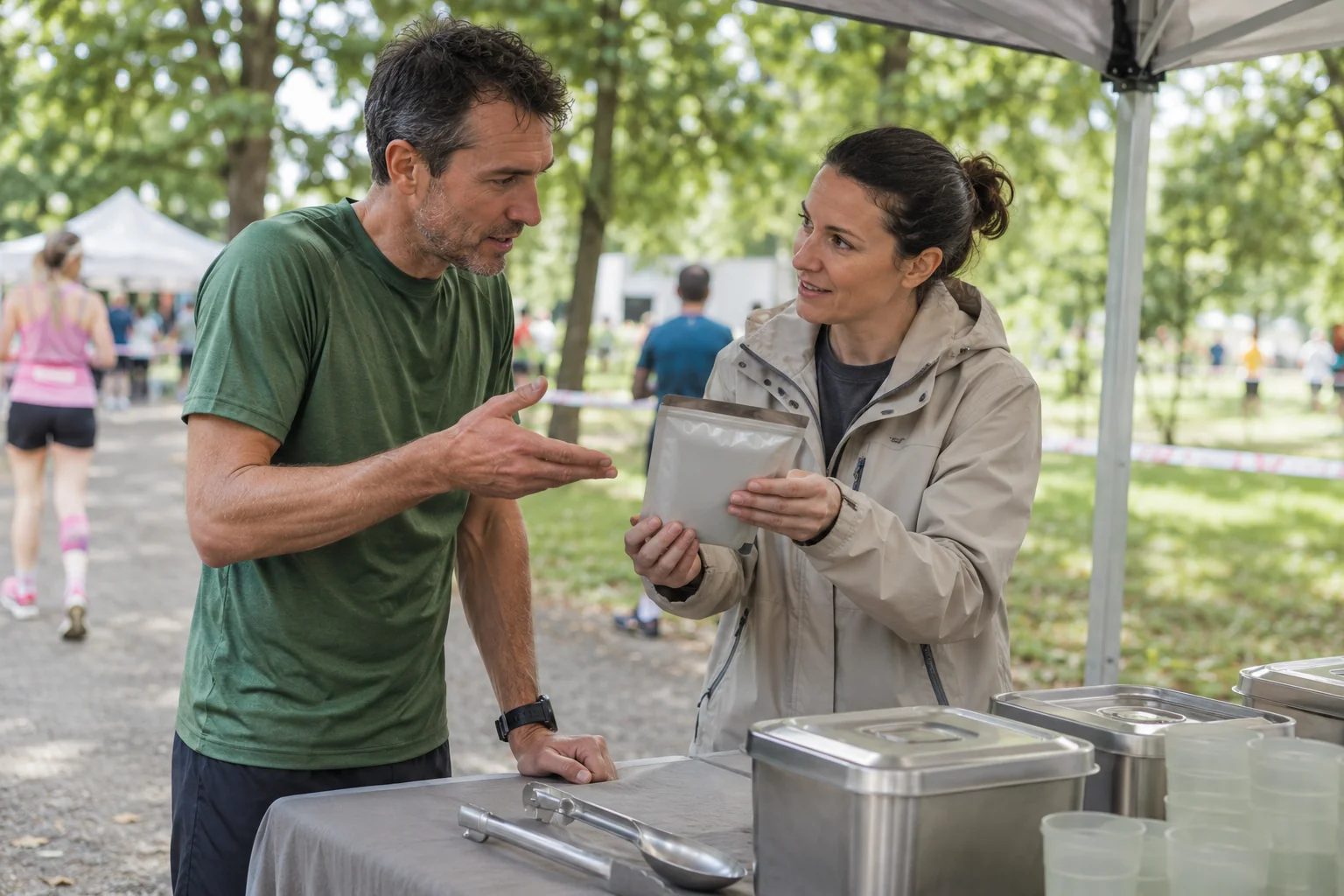
Show the exact location: which pocket or bag, how the outer container opens and whether it stays with you throughout. You do not need to activate, dismantle or prepare the real device as a trial. Obtain use training from an appropriate professional and material for that device when needed. Finding the bag and knowing how to administer medication are separate tasks.
The Resuscitation Council UK professional answers on anaphylaxis emphasise training with the prescribed auto-injector because technique can differ between devices. They also recommend learning with a trainer device. If you receive another type, memory of the old one does not replace new instruction. A running article’s drawing or a friend’s previous device is therefore not a suitable universal user guide.
One useful sentence is: ‘If I become unwell, we should not walk back to the car.’ Your companion then need not guess the help intended. Their role is not a heroic promise to prevent every problem; it is knowing the reference points and seeking help. Responsibility in a friendship cannot rest entirely on one person’s shoulders.
 Enlarge image
Two prescribed devices should be accessible together
The MHRA medicine-safety guidance emphasises always carrying two adrenaline auto-injectors and checking expiry dates for people prescribed them. A kit is not equivalent if one is with you and the other in a distant car. Follow your own prescription and emergency plan; this article does not select a device or medicine for you.
Think through access across the whole day. A race may involve bag drop, waiting in a start zone, a separate finish area and travel home. If the bag stays only with a supporter, they may be at another gate or street when needed. ‘Somewhere nearby’ is insufficient. Arrange carrying that works at the real stages of the outing in line with your plan.
If equipment changes during the route, do not discuss its location only at the start. Removing layers may move belongings to another bag while keys go to another person. Emergency equipment should not disappear in this reshuffling. One shared, known location may help if it meets product storage and personal-carry guidance. The aim is a recognisable system, not elaborate bag discipline.
| Part of the outing | What should you clarify beforehand? | What can cause unnecessary delay? |
|---|---|---|
| Travel there | Do you have the current personal kit with you? | Equipment left in another bag. |
| Meeting | Does your companion know the exact location? | ‘In one of the pockets’ as the only information. |
| Bag drop | What remains accessible throughout? | Necessary belongings go into a locked bag store. |
| Route | How will you describe the location when seeking help? | An invented name known only to runners. |
| Journey home | Who keeps the plan and personal kit? | A bag elsewhere after the group separates. |
Expiry, storage and device changes in everyday life
The Allergy UK patient information on auto-injectors highlights monitoring expiry, arranging timely replacement and protection from extreme temperatures. Clarify exact storage rules through your product leaflet and a pharmacist. A sunny car or self-selected cooling method is not automatically appropriate. A bag’s name does not guarantee the heat protection it suggests.
Do not leave replacement until the evening before a race. If checks reveal a need, allow time to contact the appropriate clinician or pharmacy. A reminder helps organisation but does not replace checking. If devices have different expiry dates, inspect each; one box’s date does not represent the whole kit.
After changing devices, update what your companion needs to know. Colour, size or container may differ, and recognising the old object does not establish knowledge of the new one. Keeping a medication-free trainer separate matters too, so it cannot be confused with the emergency kit. Learn detailed use through proper training rather than improvising during a run.
Seeking help should not begin with photographing a rash
According to the NHS information on anaphylaxis, a reaction can develop rapidly, with throat or tongue swelling, difficulty breathing or swallowing, sudden confusion or fainting. A rash may occur, but you do not have to wait for one. In Hungary, call 112 immediately if anaphylaxis is suspected. Use your prescribed adrenaline auto-injector as taught and according to your plan, without delaying the emergency call.
The MHRA says a person who is unwell should not stand up even if feeling better. Lying down may be needed; breathing difficulty may require a different position. Follow the dispatcher and your emergency guidance. Momentary improvement does not mean finishing the run or forgoing care. A familiar route is no reason to walk back to the car.
The companion should tell the call handler that anaphylaxis is suspected, the exact location, the person’s condition and actions taken. In a group, another person can help emergency crews find you. Someone should remain with the person while the dispatcher directs further tasks. If unresponsive and not breathing normally, resuscitation may be needed. Observation and action take priority over group speculation about a triggering food.
Food, route and companions: start from the plan
An organiser’s general ‘allergen-friendly’ statement should not replace guidance about your known triggers. If using an aid station, ask for the specific information you need and treat an uncertain answer as uncertain. A running club need not decide for you that a small amount or brief time difference is definitely acceptable. Such questions belong to your specialist plan.
Route access should be real too. A hard-to-reach location, uncertain phone signal or a separated group creates different demands from an easily identified meeting point. But a flat park does not automatically become safe for everyone. Clarify practical location details alongside individual activity conditions; a map alone is not a medical decision.
Choosing a companion is not simply about pace. Both need to understand and accept the agreement. If someone regularly runs far ahead, the support role no longer works in the same way. This need not be called a personal fault: another outing or arrangement may fit better. Honest discussion is worth more than a kindly but undefined ‘I will look after you’.
 Enlarge image
Keep the plan accessible while protecting your information
A health plan is different information from a race number or meeting time. Share it only with people you consider necessary and acceptable. If stored digitally, consider who has access and can actually open it. A document inside a password-protected app on a locked phone may be unusable to a companion. Discuss suitable format and content in care too; there is no need for a public cloud folder.
Information given to an organiser should not automatically become a group medical introduction. Ask for the necessary contact to know the plan without sending detailed messages to everyone. Sharing what emergency care requires differs from community storytelling. Briefing friends aims to reduce uncertainty in an emergency, not make them treat you constantly as a patient.
If you have had a reaction, you can also choose whom to discuss it with afterwards. Preserving facts may help professional follow-up, but a public post or detailed discussion with every participant is not required. A running partner can ask what practical change would help next time. Update the sporting plan from individual post-care guidance, not the immediate feeling of relief.
Questions to finish the pre-start discussion
Do you and your companion mean the same place when describing the kit’s location? Have you learned the current device’s use through proper instruction? Does the plan explain which signs require action and help? Will equipment remain accessible throughout? These are not tests proving zero risk. They keep using existing guidance from depending on small practical obstacles.
If something is uncertain, bravery is not a substitute. Seek further training, change the outing or review the individual plan with your care provider. A companion’s presence is valuable support, not a guarantee or medical clearance. In a working agreement, both know their roles and when outside help is needed.
Good preparation is often quiet: updated contact details, checked expiry, an accessible pocket and a precise sentence. It need not become an equipment demonstration. What matters is that your plan is understandable and reachable in real circumstances. Running then finds a place alongside care under its conditions, with the necessary option of seeking help.
Sources
- BSACI: professional background to adult allergy action plans
- BSACI: adult action plans
- Resuscitation Council UK: anaphylaxis, training and devices
- MHRA: safe use of adrenaline auto-injectors
- Allergy UK: looking after adrenaline auto-injectors
- NHS: anaphylaxis
- Resuscitation Council UK: 2025 first-aid guideline
How Futószív articles are prepared: our editorial guidelines.