The first night with a new watch starts a measurement change
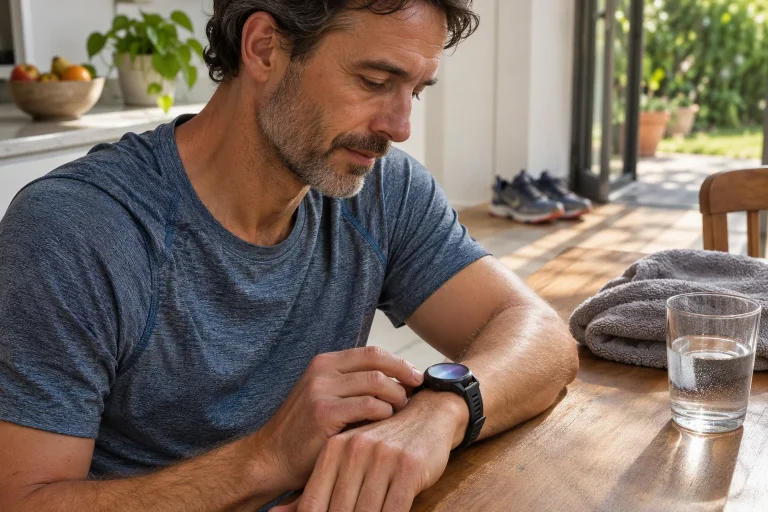
You put on a new sports watch, and next morning HRV differs considerably from the old device’s usual value. The first question is not whether your condition changed that much overnight. The measurement system is new too. Another sensor, time window, aggregation and personal history may underlie the number. Mark the watch-change date as a method change in the log rather than merely new equipment arriving.
HRV is more than a name on a screen. The Kubios professional guide lists different metrics, including RMSSD derived from successive beat-interval differences and SDNN expressing the intervals’ standard deviation. Identical millisecond units do not make them identical calculations. Naming the exact metric is already necessary before joining two devices’ series into one continuous line. Source: Kubios HRV metrics.
The change makes neither watch worthless. Instead, comparability needs treating as a separate task. The old series was interpretable within your earlier system; the new one may build a new reference framework. Preserving this boundary helps prevent later attributing a jump to training or illness when it coincided partly or entirely with changing the measurement procedure.
Place the method profiles side by side
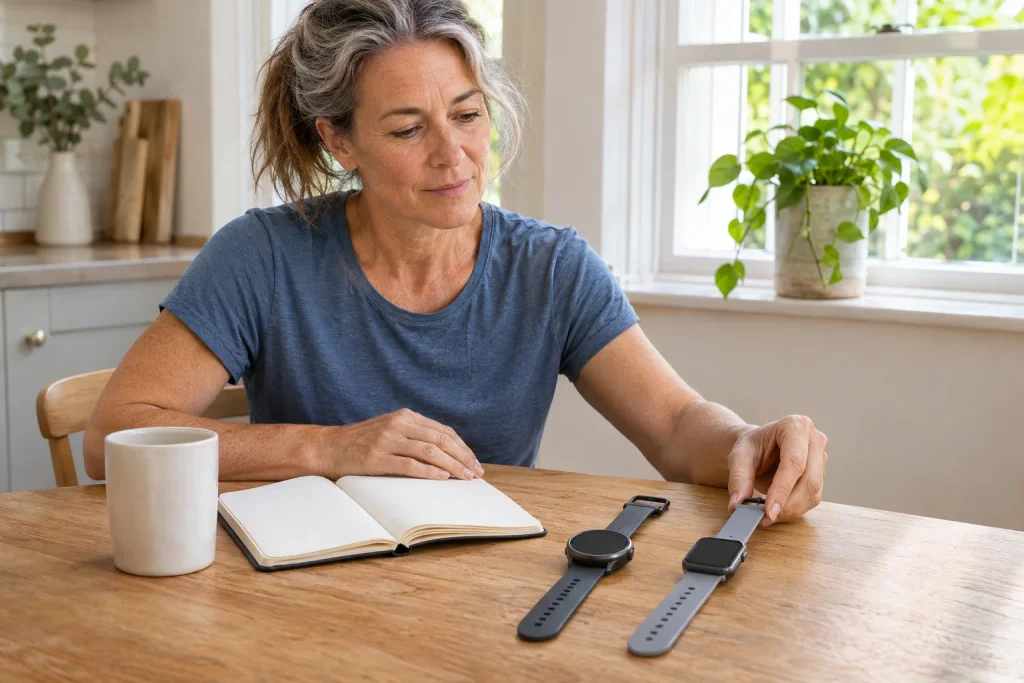
Record a few details for both devices: exact model and software version, feature name, displayed metric, measurement period and aggregation. A short morning measurement is not a whole-night average. One night’s value is not a multi-day trend. If documentation omits a detail, leave it unknown. A guessed profile would create false confidence for later calculation.
Polar Nightly Recharge, for example, specifies heart rate, HRV and breathing-rate data from roughly the first four hours of sleep for its ANS component, relative to the usual level. Garmin HRV Status instead compares its seven-day HRV average with a personal baseline range. Their labels are not renamings of the same raw number. Source: Polar Nightly Recharge. Source: Garmin HRV Status.
In a table, therefore, give numerical HRV and a composite recovery classification separate rows. “Good” in two products may summarise different histories and several inputs. If one system gives a score and another milliseconds, a simple combined mean is impossible. Narrow the question first: are you comparing identified data with the same purpose or reading two systems’ own summary messages alongside one another?
 Enlarge image
A short overlap can document differences without validating everything
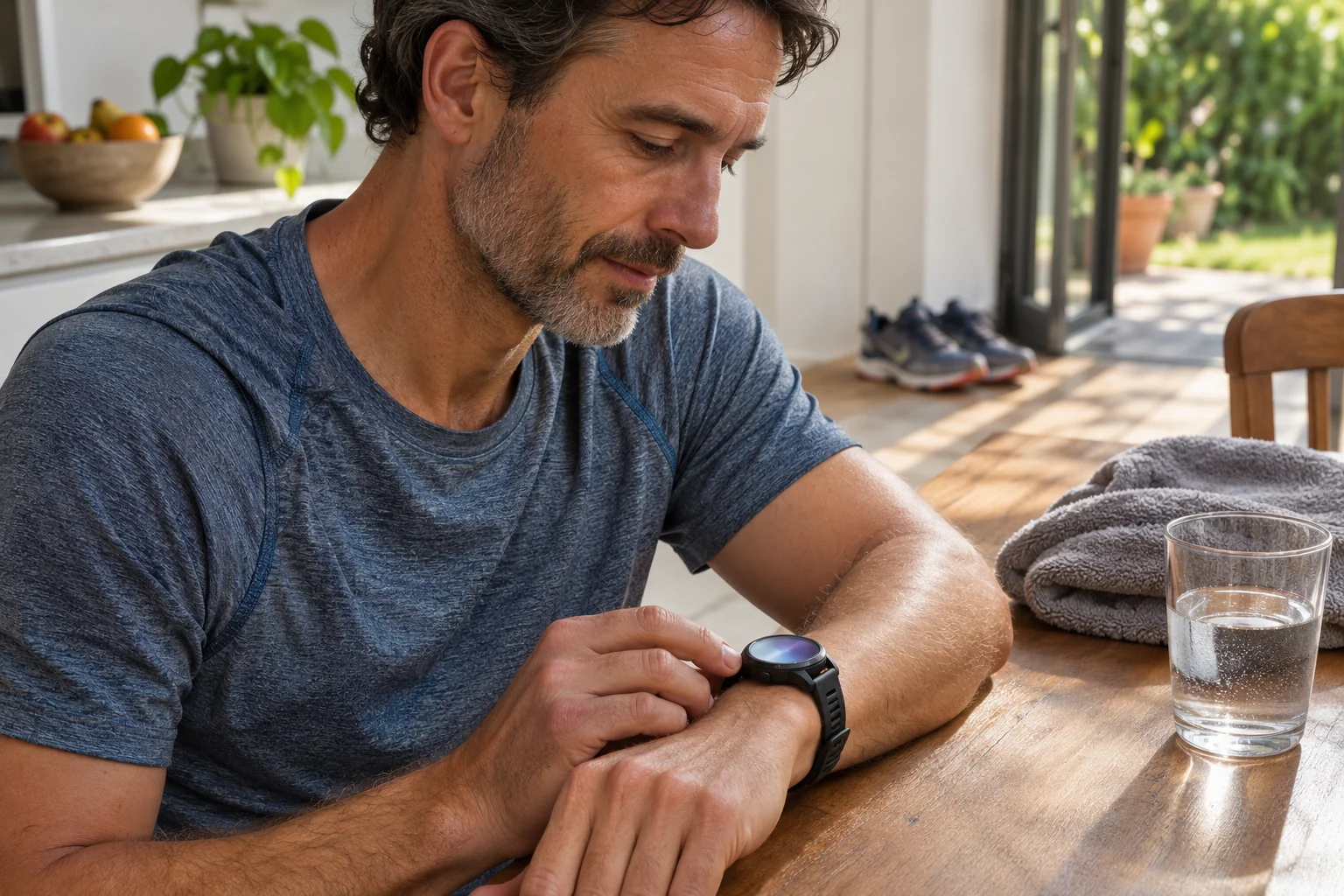
If using both devices simultaneously is comfortable and compatible with manufacturer wearing instructions, you can keep a short overlap. Its purpose is observing your pattern rather than producing clinical accuracy certification. Record how you wore them and which nights yielded suitable data in both systems. Presence on the wrist alone does not prove flawless recording. Mark gaps or uncertainty visible in the app too.
Do not begin overlap by forcing the new watch’s value towards the old one. Retain both original series and the meaning of their time windows first. Wearing another device on the other hand introduces a wearing difference. Summaries from different portions of the night also differ in period. A personal trial helps only when these are not hidden for the numbers’ sake.
Do not replace a missing night with yesterday’s value for a continuous graph. Missingness is information about overlap: no suitable comparison pair exists that day. Keeping only occasions when watches agree well biases your result. A simple advance inclusion rule is to pair only data actually available in both systems and unambiguously assigned to the same date.
Looking for a constant difference is not automatic calibration
In an invented example, five morning pairs show old-device values of 40, 42, 38, 45 and 41, and new-device values of 48, 50, 46, 53 and 49 milliseconds. Each differs by eight. This attractive simple pattern still does not establish that eight should be subtracted from every future new value. A short series covers limited ranges and circumstances. Another window or processing method may yield a different relationship elsewhere.
In a second example, retain the old series while the new one becomes 44, 51, 42, 58 and 47. Differences are 4, 9, 4, 13 and 6. One average correction does not describe every pair. Calculation helps recognise a non-constant difference rather than create a new health scale from a small sample. Observing differences between your series is separate from determining which device measures closer to an appropriate reference.
Good co-movement does not establish identity either. If every new value were one and a half times the old one, rises and falls could align perfectly while numbers differed systematically. Consider this mathematical example before calling similarly shaped graphs interchangeable. Preserving rank, numerical agreement and substitutability in use decisions are three distinct claims.
Research comparisons name the reference too
Johansson and colleagues’ work published in 2026 examined separate ECG, an H10 chest strap and a phone-camera app in 37 trained participants. Reliability and agreement were analysed using two short recordings on the same day. This is not investigation of unrestricted interchangeability between two overnight watches. The example matters because method, recording environment and the reference’s role are specified. Source: Johansson and colleagues, original research.
A home overlap generally lacks such an external reference. Your conclusion should therefore concern the systems’ relationship to each other. “On five shared nights the new value was consistently higher” is traceable. “The new watch is more accurate” needs further evidence. The older system does not become truth because its numbers are familiar. Wanting continuity is understandable but does not replace measurement validity.
Do not copy an accuracy percentage from a paper as your new device’s error limit either. Its particular sensors, software and short recordings form a different setup. Research can help ask an appropriate question rather than answer every later model in advance. Organise the origin and comparability of your data during a switch. If these cannot be established, retain the series separately.
Do not transfer old colour thresholds while the new baseline develops
Garmin’s cited manual requires three weeks of consistent sleep data for HRV status. Missing classification in the first days can therefore be a known prerequisite rather than malfunction or poor recovery. Find your model’s documentation on when and from which data a usable reference develops. Do not automatically rewrite the old watch’s range as the new system’s expected personal baseline. Source: HRV Status data requirements.
Transferring colours and categories can be particularly misleading. If an old device marked a value as usual, the same threshold cannot classify a new device’s differently produced value. The reference framework is part of the feature. Interpret the new system’s baseline and feedback under their own conditions. The log can continue during transition without ending every morning compulsorily with a colour.
Keep training history and notes about how you feel alongside the developing baseline too. These are valuable even without watch confirmation. During method-change weeks, avoid judging all preparation from one new metric. The first available category does not replace a personal loading decision. The system’s learning period is no justification for an extraordinary test workout or arbitrary correction.
 Enlarge image
Keep the changeover line visible in the log
The simplest solution is two separate series and a clear device-change marker. They can share a graph if the legend distinguishes them and you do not join the methods without evidence. Preserve the long-term account without losing the technical boundary. Running history may be continuous while the measurement method changes at one point. Both statements can be true.
If making an illustrative adjustment in a working copy, preserve the original and name the modification. A series shifted by an invented constant must not later appear as original measurement. Retain the transformation’s purpose and formula too. This transparency matters when looking months later for relationships between training, rest and condition changes. An attractive overlay is not worth losing measurement origin.
Old data need not be discarded because they cannot map directly onto the new scale. Within their own system they may show earlier patterns and recall training-period circumstances. The new series gradually develops its own interpretive framework. A precise log can preserve two methods at once. A falsely continuous graph is convenient briefly but makes later numerical changes harder to understand.
Do not turn technical transition into self-grading of health
If the new watch shows a different number, clarify method and data quality first. Handle symptoms or persistent changes in wellbeing separately; a device change does not automatically explain every symptom. Conversely, a favourable-looking new value does not rule out a health problem. A traceable log can inform necessary professional assessment, but a new HRV category is not an independent diagnosis.
Ask manufacturer support a targeted question by providing full old and new model names, feature, measurement window and observed difference. Ask whether transfer of the earlier baseline is supported or new history is required. Do not assume every switch within an ecosystem works identically. A specific answer can prevent unnecessary resets, deletion of old data or incorrect manual rewriting.
A new watch fits the running log well when you also reorganise interpretation in the first weeks. Metric name, time window, personal baseline and original recording give the data meaning together. You need not force two systems onto an unproven common scale to learn from both. A visible change boundary makes the long-term account credible and helps separate a technical jump from an overnight change in your body.
Sources
- Johansson and colleagues: investigation of HRV devices
- Garmin Forerunner 570: HRV Status
- Polar Nightly Recharge
- Kubios HRV Scientific 2026 guide
How Futószív articles are prepared: our editorial guidelines.