Garmin Index S2 is a home smart scale offering body-composition estimates from bioelectrical impedance alongside weight, with Wi-Fi synchronisation to Garmin Connect. Convenient log integration may appeal to runners. Weight and impedance-based estimates are different measurement questions, however: one being meaningfully trackable does not automatically turn the other into a laboratory result.
This guide uses manufacturer documentation checked on 21 November 2026 and general smart-scale research. It is neither our own Index S2 accuracy test nor a weight-loss programme. Its aim is to clarify conditions, data transfer and interpretation limits. We do not turn the scale into a running-fitness grade or consider lower weight necessary or beneficial for every runner.
Weight, BMI and BIA follow different paths
Weight relates to the scale’s load measurement. BMI is calculated from entered height and weight, while body fat, body water and other composition fields involve further calculations. BIA, bioelectrical impedance analysis, uses the behaviour of a small electrical signal passing through the body. From that and profile data, the device estimates composition; it does not directly image fat, muscle or bone.
Our purely arithmetic BMI example: 75 kilograms and 1.75 metres give approximately 24.5 using 75 / 1.75². This does not grade a particular runner’s health. The formula includes no separate performance, injury, training history or strength. Displayed BMI is therefore not a newly and independently measured body property, but an index calculated from supplied data.
Check each label’s units separately too. Percentage body fat and muscle mass in kilograms are different variables; a one-unit movement does not mean the same thing. More decimal places do not demonstrate greater biological accuracy either. Display resolution and overall measurement error are separate properties that cannot be established from an attractive app graph.
What do body water and bone mass mean on the display?
The body-water field is an estimate relative to total mass, rather than a direct measure of sweat lost during running. Changes in fluid status may affect bioimpedance, so a post-run difference cannot immediately reveal an exact drinking amount. Body-water percentage and hourly fluid loss have different units and paths.
Estimated bone mass is not bone-density measurement. It cannot show a particular bone stress injury or establish that a painful leg can safely run. Muscle mass does not directly examine one muscle’s strength or volume either. Where a health question exists, do not select or replace a necessary investigation from a scale label.
Add the method name alongside data in your log. “Index S2 BIA estimate” is more accurate than “laboratory-confirmed muscle mass”. Two scales using different calculations may yield different results on the same day. That alone does not mean body composition changed within hours; clarify method and conditions first.
Settle measurement conditions before interpreting trends
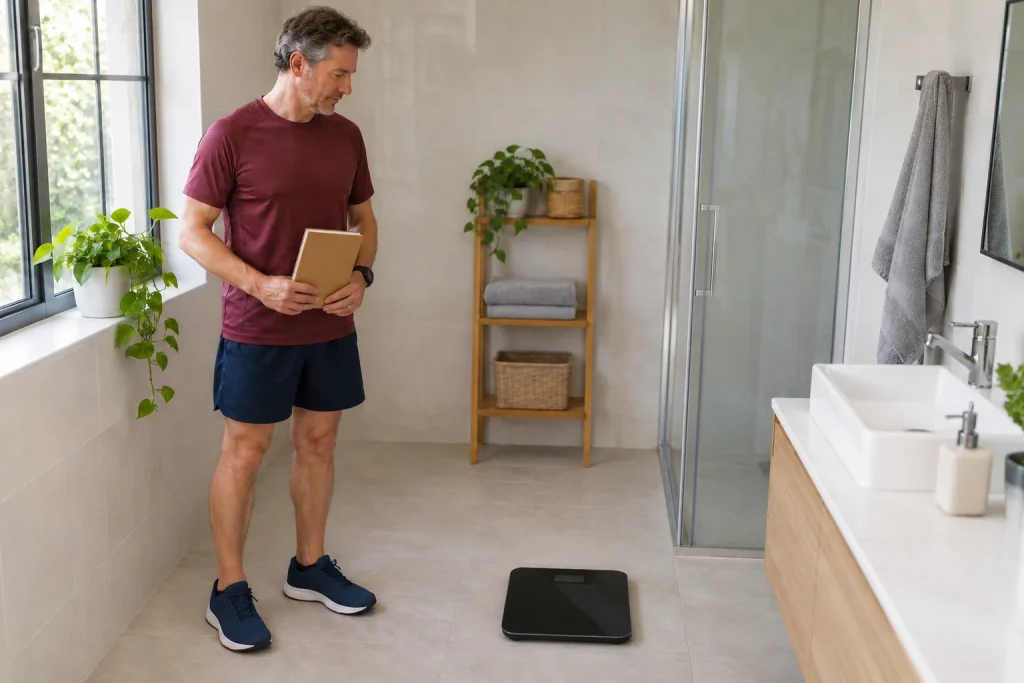
Manufacturer reading instructions require a hard, level floor and standing calmly barefoot with feet on the appropriate glass surface. Shoes and socks can add more than weight: they alter electrical contact too. Stepping on the display edge or scale rim is inappropriate. A dry, intact surface and stable placement underpin repeated measurement.
Garmin’s comparison support recommends similar conditions, approximately the same time of day and correct profile data. It specifies waiting two hours after eating, drinking, exercise, bathing or sauna for body-composition measurement. This is a manufacturer measurement protocol, not advice to postpone necessary fluid or food for the scale. If the occasion is unsuitable, skip the measurement.
Do not merge an evening clothed weight with a morning recording under different conditions. The same applies immediately after exercise. A consistent, less frequent series may be easier to interpret than many dissimilar moments. Match frequency to your purpose and wellbeing; the device does not require several checks daily.
 Enlarge image
Why does good weight measurement not prove accurate body composition?
Frija-Masson and colleagues’ 2021 JMIR study compared three other brands’ smart scales with DEXA. Weight readings were relatively close to the reference, but body-composition estimates were not suitable substitutes. Models were Téfal Body Partner, Terraillon DietPack and Nokia Withings Body Cardio. This was not an Index S2 test, so we do not assign their specific errors to Garmin’s model.
The methodological lesson separates the tasks. A device may track weight reasonably well while its algorithmic fat-mass estimate carries different uncertainty. A manufacturer-recommended routine may reduce inconsistency but is not laboratory validation by itself. A trend using one method does not become certain tissue change merely because it has more points.
If precise professional body-composition assessment matters to you, clarify method and interpretation with an appropriate professional. We do not claim every runner needs regular DEXA. Ask instead which decision the information will support and what evidence that requires. Simple home observation and a healthcare decision are different purposes.
Profile and Athlete Mode: settings change the model
Garmin support emphasises correct birth date, height, sex and activity profile. Athlete Mode may yield different body-fat estimates; the manufacturer has a separate FAQ for unexpectedly low values. Do not keep changing profile data until a preferred number appears. That harms comparability and makes the next graph unable to separate effects of the setting change.
The manufacturer also supports manually entering certain recent reference body-composition data in your account. This still does not turn the device into an equivalent laboratory investigation. A reference has a date and measurement background; later device figures remain estimates. Combining a reference value and proprietary algorithm is not independent repeated validation.
Mark firmware or profile changes separately in your change log. If you alter a setting one day and see a large jump the next, start interpretation there. A less dramatic but traceable series is more useful than a profile adjusted for “better” numbers. Personal app feedback is not a contest for the smallest percentage.
Wi-Fi synchronisation and the Connect account path
Full Index S2 setup uses pairing through Garmin Connect and compatible Wi-Fi. Initial Bluetooth pairing and later automatic network upload have different roles. A phone seeing the scale does not prove a measurement reached the cloud account. Checking the correct profile and fresh timestamp belongs in the functional trial too.
The manual allows up to seven stored Wi-Fi networks, managed by the device owner. Switching to another network has a separate setup mode. Manufacturer instructions say opening that mode alone does not delete stored users and networks. It differs from a full factory reset, so select the action behind RESET according to its precise description.
For troubleshooting, first check whether the scale recorded a result, then network state, then the appropriate date and user in Connect. A good display value missing from the log need not be a measurement fault. Do not try to fix network or account problems by rewriting profile data; that could alter a functioning calculation condition.
Multiple users: check initials too
The owner can invite fifteen additional people, giving sixteen profiles in total. Each needs their own Garmin Connect account and documented invitation link. The scale identifies users by weight and displays initials. With similarly weighted family members, do not assume the selected person is certainly correct.
The manual describes switching a wrongly selected profile by tapping. In guest mode, measurement is neither stored in device memory nor synced to Garmin Connect. The user should understand the difference between guest and registered use. A shared bathroom device does not justify automatically sending everyone’s data into one family account.
For an initial family trial, each person should separately check the entry in their own log. Weight is personal information; shared hardware and shared cloud access are separate decisions. Do not treat someone else’s curve as a competition or comparison benchmark. Correct ownership assignment is as much part of practical shared use as good Wi-Fi.
Trend view, multiple daily readings and visible widgets
The manufacturer’s Measurements description says the scale’s one-month weight trend uses daily values; if measured several times, it uses that day’s last recording. This is not a daily average. Morning and evening measurements may therefore produce a curve following another selection rule than you imagined. Check view logic separately from the actual recording list.
Connect device settings let you customise widgets and mass fields shown on the scale. The manufacturer says a measurement must sync the change after setting it. Hiding a field is a display decision. It does not establish that BIA’s electrical measurement is disabled or make prohibited use permissible.
A simple view can retain only the few fields you actually use. More numbers do not necessarily improve understanding. If unsure of a value, find its definition and unit rather than invent another target. Observation helps when it answers a particular question, rather than attaching daily expectations to every possible curve.
 Enlarge image
Medical and practical limits of use
Garmin clearly warns that people with a pacemaker or another internal medical device must not use Index scales. It requests medical discussion before use during pregnancy or suspected pregnancy. Hiding a displayed field does not remove this, and we offer no workaround to bypass the manufacturer’s prohibition. Read the package’s important safety information too.
Use the scale on a dry, intact surface within its load limit. Jumping onto the display or edge, or stepping unsteadily on a wet floor, creates different risks from data transfer. Care instructions call for gentle cleaning and avoiding abrasive or solvent-based products. Do not judge condition solely by a Wi-Fi icon still lighting up.
If weight tracking reinforces anxiety or compulsive checking, reconsider the routine, with professional support if needed. One body-composition field does not determine running’s value. A smart scale can be a convenient logging tool, but is not compulsory running equipment. An appropriate purpose differs from constant pressure to lose weight.
Resetting and long-term data retention
The manual says full factory reset deletes users and local data on the scale, but not information already held in Garmin Connect. This matters for passing on a device or troubleshooting. A local reset is not remote deletion of every cloud entry. Handle an erroneous account measurement separately using documented options.
Retain dates of important setting changes and the measurement source in your own records. If you later change devices, do not automatically smooth away the resulting jump. Different system models may start a new baseline. This makes a series more accurately interpretable than treating every point as coming from one unchanged instrument.
Index S2’s main convenience may be an automatic log within Garmin’s ecosystem. A useful weight trend and cautiously read BIA information can together add context to running weeks. Body water, bone mass and BMI still cannot independently make sports-medical decisions. A named method, consistent conditions and modest conclusions are more useful than excessively precise-looking percentages.
Sources and verification context
Primary Garmin manual and support sources, plus general methodological research; checked on 21 November 2026. Research on other brands does not validate Index S2.
- Index S2 official product page
- Measurements – BIA, metrics and trend view
- Taking readings and automatic upload
- Garmin – body composition, profiles and comparison
- Frija-Masson and colleagues, 2021 – comparison of three other smart scales
- Index S2 v4 manual – setup and device information
- Changing Wi-Fi networks
- Additional users
- Switching users and guest mode
- Customising display and widgets
- Warnings for pacemakers, internal medical devices and pregnancy
- Device care
- Full reset and separately retained Connect data
How Futószív articles are prepared: our editorial guidelines.