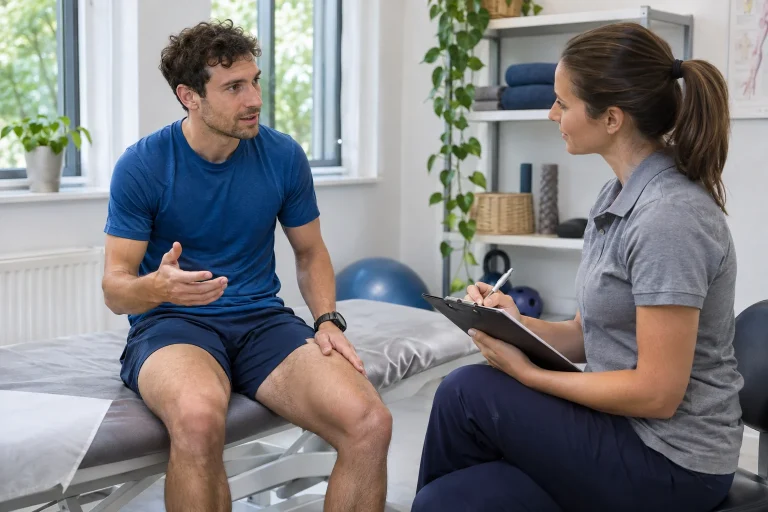
You hear clicking when standing up or moving, but there is no pain, swelling or change in usual tasks. The sound alone does not automatically mean the knee is “wearing out” or that you move incorrectly. The NHS knee-pain information distinguishes painless clicking from painful clicking, locking and giving way. Understand the whole situation rather than the sound alone.
The question can change urgently if new painful clicking, locking or giving way appears, especially after injury. Very severe pain, substantial swelling, changed shape or inability to move the knee or bear weight require prompt healthcare help; a hot, red knee with fever or feeling unwell may also be urgent. Do not explain these away through an earlier apparently harmless sound or test them through repetition.
Sound and symptoms are different information
Clicking, cracking and creaking describe what you hear or feel. Pain, swelling, restricted movement and instability are different experiences. They may occur together, but one word does not replace another. Name them separately when describing your situation. “My knee is noisy” need not mean the same as “it hurts with a click and I have to stop”.
The IASP definition of pain treats pain as a personal sensory and emotional experience and emphasises respecting the person’s account. Sound is not a volume meter for that experience. A louder knee is not necessarily more painful or more severely damaged, nor is a quiet knee healthy in every respect.
You do not need a medical term for what you hear. Explain when you notice it, whether anything accompanies it and whether usual function has changed. An account becomes useful by distinguishing a sound alone from the history of a new symptom, rather than through elaborate imitation of the noise.
What does the newer review show about prevalence?
A systematic review published in a 2025 journal issue combined 103 studies. In samples examining pain-free participants, estimated knee-noise prevalence was 36%, with a wide uncertainty interval of 23–50%. The authors rated overall prevalence evidence as very low certainty. Studies differed substantially; this is neither an exact proportion for runners of every age nor a personal risk calculator.
The review also found associations with structural findings such as radiographic osteoarthritis, but the evidence was low or very low certainty. Both findings matter together: sounds occur without pain and can be associated with abnormalities in some studied groups. An association does not make sound alone a diagnostic test. Your knee’s condition cannot be read from a pooled proportion.
The research does not mean everyone needs imaging because of a sound, or that sound can be ignored in every circumstance. Current symptoms, history and function matter for the individual question. Evidence helps when used within its limits, rather than turned into a promise of certain future disease or complete safety.
 Enlarge image
Why might a follow-up study still discuss risk?
In Lo and colleagues’ 2018 publication, data from 3,495 Osteoarthritis Initiative participants were analysed; average age was approximately 61. More frequent self-reported knee sounds were associated with higher odds of subsequent osteoarthritis defined by symptoms and radiographic changes together. Most new cases arose among people who already had radiographic changes at baseline but no frequent knee symptoms.
This is observational information from a group of particular ages and backgrounds, rather than proof that sound causes damage. The right knee was analysed, and patellofemoral osteoarthritis was not systematically assessed. It cannot assign identical future risk to every pain-free young runner or show whether silencing a knee would change outcomes. This study cannot replace assessment of personal history either.
Risk and current diagnosis are therefore different claims. Research can describe a group-level association without classifying every sound as disease. General reassurance must remain precise too: painless sound alone often does not indicate a problem, but new symptoms, injury or functional changes need separate assessment.
What changes alter the individual question?
One important difference is accompanying pain. A longstanding painless sound is not the same situation as a new click that makes you stop. Describe timing, activity and sensation in your own words. You do not need to reproduce it repeatedly so it can be heard more clearly. The history of an existing symptom can begin the conversation.
Swelling, locking or giving way also raise a different question. Do not call these merely sounds. The NHS discusses them among situations needing urgent attention, so seek appropriate help rather than drawing reassurance from the earlier symptom-free period. Change matters, as does its effect on usual functioning.
An injury event is separate information. Do not merge a new phenomenon after a fall, twist or collision with an old knee sound, even if it sounds similar. Explain what happened, what you could do afterwards and what has changed. Sound alone cannot establish which structure is or is not injured; the next step may depend on the whole situation.
No sound test or technique correction is required
Focusing on which squat or turn produces a sound can easily create another series of tasks around the knee. That may provide little useful information and is unnecessary for understanding painless noise. Avoid repeating painful, forced or uncertain movements in particular. This article gives no home noise test and does not classify your knee by the click’s character, location or strength.
Nor do you need to rewrite your running movement solely to hear nothing. Quieter execution does not prove better joint function by itself, just as a sound does not automatically establish a technical fault. Discuss a concrete movement question with a professional using the task, history and individual feedback. Removing one sound is not the goal of individual assessment.
Do not automatically link the phenomenon with buying something either. A brace, insole or product advertised for “cartilage protection” does not become necessary because of sound. If a device belongs to an individual care plan, understand its role with the professional. This article does not recommend abandoning prescribed support, but does not treat a quiet knee as a health outcome purchasable through a product.
A brief observation may suffice; constant checking is unnecessary
If asking a professional, note whether the sound is longstanding or new, whether pain, swelling, obstruction or changed function accompany it, and whether there was an injury event. You do not need to count every click. Repeated audio and video recordings are not compulsory proof either. The amount of digital material does not make personal history assessable.
With no change beyond the sound, you can still ask about uncertainty. You need not first provoke symptoms or complete a symptom list. Rather than repeated self-checks, clarify once what changes to report later. Answering the question should not become a daily examination of how quiet your knee was.
If worry about the sound persistently limits movement or everyday life, mention that too. It neither proves an injury nor makes the fear insignificant. Appropriate explanation and support may help understanding. You do not need progressively harder running tests to disprove concern.
 Enlarge image
An already known knee condition also has its own context
After earlier injury, surgery or rehabilitation, place the sound within your personal history. The general observation that painless clicking is common does not override care instructions. Report a new or different phenomenon to the professional following your plan. Discussion concerns not only what you hear, but changes in function and relative to earlier history.
Having no symptoms is not general certification of fitness to run. Other health or exercise-load considerations can affect individual activity choice. This article explains sounds, rather than providing full screening. Equally, a known condition does not mean every later sound belongs to it. Describe change accurately rather than automatically fitting it into the old explanation.
Discuss your task and necessary framework with a coach, and clinical questions with an appropriate professional. You do not need a report or audio recording to justify yourself before a group. Useful sports planning answers a specific question, rather than trying to make everyone’s knees follow one quiet model.
Let the whole story matter more than the noise
In a fictional situation, a runner has occasionally heard a painless click for years without noticing functional change. Later, swelling and instability appear after an injury event. The earlier reassuring history cannot settle the new situation; accompanying symptoms require appropriate assessment. The example offers no diagnosis, but shows when the question changes.
Painless knee noise alone is therefore not a certificate of knee condition. It is common, and need not prompt an immediate conclusion of cartilage damage or technical fault. Pain, swelling, locking, giving way, injury and changed function, however, can create a new assessment situation. Understanding your own history offers more guidance than repeatedly testing or seeking to silence the sound.
Sources and research limitations
NHS: Knee pain; Couch and colleagues, 2025: Noisy knees, systematic review; Lo and colleagues, 2018: Subjective Crepitus, OAI cohort; IASP: definition of pain. Study associations are not individual diagnoses; prevalence evidence is very low certainty, and the example story is fictional.
How Futószív articles are prepared: our editorial guidelines.