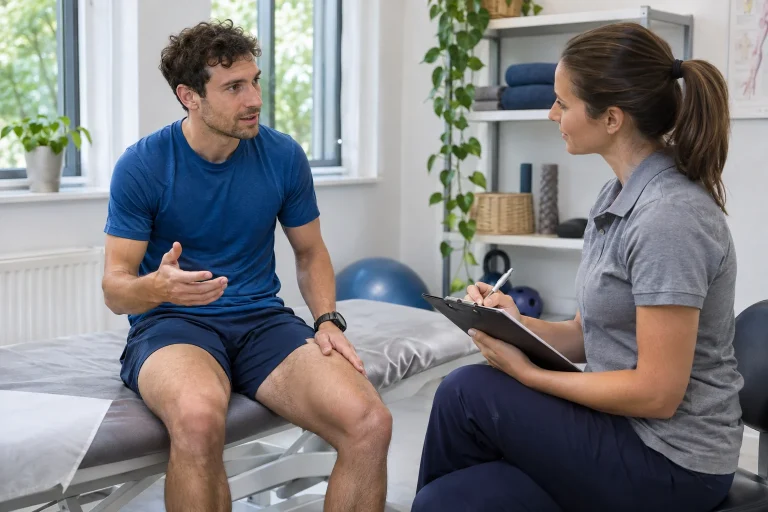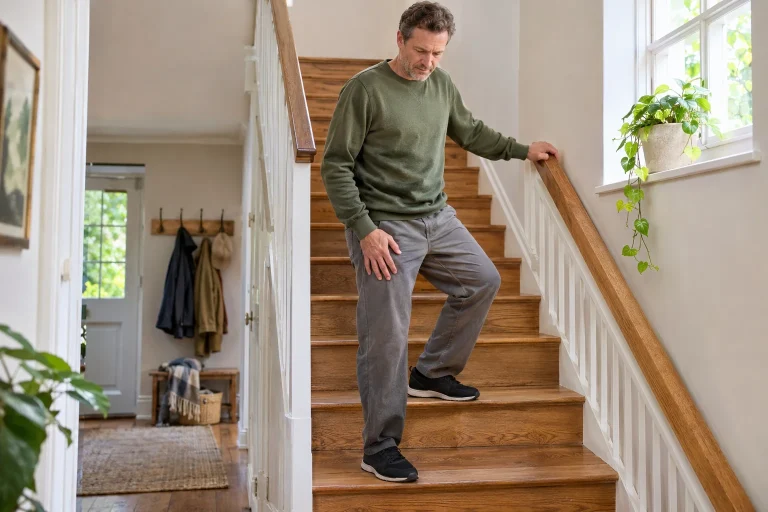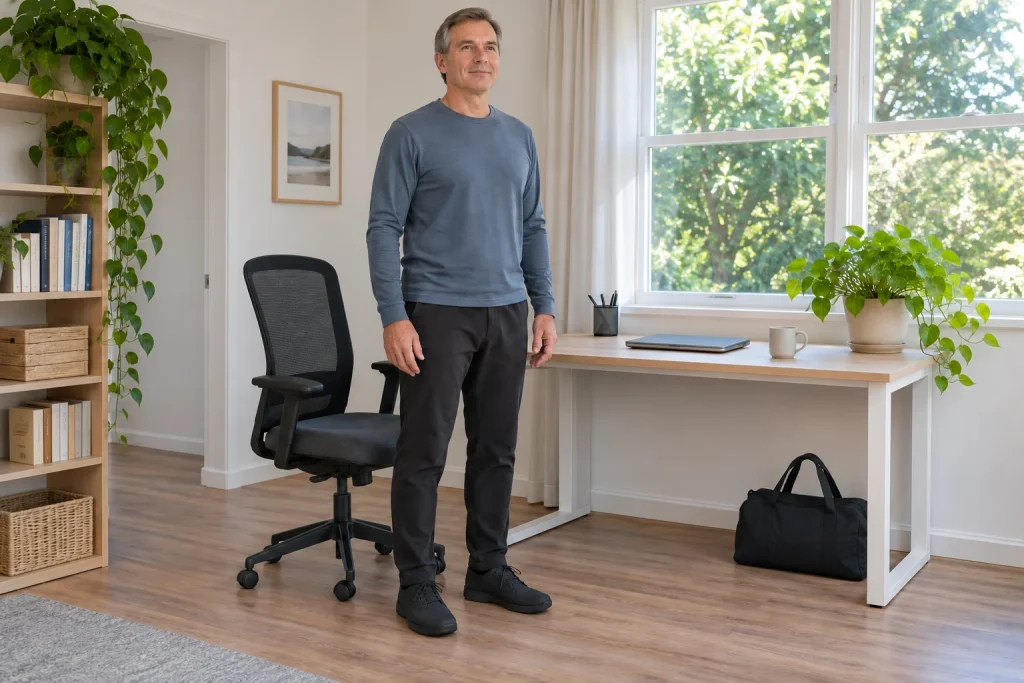
You remember the run more readily than the hours spent in the office or car beforehand. Yet pain at the front of your knee may become most noticeable when you get up after prolonged sitting. Your movement history does not end with the kilometres recorded in an app. The sequence of sitting, standing up, travelling and later sport can support individual assessment without identifying the cause of pain by itself.
Do not start with a diary if urgent signs are present: very severe pain, inability to move the knee or bear weight, significant swelling, a change in shape, locking or giving way require prompt healthcare help. A red, hot knee with fever or feeling unwell may also be urgent. The NHS knee-pain guide highlights these specifically. You do not need to check such a problem by running or repeatedly standing up first.
What does “it hurts after sitting” mean?
This wording can cover several sequences. Do you feel it while sitting? Does it become noticeable as you stand? Does it occur in the first few steps or later during another activity? Explain the distinction in your own words. You do not need another prolonged sitting test; describe what actually happened. Symptom timing is information, rather than the result of a home diagnostic task.
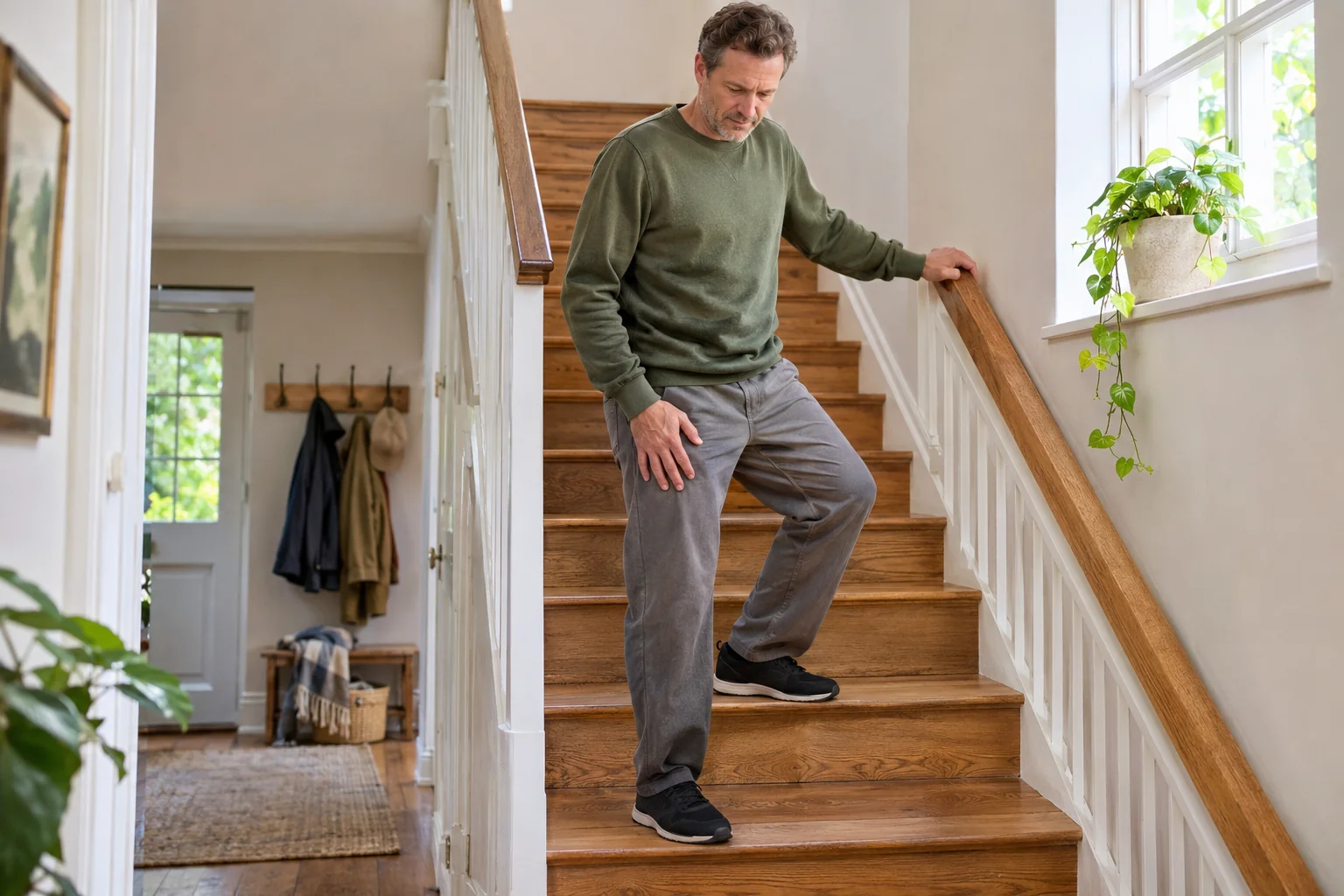
The AAOS information on patellofemoral pain includes front-of-knee pain after prolonged sitting with bent knees among possible symptoms. Its examples include the cinema, car journeys and flights. This does not mean every such problem is patellofemoral pain or that sitting explains it as a single cause. The pattern may provide a reference for further assessment.
Describe the location as precisely as your experience allows. Is it around the kneecap, behind it or more below it? On one side or both? Being unable to point to it with one finger does not invalidate the symptom. Avoid inventing a tissue explanation simply to sound precise. Describing the sensation and establishing its cause are different tasks.
Position is part of the story, rather than a culprit
During prolonged sitting, knee position and surroundings can vary greatly. A high or low seat, limited legroom, a car seat, public transport and an office chair present different circumstances. Mention details when they seem connected with your experience. You do not need to find one “bad posture” explaining everything or blame yourself because your job involves sitting.
The IASP professional overview discusses patellofemoral pain as multifactorial. Prolonged sitting with bent knees can aggravate symptoms, but understanding symptoms and their persistence cannot be reduced to one mechanical explanation. This does not give an individual diagnosis, and we do not prescribe the same chair height or mandatory sitting angle to everyone.
If the setting can be changed, discuss a concrete practical task: is there enough room, is help with adjustment needed, and what options exist for organising the day? A change does not retrospectively prove the cause. A position feeling more comfortable still does not reveal which tissue hurt or why. The observation remains valuable without becoming a complete explanation.
 Enlarge image
Map the day using a few main events
A timeline may need only work or travel, prolonged sitting, standing and walking, then the planned sport. Add where symptoms appeared and what was new or unusual. You do not need minute-perfect data from every day. A few important events recalled in your own words can ensure that the last kilometre of a run is not the only thing you can name in a healthcare conversation.
If the symptom was present before running, say so. Not feeling it while seated but feeling it after standing is another sequence. If it became noticeable during travel after sport, do not automatically rewrite that as “running caused the pain”. This article cannot decide which event caused it. A clearer sequence prevents an uncertain association being passed on as established fact.
Changes matter in the notes too: did it previously occur in one situation but now occur during other activities? Does it affect walking, work or sleep? Do not hide reduced function behind sporting data that still look similar. If symptoms persist, worsen or interfere with everyday functioning, seek individual assessment; you need not collect a long series of data first.
Running mileage is only one circumstance
Life can change even when running distance stays the same. Your commute may be longer, your workstation different, you may use more stairs or have added another sporting task to the week. AAOS also mentions changes in activity frequency, duration and intensity as potentially important history. A kilometre total alone therefore does not contain everything relevant to assessing symptoms.
The character of running may differ too: a new route, different surface, more downhill, a shared group pace or a longer journey can accompany the same distance. You need not immediately identify one detail as wrong. Explain what actually changed and what remains uncertain. Bringing events together during professional assessment is more useful than randomly replacing one factor.
Fellow runners’ experiences cannot settle your situation either. Someone may have a similarly named problem with a different history, and an adjustment that helped them may not be your next step. There is no need to compete over who sits more or has greater weekly mileage. Your story becomes useful through clear description, rather than comparison.
Organising sitting and providing treatment are different tasks
Options at work or while travelling are often limited. Where possible, you can discuss arrangements that do not require staying in one position throughout, but feasibility depends on your environment and individual condition. This is not a standing-up timer or physiotherapy programme for everyone. We do not recommend painful repetitions, compulsory stair use or one mandatory alternative position.
If a planned change is uncertain, request advice applicable to your circumstances. Not everyone can easily stand, walk or choose another seat. “Just get up more often” may therefore be inadequate and does not address the cause. Identifying necessary accessibility or work-organisation support has value in itself, even while healthcare assessment is underway.
Seeking more comfortable circumstances should not become a prerequisite for care. With new or persistent symptoms, you need not try every chair setting, cushion or online tip before asking for help. Replacing objects can also introduce expense and uncertainty. Clarify the actual practical problem before purchasing; a product promise cannot replace individual assessment.
Assessment considers the pattern within the whole situation
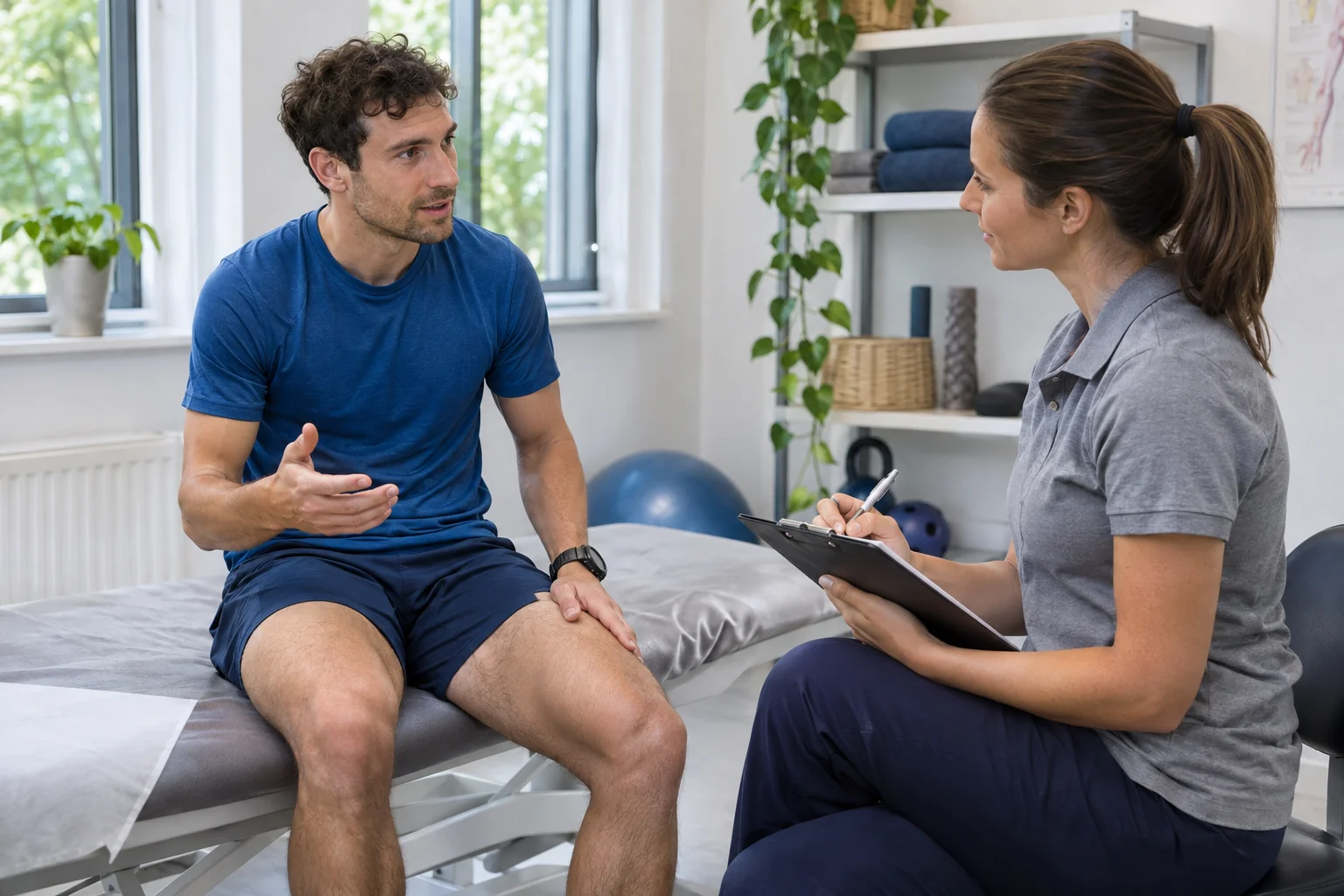
Alongside the symptom history, an individual examination can help clarify function and further questions. IASP notes that clinical assessment of patellofemoral pain also considers other identifiable causes; no single home sign settles everything. Resemblance to a symptom list therefore does not remove the need to understand your circumstances. Finding the right online label is not the goal.
More pain after sitting does not itself prove cartilage degeneration, muscle weakness or the state of a particular tendon. Likewise, the first steps improving does not automatically make any amount of running appropriate. A decision about individual exercise load should not rest on one favourable or unfavourable moment. Assessing symptoms, adjusting activity and a later treatment plan may be connected, but are different tasks.
If imaging or another investigation is considered, understand what question it is meant to answer. You need not order your own test based on a symptom pattern, nor interpret an existing result without the whole history. A useful question is what would change the next step. Naming uncertainty does not mean an absence of care; it may be part of preparing an appropriate decision.
 Enlarge image
An established condition may lead to an individual plan
The 2024 best practice guide for patellofemoral pain prioritises exercise therapy with education based on individual assessment, and links consideration of other interventions to the person’s circumstances. It does not describe a single task for every knee problem. We therefore do not copy repetition counts, pain-score thresholds or a post-sitting routine intended for every reader into this article.
If you receive individual instructions, clarify their purpose, how they relate to work, travel and sport, and what changes to report. A new symptom or worsening function may differ from the situation the previous plan addressed. That calls for feedback and reassessment where needed, rather than automatically making the programme harder according to the calendar.
A running goal need not disappear when another priority temporarily comes first. Clarifying symptoms and everyday functioning may initially matter most. Group or race plans can be reconsidered accordingly. An earlier entry, streak or app target does not override an individual healthcare framework or make replanning less valuable.
A day’s story is more than one training-log row
The following example is fictional. A runner says their distance has not increased, yet knee symptoms are becoming more noticeable. Reviewing the day reveals a new commute and longer sitting around sport, with the first everyday tasks after standing becoming harder. This does not prove travel caused the symptoms. It shows what information would have been missed by looking only at the training log.
In this example, the next step is appropriate assessment of symptoms and function, rather than self-selected chair exercises or a shoe change. Organisational circumstances can be discussed separately, but do not replace necessary examination. The day’s story then supports a decision instead of becoming another troubleshooting assignment for the participant.
If the front of your knee hurts after prolonged sitting, preserve the full sequence: what happened while sitting, standing, travelling and doing sport. You do not need to manufacture a cause from every detail. Your factual account together with individual assessment can provide a basis for continuing; running kilometres alone cannot describe the whole day.
Sources and interpretation limits
AAOS: Patellofemoral Pain Syndrome; NHS: Knee pain; IASP: Patellofemoral Pain; Neal and colleagues, 2024: best practice guide for patellofemoral pain. Symptom timing alone is not a diagnosis. The everyday situation is an original fictional illustration, not an individual treatment plan.
How Futószív articles are prepared: our editorial guidelines.