The Gatorade Gx Sweat Patch is a single-use microfluidic sweat-collection patch. An app processes the colour pattern inside it from a camera image and calculates a sweat profile. The patch does not need to transmit a continuous radio signal to a running watch. Physical sample collection and phone-based scanning form the system together; having either one does not automatically replace the other.
This guide uses official product, support and app pages checked on 21 November 2026. Alongside earlier development research, it presents contrasting findings from a 2026 primary study. It is not our own product test or a hydration plan applicable to everyone. Importantly, the manufacturer says to photograph the patch while it is still on the skin: a device removed and placed on a table is not the same documented scanning situation.
Tiny channels, colour changes and phone image processing
In the microfluidic system, locally produced sweat travels through small channels. GSSI’s technical description discusses separate channels for local sweat rate and sweat chloride concentration. Image processing of colour development and channel filling is followed by calculation. Whole-body loss is already a model-based estimate, rather than a value measured directly across the entire skin surface simultaneously.
Read the terms chloride and sodium carefully. The technology uses a chloride-related colour reaction; the app’s sodium-loss estimate relies on further relationships. It is incorrect to say the patch directly measures blood sodium or senses every electrolyte separately with laboratory precision. Sweat composition and a blood test provide different information.
Our data-path diagram in words: local sweat produced on the skin, a signal developing in a channel, a phone photograph, image processing, a body-level estimate and then an app recommendation. Sweat collection may have occurred even if the photograph is faulty; if the patch detached, a beautiful camera image alone cannot repair the sample. Look for a potential error at the stage where it arose.
Placement is not arbitrary
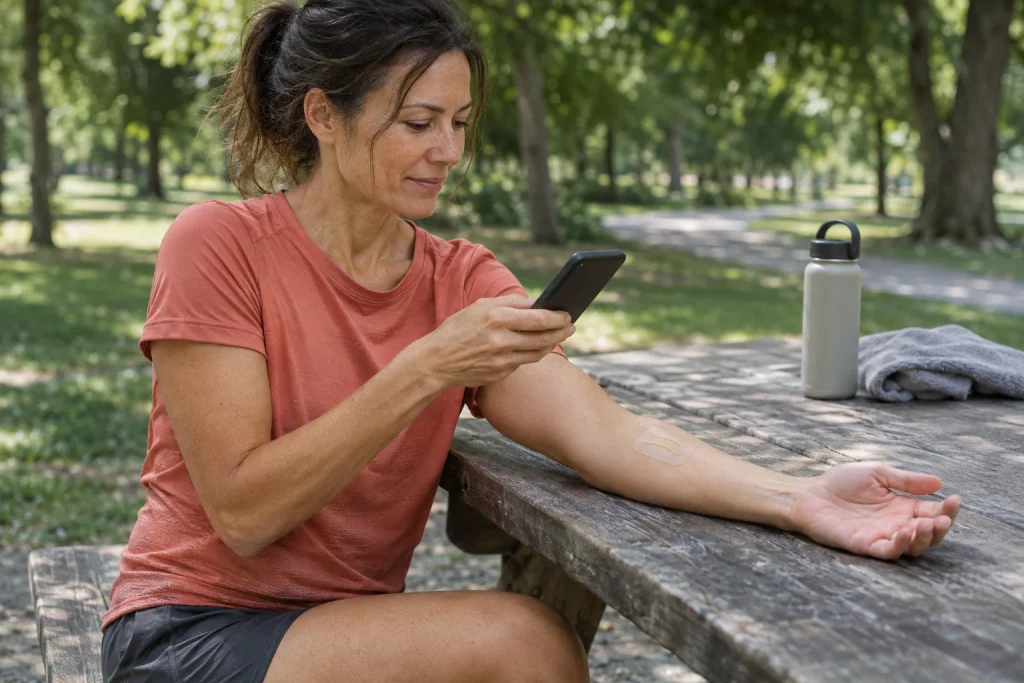
The manufacturer specifies the inside of the left forearm, approximately two to three inches below the elbow crease. The area should be clean, dry and free of lotion and sunscreen residue so the patch adheres properly. A forearm product is not therefore usable with the same calculation on the upper arm or lower leg. Its own manufacturer’s placement diagram matters more than another brand’s patch position.
Firm adhesion is part of data collection. A clothing edge, armband or another device should not lift the patch’s edge; detachment during movement is not merely a cosmetic fault to correct later. The Gatorade FAQ also details site preparation and pressing it down for the appropriate time. Reattaching an already used patch does not create a new test unit.
As a preparation sequence, make the installed app and necessary function accessible before opening the package. Then check the patch’s integrity and the placement area. If skin irritation develops, obtaining data should not become the main goal. Skipping the recording is a smaller loss than maintaining an uncomfortable wearing situation simply because the consumable is already out of its packet.
Scan it while it is still on your arm
The official consumer instructions say to photograph the patch on your arm in the Gx app at the end of activity, before cooling down. Adequate light and holding still matter. Visible colour in the sweat channel is needed for a result, but the channel does not always need to be completely full. We do not describe photographing a removed patch afterwards as equivalent to the documented procedure.
The manufacturer gives an environment of approximately 8–35 degrees Celsius and a duration of 20–120 minutes among the product’s operating conditions. This converts the 47–95 degrees Fahrenheit range; it is not recommended weather or an individual running duration. Actual filling depends on sweating, and channel saturation can also be a limit. There is no need to run longer or choose greater intensity than usual for the data.
Our photo checklist: within the same attempt, first check the app’s feedback and only remove the patch after saving. An ordinary phone photograph does not prove that the Gx recording successfully reached your account. If no usable result is available, note the fault rather than inventing an estimate from a partly visible coloured strip. Scanning failure is also a practical outcome of the method, rather than zero sweating.
 Enlarge image
What did the earlier development research claim?
The 2020 Science Advances paper presented the soft microfluidic patch, image processing and calculation of an individual sweat profile together. The solution was studied as a multistage sports-science measurement system, rather than merely a coloured sticker. One important research role was establishing the estimation relationship between the local signal and whole-body values. Research publications therefore also document the system’s development.
GSSI’s summary discusses studies across several sports and comparisons with standard patch techniques. These development findings do not mean that every home recording will produce the same outcome. Sport, contact, environment and adhesion can vary. Author and manufacturer relationships matter too: GSSI is a research organisation involved in product development, rather than a consumer-testing site independent of it.
The methodological lesson is not to ignore manufacturer research. Instead, identify precisely which claim was tested: agreement of the local signal, whole-body estimation, repeatability or scanning at home. Each may require a different experiment. Several evidential steps separate promising underlying technology from one particular user successfully completing the entire workflow every time.
Why does the 2026 study call for caution?
In Atkins, Chopelas and McDermott’s 2026 study, twenty-two participants, eleven men and eleven women, completed two matched cycling trials at 30 degrees Celsius and 55 percent relative humidity. The commercial microfluidic patch was compared with a laboratory method. Nine of the forty-four trials yielded no usable sweat-rate estimate, while the sodium-loss data dropout rate was 43 percent.
The paper reported that, on average, the patch estimated lower sweat rate and sodium loss than the reference procedure, and repeatability was also problematic in this setup. This is not an error percentage for every user in every circumstance. It is a finding from a particular sample and protocol that provides an important counterweight to earlier, more favourable validation. Selecting only one result as an advertising slogan would be unfair.
For a purchasing decision, both uncertainty around the estimate and the chance of an unsuccessful scan matter. Do not build an unchanged plan, precise to grams and millilitres, for every future race on one recording. In your own professional discussion, show how and when the result was obtained alongside the result itself. Do not treat faulty, incomplete or warning-flagged data like a checked, good-quality sample.
Gx app: iPhone, Android and availability in Hungary
The current official Gx page links to both App Store and Google Play downloads. The publisher’s own Google Play listing shows a 2026 update, so the system should not automatically be presented as a long-discontinued, iPhone-only solution. However, a US product page and an app-store listing do not prove that every Hungarian user can install and register locally.
In the US App Store, Gatorade Gx: Sports Science is listed as an iPhone app, currently requiring at least iOS 15.1, with English, Portuguese and Spanish languages. That list does not promise a Hungarian interface. Check local installation availability in your own account region. We do not recommend obtaining an old version from an unknown APK site as a workaround for using the sensor.
Before obtaining the physical package, check that you can reach the sweat-profile function you want on your own phone. An information page opening on the web and an actually usable phone service are separate requirements. If the function is unavailable, an already applied single-use patch cannot solve the problem. Compatibility checks therefore belong before consuming the patch, rather than in troubleshooting after the first run.
US terms of service and data permissions
The currently available official Gx terms page names a US audience and does not guarantee appropriate availability in other countries. This is not the same as claiming that all use from Hungary is legally prohibited; we draw no such general conclusion. For purchasing, it means clarifying local operation and customer support separately rather than assuming them from US advertising.
The app may combine profile information, health-related permissions and device connections for personalised recommendations. Apple’s privacy label indicates several kinds of data processing, including identifiers and usage data; this is developer disclosure, not an independent audit. Grant permissions you understand for the functions you actually want, and read the information currently displayed. A general “free” price label is not a data-processing summary.
For your own data review, find account deletion, identify which information you connect to another system and decide how to retain the result you need. Throwing away the physical patch is not the same as deleting a cloud-stored profile. In group data collection at a club, make clear for each person whose sample it is and who has access. Mixing up another runner’s account or result can create both technical and interpretation errors.
Smart Gx Bottle and drink logging are separate product functions
The Smart Gx Bottle in the Gx system is a separate device associated with tracking fluid intake. The Sweat Patch alone does not sense how much you drink from a conventional bottle, nor is it the consumable pod used for Gatorade drinks. Bottles, drinks, the app and the sweat patch may all share the Gx family name. Record each product’s role using its full name.
Our comparison example: one field is estimated loss, another is intake tracked from a bottle, and a third is a manually logged drink. They arise in different ways. If you incorrectly enter an amount consumed on the phone, the patch’s colour pattern cannot verify it. Logging loss and intake separately is clearer than merging everything under the word “hydration”.
Break down the system’s total price accordingly. You may only want a single sweat profile and have no need for a smart bottle. Or you may want an observation alongside an existing simple drink log. More accessories do not guarantee a more accurate conclusion when input data or recording conditions are faulty. Choose equipment for the specific missing information, rather than for the largest number of packaged features.
 Enlarge image
How can you read the result without excessive precision?
Total fluid loss and loss per hour use different units. Our arithmetic example: an estimated half-litre loss in sixty minutes would become one litre over two hours at the same assumed constant rate. This is arithmetic alone, not an actual physiological prediction or an amount to drink. The real rate can change during activity, and a short sample may not represent a longer race.
Do not unjustifiably convert an estimated range into one certain number either. If the app displays a band, its width is part of interpretation. Overlap between bands obtained in two different conditions and roughly similar averages are not the same observation. Keep the original range, environment and scanning status in your notes, especially if you want to discuss them with a professional later.
An apparently reassuring loss figure does not override symptoms. Severe illness should not be diagnosed from a Gx profile, and estimated losses do not automatically need to be replaced immediately in full. The manufacturer’s terms themselves distinguish the service from medical advice. Useful sports technology remains useful when the boundary between observation and healthcare decisions is clear.
A short operating plan before purchase
First clarify phone access and the desired function, then obtain the patch and choose an appropriate recording occasion. Check the actual Hungarian final price, shipping and customer service with the retailer; a US webshop offer is not a Hungarian price guarantee. For a consumable, read shelf-life and storage information on the package you receive too, rather than assuming an indefinitely storable supply.
Use the recording to answer an identified question, such as understanding a sweat profile associated with the circumstances of a particular activity. If you seek one number for every run, the technology may give an apparently simple but misleading answer. A well-documented sample is worth more than many unidentified patch photographs whose conditions you can no longer remember.
The Gx Sweat Patch is an interesting example of a small passive device becoming a source of sports data through phone image processing. Its development background and the critical 2026 study together show why opportunity and uncertainty need to be considered at the same time. It is not a continuous blood-electrolyte monitor or an infallible fuelling prescription. With an understood purpose and appropriate checks, it may have a place among the tools supporting a training log.
Sources and verification context
Primary manufacturer and app-publisher pages, together with research papers; checked on 21 November 2026. We did not test app installation in Hungary on our own device.
- Gx Sweat Patch official instructions – scanning while on the arm
- Gatorade FAQ – placement and Gx products
- GSSI – technical operation, chloride signal and development background
- Baker and colleagues, 2020: microfluidic system and individual sweat profile
- Atkins, Chopelas and McDermott, 2026: validity and reliability of an at-home patch
- Gx app and the separate Smart Gx Bottle
- Gatorade publisher’s App Store listing – requirements, languages and privacy label
- Gatorade publisher’s Google Play listing
- Gx terms, US audience and distinction from medical advice
- Gx Sweat Patch official product page
How Futószív articles are prepared: our editorial guidelines.