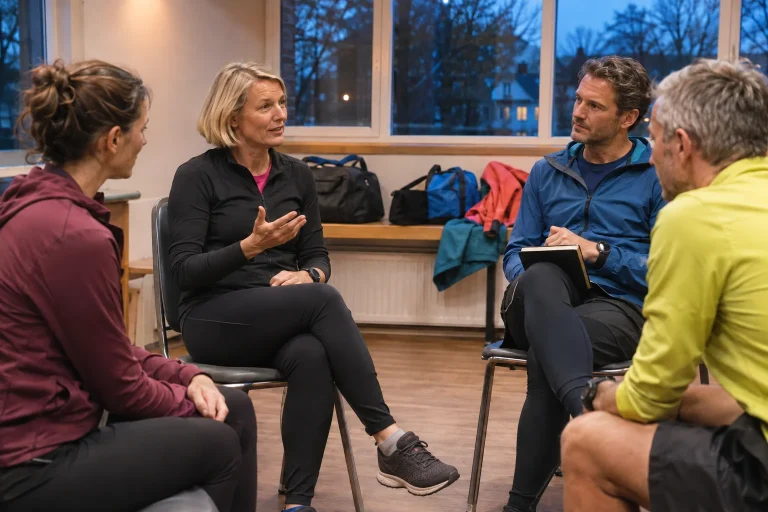
You may arrive at the first meeting wanting to understand activity better, find a suitable routine or prepare for a community event. The coach immediately asks for a target weight, however, and you suddenly feel you must explain why you sought help. Body size does not automatically determine your sporting goal. Explain from the outset what you want from working together and how weight loss relates to it, or does not.
This does not mean health circumstances or information relevant to activity cannot be discussed. The aim is an understandable, task-related and personal conversation. The following points help you prepare an introduction to a coach; they do not determine your individual fitness to run or replace healthcare. A good introduction clarifies where you need help and which questions require another professional.
Start with why you are there
Your first sentence can be a specific sporting question. “I’d like an activity routine that fits around my shifts.” “I’m interested in a community programme but don’t know what starting point is appropriate for joining.” “I’d like to understand the tasks and how to say when I need a modification.” These reveal more about working together than “I want to get in shape”, which you may each interpret differently.
If weight loss is not your sporting goal now, say so: “I’m asking for help with activity; I don’t want to set a weight target at present.” If you receive separate healthcare for weight management, explain that it has its own provider and plan and you want to discuss coordinating activity with the coach. These situations differ, but in both, your goal should not be guessed from appearance.
The NICE principles of care emphasise listening to the person, asking permission for weight discussions and respecting history. These are British healthcare recommendations, not compulsory scripts for a Hungarian coaching service. They are nevertheless a useful starting point for the other person to understand what you came with before placing you in a ready-made body-transformation story.
Describe your current activity
Useful information for a coach includes which activities you currently do, what is regular and what is occasional. “I don’t do sport” may conceal substantial walking, physical work or other everyday movement; “I used to run” can mean a long break. Clarify the present situation for planning. You need not exaggerate experience, and calling all everyday activity insignificant does not help either.
Explain what is new. You may know walking routes but never have exercised in a group, or have attended training but struggle to interpret an independent task. The first meeting is not a competition in reporting achievements. Naming missing experience lets the instructor avoid assuming knowledge where you need explanation, demonstration or another approach.
The NICE recommendations on activity emphasise current ability and fitness and recognise health benefits beyond weight loss too. This is not an instruction for every reader to run. In your introduction, it is a reminder to convey the activity situation and its feasibility, not just a weight result.
 Enlarge image
Make the important healthcare framework factual
If you have a symptom affecting activity, a condition, previous injury or care instructions, clarify its role within an appropriate professional framework. You do not need to diagnose yourself for the coach. You can say a symptom’s cause remains unclear or you want to discuss a particular task with your care provider first. Naming uncertainty is more precise than choosing an internet label.
Communicate a care restriction according to what it actually says. If you do not understand its scope or duration, ask the person who gave it. Even with the coach, avoid filling gaps as though a generic “Be careful” permitted every specific task. Working together may include waiting for clarification or appropriately arranging discussion between professionals.
The NICE assessment recommendations specifically warn against automatically attributing symptoms to weight. In your introduction, therefore, a specific symptom should not disappear into a generic weight-loss discussion. The coach does not treat every health problem; recognising when another competence is needed is also an important professional response.
Explain how participation would fit
Your calendar is part of the task alongside the sporting goal. When can you leave, how long is travel, do you need a changing room and how will you get home? The whole occasion can exceed the duration beside the session name. Discussing this beforehand reduces the chance of a plan that works on paper requiring rushed implementation at the expense of meals or rest.
Your location preferences can be specific too. Do you want a well-lit, easily reached route? An easy way to signal stopping? Do crowded changing rooms or unfamiliar terrain feel uncertain? You need not derive or justify these from body size. Describe which circumstances support participation. The coach can then answer as an organisational question rather than through generic motivational advice.
Do not leave the budget until the last moment either. Know what the service includes, whether there are extra venue, travel or equipment costs and the conditions for changing a session. This article does not define contractual rights, but knowing your conditions is part of realistic sporting planning. A workable time and affordable format are no less serious considerations than an ambitious goal.
You can discuss how feedback is given too
The same encouragement does not help everyone. Say if you want feedback on the specific task: what you understood well, which part needs more demonstration or how participation could be arranged differently. If comments about weight, shape or food eaten are burdensome, ask that these not be used as motivation. This does not reject instruction; it identifies communication in which you can cooperate.
A useful sentence might be: “Rather than changes in clothing size, I’d like feedback on how I handle the task.” Or: “Judging my body in front of others doesn’t help me; let’s discuss important questions privately.” You need not give a lengthy explanation of why a comment affects you. Working together should clarify which feedback serves the shared task and what is outside the agreed goal.
A specific professional observation can differ from a body judgement. A garment interfering with movement is practical; saying when your body would look “better” in it is another claim. Equipment usability can also be clarified factually. A useful explanation makes the problem and purpose of a change understandable. Respectful conversation does not require avoiding every word related to the body.
Ask where the coach helps and where they do not
Getting to know a new professional includes their qualifications and role. What experience do they have with adults at different starting points? How do they follow your feedback? Whom do they approach when a question goes beyond sports instruction? The NIDDK guide to choosing a programme also recommends clarifying staff qualifications, programme operation and necessary healthcare cooperation. We use this as a basis for questions, not a rating of a specific Hungarian coach.
A coach’s role is not valuable because it promises every answer. A clear activity task, workable organisation and taking feedback seriously can be important help in themselves. Medication, diagnosis, complex nutrition or mental-health problems may need other expertise. Clarifying this boundary in advance makes later questions easier to place and less likely to be subsumed under a generic weight-loss goal.
Ask how they revise plans if your goal changes too. Not every sporting goal stays the same throughout the year, and everyday circumstances are not constant. A review may be scheduled, but a new symptom or important change can require earlier discussion. You do not have to wait until a package ends if the original task meanwhile becomes unclear or unsuitable.
 Enlarge image
A brief introduction in five sentences
The following is an original fictional template, not a health questionnaire everyone must fill in: “I’ve come because I’d like an activity routine that suits me. These are the activities I do now, and this would be new in running. These participation circumstances and questions needing clarification are important for you to know. I don’t want my goal automatically defined as weight loss. I’d like feedback on specific tasks and how participation works.”
Shorten the template into your own words. If you have only one question, you do not need to manufacture a complete profile. If several health details matter, however, do not squeeze them into five sentences simply to make the meeting more convenient. Brevity aims for clarity, not withholding necessary information. Arranging suitable time and privacy can also be part of the discussion.
Notice whether the coach’s response can reflect back what you agreed. Do they understand the same goal, are next steps clear and is it evident what is outside the task? A brief summary at the end can help: the next session’s goal, what still needs clarification and whom to contact with questions. This is a simple cooperation reminder, not a clinical care plan.
If the discussion repeatedly goes elsewhere
An occasional misunderstanding can be easy to clarify. It is different if, despite repeated explanations, every question still receives a body-weight judgement or unsolicited weight-loss goal. Ask whether the service can genuinely undertake the sporting task you requested. You do not have to keep rewriting your goal until it fits a ready-made package. Recognising the mismatch can help you find another format or professional.
Respecting your goal does not, however, promise automatic performance of any movement. A responsible professional may state a competence limit, request necessary healthcare clarification or explain why the offered class is unsuitable. Clear, specific professional reasoning differs from a general judgement drawn from body size. What matters is which information and task the answer concerns and which next step you can discuss.
The first discussion does not necessarily need to end with a completed training plan. A clearer question, professional role and next step may be enough. Your activity can have a goal you discuss precisely, factually and respectfully. Body size does not explain on your behalf why you arrived, and your interest in sport does not first need justification through an intention to lose weight.
Sources and the role of practical examples
NICE NG246: Principles of care; NICE NG246: Physical activity and diet; NIDDK: programme-selection considerations; NICE NG246: assessment. The sample phrases are original editorial suggestions; they do not replace individual healthcare or legal advice.
How Futószív articles are prepared: our editorial guidelines.