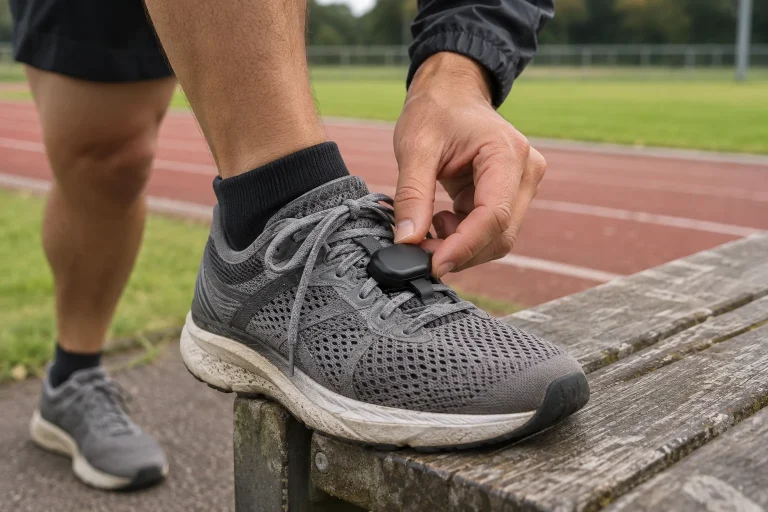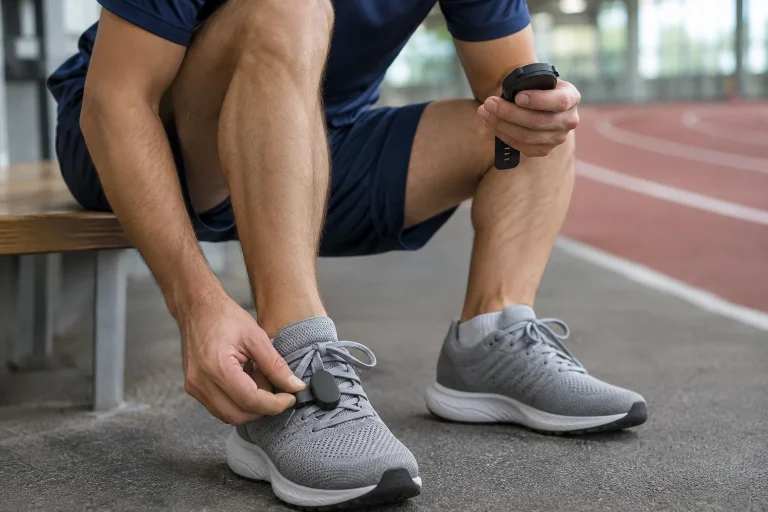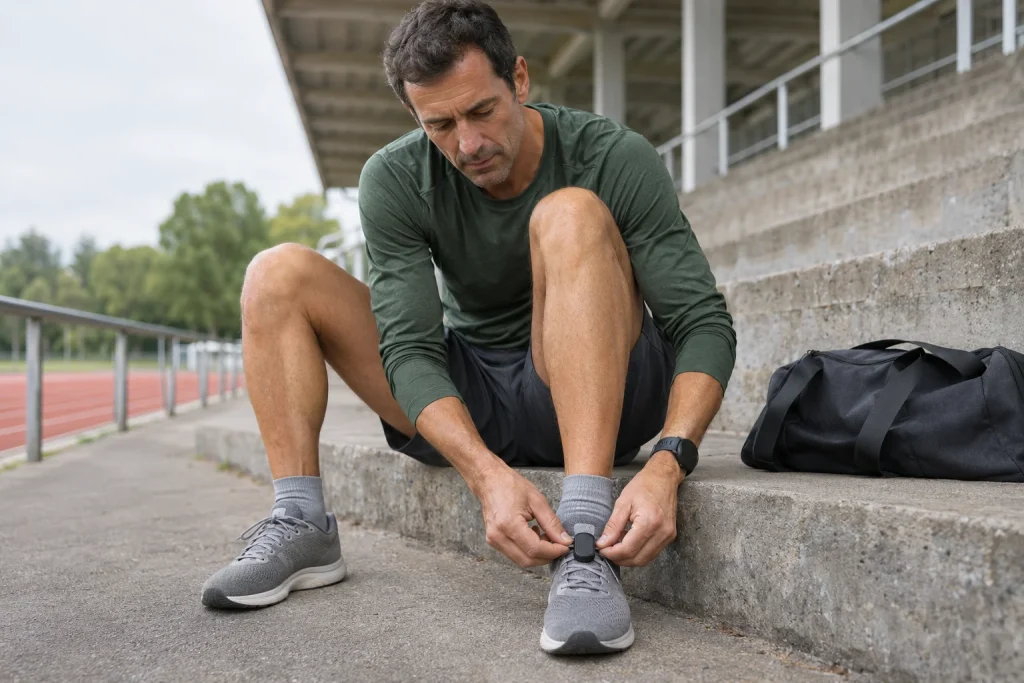
The Stryd 5.0 is a shoe-mounted running sensor that provides calculated power, pace and other running data from foot movement and additional sensor inputs. It may interest someone seeking information beyond instantaneous pace on windy or hilly routes, or an indoor data source. It is not a heart-rate monitor, a direct oxygen-consumption measurement or automatic coaching clearance to increase your load. A useful system requires understanding the roles of the hardware, receiving watch and app.
This article draws on the manufacturer’s support material checked on 21 November 2026; it is not our own Stryd test. We distinguish 5.0 hardware from the earlier Next Gen and wind-detection models, and single-sensor use from the two-sensor Duo system. Basic operational functions and paid membership services are separate questions too. You do not have to accept every marketing claim to decide sensibly whether the device would have a role in your running.
What makes it 5.0, and why does the hardware version matter?
Stryd 5.0 is the newer hardware generation announced by the manufacturer in October 2025. Its introduction lists a smaller housing, modified sensors and algorithms, and a magnetic keychain charger. Faster, more consistent power reporting should be treated as the manufacturer’s development claim, not this article’s own comparative result. For a used product, identifying the name and accessories matters more than a generic advert for a “new Stryd”.
The current accessory list distinguishes the older wind-detection model, Next Gen and 5.0 with their own chargers and clips. Having an old charger or earlier shoe clip therefore does not prove you have every accessory needed for the new device. The correct new clip for the hardware and a suitable charging method are not merely aesthetic details: they contribute to stable mounting and power supply.
The manufacturer requires two 5.0 sensors for a 5.0 Duo setup. An earlier Next Gen and a new 5.0 together do not become the same system. If considering later expansion, account for this when buying the first sensor. Starting with one sensor may still be reasonable: first clarify which question you want to answer and whether it really requires separate data from both feet.
Running power is calculated, not a direct calorie measurement
Stryd calculates running metrics from the foot’s movement in space, acceleration and other sensor data. Power shown in watts is the result of that model; it is not the same technical pathway as torque measurement in a bicycle drivetrain. Air Power also accounts for a component associated with overcoming air resistance. This explains why another metric alongside pace may interest the same runner on a windy route.
The calculation does not mean the sensor directly measured calories burned, sweat composition or blood oxygen. Watts are not heart rate or a clinical exercise-tolerance finding. For your own interpretation, they may instead be feedback from a consistently used system: compare runs using the same source, known settings and the session’s circumstances.
An original, purely illustrative numerical example: if two sections on the same system average 210 and 230 watts, the difference is 20 watts, or about 9.5 per cent relative to the first value. This does not mean you burned exactly 9.5 per cent more calories in the second section or increased cardiac load by that amount. The ratio between two numbers is a mathematical statement; physiological interpretation would require more information.
The same watts on another system are not necessarily the same
Stryd and a watch’s own running-power estimate, such as Garmin’s, are separate data sources. The manufacturer’s support explicitly distinguishes Stryd Power from Garmin native power. Do not simply mix them into the same time series and call the difference improvement or decline. Introducing a new sensor into your log can also change the method, rather than merely add another number on an identical scale.
On a Garmin watch, configuring the correct Stryd data field or app matters; selecting just any watts field is insufficient. For its own setup, Stryd also describes disabling native power recording; always handle this according to the chosen current setup guide and your watch. We do not rank the different methods’ accuracy from a manufacturer’s self-assessment. The aim here is to clarify the source.
An original log-organisation idea is to add the date of the device change and the new data field’s name to your workout notes. Looking back over several months of graphs, you can then see where the measurement chain changed. Do not invent a universal conversion multiplier between old and new systems from a few runs. One manufacturer’s zones and thresholds cannot automatically be copied onto another system’s watts either.
 Enlarge image
One sensor with a watch, phone or later synchronisation
According to Stryd support from January 2026, a single sensor can also record running data independently for later synchronisation with the phone app. A suitable watch, meanwhile, can provide live power and other supported displays. Some older watches receive pace and distance as a foot pod but do not show live watts. A supported connection and a fully featured live display are therefore different concepts.
During phone recording, the app may also record the route if the necessary conditions and permissions are in place. Running data from the shoe sensor’s own memory is not, by itself, a GPS map. Decide beforehand what you need during and after a run. If you only expect later analysis, different equipment may be sufficient from what you need to follow a live target range on a watch.
Do not transfer the documented automatic recording of single-sensor use to Duo. For the two-sensor setup, the manufacturer requires an appropriate watch or phone-app connection even to record offline data. One sensor and two sensors are therefore not simply more or fewer identical devices: the recording process must also be learnt separately. Think through the whole daily routine before expanding.
The clip and shoe are not minor details
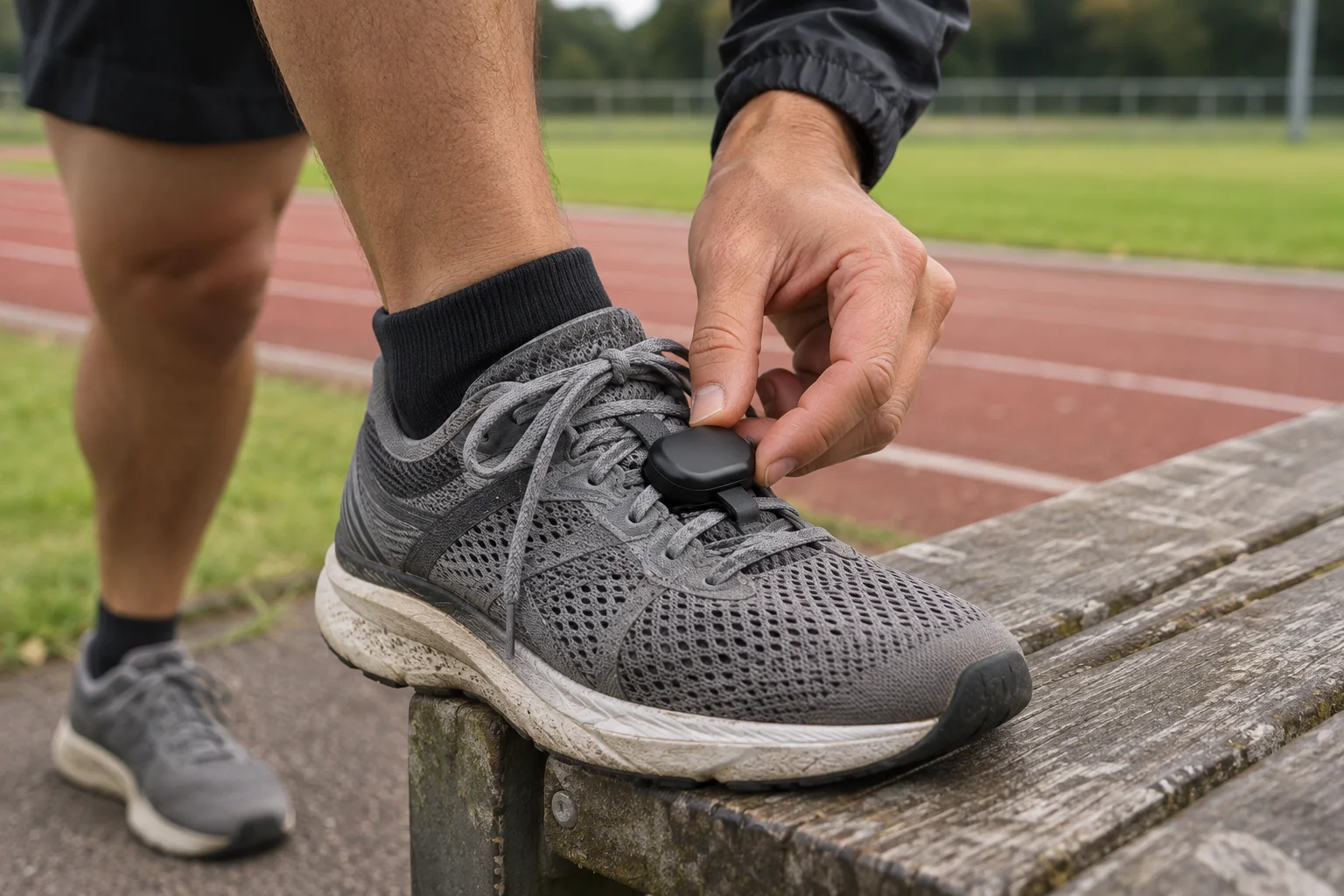
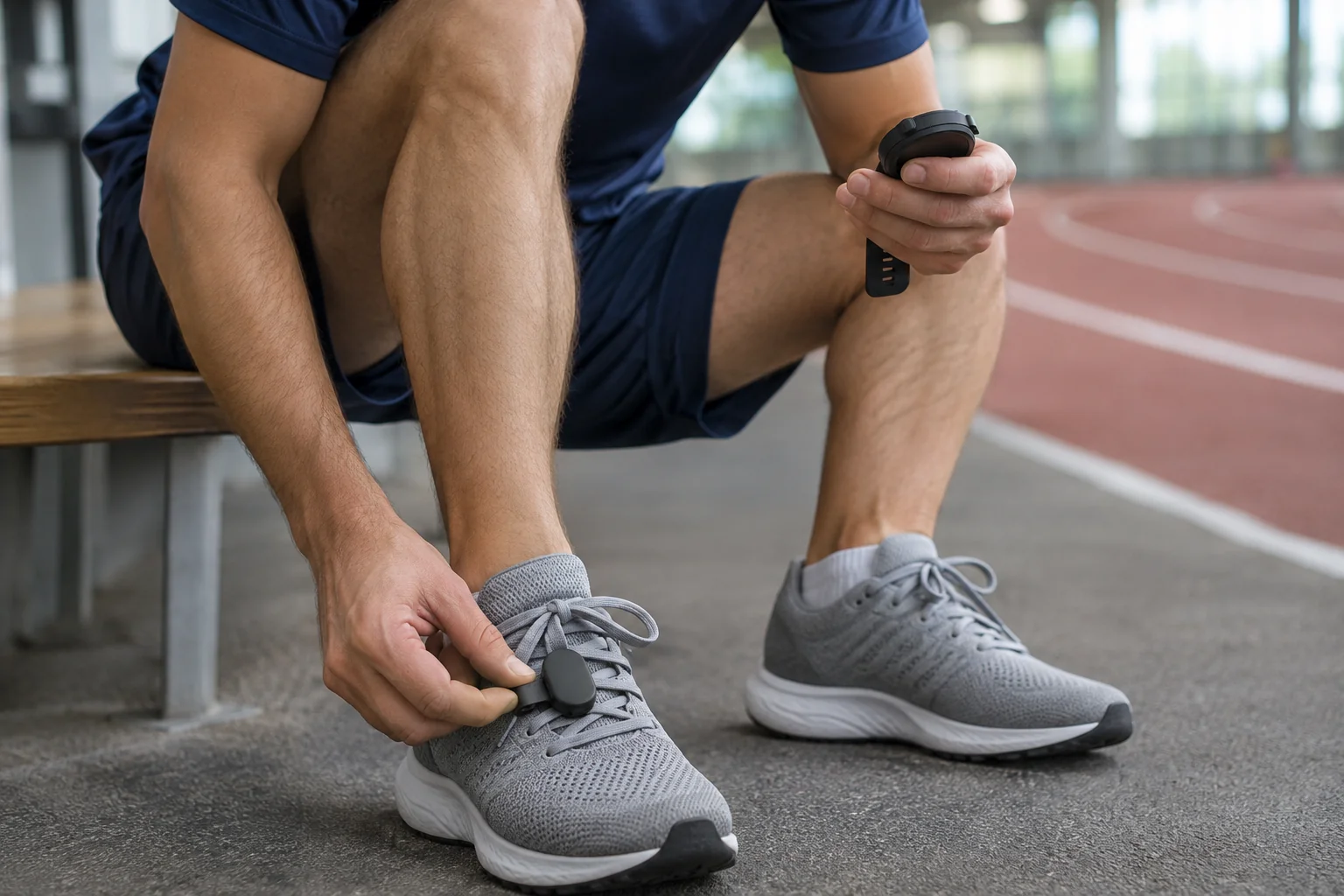
The manufacturer’s mounting guide calls for stable, consistent attachment and the correct orientation on the shoelaces. Laces must not cover the sensor’s wind-related opening. Centring is particularly important on a shoe with asymmetrical lacing. A device placed on the shoe but not properly engaged is different from a sensor securely held in its own clip; check this while stationary before the first run too.
The manufacturer also describes possible disruption of air-pressure sensing with some covered shoes or those with integrated gaiters. Do not infer from a generic “waterproof sensor” statement that every data type works unchanged beneath every shoe cover. The usage guide mentions running and walking and separately limits other machines and sports. A device left on the shoe does not become a universal power meter for cycling or an elliptical trainer.
Do not automatically apply your sports watch’s water-resistance habits either. Stryd’s own guide warns against running through streams, rivers or puddles despite the IP68 label. Follow the specific usage limit rather than extrapolating from the rating to arbitrary situations. This is also a running-equipment planning question: if your route involves a water crossing, resolve sensor usability and safe placement beforehand.
It works without membership, but not every service is basic
The manufacturer says Stryd Membership is not compulsory to use Stryd 5.0. The current feature table marks post-workout data, basic Critical Power functions and some power-based training options, among others, as available to all users. The paid column includes Workout Builder, several planning tools and Adaptive Training, for example. Neither “unusable without subscription” nor “every analysis is included forever” is an accurate simplification.
Before buying, write down the actual service you want and find its row in the current table. Feature names and availability may change over time. A previous owner’s Pioneer entitlement is not necessarily your new account’s entitlement either. Basic sensor data and personalised software services are separate product components; owning the hardware does not automatically give access to every later development.
Check the price of the specific package at checkout with the correct country setting. We do not treat membership prices in euros from the 2025 announcement as an unchanged final price in Hungary. An original, entirely fictional cost example: a service costing 5000 forints monthly totals 60,000 forints over twelve months at the same fee. This is not a Stryd price, only an illustration of why later service charges belong alongside the hardware’s one-off cost.
Trial period, package commitment and automatic renewal
The October 2026 Membership FAQ distinguishes several purchase packages. Some regions may offer a free initial membership period; elsewhere, hardware comes with an initial paid membership commitment. These are different offers. The words “six months of membership” alone do not tell you when or how much you pay, or under which conditions the package can be ended. Your own purchase summary and terms govern.
The manufacturer also describes automatic membership renewal. A free initial period may be followed by paid monthly renewal, while multi-month and annual periods may renew under their own terms. Manage the subscription in your account or through the original purchase platform; simply deleting the app is not cancellation. At purchase, save where the subscription was made and when it next renews.
Your own subscription routine might include a calendar reminder a few days before renewal, with the relevant contractual terms understood. This is not a general legal deadline or automatic cancellation. The question is whether the service you tried has actually become part of your running. The difference between useful, regularly used analysis and a forgotten subscription can be greater than between two similar hardware prices.
 Enlarge image
Footpath with one sensor: single-sided data with separate conditions
The current Stryd Footpath guide now also describes single-sided Footpath use with one 5.0 or Next Gen sensor, an active membership and suitably updated app and firmware. This is an important change from older presentations describing only two sensors. Post-recording Footpath synchronisation and the web PowerCenter view may be separate steps; a workout appearing in a simple list does not prove every detail was uploaded.
Data from one foot does not replace simultaneous measurement of both feet. Do not invent a full left–right symmetry result or injury diagnosis from a single-sided trajectory. In your own interpretation, the device may instead provide questions for tracking movement on a known side. A curve changing with different shoes, pace or route does not alone tell you whether running improved or worsened, or what caused the change.
Duplicate data, profile settings and a consistent log
Offline synchronisation support specifically warns that a recording saved on a watch and a later upload from the sensor may create two entries for the same run. Choose a primary recording and upload route. Memory data may help when recording was missed, but every run does not need uploading a second time automatically. Different starts, endings or pauses in the two entries can also cause different averages.
Changes to profile data can alter the calculation too. The manufacturer describes a change in body-weight settings, for example, as a possible cause of unexpected power differences. Do not change the entered weight to get better-looking watts. Check consistency in your own data and the profile actually applied after synchronisation; do not assume complete retrospective recalculation of older runs with incorrect settings is a guaranteed basic feature.
Stryd 5.0 can be useful equipment if you know which question you use it for and keep the source consistent. Retain your own perceived effort, the route and workout purpose alongside power. An algorithmic target must not override symptoms or feeling unwell. The technology’s value here lies in understandable feedback: you do not have to make every run an exercise in collecting the maximum number of metrics to have useful data.
Sources and verification
- Stryd 5.0: hardware generation, Duo and membership
- Stryd: model-specific chargers and clips
- Stryd: power and Air Power calculation
- Stryd: the difference between Garmin and Stryd power data
- Stryd: use without a compatible watch, single versus Duo
- Stryd: initial setup and shoe attachment
- Stryd: intended use and limits involving water and covers
- Stryd: current free and membership feature table
- Stryd: October 2026 packages and renewal
- Stryd: requirements for single-sided Footpath
- Stryd: offline synchronisation and duplicate entries
- Stryd: differences caused by hardware changes and profile data
How Futószív articles are prepared: our editorial guidelines.