On a windy riverside, a T-shirt sleeve has a life of its own: the chest billows out, then snaps back with each step. A runner beside it wears a close-fitting top that barely moves. The second garment intuitively seems faster, but appearances do not establish the size of the difference or what happens to movement freedom and heat loss.
Clothing aerodynamics is a real research question. The answer, however, is not for every runner to choose the tightest possible top. We examine original clothing tests, how a force change becomes a hypothetical time benefit and a useful trial with your own wardrobe. This is not a ranking of current products, but a practical framework for the right questions.
Clothing also changes the shape presented to the air
Air flows around the combination of body and clothing. Loose fabric can give the torso a different outline from a smooth, close cut; folds and moving surfaces can affect flow too. Yet close-fitting does not describe the whole surface: fabric structure, seam position and fit jointly form the system. A garment looking tight in the mirror does not reveal its drag coefficient.
The NASA drag equation relates force to fluid density, relative speed squared and the body’s area and drag coefficient. Size and shape both matter. A top can change both area and flow characteristics; their combined effect needs investigation. ‘It looks smaller’ is not a complete measurement method.
In our physics example, let area multiplied by drag coefficient for one clothed body be 0.50 square metres and for another 0.48. With the same air and speed, this would give a four per cent force difference. These values are purely illustrative, not known figures for a loose and tight T-shirt. They show what would actually need measuring to turn appearances into a numerical claim.
What did the classic 1986 study measure?
Kyle and Caiozzo’s 1986 work tested clothing materials, hair and shoes in a wind tunnel, then used mathematical models to estimate possible time effects in sprinting and distance running. Reported drag changes are not the same as a directly measured marathon improvement from wearing a current top. The study is important historical evidence for clothing aerodynamics, but products and models belong to their time.
One model calculation estimated a 5.7-second marathon benefit from a two per cent drag reduction. That was the particular model’s result, not a guaranteed gain for every runner. It illustrates linking a long distance with a small force change, but does not give today’s reader a rule that a tighter T-shirt is automatically that much better. Measurement and the time model remain separate steps.
Pause at the year too. The research appeared in 1986; its materials, cuts and comparisons do not cover today’s range. A modern product does not become proven fast merely by resembling a historically favourable category. A specific current claim needs examination of that garment, size, posture and speed.
 Enlarge image
Another clothing test: a mannequin, several speeds and a separate field trial
In 1987, Brownlie and colleagues measured several commercial running outfits and two experimental-fabric garments on a mannequin at four airspeeds: 4.7, 7.1, 8.8 and 9.7 metres per second. They found drag differences between garments. The setup allowed control of body and clothing positions, but the mannequin did not perform a full live running motion.
The publication also included a hundred-metre field trial in sixteen young men wearing a specific experimental garment. This differs from wind-tunnel force data: it assessed actual running time in a defined sample over a short distance. Both results can be interpreted together, but must not become one universal claim for every garment and distance. Marathon application is a separate question.
The methodological lesson still applies: check clothing-aerodynamics claims at several speeds. An advantage for a material or cut in one flow state does not automatically describe another pace or posture. Stretch, fabric tension and wearer size can also alter the actual outline. A size label does not replace that description.
Four per cent less drag is not four per cent less total energy
The aerodynamic component is only part of total running cost. In our fictional budget, total cost is one hundred units, four belonging to an appropriately defined component of moving against air. If clothing reduces that part by five per cent, the saving is 0.20 units. The total becomes 99.80. A five per cent component benefit gives a 0.20 per cent overall benefit in this artificial example.
This assumes other components stay unchanged and the affected part is defined within the same overall energy budget. A further relationship is needed between real mechanical force and metabolic cost. If clothing changes movement or heat load too, ‘everything else unchanged’ also fails. A drag percentage therefore cannot simply be applied to all running.
Possible time benefits require another step. Lower cost at the same pace does not automatically mean the same percentage speed increase; the relationship between speed and total demand matters too. Sprint and distance models solve different tasks. A good clothing test identifies where direct measurement ended and which assumptions produced the time estimate.
Heat loss is not a minor footnote in choosing clothes
A favourable aerodynamic surface alone does not establish how a garment works during sustained wear. In Brownlie and colleagues’ separate 1987 thermoregulation study, six male middle-distance runners ran in different clothing in controlled environments at zero and twenty-five degrees Celsius, with fan-generated airflow. Some experimental outfits involved unfavourable sweat retention and limited wearability in warmer conditions. The result concerned those materials and conditions.
This does not prove every tight top is warmer or every loose one cools better. The original materials and designs differed in complex ways. The lesson is separating requirements: lower wind-tunnel force, comfort while moving and heat loss are different endpoints. A good choice needs to work across several tasks, not just one measurement.
In your own trial, separately observe fabric movement and the wearing experience. You do not need health data collection to notice restricted shoulder movement, twisting around your torso or wet fabric clinging unpleasantly. These are important usability findings in their own right. They are not valid drag measurements, nor need they be called that.
How can a fitting give running movement a say?
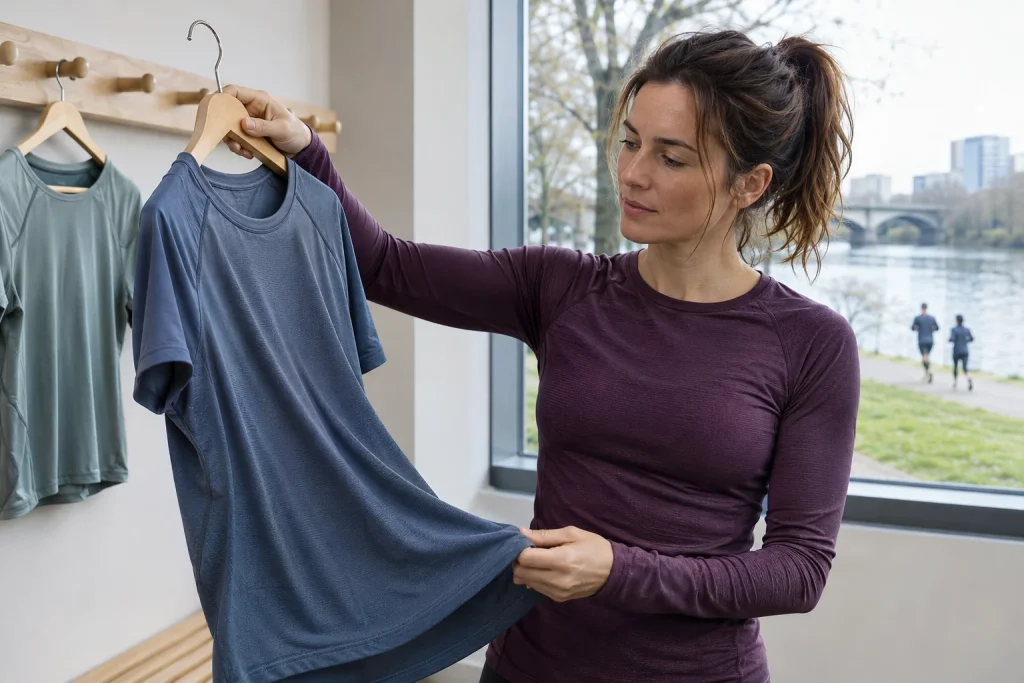
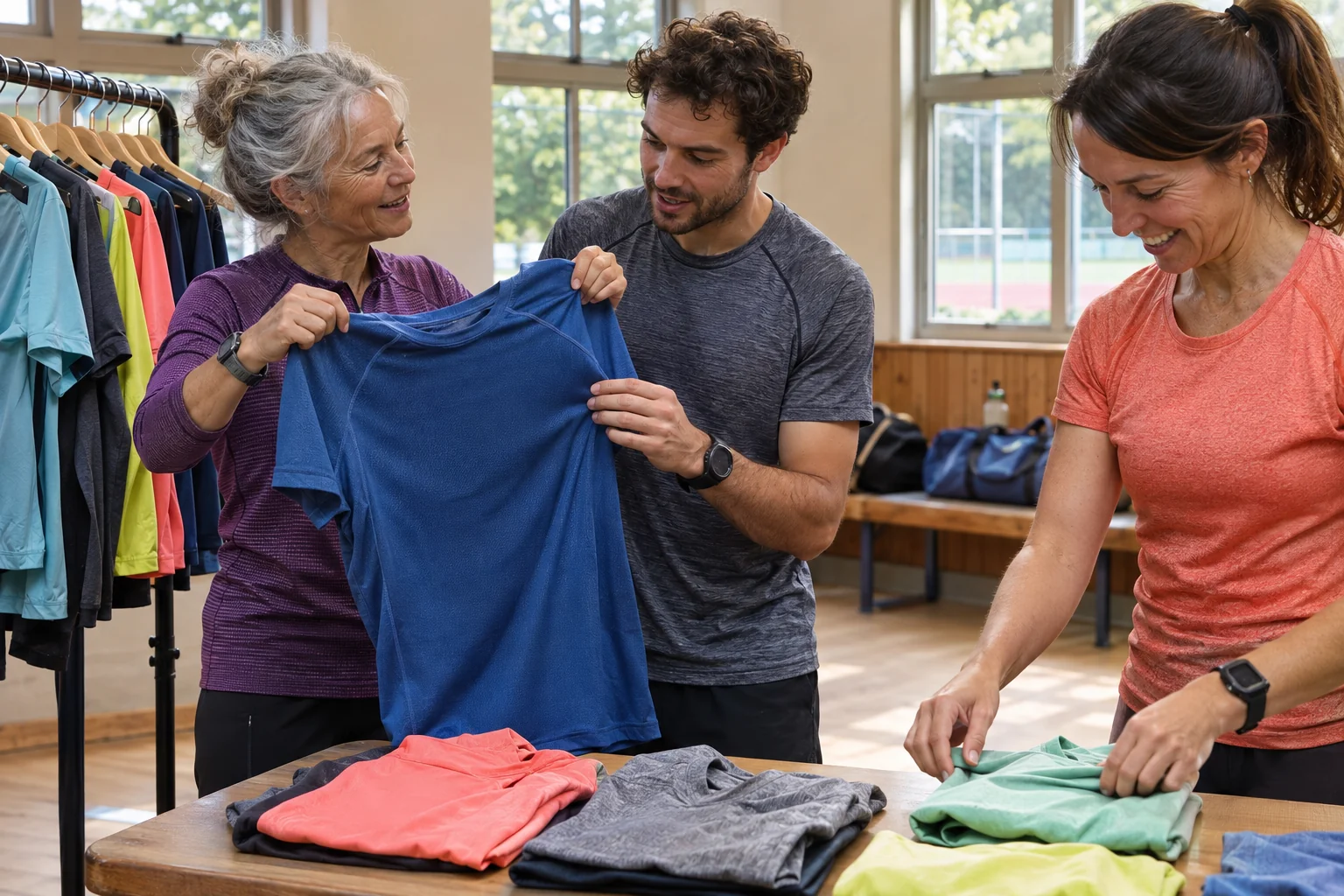
A stationary body in front of a mirror and a running body make different demands on a top. Try natural arm movement, turning and comfortable forward bending; notice shoulder movement, the hem riding up or the neckline pulling. The aim is not laboratory reproduction of running in a changing room, but identifying usability problems invisible while standing.
If comparing two existing tops, choose them for the same task. An outer layer designed for cold wind and a thin summer racing top do not make the same promise. One may suit environmental protection, the other lightweight wear. First ask which serves that run; only then ask whether an aerodynamic difference has been verified.
After an easy personal trial, record a specific observation: ‘the chest repeatedly billowed in an exposed headwind’ or ‘the sleeve pulled the top during shoulder movement’. ‘It felt faster’ mixes many effects. A factual description helps later size or cut choices without inventing a number that looks like measurement evidence.
 Enlarge image
What would a fair modern aerodynamic comparison require?
First, examine the same body or a clearly defined model at the same pose, airspeed and direction. Document size, dressing method and fit. Garment order and repetitions matter: one favourable arrangement or different settings do not reliably isolate cut effects. The method should be repeatable.
Second, describe uncertainty. In our purely conceptual example, two garments differ by 0.05 newtons while repeated measurements vary by around 0.10 newtons. The difference’s sign alone is insufficient for a confident ranking. We do not claim this precision for every clothing test; the example shows why uncertainty matters alongside a raw number.
Third, broad application claims would need examination of the usage environment. A dry mannequin in a fixed pose does not automatically describe wet fabric, swinging arms or crosswinds. This does not devalue the basic measurement. It asks that conclusions be as broad as the data genuinely support.
When is it worth considering in your own running?
If a top visibly flaps, twists or obstructs you, another size or cut is worth trying even without aerodynamic evidence. The usability problem can be named, and a better solution may already exist among your clothes. Every small discomfort need not be expressed in watts to make a good decision. There is room to choose between comfortably following the body and being too tight.
For race-focused differences of a few seconds, specific product testing at an appropriate pace and comparison of heat loss would provide a stronger basis. ‘Race’, ‘aero’ or ‘compression’ names are not themselves such evidence. Compression may concern clothing’s action on the body; an aerodynamic claim concerns the surface interacting with air. One term does not replace measurement of the other.
A flapping T-shirt and a close-fitting top can therefore differ in drag, but the actual magnitude depends on the whole system. Original research showed how to investigate it; it did not pre-approve today’s wardrobe. The best personal choice works in the weather and allows free movement, with any seconds-saving promise supported separately by appropriate evidence.
Sources
- Kyle and Caiozzo, 1986: clothing drag and running-time models.
- Brownlie and colleagues, 1987: wind-tunnel and short field studies of clothing.
- Brownlie and colleagues, 1987: thermoregulation study of running outfits.
- NASA: the drag equation.
How Futószív articles are prepared: our editorial guidelines.