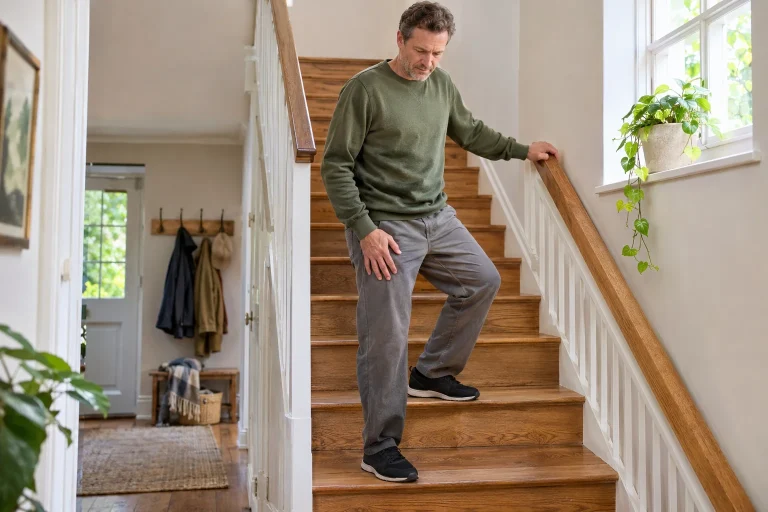
“Just take the stairs and lose weight faster” is memorable advice. It seems practical: stairs are common and need no gym. Yet it skips several questions: which stairs, how many repeated ascents, what current condition and which symptoms? An accessible location does not automatically make an activity a suitable starting task.
At a higher body weight, you need not undertake stair workouts to prove determination or because an app assigns high energy expenditure. Necessary daily ascent, more independent stair use as a personal goal and repeated sporting stair climbing are three different situations. Discuss them separately because preparation and help may differ.
Do not use stairs as a trial with new severe knee pain, major swelling, inability to bear weight or a hot, red joint with fever: urgent healthcare assessment is needed. The NHS information on knee pain indicates these are not simply signs of poor fitness. Feeling unwell with chest pain, severe breathlessness or fainting also needs urgent help.
A calorie table answers a different question
Energy estimates characterise what a defined activity may demand under particular conditions. They do not examine your knee, see the handrail or know how securely you place a foot. A seemingly favourable table figure cannot decide suitability. Calories cannot supply missing safety details in task selection.
The CDC page on activity and weight emphasises several health benefits and individual differences. Its tables estimate specified conditions. They cannot reliably calculate your weight change from a particular number of stair climbs. Nor must activity’s value be judged solely through scales.
“Eat something, then climb stairs to burn it off” links exercise to punishment. Food and sport need not become debts to repay. Even a personal weight-loss goal needs a plan considering full life circumstances and health. A painful task does not become appropriate through a higher energy estimate.
Stairs require several abilities at once
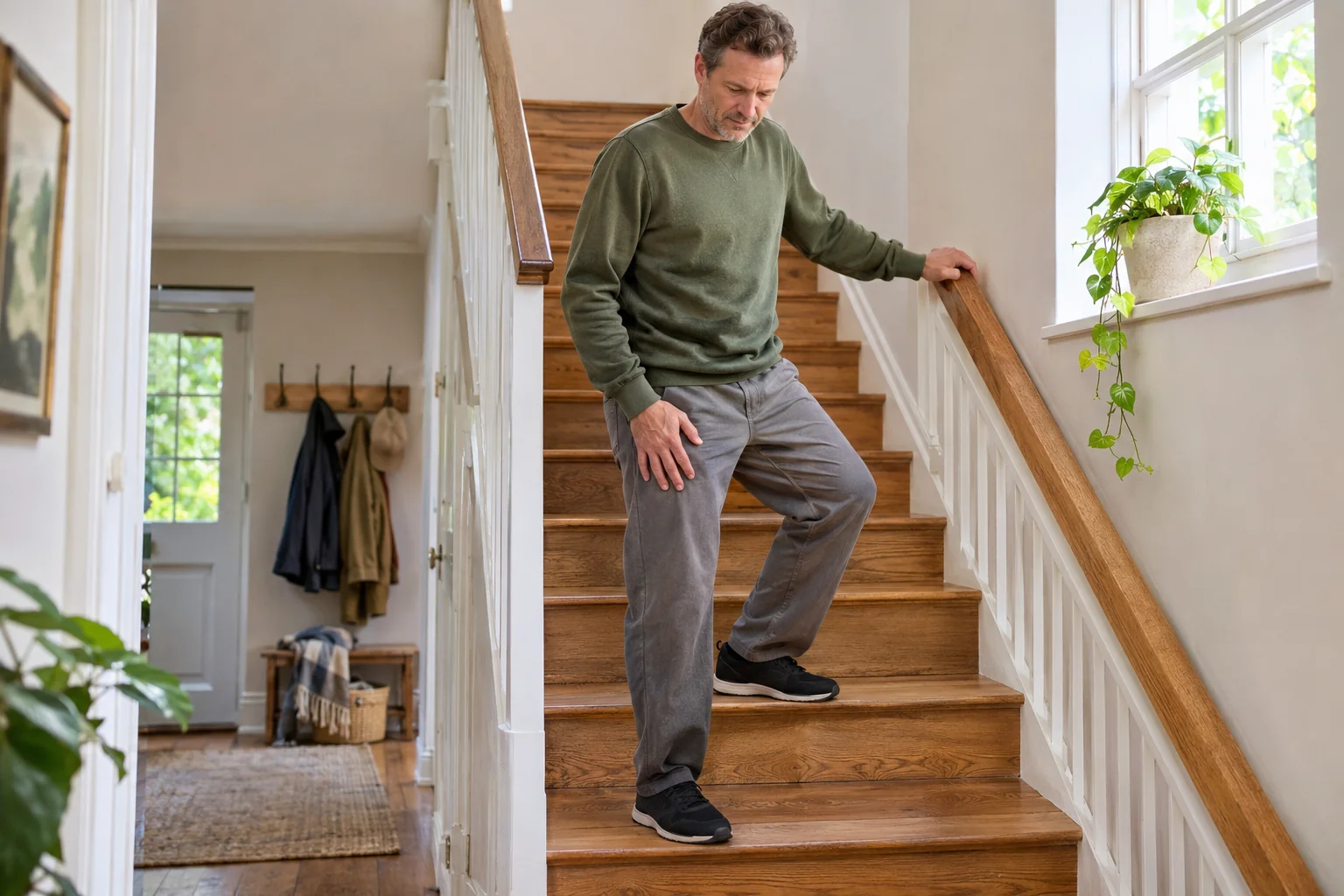
Ascending raises your body while positioning a foot on the next step and controlling posture. Descending creates another situation for foot placement and movement control. Familiarity with one direction does not necessarily make the other equally easy. Consider the complete route rather than only the impressive ascent.
The American Heart Association information on balance also identifies balance as important for everyday walking and stair use. This does not mean turning a staircase into a home balance test. If uncertain, clarify the task and support individually rather than removing handholds to test your ability.
Body size alone cannot reveal these abilities. Two people of similar weight can differ in experience, joint symptoms, movement confidence and daily load. Neither a universal stair ban nor compulsory stair workouts can be assigned to a larger body. Gather information about your function and the particular task rather than following appearance-based assumptions.
 Enlarge image
A short task can still be too intense
A few minutes of exercise is not necessarily easy. The CDC intensity information says effort can be interpreted relative to personal fitness. The same task can be manageable for one person and very intense for another. “Only a few minutes” therefore cannot answer difficulty speaking or unstable movement at the first landing.
Time, speed and repetition are separate variables. Advising faster ascent, turning back and several repeats adds several demands to everyday stair use simultaneously. Beginners need not follow automatically. Adding “everyone at their own pace” does not personalise an unfamiliar task.
Comfortable speech can guide effort observation without explaining every breathlessness episode. Do not assume new or unusual symptoms simply require accepting intensity. Symptom, task and health history need consideration together. Stairs are no place for forced sentence tests or continuous watch monitoring.
Do not silently merge daily travel with training
Without a lift at home, several daily ascents and descents may already be routine. This is actual daily activity, not automatically additional training capacity. Describe travel and work tasks before accepting extra stair series. Getting home after exercise is not empty time if several floors remain.
Making stair use easier can instead be a personal aim: reaching a clinic more calmly or feeling steadier descending at home. Assess the initial difficulty and establish suitable practice. Repeating as many complete flights as possible is not necessarily the route. A professional can select tasks related to the actual difficulty.
Ascending with shopping, a child or work equipment adds circumstances. Do not voluntarily turn carrying loads into weight training because someone calls it efficient. If vision or handrail use is obstructed, change travel arrangements. Meeting daily needs safely matters more than extracting maximal training load from the situation.
A handrail is not a sign of weakness
The National Institute on Aging information on preventing falls at home highlights secure handrails, adequate lighting and clear stairs. These conditions matter for daily travel as well as sporting trials. Holding on can provide necessary assistance; you need not remove it to satisfy fitness advice.
Stairwell lighting, slippery steps and obstructing objects are not personal fitness problems. Report poorly visible edges or insecure rails to the operator and seek a usable arrangement. Do not adapt by passing through bad conditions faster. A busy route may also be unsuitable for repeated exercise involving stops that obstruct others.
Phone viewing, timing and sudden turns make attention to surroundings harder. If stairs feature in a personalised plan at all, clarify organisation: safe stopping places, others’ routes and what happens with fatigue. A watch reminder does not outrank a person ahead or the next step’s location.
How can you recognise advice that promises too much?
Pause at offers prescribing identical daily stair totals for every beginner, promising specific rapid weight loss or portraying pain as necessary evidence of results. Personal starting point and health circumstances may be missing. Confidence, striking before-and-after images and many views cannot replace that information.
The NIDDK information on activity myths also stresses that exercise need not always last a long time. This does not make every short, intense challenge appropriate. Being brief and personally suitable are different properties: something short can still be too difficult or inaccessible.
Ask: “What makes you think this task suits my current circumstances?” Your goal, experience, symptoms and environment can all belong in the answer. If only supposed calorie burning is discussed, the essential question remains open. You need not settle uncertainty by attempting the hardest version alone.
 Enlarge image
What can you choose instead of compulsory stair workouts?
First identify why you seek activity: more regular daily movement, company, endurance work or easier everyday tasks? Knowing the aim helps find usable options. Among a short level walk, suitably adjusted equipment or another agreed activity, the largest calorie figure is not the sole selection criterion.
With little time, feasibility matters. Seek an easily shortened route that does not leave a long strenuous return. Painful legs require considering alternatives with that information too. “Anything instead of stairs is fine” is as general as saying everyone must climb stairs. Name the chosen activity’s actual conditions.
You need not compensate for activity totals every day. A hard workday or poor sleep can make a smaller agreed session or rest part of a flexible plan. A skipped landing is no debt requiring double repeats tomorrow. Sustainable routine fits your full everyday life rather than a rigid online-challenge calendar.
Keep your personal stair goal specific
If easier access to your home matters, name it to the professional. Explain where difficulty occurs: breathing, leg pain, a turn, descending or reaching a handrail? This opens a more targeted conversation than “burn more calories”. Assessment may indicate changing activity, environment or both.
Observe progress in ways matching the aim. A reliably reachable rail, clear stairs and organised help can improve the situation alongside suitable practice. Not every advance comes from greater bodily performance. A usable environment is not an inferior solution, and choosing a lift is no moral failure.
Stairs can therefore be daily travel, a later chosen exercise or part of a personal functional goal. A good decision is understandable in your situation and usable under appropriate conditions. A rapid-weight-loss slogan is insufficient. Concrete aims, clarifying symptoms and reviewing surroundings help more than a daily floor total assigned to everyone.
Sources
- NIDDK: Some Myths about Nutrition & Physical Activity
- CDC: Physical Activity Intensity
- CDC: Physical Activity and Your Weight and Health
- American Heart Association: Balance Exercise
- NIA: Preventing Falls at Home
- NHS: Knee pain
How Futószív articles are prepared: our editorial guidelines.