One attraction of exercising at home is avoiding a separate gym, travel or complicated equipment. In a video, the instructor pulls over a chair and practice begins. Your living room may have a different floor, furniture height, chair condition and need for help when standing up. “You only need a chair” therefore conceals several preparation questions.
Living in a larger body does not mean using unsuitable furniture because it is already at home or because asking about capacity feels uncomfortable. Equally, body size alone does not establish which exercise is appropriate. This article offers considerations for the space and support. It does not create a home suitability examination or prescribe identical numbers of sit-to-stands or ranges of movement for everyone.
If standing brings dizziness, new pain or uncertain walking, do not check yourself through more repetitions. Recurring symptoms need separate assessment. Fainting during exertion, feeling unwell with chest pain, or sudden one-sided weakness or speech difficulty require urgent help. NHS information on fainting and stroke symptoms explains that these are more than signs of an exercise sequence going badly.
First clarify the chair’s intended role
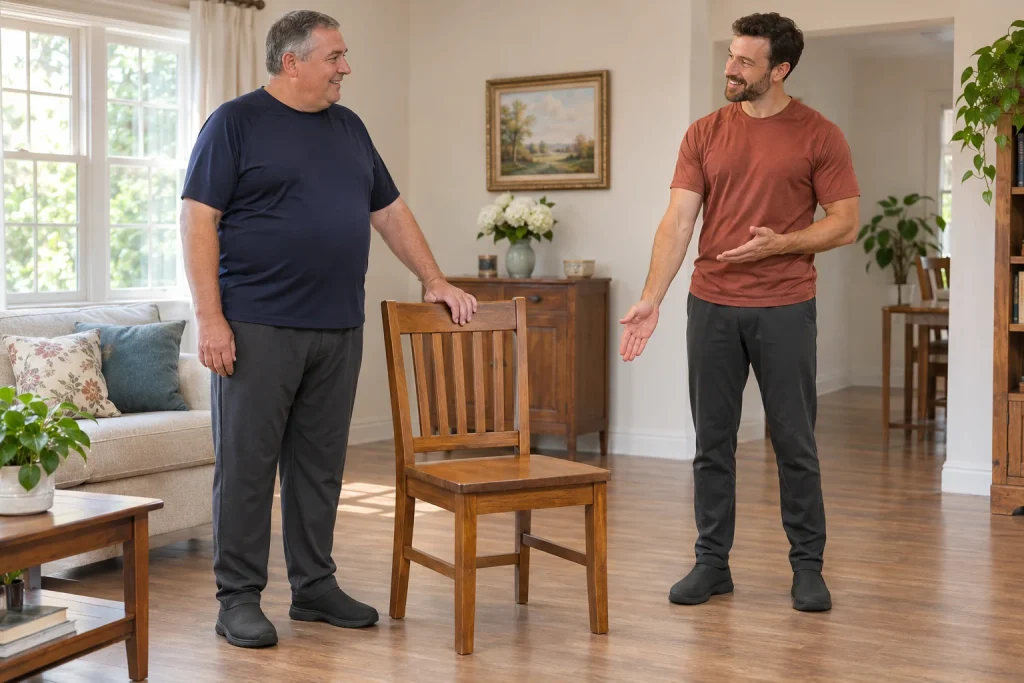
Doing an individually selected task while seated, rising from a chair and standing behind it while leaning on the backrest are different situations. The seat supports you when sitting, body position changes during standing and leaning can apply force to furniture in another direction. An everyday dining chair suitable for quiet sitting does not thereby become every kind of exercise equipment.
A chair is not automatically a step, stool or exercise bench. If a video shows standing or jumping onto it, or leaning backwards in a way that would use furniture not designed for that purpose, do not copy it. An instructor’s confidence does not determine a household object’s role. Your own chair’s manufacturer-defined purpose and condition remain separate questions even if a similar shape appears on screen.
Tell the professional helping you how you usually sit down and stand up in everyday life too. If you normally use armrests, do not leave this unmentioned because someone in a video rises with arms folded. Necessary support is not cheating. Task selection should begin with what is safe and understandable today, rather than the demands of a harder variation in a general demonstration.
Which furniture properties should you look for?
The NHS strength exercises at home recommend a solid, stable chair without wheels that does not slide on the floor for the chair-based tasks shown there. Regarding height, they highlight feet resting on the floor when seated and knees around a right angle. These are starting considerations for that demonstration, rather than compulsory positions for everyone even with pain.
Where possible, check capacity against the manufacturer’s information for that specific furniture. Do not infer it from a heavy chair, thick legs or price. If information is missing, do not replace it with a number for a similar-looking chair found online. You can seek another appropriately documented seat or an alternative agreed with a professional for home exercise; a risky trial sit need not settle the question.
Seat dimensions and design matter too. Can you fit without a hard edge pressing into your side? Do you slide forwards? A deep, soft armchair creates a different standing-up situation from a solid seat at an appropriate height. A larger or softer seat is not necessarily easier to use, and discomfort from a narrow chair need not be interpreted as personal clumsiness.
Check condition too: are there loose joints, damaged legs, an uncertain backrest or a sagging seat? Do not try to fix these during exercise. The furniture’s instructions determine how a screw should be tightened or a part replaced, rather than a general movement video. A faulty chair needs replacement with appropriate equipment, rather than the same task performed with greater caution.
 Enlarge image
The armrest question cannot be settled with one rule
The NHS demonstration names a chair without armrests for its own tasks because armrests can restrict certain movements. This does not mean someone needing armrests to stand should let go of them. The person should not forgo necessary help for the sake of the demonstration. Adapt the exercise, seat or form of support to their situation.
Show or describe precisely what happens: “Without armrests, I can rise from this chair only using momentum” or “I feel uncertain holding the backrest.” These say more than “I am unfit”. You need not repeat a movement until someone is convinced it is genuinely difficult. Discussing which version you will not do alone at home can form part of an initial consultation.
Another person’s hand is not an automatic substitute support either. A relative’s good intentions do not establish training in supporting you, and an unexpected loss of balance can endanger both of you. If moving between positions regularly requires personal assistance, review how to do this with an appropriate professional. A helper’s presence alone does not make sliding or faulty furniture suitable.
The floor and clear space are part of the equipment
Keep an orderly surface beneath and around the chair so you do not have to step over rug edges, cables or scattered objects. Stability depends on where furniture meets the floor: the same chair may behave differently in two rooms. Even a mat labelled non-slip is not a general guarantee; bunching or moving with the chair can introduce a new problem.
Consider the space needed for the whole movement. When seated, fitting your feet under a table is insufficient if the selected task requires placing them forwards. When standing, a narrow strip behind the chair is insufficient if sideways movement is involved. Do not compensate for limited room through abrupt turning or forcibly compressing the movement. Another location or task may be a good solution too.
Where possible, place a phone or screen where following it does not require constantly looking down or sideways. Agree beforehand with family members to keep toys and pets away from the route during exercise. A perfect training room is unnecessary. A small, predictable and orderly area helps more than many new devices in an overcrowded corner.
What can an online video show, and what can it not?
A recording can show task order and one way to perform it, but cannot see your chair, pain or difficulty standing. A “beginner” label does not automatically make every movement appropriate. If starting a task would require holding your breath, sudden momentum or uncertain gripping, seek individual help instead of following the video.
The NHS sitting exercises also advise discussing uncertain suitability with a healthcare professional involved in your care. You need not adopt the listed repetitions as a personal daily obligation. A sequence easy for someone in another condition may be too much for you, while for someone else it may not provide the load needed for their particular goal.
Ask the professional for more than a video title. Be clear about which task you would do, which support you may use, what is omitted and which changes mean stopping or discussing again. If needed, request a short, understandable written summary. A precisely described personal sequence with fewer choices may be more usable than a long playlist from which you select at random.
Name discomfort and symptoms separately
Pressure from a seat, tight trousers, effort associated with muscle work and new knee pain are different things. Everyday observation aims to describe these separately, rather than diagnose at home. For example: “The seat edge pressed into me, but standing brought a different kind of pain around my knee.” Furniture comfort and health symptoms can then be discussed separately.
Do not automatically label dizziness on standing suddenly as weakness or a natural consequence of a larger body. The NHS page on dizziness describes several possible associations and recommends assessment for persistent or recurring symptoms. Appearance alone cannot identify blood pressure, medication effects or another factor as the cause. Do not randomly change medicines, fluid or salt intake because of a chair-based trial.
If usual tasks become noticeably harder after an exercise, record that too. What happens during the movement is not all that matters: how were walking around home, stairs or sitting down later? A few sentences may be enough for the next discussion. You need not provoke pain again to obtain more precise information, or compensate for a bad day with a larger sequence next time.
 Enlarge image
Two home situations call for different preparation
Imagine someone whose dining chair is stable and at an appropriate height, but whose surrounding rug edge curls up easily. Organising the space comes first, rather than seeking a harder exercise. If the task already belongs to their individual plan, preparation can improve predictability. This still does not justify immediately adding repetitions: resolving the environment and increasing load are separate decisions.
Another person has only a deep armchair and usually relies on its armrests to stand. Putting their hands behind them and trying to rise with momentum for the sake of general instructions is not a solution. Appropriate seating and task selection need clarification. Without suitable furniture, they can choose another already-agreed activity that day or postpone this section. An available object’s limitations are not a personal failure.
In both examples, a concrete description is more useful than judging yourself. The key information is not “I was useless”, but that the chair slid, the seat was deep, armrests were needed or pain occurred. Explaining the situation in your own language helps find a solution you can actually use. The aim is to organise conditions for your own home movement, rather than copy the person in the video.
Make the next occasion easy to follow too
Write a short note about the usable setup: which chair, which place, which support and which agreed task. Add what remains omitted for now. This is not clinical scoring, and you need not turn your home into a permanent gym. It prevents a busy day leading to hurriedly rearranging furniture from an uncertain memory and restarting the whole experiment.
The NIDDK material on activity options at any size emphasises suitable equipment and finding workable solutions. In your planning, this may mean choosing a short session you can prepare, rather than a compulsory full video. Movement beside a chair does not become more valuable by being uncomfortable or visibly difficult.
Once you have found appropriate furniture and your own task, repeatability becomes an advantage. You need not seek a new challenge every time. If the chair, floor, health situation or necessary support changes, reconsider setup. A good home routine rests on everyday conditions that let you attend to movement, rather than troubleshoot the surroundings while exercising.
Sources
- NHS: Strength exercises
- NHS: Sitting exercises
- NIDDK: Staying Active at Any Size
- NHS: Dizziness
- NHS: Fainting
- NHS: Stroke symptoms
How Futószív articles are prepared: our editorial guidelines.