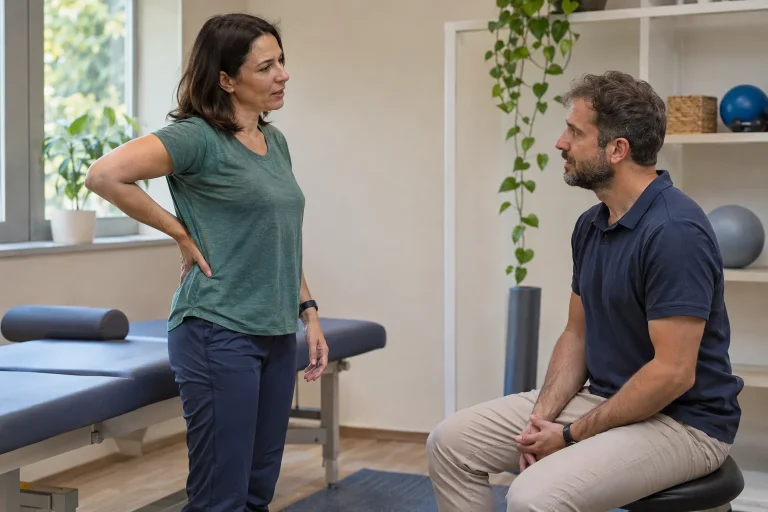
You may have known about your scoliosis since childhood and now want to run more regularly. Or you may have first heard the word scoliosis during a recent examination. In either situation, your personal history matters for your running goal: what assessment you had before, what you experience now and precisely what movement you want to do. The diagnosis’s name alone is not a complete sports guide.
Visible asymmetry does not automatically prohibit running, and a one-sided exercise chosen from a photograph is not an individual rehabilitation plan. This article organises questions to bring to a consultation. We do not measure curvature from photographs, prescribe correction or create a running programme without assessment.
Scoliosis is more than one shoulder being higher
The NHS defines scoliosis as sideways curvature and twisting of the spine. A noticeable difference in the appearance of the shoulders, waistline or trunk can be a sign, but does not by itself describe the whole condition. Examination and imaging where needed help assessment. NHS: scoliosis overview.
A photograph taken while running, a reflection or the position of a clothing seam therefore cannot establish severity. Camera angle, the movement at that instant and clothing all contribute to appearance; an image does not become a clinical measurement. If you notice a new difference or are concerned about change, seek individual assessment. You do not need to prove the difference through ever more photographs in a running group.
The SRS, or Scoliosis Research Society, explains the roles of physical examination and assessing curvature on imaging in diagnosis. A professional considers more than shoulder height. A sign noticed at home can therefore prompt a question, rather than provide a complete diagnosis or treatment choice. SRS: scoliosis and assessment.
Bring your earlier diagnosis with your own documents
If scoliosis was diagnosed long ago, explain when and on the basis of which examination. Were there regular follow-ups, individual physiotherapy, a brace or surgery? You need not list these from memory in flawless specialist terminology. Available findings and discharge summaries can connect the current question with the actual history.
“As a child, I was told to be careful with my back” is too general to become a running rule today. The instruction may have related to a particular treatment or period. Ask what still applies and what needs reassessment. Do not discard old advice independently, but do not try to apply it uncertainly to every current activity either.
If you no longer have the documents, say so and ask how to retrieve them or what new assessment is needed. Missing paperwork is no reason to postpone discussing symptoms. You can still describe current symptoms and sporting goals. Do not fill gaps in your history with measurements from a similar case found online.
Do not automatically attribute current back symptoms to the curvature
Back pain can occur alongside adult scoliosis, and the NHS information for adults discusses symptom management separately. This does not mean every new lower-back, buttock or leg symptom belongs to the same old diagnosis. Describe onset, location and effects on function as your current situation. NHS: adult care.
Separate what has long been familiar from what has changed. For example, your trunk may have looked similar for years, but pain now appears at the end of the working day for the first time. Or you previously had intermittent back symptoms, but your usual walking pattern has now changed. Details of the change matter more than assuming scoliosis must be responsible for everything.
Do not merge pain, stiffness, tingling and a feeling of weakness into one word either. Explain what the symptom means for you, when you noticed it and whether anything in everyday life has changed. You do not need to perform a home provocation test. Report new functional changes even if pain is not currently severe.
 Enlarge image
The appearance of curvature and the purpose of movement are separate questions
The NHS says individually taught back exercises may help pain management, while being unlikely to improve the curvature itself. This is an important distinction between goals. Better daily function, more comfortable movement and curvature measured on imaging are different endpoints. Ask which goal your prescribed exercise addresses and how change will be evaluated.
Your goal as a runner need not be looking more symmetrical in a mirror. Perhaps you want regular movement, more comfortable participation in a group activity or an understanding of recurring symptoms. These are valid goals. Organise treatment and sporting questions around your own activities too, rather than only your body’s appearance.
With a programme promising to “straighten” you, understanding what is claimed and its basis is particularly important. A before-and-after photograph does not replace individual assessment and follow-up. Ask for exercises chosen for your condition, rather than for a shoulder difference noticed in a social-media image. This article recommends neither one-sided correction nor any general method for eliminating curvature.
Why does the diagnosis not imply a general ban on movement?
The NHS overview says many people with scoliosis can undertake most everyday activities and sports. Its adult guidance nevertheless recommends discussing a new programme with a healthcare professional beforehand. These statements belong together: the diagnosis’s name does not prescribe general immobility, but your own circumstances and running goal deserve individual assessment.
The CDC’s activity recommendations for people with chronic conditions or disabilities likewise emphasise opportunities for appropriate activity and recommend involving a professional when choosing its type and amount. This is a general public-health framework, rather than a personal scoliosis plan or plan for running soon after surgery. Weekly recommendations alone cannot calculate your running dose. CDC: activity and individual advice.
During assessment, clarify whether you have a specific restriction and, if so, what it covers, why and for how long. Translate “take care of yourself” into real situations together. Daily walking, individually taught exercises and running training may be different tasks. Rather than swinging between complete avoidance and unchanged training at all costs, you need clear individual guidance.
Describe your running goal with its situation and expectations
Add specifics to “I would like to run”. Are you starting, returning after a longer break or already running regularly and planning a new goal? Does this mean a short session on flat, predictable ground, or a longer trail race? These details matter so the professional understands the actual sporting demand, rather than so you can calculate a risk score from this article.
Discuss your expectations too. Is the main goal community, time outdoors, racing or a daily routine? If a particular load is currently unsuitable, choosing a meaningful alternative is easier when what you want to preserve from movement is clear. Activity’s value is not determined solely by race distance or pace.
Do not omit everyday demands. Prolonged standing, travel, lifting tasks and household work affect how an individual plan can be put into practice. They may not appear as training on a sports watch. You need not quantify every movement, but describe important circumstances so the advice addresses your actual day rather than an imagined empty diary.
Purpose and feedback both matter in individual exercises
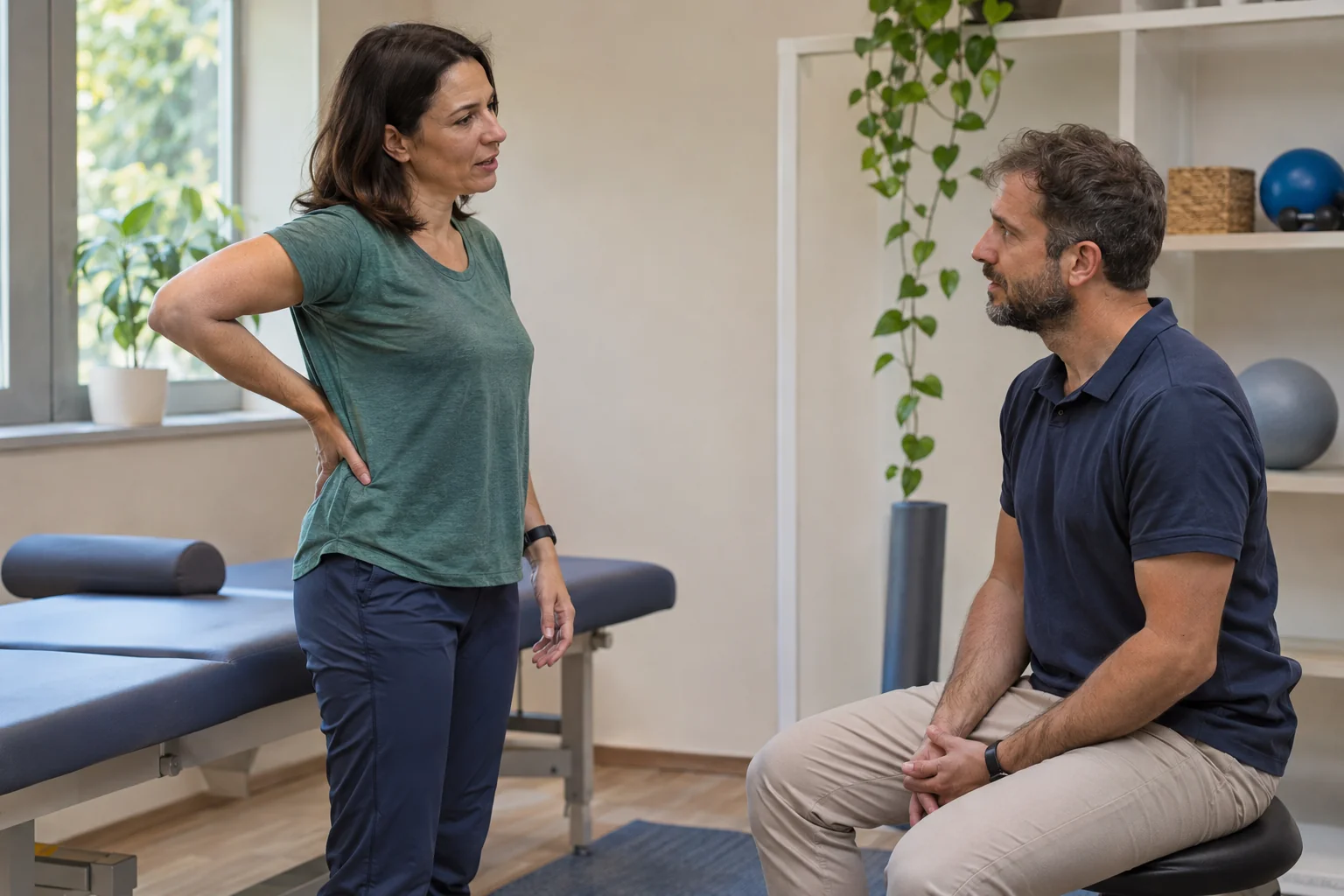
If physiotherapy is prescribed, ask which assessment informed its selection and what it aims to address. Seek feedback on your own technique, rather than taking home only a picture or movement name. Knowing a method’s name does not make your interpretation precise; understanding your own task and the conditions for adjustment does.
Do not independently choose a side for an online “asymmetry-correcting” exercise. A shoulder appearing higher or one turning direction feeling easier does not automatically identify which side to strengthen, stretch or omit. If unsure about a prescribed exercise, say so. Do not add tasks at random to an individual plan in the hope of faster correction.
For monitoring, ask what change is being sought and how to discuss it. Symptoms, daily function and clarity of technique can all be relevant; your own care should define the specific assessment. If a new symptom appears alongside an exercise, do not focus only on symmetry in a photograph. Report the change to your provider.
Previous surgery or brace treatment adds a distinct history
For someone who has undergone spinal surgery, their own surgical records and instructions are especially important. General scoliosis information cannot be used as a postoperative running protocol. Ask which spinal region was involved and how, which current restrictions apply and who will assess your question about sport.
Mention memories of a previous brace or school-age physiotherapy too, but do not infer current needs from these alone. Childhood and adult care may have different goals and circumstances. The NHS therefore discusses adult treatment on a separate page. Do not independently restart an old device or exercise simply because you have now set a more sporting goal.
The role of follow-up should be clear too. Which question requires review, which documents should you bring and what warrants earlier contact? If care has come from several places, ask for help coordinating interpretation of the advice. Do not create a more permissive or stricter mixture of your own from instructions intended for two different situations.
 Enlarge image
A short list for the consultation
The table below is not a suitability test. It helps identify which personal information may be missing from a question about running beyond the diagnosis’s name. Record only what is already known or naturally observed; completing it does not require trying a new movement.
| Topic | What should you bring to the discussion? |
|---|---|
| History | Records of a previous diagnosis, follow-up, physiotherapy, brace or surgery. |
| Current symptoms | Where, when and for how long do they occur, and what differs from usual? |
| Daily function | Which everyday task has changed, and what help do you need? |
| Running goal | Starting, returning or a new load; in what environment and for what purpose? |
| Monitoring | What will be reassessed and when, and which new symptoms warrant earlier contact? |
Your questions might include: “Is my current symptom related to the earlier diagnosis?”, “Do I have a specific movement restriction?” and “Does the exercise target symptoms, function or another area?” Summarise the answers in your own words. This can reveal whether your sporting goal remains unanswered because the discussion covered only general activity.
With new neurological symptoms, care takes priority over the running goal
Even with a longstanding scoliosis diagnosis, do not treat every new weakness, sensory disturbance or change in walking as familiar. Report new functional deterioration promptly. For back symptoms accompanied by new loss of sensation around the perineum, bladder or bowel dysfunction, or severe or worsening weakness and numbness in both legs, the NHS considers immediate emergency care warranted. NHS: urgent warning symptoms.
In a serious emergency in Hungary, call 112. Do not wait for a scheduled sports or spine follow-up when new warning symptoms appear. When requesting help, describe the current change first, then the old diagnosis. Being able to walk or having a previously reassuring finding does not replace assessment of a new symptom.
Your own story is the best starting point where adult scoliosis meets a running goal. Earlier findings, current function and actual sporting needs together make the question specific. You need not turn your body into a task to be corrected from a photograph; you need an individually interpreted movement plan you can follow.
Sources
- NHS: Scoliosis
- CDC: Chronic Conditions & Disabilities Activity
- NHS: Scoliosis treatment in adults
- Scoliosis Research Society: Scoliosis
- NHS: Sciatica
How Futószív articles are prepared: our editorial guidelines.