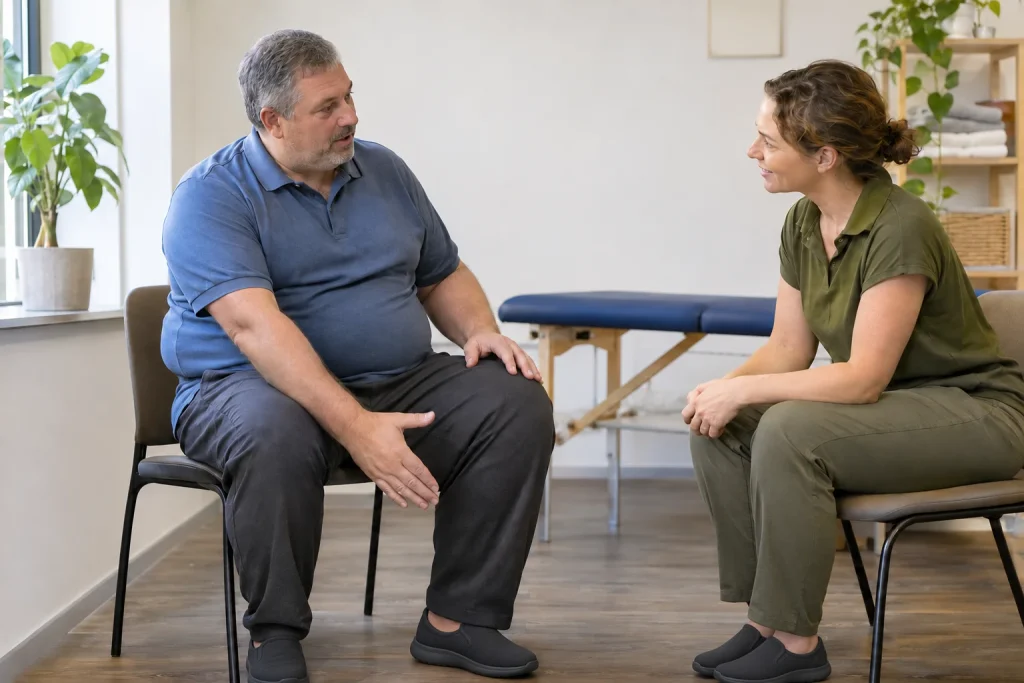
Your knee hurts, so you feel less confident about moving. Meanwhile, you hear that you should lose weight first and only then can the problem be addressed meaningfully. This can feel like a closed circle: pain makes everyday life harder, while you make help conditional on a future body size. Assessing the current symptom and longer-term weight management are connected but separate tasks.
Weight may have a role in an individual healthcare plan. That does not remove the need to understand what is happening with your knee, what movement is appropriate now and how daily difficulties can be addressed. This article does not diagnose or provide personal treatment. It helps prevent the question of help narrowing to a single weight-loss condition.
Some symptoms should not wait
The NHS information on knee pain recommends urgent assessment for severe pain, inability to bear weight, significant swelling or a change in shape. A hot or red knee accompanied by fever, shivering or feeling unwell is another important warning situation. Do not wait for a weight-management programme’s results or try to identify the cause by running.
New locking, instability or difficulty moving the knee should also be named. A change in a longstanding problem is not automatically the same story as before. If the situation seems severe or unusual, seek appropriate help. Body size does not make a current change insignificant.
Less urgent knee pain that is not improving or makes daily function difficult also belongs in an individual assessment. You need not wait until you can do nothing at all. Arranging an appointment does not require first completing a sporting or weight-related task to prove yourself.
Knee pain has not yet named its own cause
Pain location, onset and an associated event can raise several questions. Symptoms after an injury and a gradually developing difficulty have different histories. The NHS describes several possible causes and cautions against self-diagnosis. Do not automatically replace the symptom’s name with a disease name read online.
Osteoarthritis is frequently discussed, but not every painful knee means this condition. Recommendations about it can be applied only within an appropriate individual assessment. You do not have to assign yourself a diagnosis based on weight or age. A ready-made label can easily obscure a detail that matters in your own story.
A previous running history does not settle the question either. You may know movement well and still develop a new symptom. A familiar route or many completed races do not mean your current situation has already been assessed. Personal experience is important background, but does not replace every new question.
What does the symptom tell you about everyday life?
Alongside missing runs, name the daily impact. Are stairs, standing up, shopping or a familiar walk harder? Does the symptom restrict another important form of participation? These can provide specific goals for discussion. From the perspective of your life, the question is about more than when your old pace will return.
Keep the situation and change in your notes, rather than an imagined diagnosis. For example, identify the task during which pain appears and how you function afterwards. You need not retry every staircase to obtain more precise data. Experience from your actual day can be described without a performance test.
| Aspect of the symptom | What should you explain? |
|---|---|
| Onset | Was there an injury, a new task or a gradual change? |
| Activity | During which movement or daily task does it appear? |
| Course | What has changed since the start? |
| Your goal | Which important activity would you like to manage more reliably? |
The table does not score your knee’s condition. It helps clarify your question and is not a requirement for receiving help. If symptoms make another task difficult, you can name that too. The overall picture can change without any change in your weight.
 Enlarge image
Several treatment elements may belong together in confirmed osteoarthritis
The NICE osteoarthritis recommendations describe management guided by symptoms and physical function, individually tailored therapeutic exercise, information and weight management where needed. Strengthening and aerobic tasks adapted to individual needs may form part of the plan. The recommendations do not say running is the only form of movement or appropriate for everyone.
Therapeutic exercise and your own running training are not two labels for identical content. Their purpose, method and monitoring may differ. If someone recommends physiotherapy or another personal programme, understand how it differs from previous training. You should not have to infer precise instructions from an exercise with a similar name in a video.
NICE notes that individually tailored therapeutic exercise may initially involve increased pain or discomfort. This is not general permission to run through every pain. An individual programme should clarify what experience is expected, which changes to report and how the task may be adjusted. New, severe or unusual symptoms cannot be dismissed by saying exercise may be difficult initially.
Improved daily function and quality of life can be goals too. You need not measure every task against a returning running distance. Seeking individually appropriate support for an important everyday activity is a valuable goal in its own right. Your sporting interest can remain, without every decision needing to lead back to the same former performance.
Weight management can be a parallel task, rather than an entry ticket
For osteoarthritis in people living at a higher weight, NICE also recommends discussing and supporting weight management, with attention to possible improvements in pain and physical function. This does not mean assessment of current symptoms must wait until a future goal is reached. Several elements of an individual plan can begin alongside one another.
The NICE weight-management guidance explicitly says not to delay treatment of identified comorbidities until weight loss. It also avoids automatically attributing symptoms to weight. The practical question is therefore which help and next step are needed now, while another goal may also have a place in the plan.
If you want weight-management support, ask about suitable help and available options. You need not promise rapid weight loss while feeling vulnerable because of pain. Dietary or medication decisions require individual assessment. This article does not specify an energy intake, product or deadline for resolving knee symptoms.
Weight-change outcomes and the course of symptoms remain separate observations. If your weight changes but your knee continues to cause difficulty, report that. If your weight does not change but part of the individual programme becomes easier to follow, you can mention that too. A single measure does not have to describe every personal outcome.
Understand the specific form of help too
The NICE shared-decision-making recommendations support discussing understandable options, personal goals and next steps. For your knee symptoms, this does not mean demanding the same examination for everyone. Understand the current assessment, the actions associated with it and how change can be followed.
If you receive an exercise sequence, clarify the version applying specifically to you. Which movement, what support and what monitoring framework form part of the programme? You do not have to fill uncertain details with a load found online. An individual plan is usable when you understand what it means in your real day.
Different treatment elements may involve different professionals or services. Know whom to approach for each question and how important information reaches the others. Knee symptoms, the movement programme and weight management should not become three stories invisible to one another. Coordination can make the next step clearer.
Report recommendations that are unusable too. If the location is inaccessible, the task description unclear or the programme incompatible with daily possibilities, this is more than a lack of motivation. Individual circumstances belong in a workable plan. Naming a specific obstacle makes it possible to seek a more suitable solution.
Specialist care and the question of surgery are not reducible to one BMI number
If a joint-surgery opinion is later considered for confirmed osteoarthritis, NICE says overweight or obesity alone should not exclude someone from referral. This UK professional recommendation is neither entitlement to care in Hungary nor a promise of surgery. Assessing individual suitability, options, benefits and risks remains a separate task.
Referral does not mean surgery is definitely necessary or will definitely be performed. The article does not urge such a decision. The important distinction is that a body-size category should not replace complete individual judgement. You can formulate your own question even if the eventual option is not yet clear.
Understand why a particular level of care is recommended and what current actions accompany it. If waiting or further discussion is needed, monitoring symptoms still matters meanwhile. Managing your present daily function may require a more precise, individual plan than “once you have lost weight”.
 Enlarge image
Put movement and daily life in the same plan
Standing up, climbing stairs, working and travelling are not insignificant background outside training. If knee symptoms affect these, the change belongs in the discussion. You need not wait until running restarts to report how usable the programme is.
Social participation can adapt too. Another form of movement or a community occasion without exercise may fit your individual circumstances now. Maintaining contact does not require completing a painful run. A suitable choice is not valuable only to the extent that it outwardly resembles your former programme.
The NICE principles of care also emphasise personal context, individual choice and respectful language. You can name what matters to you and what help you seek. The question of weight must not automatically remove your own role in decisions about knee symptoms.
A workable continuation is not described by one condition
A fictional runner living in a larger body seeks help for new knee pain. They explain how it began and which daily journey became difficult. Alongside individual assessment, movement and weight management where needed receive a place in the plan. They do not make talking about a current symptom conditional on reaching a future number.
If osteoarthritis is already known, their programme is adapted accordingly and questions are clarified. The story does not promise freedom from pain or a return to running. It illustrates making different tasks visible together: current symptoms, daily function, movement and a possible weight goal are different questions.
Having knee symptoms assessed therefore does not require first solving every longer-term goal alone. Weight’s possible role and the present need for appropriate help can be discussed together. A usable plan provides concrete action and a way to report back, rather than turning pain into merely a weight-loss task.
Sources
NICE NG226: osteoarthritis, individual exercise and treatment options; NICE NG246: respectful principles of care; NICE NG246: symptom assessment and managing comorbidities; NHS: knee pain and urgent signs; NICE NG197: shared decisions and the next step. Checked: 21 November 2026. The examples are not diagnoses, statements of entitlement to surgery or individual treatment plans.
How Futószív articles are prepared: our editorial guidelines.