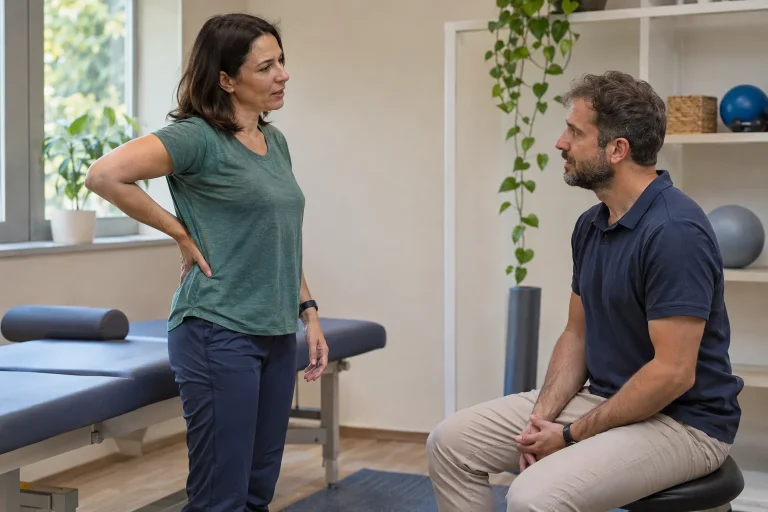
Pain extending into the buttock can quickly acquire a sciatica label. A running friend has heard of it, search results instantly suggest exercises and you remember old back symptoms. The name does not describe exactly what you experience now, however: pain, tingling, reduced sensation or changed strength. These differences can genuinely matter in individual assessment.
This article helps you discuss radiating symptoms that feel nerve-related and identifies new symptoms that must not wait for routine review. It does not establish which nerve or spinal region is involved. It provides neither a home nerve-tension test nor a running load in place of assessment.
What does sciatica mean, and what does one word leave unexplained?
The NHS says sciatica occurs when the sciatic nerve is irritated or compressed. Symptoms often affect the buttock and back of one leg, and may extend towards the foot and toes. Tingling, numbness or weakness may occur alongside pain. This helps explain the term without making it a definite diagnosis for every pain radiating into the buttock. NHS: Sciatica.
The word sciatica does not settle the cause either. Official information describes several possible backgrounds, so your sensation cannot automatically be assigned to a single disc or muscle. Even with an existing diagnosis, when and on which symptoms it was based matters. The current situation can differ, especially with new sensory disturbance or strength changes.
The NHS specifically notes that a situation involving back pain alone is probably not sciatica. Everyday speech nevertheless often uses the term for any lower-back problem. In the consultation, follow the label immediately with the actual symptom. “I have lower-back pain” and “new numbness accompanies a sensation extending downwards from my buttock” are different accounts.
Describe the path of radiation in your own words
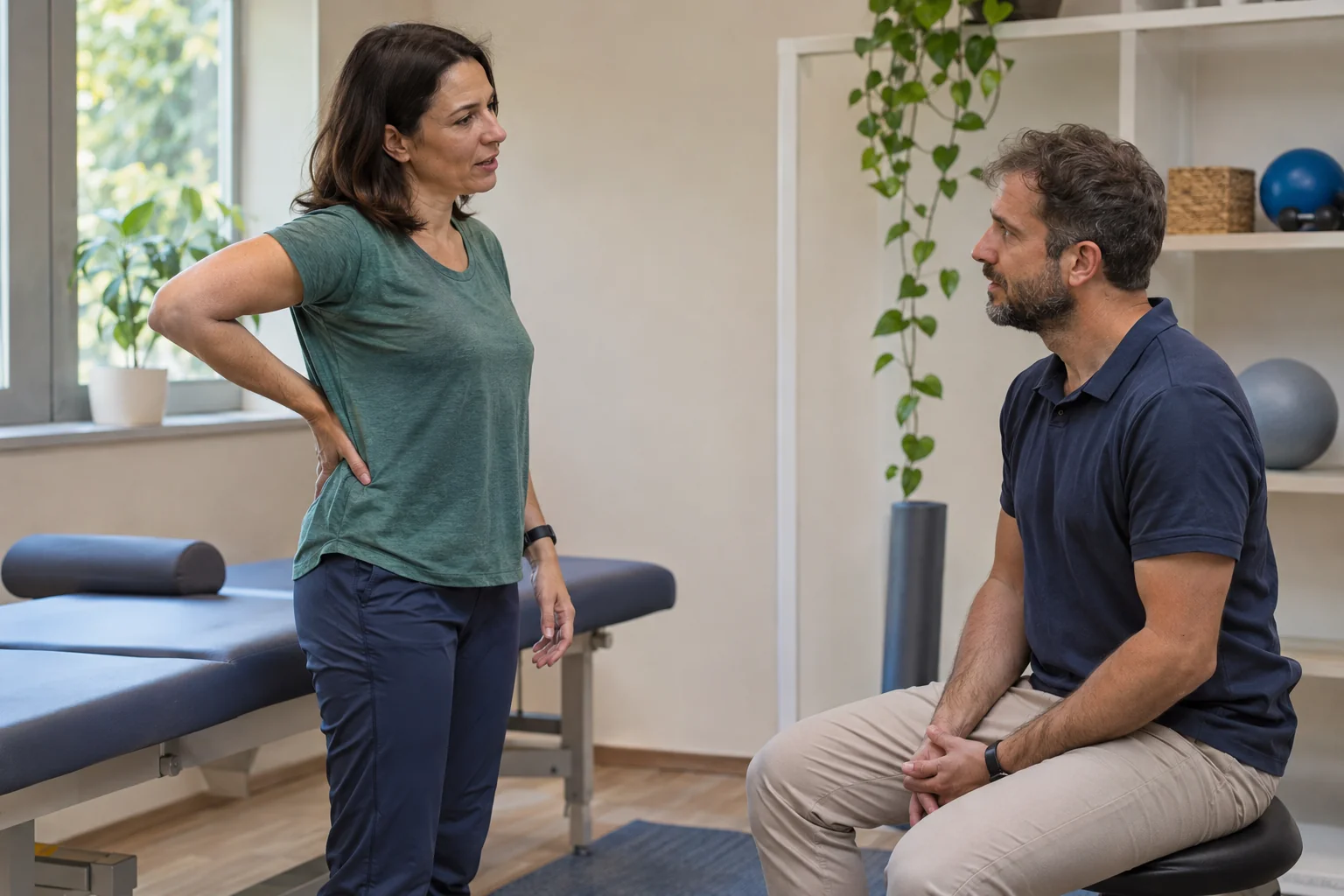
“It goes into my leg” can mean several experiences. Show through clothing where it begins and ends, which side is involved and whether it occurs as a continuous band or separate points. You need not adapt your account to a nerve-path diagram. If your experience does not fit a coloured picture online, tell your own story rather than copying the image.
The sequence can matter too. Did something begin in the lower back and later appear in the buttock, or did leg symptoms come first? Do they occur simultaneously or at different times? You can recall these distinctions without performing movements that provoke pain. Leave uncertainty uncertain, rather than filling it with guesses.
Report changes in spread too. If discomfort once affected a smaller area but now appears elsewhere, explain when you noticed. Pain felt farther away does not necessarily identify the cause’s location; assessment must interpret this. Your observation is valuable because it is precise, rather than because it already names the responsible structure.
Do not merge pain, tingling and numbness
Pain may be sharp, burning, pulling or another quality; tingling is often described as crawling ants or pins and needles. People may use numbness either for that sensation or for reduced feeling. You need not use a perfect dictionary. Explaining what a word means for you makes discussion much more precise than “my leg feels strange”.
Describe naturally noticed sensory changes, such as something apparent while dressing or walking. Do not test yourself with needles, hard pinching, hot objects or another potentially injurious method. Mapping nerve function at home is not your responsibility. New or significant loss of sensation calls for appropriate medical assessment.
Pain intensity and the presence of sensory disturbance are separate information. Less pain on one day does not make new numbness unimportant. Explain both and identify which changed during consultation. Bring more than a pain score: character, location, onset and effects on function together give a more useful picture.
 Enlarge image
Report weakness with its everyday consequences
“It feels weak” may involve caution because of pain, uncertain support or a previously easy task genuinely becoming harder. Your job is to describe the observation, rather than distinguish these causes. For example, did usual walking change, did you request help in an everyday situation or did you notice you could no longer perform a movement as usual?
Seek medical guidance promptly about new or worsening strength changes. Do not assess severity at home through stairs, standing on one leg or heel- or toe-standing trials. Checks during individual examination differ from repeatedly doing a symptom-provoking task alone. Not having tested further is useful information for the examiner too.
The NHS slipped-disc page includes weakness and sensory changes among possible symptoms and mentions further assessment for worsening symptoms. This does not establish that your problem definitely originates from a disc. It supports not recording such changes merely as training fatigue. NHS: Slipped disc.
Do not save new urgent signs for the next review
The NHS lists sciatica on both sides, severe or worsening weakness and numbness affecting both legs, and altered sensation around the perineum as situations requiring urgent hospital assessment. New difficulty urinating, urinary retention or new loss of bladder or bowel control also require immediate help. All signs need not be present together.
In a serious emergency in Hungary, call 112. Do not try to reach care by driving yourself or running if your condition makes that unsafe. Begin the request for help with the new symptom and its onset, rather than only saying you have old sciatica. A previous diagnosis does not automatically make a new change known or harmless.
Name intimate symptoms directly and simply too. For example: “Today I have difficulty starting to urinate; this did not happen before” or “I noticed new loss of sensation around my perineum.” Embarrassment is understandable, but do not wait for another occasion. You need not first be certain of a relationship to back symptoms; care should clarify that.
An old MRI report and current symptoms are separate information
A disc finding in an old report can easily become a ready explanation for every new buttock or leg symptom. The NHS notes, however, that not every slipped disc causes symptoms. Interpret the relationship between the report and current history individually. Bring the imaging result, but do not begin and end the entire discussion with its diagnosis name alone.
Bring the original text and available earlier documents, rather than only the vertebral number remembered. Explain when the examination occurred, which symptoms you had then and what differs now. Highlight if the other side is involved or a new sensory disturbance appeared. A change does not disappear because an earlier document also lists a finding.
Discuss further investigations with your provider. Ask which question they aim to clarify and how a result would change the next step. Rather than choosing a test in advance, your most useful contribution is a precise symptom account. New urgent symptoms do not become less urgent because you already have an old image of your spine.
Why is an online nerve-tension manoeuvre not a good self-test?
Leg raising or seated forward bending in a video can look like a simple yes-or-no test. In individual examination, however, a professional considers execution, the sensation produced and other information together. Imitating it at home cannot provide the same conclusion. You need not provoke symptoms more strongly to feel more certain of a label.
A sensation changing during one movement does not explain what you should repeat regularly. “It pulled just now” does not automatically imply “this needs stretching”. If movement or exercise is recommended, ask its purpose, about your own technique and when to report changes. A general video does not know your symptoms and history.
The same applies to massage or strong pressure on a painful point. You need not prove a sensation can be triggered from a particular place. Preparing for assessment can be as simple as writing down what happened and not experimenting further. A symptom disappearing momentarily does not itself establish that you found and removed its cause.
 Enlarge image
Collect clear examples from daily situations
Changes experienced while sitting, standing up, walking normally and resting can help your account. The aim is not to manufacture a pain value for every situation. Choose a few naturally occurring examples and explain their sequence. Mention work involving much driving or standing too, because the structure of your day affects putting advice into practice.
Be specific about running as well. Did you notice symptoms during it, immediately afterwards or the next day? Did you stop, did your step change and what has happened in everyday life since? Exact pace is only one possible extra detail. A watch does not sense numbness for you, and a perfect training graph does not settle a new neurological-type symptom.
The short table below clarifies words. Nothing needs trying to complete it; write only what you noticed anyway. A missing observation is not a negative test result.
| What you might say | How to make it more precise |
|---|---|
| It radiates | Where does it start, on which side and how far do you feel it? |
| It is numb | Do you mean tingling or reduced sensation? |
| It is weak | Which usual daily task changed or became harder? |
| It improved | Which changed: pain, altered sensation or function? |
| Old sciatica | When was it diagnosed, and how does the current story differ? |
Clarify the next step before the running plan
If symptoms worsen, fail to improve or prevent normal activities, the NHS also recommends medical advice. General activity guidance does not mean continuing familiar running training with every symptom. Discuss your sport’s nature and current condition together. Do not try to complete a fixed programme by suppressing pain or changing medication independently.
At the end of consultation, clarify which changes will be monitored, when to report back and which symptoms require earlier help. Ask separately what advice means for everyday movement and running. If an instruction does not make sense in your day, request an example or clarification. A follow-up plan should remain usable outside the consulting room.
Sciatica can be a useful part of a professional explanation, but does not replace describing your own symptoms. Radiation, pain character, sensory change and function provide separate information, helping assessment concern the current situation. You need not adapt a new symptom to an old label or settle the need for care through a running workout.
Sources
How Futószív articles are prepared: our editorial guidelines.