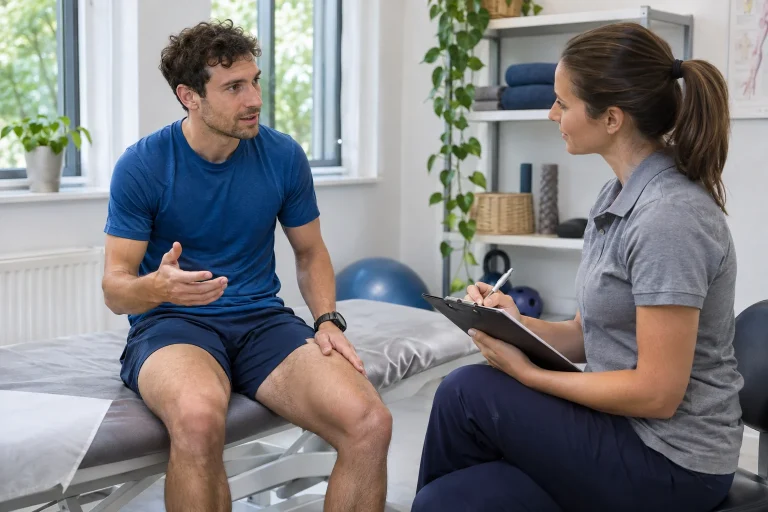
After hip arthroscopy, the visible external mark may be small even though several different procedures could have occurred inside the joint. ‘I only have a few tiny cuts’ is therefore a misleading reference point for a runner. Clarify rehabilitation through the actual operative findings, treatment performed and your own recovery guidance rather than scar length.
The same word arthroscopy may appear in two discharge summaries while the people’s subsequent needs differ. The aim is not to construct a running programme alone from the operative description. Understand the essentials of your situation, know which instructions apply and be able to ask separately about running at follow-up.
Arthroscopy also describes the access method
During arthroscopy, a surgeon works inside a joint using a camera and instruments through small incisions. The term alone does not reveal exactly which tissue was treated or what was done. Surgical approach and content are related but distinct information. ‘Keyhole surgery’ describes access, not one uniform running-rehabilitation programme.
The AAOS lists several possible arthroscopic treatments, including addressing damaged cartilage surfaces, labral repair or reconstruction, correction of bony abnormalities and removal of inflamed synovial tissue. These are not components of one compulsory package. The list helps explain why you should ask which occurred in your case and whether anything else was done. AAOS: Hip Arthroscopy.
The preoperative plan and actual operative report are not necessarily identical documents. If you remember only the earlier consultation, request an understandable summary of the procedure performed. You do not need every technical detail, but should understand findings and restrictions important to rehabilitation in your own words.
The labrum and articular cartilage surface are separate structures
The hip is a ball-and-socket joint, with the femoral head fitting into the pelvic socket. Cartilage covering the joint surfaces differs from the fibrocartilaginous labrum around the socket rim. Gateshead Health’s patient guide explains this anatomy. ‘They fixed the cartilage’ can therefore cover different treatments and may need clarification at follow-up.
Labral treatment can differ too: the hospital information describes repair and removal of the damaged portion. The reader’s lesson is not a treatment ranking, but a specific question: ‘Which tissue was treated and how, and why does this matter for my current guidance?’ Ask your own team to interpret the operative details. Gateshead Health: hip arthroscopy.
If a report says repair, reconstruction or bone correction, do not choose a general online programme solely from that term. One word does not describe the full surgical situation. Ask which details determine your weight-bearing restrictions, movement and progression criteria. The answer needs a professional familiar with the complete documentation.
A small skin wound does not measure internal recovery
Outside, you mainly see skin and a dressing. That does not reveal internal procedure details, and scar appearance does not establish sporting readiness. If others say ‘you can barely see anything’, follow your instructions nevertheless. You need not adapt recovery speed to an external impression or justify scar size.
General NHS postoperative guidance emphasises following your own providers’ advice for wound care and activity. It links immersing the wound, for example, to healing and medical approval. Clarify this because ‘I can wash now’ and ‘I can start swimming’ may be different questions. NHS: getting back to normal after surgery.
Report skin observations just as you report deeper symptoms, but do not merge them. A change around a dressing differs from a joint sensation while sitting. You need not decide the origin at home. Precise location and timing can help the team address the appropriate question.
 Enlarge image
Make weight-bearing instructions understandable in practice
According to the AAOS, postoperative aid use and weight-bearing progression can depend on the procedure required. It likewise connects rehabilitation to the intervention performed. Do not independently abandon crutches because limping stopped or they are inconvenient. If discharge wording is unclear, ask for explanation before your next change.
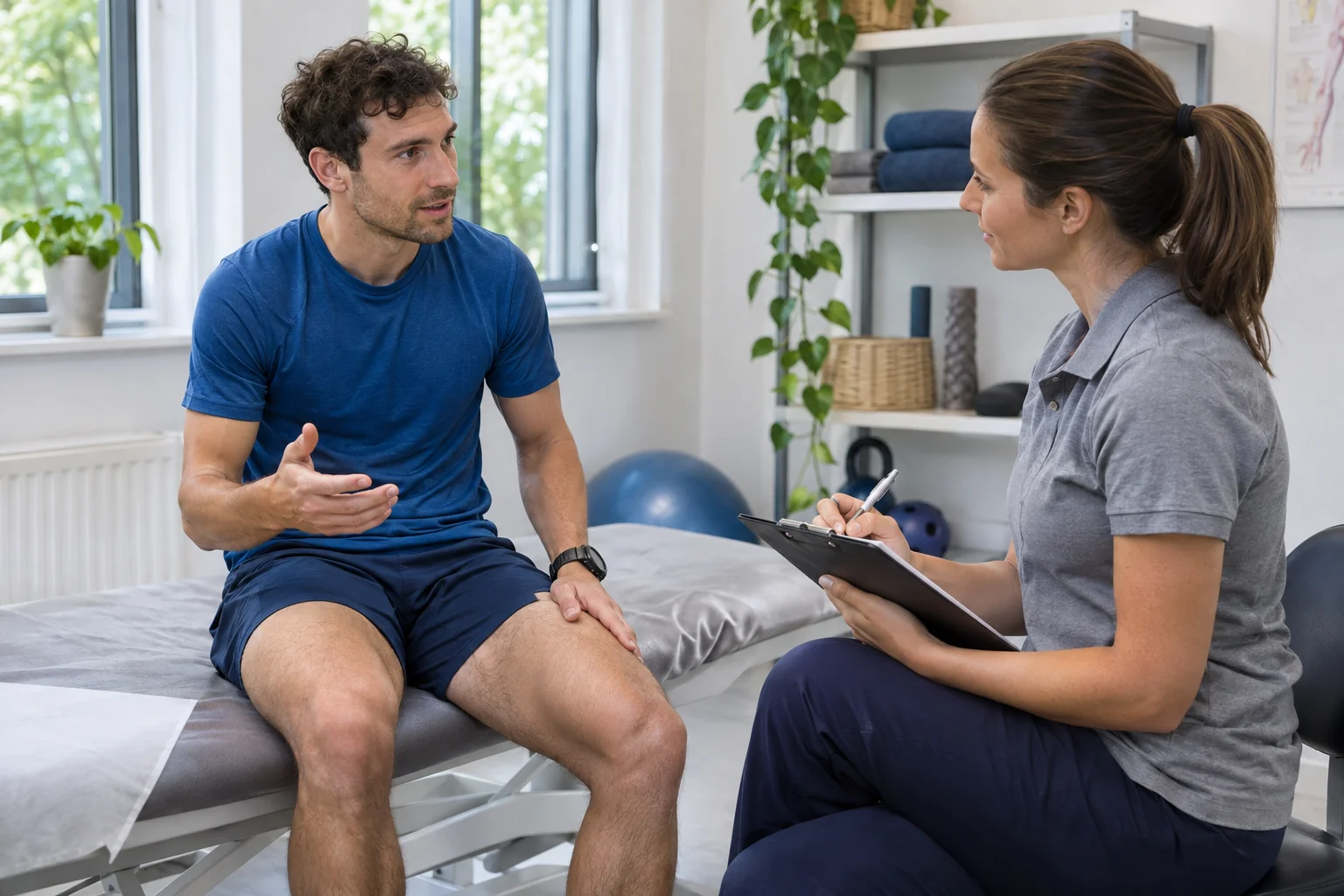
‘Partial weight bearing’ or a movement restriction is useful only if you know how to implement it daily. Request individual demonstration and feedback on your own performance. Moving around home, stairs, commuting and carrying objects can all raise practical difficulties. Ask about these situations rather than creating a new technique from video.
Organise help at home around the actual instructions too. If both hands are needed for an aid, plan who will carry meals, shopping or a bag. Ignoring instructions for an everyday task is not the solution. Tell the team if home circumstances make something difficult; understanding and feasibility both matter.
Know the rehabilitation exercise’s purpose too
Do not identify assigned exercises only by name or picture. Ask their purpose in your case, how to perform them and which individual limits apply. A programme may concern one phase; adding an earlier or later online sequence can change it. Do not collect extra tasks simply because a few repetitions feel insufficiently athletic.
If you cannot perform something as demonstrated, do not silently invent another version. Describe where you became stuck and request clarification. Alongside ‘I am doing physiotherapy’, it matters whether instructions are clear, equipment accessible and a contact available for questions. Rehabilitation is shared work, not a solo dexterity examination.
At follow-up, describe changes through the agreed activities. Do not select deep squats, forced hip rotation or jogging as your own test of readiness. Describing actual difficulties, tasks completed and responses can help. Clarify assessment criteria within the individual plan.
Ask about running separately, explicitly including jogging
For someone keen on sport, ‘I can move’, ‘I can load it’ and ‘I can run’ can merge. Do not leave this general at the appointment. Say you are asking about running even if you mean only short, slow jogging. An activity called easy still has specific demands to assess with the procedure performed in view.
The AAOS section on longer-term outcomes notes that return may depend on the hip abnormality found and that some people need another sport instead of higher-impact activity. This need not be extended to everyone beforehand. It does warn that surgery itself does not promise a particular running result or race distance.
Describe intended sport specifically: alone or with others, level predictable ground or trails, a short session or regular training? Do not calculate your own risk score from these lines. The point is for the professional to understand the desired activity rather than answer about something quite different.
Similar operation names can conceal different histories
Imagine two runners having hip arthroscopy in the same month. One reports labral repair, the other another internal treatment. Social media shows only operation day and the first sporting photograph. That cannot establish one recovered faster and the other is overly cautious. Missing information can make the comparison itself misleading.
Another patient’s experience may still offer useful organisation ideas: recording questions, remembering what they forgot to ask or arranging help to attend follow-up. Do not borrow your loading restriction from it. In particular, do not copy their date of stopping aids or first run into your own calendar. A sequence of events is not an individual plan.
The same applies to a public hospital protocol. A document for one institution’s procedure may provide useful background without fitting your surgery. If your instructions differ from an online table, ask why. Do not construct a more permissive mixture of the two.
 Enlarge image
Do not treat new symptoms as compulsory recovery
Postoperative guidance also addresses complications and seeking help. Gateshead Health emphasises notifying the team for fever, wound pus or increasing wound symptoms. The NHS recommends prompt medical help with new leg pain, swelling, warmth or discolouration. Do not record these as familiar post-workout muscle sensations.
Sudden breathlessness or chest pain may be an emergency; call 112 in Hungary. Know your discharge summary’s urgent warnings and have the specified contact route available. You need not identify the complication type with certainty at home before seeking help. Describe the symptom, onset and recent surgery.
Do not change medication, wound care or other postoperative instructions to fit planned training. Discuss suspected side effects or other problems with your provider. This article does not replace your operative guidance or list every possible problem. Ask which changes to report sooner while waiting for follow-up too.
Five questions to make your own plan understandable
These questions are not an authorisation test. They prevent unspoken leaps between the operation’s name, daily tasks and longer-term sporting goals. Bring the original document and, where possible, summarise answers in your own words.
| Question | The connection to clarify |
|---|---|
| Exactly what was done inside the joint? | Know the actual treatment rather than only the operation name. |
| Which instruction relates to which procedure detail? | Understand the restriction’s purpose. |
| How should I perform daily movement and exercises? | Make written advice work in your actual situation. |
| When and on which criteria will we decide about running? | Assess sport separately rather than misunderstand general activity advice. |
| Which changes should I report to whom before follow-up? | Keep the follow-up plan usable until the next appointment. |
Independence during recovery does not mean making every decision alone. Clear instructions, opportunities to ask and accessible help together make time at home manageable. A small scar does not remove your right to a detailed explanation of what happened inside and what that means for the coming weeks.
A sporting goal’s value is not how quickly it follows surgery. A clear plan suited to your situation supports decisions better than another runner’s impressive return date. Running after arthroscopy concerns the actual procedure and current condition; scar size offers no shortcut answer.
Sources
How Futószív articles are prepared: our editorial guidelines.