Your first jog went well, so you would repeat it the next day and join a friend at the weekend. Each occasion seems short. By the end of the week, however, the programme differs from what you imagined after that first run. As a beginner, the story of all sessions matters, not only having set off bravely once.
At a higher starting body weight too, no single number determines individual capacity for exertion. Research examines initial running amounts, but seeks answers in defined people and programmes. The useful lesson is not a kilometre limit handed to everyone, but clearer planning of the whole first week and actual experience.
One session and the week provide two views
Completing a short run shows what happened on that occasion. It does not automatically explain how several similar tasks fit together. The weekly view includes how often you set off, on which days, what happened between sessions and any important changes. Repeating the same occasion creates a different total amount.
When alternating running and walking, total route distance and the portion run are also different data. An app’s total distance does not necessarily reveal how much running occurred. You do not need laboratory precision for everything, but retain the distinction. In discussions of your programme, you can then mean the same thing by amount.
Weekly structure also concerns distribution over time. Sessions at opposite ends of the week and days clustered consecutively are different organisational situations. This article does not calculate personal risk from them. It makes visible that sequence and daily reality belong in the story alongside the sum.
What did the research on starting distances examine?
A randomised study published in 2018 included 56 novice runners with BMI values between 30 and 35. It compared two programmes over four weeks. One began with 3 kilometres of running per week, the other with 6, both divided across three sessions. Both programmes included weekly increases of ten per cent.
In the paper’s primary intention-to-treat analysis, the injury difference was not statistically clear. Several participants did not run according to the prescribed programme, and 15 uploaded no training. An additional analysis accounting for adherence found a more favourable difference for the smaller starting amount. Both types of findings must be reported together.
This small study does not establish a universal safety threshold. It does not promise freedom from injury below the published distance or specify the right start for people with every other condition. Nor did the shared increase rule become a proven protective formula for every reader. The main lesson is that starting amount and actual programme adherence are meaningful research questions.
Why distinguish the prescribed programme from what happened?
A plan on paper is not the same as what you eventually did. A session may be missed, an extra group run added or a section intended for walking may become jogging. These disappear if you retain only the programme name. Discuss actual data even when the result did not match your original expectations.
In the research example, differences in adherence formed part of interpretation. That distinction can help everyday planning too, without blaming participants. If a plan repeatedly proves unmanageable, timing, environment or personal circumstances may explain why. The precise history can produce a better question; a ticked programme name cannot.
Two short fields can fit in your notes: what did I plan, and what actually happened? State the cause of a change as certain only when you genuinely know it. ‘It became longer with friends’ differs from ‘I finished earlier because of knee pain’. Both can be retained, but may open different next steps.
| Planned part | What actually happened |
|---|---|
| A short personal session | Did it remain the same, or last longer because of company? |
| Walking portion | Did it stay walking, or silently become running? |
| A day left free | Did both a missed task and a new one end up here? |
| A preselected route | Did distance, terrain or outward-and-return arrangements change? |
 Enlarge image
Short sections add up
Understanding amount requires no complicated model. If a session contains several running portions, together they form that session’s running amount. Adding separate sessions produces the weekly view. This is a simple description, not an injury prediction. It prevents every portion from seeming so small individually that none ends up being counted.
An original illustration: including a particular short section once in a session differs from repeating it several times. Repeating the whole session several times in the week creates another sum. We deliberately prescribe no particular section length here. The lesson is the calculation method, not a beginner dose to follow.
Walking need not be considered worthless; simply retain it as a different type of information. Total time, the running portion and other daily movement can provide separate views. They need not be merged into one imagined load score. Precisely named information is already more useful than the general statement ‘I only moved a little’.
Flag uncertain measurement. A GPS dropout or mixed-up recording does not invalidate the occasion, but may affect comparison. You do not need to invent the last metre. It is acceptable for your log to record the sequence of running portions without an exact distance.
Rest and daily tasks belong to the week
The NHS introduction to its beginner running programme places rest days between running sessions. This is a structural element of a named programme, not an empty calendar slot. Squeezing in a missed session at any cost can create a different sequence from the one originally followed.
A rest day does not necessarily leave every other part of life motionless. Work, travel or household tasks may remain. You do not need to convert them into exact running kilometres, but can mention unusual daily demands. A running app may not see the whole day, so your account can contain more than the list of recorded workouts.
The weekend is not a compulsory catch-up workshop either. If earlier days unfolded differently, plan the next step within the current framework. The reason for missing a session matters: an organisational difficulty and a new symptom may require different answers. You do not have to repay every absence with more running.
Social outings also belong in the full picture. If part of a walk with friends regularly becomes jogging, that movement still occurred even without being labelled ‘training’. A name should not erase the actual task. Enjoying the shared occasion and planning the week can both remain possible.
A good first experience does not settle later questions
You can enjoy having felt good when starting. There is no need to devalue that; simply describe it proportionately. One pleasant occasion does not answer every later day. Subsequent sessions and the rest of the day also help you understand your own beginning.
The NIDDK guidance on starting activity emphasises building gradually, manageable goals and considering practical barriers. This need not immediately be reduced to one percentage rule. Current capacity, the activity and your individual healthcare framework matter together in your own programme.
‘It was not hard, so it must have been too little’ can also mislead. Not every appropriate session needs to be exhausting. Retain a good experience without immediately lengthening the next one. At the beginning, manageability matters too, not only how powerful a story you can tell about the first day.
Symptoms should not become the accepted price of the total
The NIAMS information on sports injuries emphasises avoiding sport through pain. If a new or worsening symptom appears, you do not need to complete the remaining weekly goal before taking it seriously. Being close to the planned total does not make an individual symptom acceptable.
Severe pain, substantial swelling, inability to bear weight or feeling seriously unwell may require appropriate and, where necessary, urgent assessment. A smaller recurring problem can also be named. Record pain’s timing, location and changes in daily function rather than running again to prove a cause.
Do not turn body size into a ready-made explanation for every symptom either. Symptoms have their own history, which may include prior loading. Appropriate help does not begin with a moral judgement on your first week. The aim is assessing the present question and clarifying a manageable continuation.
 Enlarge image
How to make your first week clear
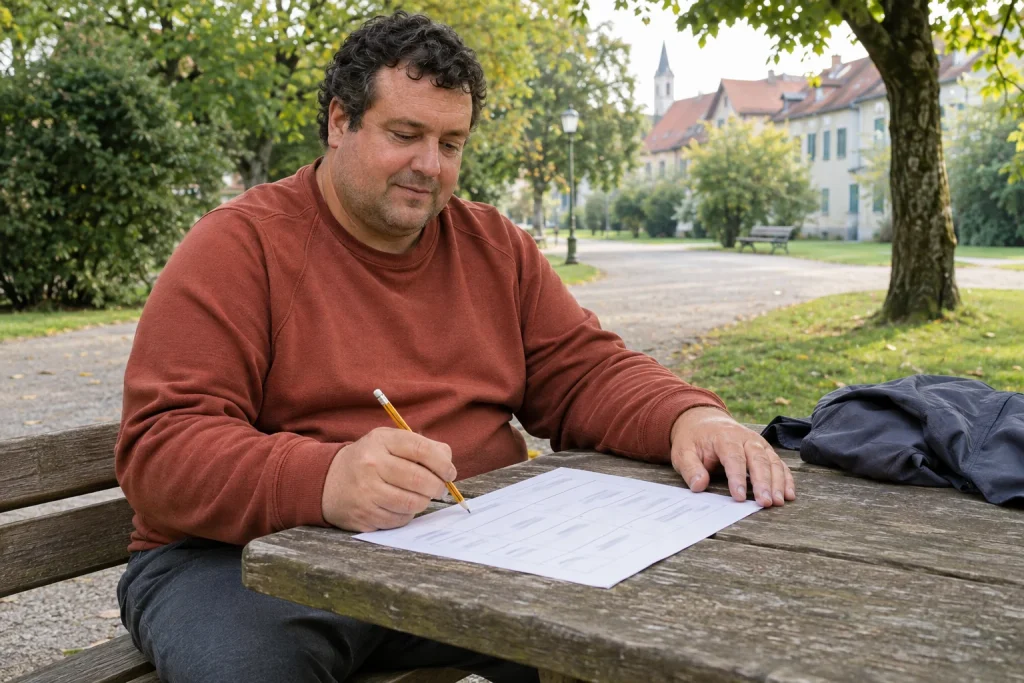
Choose simple notes showing the sessions and main changes. The running portion, whole outing and important circumstances can occupy separate lines. You do not need a new system every day. A log helps when it preserves the actual history, not only a pre-imagined successful week.
- On which days did running actually happen, and as part of which programme?
- What remained of the original plan, and what changed along the way?
- How did sessions and other important daily tasks follow one another?
- Were there new symptoms or data whose meaning is uncertain?
This list is not a clinical risk checklist. You do not need favourable answers to every question, and observation is not a prerequisite for seeking help. Its purpose is to retain the whole week alongside ‘I managed it the first time’. The next plan can then start from more than one memorable moment.
A fictional beginner considers three separate sessions short, then adds a fourth shared outing. At the week’s end, they recognise that they had not viewed the running portions together. They do not punish themselves for the changed plan, but record it precisely. Actual amount and experience become the basis for continuing, rather than the name of the programme originally downloaded.
After courage, a manageable continuation matters too
The joy associated with first setting off can belong in your story. The next step does not require repeatedly producing greater proof. A clear week, an appropriate individual framework and necessary changes can all be part of learning through sport. A seemingly smaller but manageable process is no less serious.
Research on starting distances can also be read responsibly only by retaining results and uncertainty together. In personal practice, the transferable lesson is naming the whole week. A study’s kilometre value is not a badge below which you cannot be injured, or a judgement about who belongs in running.
The useful question is therefore: which actual running and other tasks came together this week, and how did they fit me? This can say more than one brave outing. The answer needs an accurate story, not a beginner dose imposed on everyone or a total completed through pain.
Sources
Bertelsen and colleagues, 2018: full paper comparing starting distances; PubMed abstract of the same original study; NIDDK: starting activity gradually; NHS: beginner programme and rest days; NIAMS: sports injuries and the appropriate next step. Checked: 21 November 2026. The adherence questions and story are original illustrations, not an individual loading prescription or injury prediction.
How Futószív articles are prepared: our editorial guidelines.