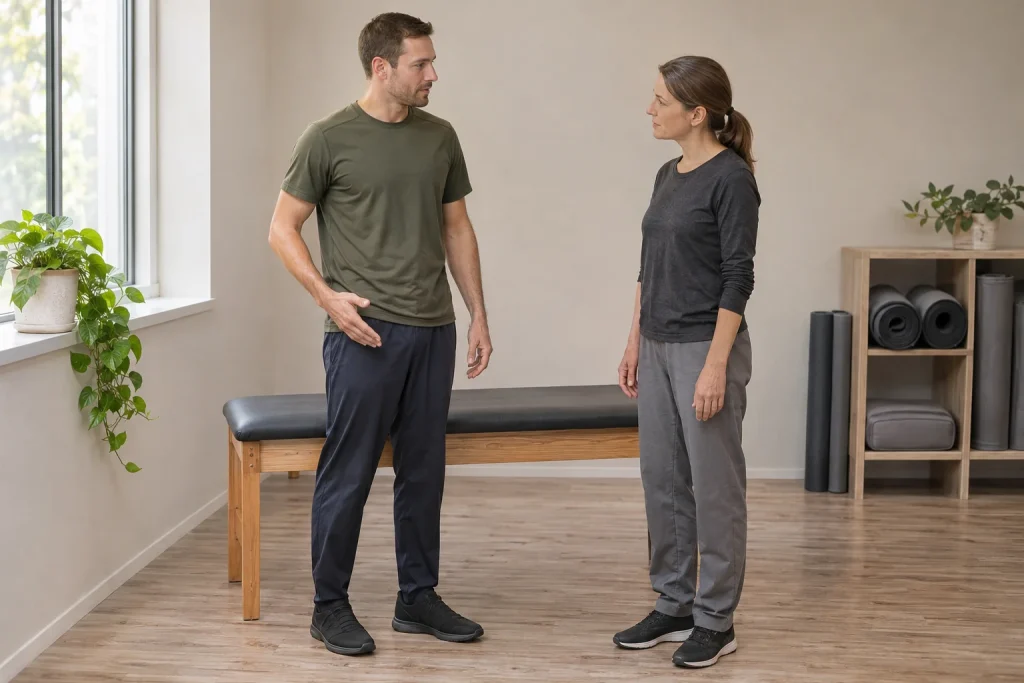
At the beginning of a run or after prolonged sitting, you feel tightness at the front of your hip. A familiar explanation quickly arrives: the hip flexor is short, so it needs stretching. The sensation may be real, but that sentence does not tell us which tissue is involved, your range of movement, whether an injury occurred or what task would suit you.
‘It feels tight’ is useful language for describing a symptom. You do not, however, need to attach a treatment name automatically. The following helps describe the sensation at the front of the hip more precisely, distinguish sudden onset from a recurring situation and understand why observing a symptom differs from trying an online stretch.
Your sensation is a description, not a muscle-length measurement
Tightness describes your experience. Measurable range of movement concerns the available extent of a particular motion, while assessing a muscle or other tissue’s condition may need further individual evaluation. Do not treat these three as identical. You do not need to determine that something is shortened, weak or injured to discuss discomfort.
You might say: ‘I feel a pulling sensation at the front when I start moving’ or ‘this area feels tight after running’. These statements leave the question open. ‘My hip flexor is short’ already names an explanation. If a professional established this previously, describe which assessment and when.
Notice where an online description turns the language of sensation into a definite cause. Similar wording does not prove that the same thing is happening to you as to the video’s creator. Start from your own history and ask: ‘How can we clarify what this sensation means in my case?’
‘Hip flexor’ does not identify a single point
Hip flexion is the movement bringing thigh and trunk closer together. Several muscles contribute; the everyday term ‘hip flexor’ does not always identify one precise tissue. The AAOS information on hip strains explains relationships between muscles and tendons and the role of surrounding areas. The AAOS Hip Strains information presents a defined group of injuries.
Show whether you feel the symptom in the groin crease, front of the upper thigh or another nearby place. Are you indicating a point or wider area? Does it feel superficial or deeper? These are everyday distinctions, not home diagnostic maps. They can help you and the professional talk about the same location.
If showing the area precisely is difficult, say so. Do not start pressing firmly simply to find a tender point. Indicating it through clothing and telling the story may be enough to begin. Whether an examination is needed and how it should proceed must be clarified according to the individual situation.
A sudden injury and a long-recurring sensation are different histories
Consider whether onset related to one event: slipping, an unexpected movement, sprinting or another specific injury situation. Or did it appear over several days without a precise moment? The AAOS describes acute injury and muscle or tendon symptoms arising through repeated loading. Timing matters, but you need not select the injury type yourself from the description.
Do not automatically call sudden pain another episode of familiar tightness. If its character differs, movement changed significantly or an injury occurred, report this as a new development. Equally, you can seek help for a recurring, slowly changing symptom, not only after a dramatic misstep.
Earlier experience can add detail: did anything similar happen, did you receive assessment results and what happened since? Do not carry forward only an earlier label. Include the present symptom’s location, onset and everyday effects separately, because these explain what has changed.
 Enlarge image
Stretching cannot establish the cause at home
Feeling something at the front during a stretch does not prove the tissue is short or is the tissue named in a video. The movement may change the positions and loading of several body parts. Reaching an impressive lunge is not an individual injury assessment and does not itself explain symptoms while running.
Do not deepen a movement simply to produce a stronger response. With pain, pinching or uncertainty, clarify the task and what you personally should do. Calling a movement a stretch does not automatically make it appropriate for your own unassessed condition.
If you previously received an individual exercise, ask for its performance to be checked. Describe where you feel it, what you understood from the instruction and what changed meanwhile. This is more useful than adding another movement from a different programme to conceal uncertainty.
Describe training changes as context, not culprits
Did running distance, pace, route or weekly structure change? Were there more stairs, journeys, prolonged sitting or an unusual everyday task? You can describe these situations without identifying one detail as the certain cause. A list of circumstances provides background for the professional conversation.
‘I sat too much, so it must have shortened’ compresses several conclusions into one sentence. More precisely: ‘My days involved more sitting, and I noticed the sensation during this period.’ Individual assessment can explore whether a connection exists and which change might be appropriate. Coincidence in time alone does not prove causation.
If you bring a training log, highlight only relevant changes. You do not need to export your entire life history from the watch. Make the description understandable: what was previously usual, what changed and when symptoms appeared. Your experience needs to accompany the graph.
Daily function may reveal your most important question
The tight sensation may be most noticeable early in a run, but consider everyday effects through events that already happened too. Are stairs, getting out of a car or starting after sitting harder? Is sleep affected? You need not try every situation. Bring what came to your attention spontaneously during the day.
The NHS identifies hip pain disturbing usual activities or sleep, worsening or recurring as a reason to seek medical help. The NHS page on hip pain in adults also advises against establishing the cause at home. The word ‘tightness’ should not hide pain or a change in function that is actually present.
Your personal aim might be comfortable everyday movement, a question about running or understanding an assigned exercise. Name them separately. Instead of ‘I should be more flexible’, discuss more precisely which activity became difficult and what you want to learn from care.
Ask about the programme’s purpose, not only the exercise name
The AAOS hip-conditioning information emphasises individual professional supervision and selecting exercises appropriate to the rehabilitation goal. Strength and range of movement can appear as separate aims. The AAOS Hip Conditioning Program page is not a list everyone should independently complete in full for every hip symptom.
If a task is recommended, ask what it aims to change, how performance will be checked and which reactions to report. The name ‘hip-flexor stretch’ alone answers none of these. Instructions should make sense to you without requiring reconstruction from memory or several different videos.
Do not automatically increase the amount simply because you still feel tightness. Clarify follow-up and how to modify things within the individual plan. A movement becomes appropriate support through selection and teaching suited to the goal and your condition, not simply by doing it longer or more deeply.
Three different starting points sharing the word ‘tightness’
The following situations are fictional examples, not diagnoses. They show how many different histories one everyday expression can cover. The aim is not selecting treatment from the table, but understanding why your own circumstances need separate description.
| Starting history | A useful description | An open question |
|---|---|---|
| New pain after an unexpected movement | ‘It began then, and this activity has been harder since.’ | Which injury or other condition needs assessment? |
| A recurring sensation when starting | ‘I regularly feel it in this situation; at other times it changes like this.’ | What do the symptom and daily function mean together? |
| An uncertain sensation during an assigned exercise | ‘These were my instructions, but I do not know whether I understood them correctly.’ | How can performance and the personal goal be clarified? |
All three situations may involve the front of the hip, yet they do not imply the same action. You do not need to demonstrate a movement to justify naming pain. The story can already be told even if you do not want or cannot repeat the same movement now.
If you do not remember a detail precisely, mark it as a question. You need not invent a time or cause afterwards. Further questions from your care provider can organise the situation; your task is conveying actual experience, not writing a finished diagnostic history consistent in every detail.
 Enlarge image
Do not treat an urgent new symptom as a stretching problem
According to the NHS, severe pain after a fall or injury, inability to walk or bear weight on the leg, or new sensory loss may warrant urgent care. Do not use a deeper stretch to decide whether the muscle is merely tight. In Hungary, call 112 for a serious condition or if you cannot reach care safely.
Sudden severe pain without injury, a hot swollen area, fever or feeling generally unwell may also need urgent assessment. A history of familiar tightness does not automatically explain a new situation. When seeking help, also describe what is different now.
This article is not a complete list of every possible urgent sign. If unsure which care is needed, describe the symptom to a healthcare professional. Performing a stretch successfully or still being able to complete a short loop does not prove the next step is safe.
Clear follow-up can answer the next question
At the end of the appointment, understand what has been clarified about the sensation, what remains open and how change will be followed. If given an exercise, ask for uncertain parts to be explained again. If further assessment follows, clarify its purpose and how results will be discussed. The next step need not automatically be another stretch.
Phrase the running question precisely too: under which individual conditions should you plan, what must you report and when should you return? Do not let an old generic training video override the advice received. If several pieces of advice differ, seek clarification rather than adding them together.
Tightness can thus remain useful language for your experience without predetermining diagnosis and treatment. Precise location, onset, daily effects and an understandable personal plan together offer more than one movement applied to everyone. The aim is support connected to your actual situation.
Sources
How Futószív articles are prepared: our editorial guidelines.