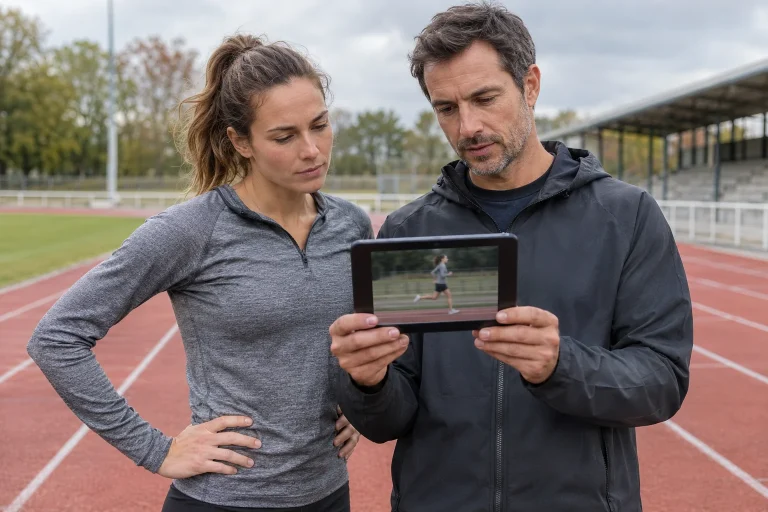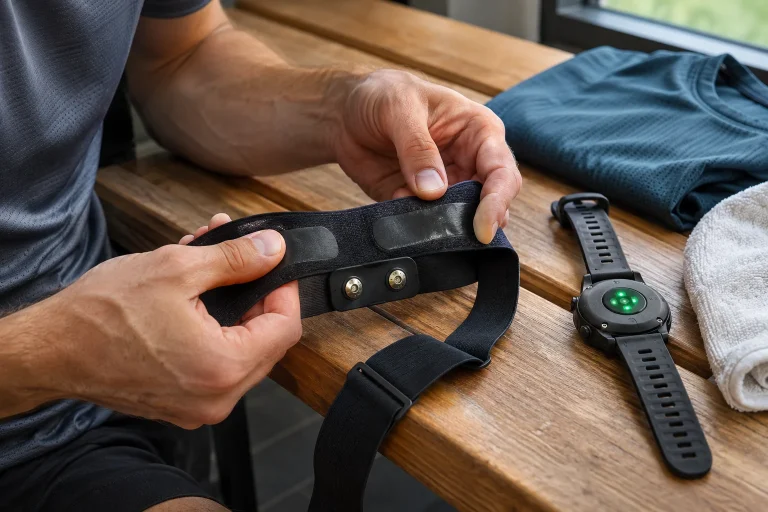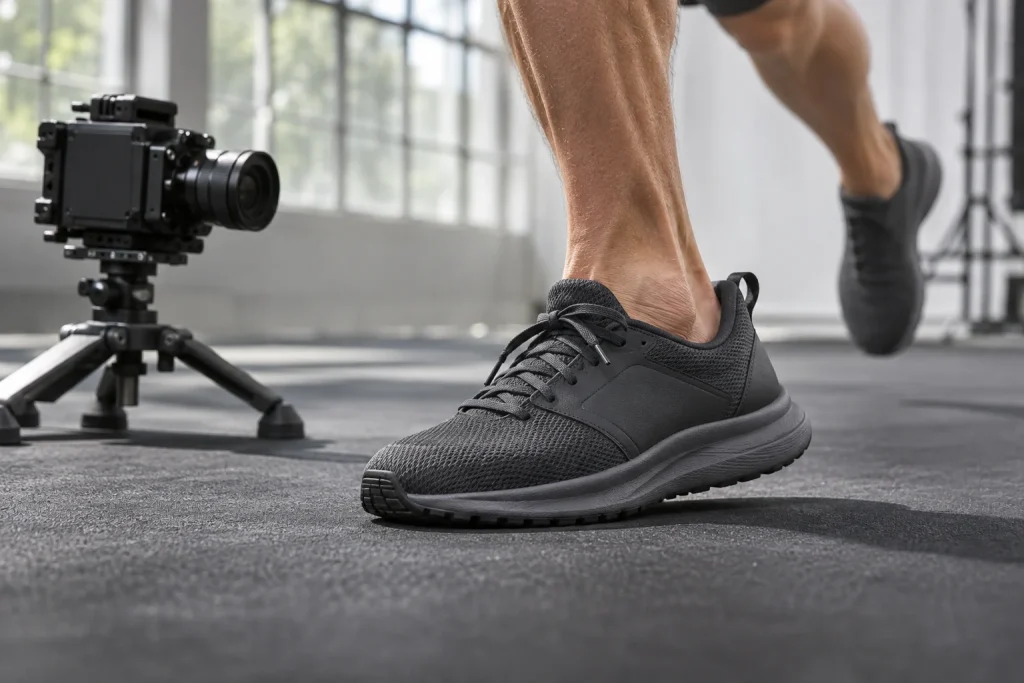
The runner’s shoe is still airborne in one image and already on the ground in the next. Slow-motion video makes the moment look reassuringly detailed, but an important question remains: how much time passed between the two original images? The answer determines how finely the beginning and end of contact can be identified. Impressively slow playback is not the same as temporal measurement resolution.
If you want to observe contact time, the flight phase or timing of foot movement, recording settings are part of the data too. You do not need to document every run with a high-speed camera. It helps, however, to know which recording supports comparisons of a few milliseconds, which offers only a coarser timing reference and when improving lighting or viewpoint is the better next step.
The time between frames is easy to calculate
Frame rate is often written as fps: the number of images the camera records per second. At a constant frame rate, consecutive samples are separated by one second divided by fps. At thirty, this is 1/30 of a second, or approximately 33.3 milliseconds; at 120, it is 8.3 milliseconds. A millisecond is one thousandth of a second, so always compare time values in the same unit.
The following table is an original arithmetic illustration. Its last column shows the fraction of an imagined 200-millisecond contact represented by one frame interval. This is not the camera’s total measurement error or validation of a sports watch. It simply makes the time grid’s scale tangible.
| Original recording | One frame interval | Proportion of the example’s 200 ms |
|---|---|---|
| 30 fps | 33.3 ms | 16.7% |
| 60 fps | 16.7 ms | 8.3% |
| 120 fps | 8.3 ms | 4.2% |
| 240 fps | 4.17 ms | 2.1% |
A higher number therefore means a denser time grid. It says nothing about whether the shoe’s outline is visible, the camera is positioned well or the same event has been selected. For a particular task, sharp, well-positioned side-view footage at 120 fps may be more useful than a dark, blurred, partly obscured video at 240 fps. Check quality in the actual frames.
Contact may begin between two original frames
Suppose one image definitely shows no contact and the next definitely shows contact. The real first contact happened somewhere between those sampling instants. The video did not directly reveal exactly when. Likewise, toe-off may occur between the last contacting position and the first airborne one. The recording approximates both event times at a particular sampling density.
A consistent rule matters: for example, choose the first definitely contacting image for contact onset and the first definitely airborne image for contact end. If the rule changes during analysis, a processing difference also enters the time difference. Another analyst may select another justified event definition, but agree this before comparing. Visible shoe contact is also a different definition from crossing a force plate’s predefined signal threshold.
An original example: in a 120 fps recording, the selected events are 24 frame intervals apart. The result is 24/120 = 0.200 seconds. Moving just one event one image later gives 25/120, or 0.2083 seconds. That is an 8.3-millisecond difference between two assessments of the same video. The calculation illustrates sensitivity to event selection, not a claim that every 120 fps measurement has exactly this error.
 Enlarge image
Two endpoints produce one duration
Duration is the end time minus the start time. If both points are uncertain, their shifts affect the result together. Imagine that on a 240 fps video one analyst selects the start one frame earlier and the end one frame later than another. The assessments will differ by two frame intervals, approximately 8.3 milliseconds. Uncertainty for individual endpoints must therefore not silently be treated as uncertainty for the entire duration.
A different situation arises when events are clearly visible and only the unknown actual instant between samples is in question. Here, a duration calculated consistently from the first images after each event uses a delay of less than one sample interval at each endpoint. The difference between the two delays affects duration. This is a simple sampling model; blur, occlusion or uncertain event recognition may cause larger differences.
A better log entry is therefore: ‘120 fps, from first visible contact to first airborne image, 24 frame intervals.’ The figure of 200 milliseconds can be reconstructed from it. ‘200 ms’ alone does not reveal whether it came from video, a shoe sensor, a force plate or an app estimate. A measurement’s origin is part of its meaning.
Slow playback does not fill missing time
Playing a 30 fps recording four times slower lets you view the same original images for longer. The camera still sampled thirty instants per second of real movement. If the player calculates intermediate images, each generated image is the software’s estimate. Movement may look smoother, but the original contact moment actually recorded has not been measured more densely.
The reverse matters too. Presenting 240 fps footage on a 30-frame-per-second timeline can create eightfold slow motion. One second of real movement then lasts eight seconds in playback. Treating those eight screen seconds as real running time multiplies duration by eight. The analyst needs to know whether a timestamp refers to the original event or the edited presentation timeline.
Keep the original file and make a separate copy for sharing. Messaging services, social platforms and editing exports may alter resolution or frame handling. You do not need to assume every app malfunctions: simply track the original setting and processing steps. With variable-frame-rate files, actual timestamps handled by the analyst may also matter instead of a single average fps value.
Shutter speed answers a different question from fps
Frame rate describes how often a sample is taken; exposure time describes how long light is collected within one image. A longer exposure can blur a moving object’s outline. The official Nikon explanation of shutter speed also illustrates this distinction: a shorter exposure can freeze movement more sharply, while a longer one may show blur. This is a general imaging principle, not a capability of one running-phone model.
Imagine two recordings at the same fps. In one, the small gap between sole and floor is clear; in the other, the shoe’s edge smears into an elongated patch. The time grid may be identical while event identification is not. If your phone does not offer manual exposure control, better light and a more suitable location can improve usefulness too. Check the actual settings for the particular device and recording mode.
There is no compulsory shutter speed for every runner and camera that can simply be copied from here. Movement speed, size within the image and lighting all matter. After a short trial, zoom into the original frames: can you recognise the sole edge, is anything obscured and can you follow toe-off? Many decimal places calculated afterwards from a blurry video cannot replace missing visual information.
Do not turn research settings into a universal quality seal
In the study by Peebles and colleagues, the two-dimensional camera and three-dimensional system both recorded at 120 Hz, yet agreement between methods differed by variable. This illustrates that fps alone does not fully describe accuracy. Point tracking, angle definition and the movement situation also determine the result. ‘It operates at 120 fps’ is only one detail in the measurement chain.
When interpreting contact time, your intended use matters too. Moore and colleagues, in ten trained runners, changed contact time at the same speed and fixed step frequency, finding an individual curved relationship with metabolic cost. A shorter time is therefore not a universal goal in itself. Measuring a time more precisely and deliberately reshaping movement are separate tasks.
First make recording methods and event definitions consistent across your videos. Then compare speed, surface, shoes and running situation. If all these changed, a difference of a few milliseconds is not a clean technique test. The measurement may instead show which further question needs more controlled observation.
 Enlarge image
Video and sports watch: two separate timelines need aligning
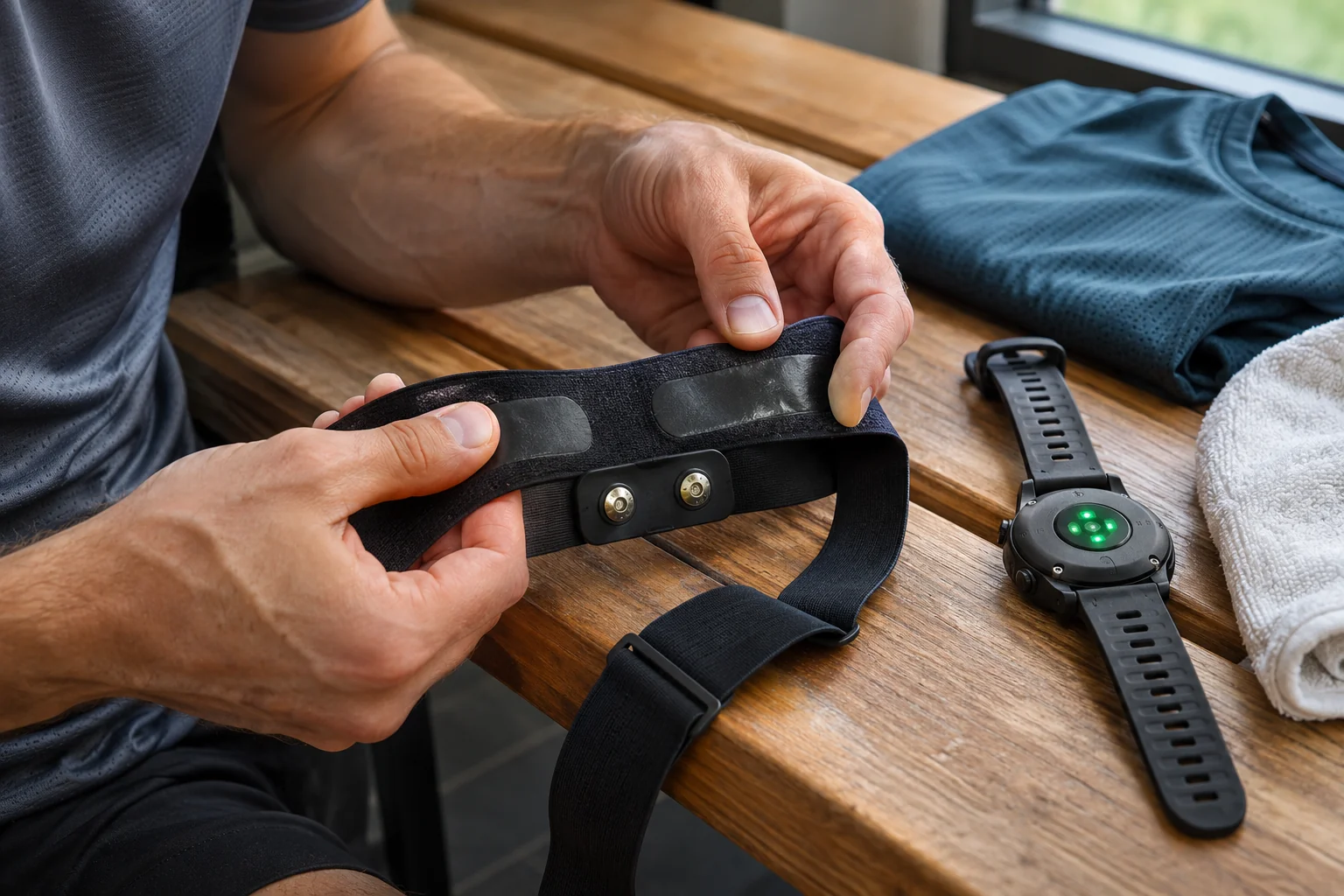
A running-dynamics curve on a watch and a video do not automatically mark the same moment. Recording may have started at different times, pauses may have occurred and exported data sampling need not match the sensor’s internal operation. A value written to a file once per second does not mean every internal calculation also happens only once per second. Likewise, summary data should not be treated as a direct measurement of one particular step.
The official Garmin FIT documentation distinguishes timestamped records and events from lap and session messages summarising a period. Recording can be denser or sparser, and pause events matter too. Before aligning data with video, establish whether you are viewing an instantaneous record, lap average or whole-session average. These describe different periods.
A pre-agreed starting situation clearly identifiable in the recording and a short note can help. Pressing a lap button manually may roughly locate the section, but human reaction and different recording methods mean this is not guaranteed millisecond synchronisation. Comparing contact time for one step requires a separate check of how the measurement systems are linked in time.
A short trial, useful footage and proportionate conclusions
Before making many videos, record a short trial in the original intended mode. Examine events frame by frame, calculate the time scale and retain the file. If you cannot select contact onset consistently across two consecutive assessments, resolve uncertainty in the image or rule first. More recordings with the same blur do not necessarily provide a better answer.
- Before recording: actual fps, suitable lighting and a stable side view.
- During analysis: the same event definition and original time base.
- When calculating: number of frame intervals divided by actual fps.
- When comparing: similar running conditions and a record of measurement origin.
The final result is useful when you can explain how it was produced. ‘24 frame intervals at 120 fps’ is a transparent claim. The resulting 200 milliseconds can be a good starting point for observation, but cannot determine technique, economy or injury without more information. Slow-motion video is valuable because it makes events easier to follow when they are difficult to distinguish with the naked eye; knowing the time grid makes them numerically interpretable.
Sources
- Peebles and colleagues: side-view running kinematics, a 120 Hz comparison study.
- Moore and colleagues: contact time and the metabolic cost of running.
- Garmin: timestamps, records and events in FIT activity files.
- Nikon: shutter speed and how movement appears in images.
How Futószív articles are prepared: our editorial guidelines.