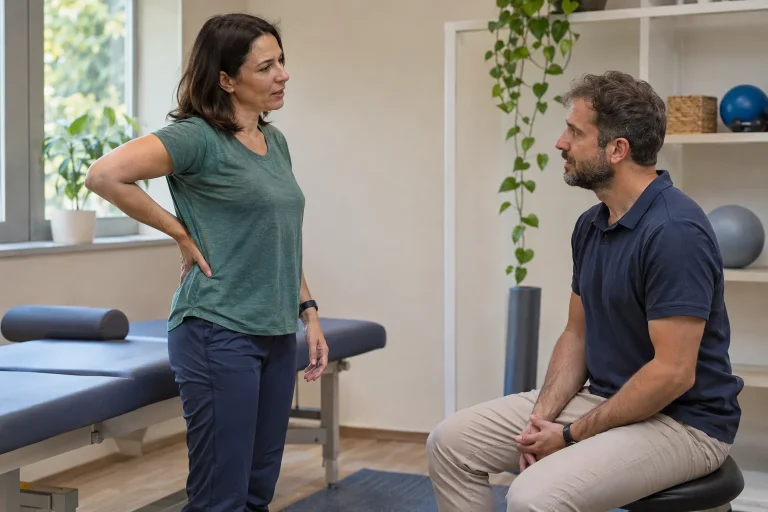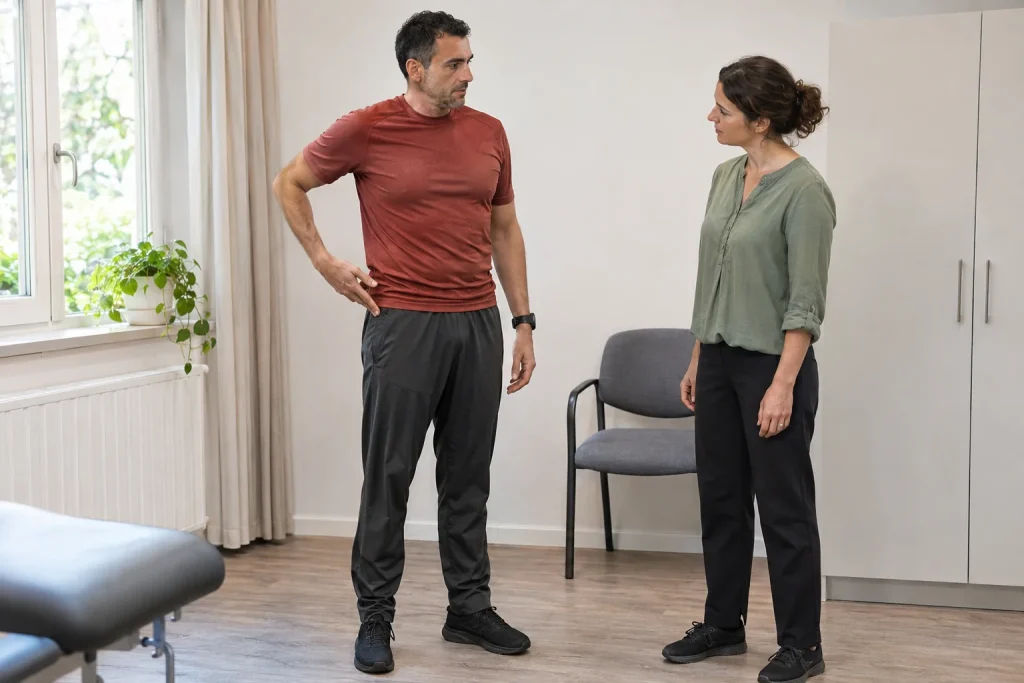
‘My hip hurts when I run’ is a short sentence, but it can mean several different places. One person means the groin crease, another the area near a side trouser pocket, while someone else points to a buttock or below the lower back. A more precise description is not fussiness: it helps a professional start from your actual experience rather than a label selected online.
Naming the location is not a diagnosis, however. You cannot reliably work backwards from one point on the body to the tissue or condition behind a symptom. The following helps organise the symptom’s story: how to show where you feel it, what to say about its onset and when seeking immediate care matters more than further observation.
Front, side or back: describe your own map first
At the front, you might identify the groin crease or front of the upper thigh. At the side, your description might be the hip region or outer upper thigh. At the back, you can distinguish the buttock, area behind the pelvis and symptoms towards the lower back. You do not need an anatomical term immediately. You can show the area through your own clothing.
University Hospitals of Morecambe Bay information mentions symptoms around the groin, outside of the hip and buttock, and notes that pain spreading into the leg may also accompany lower-back symptoms. The NHS hospital information on hip symptoms describes several presentations. Distinguishing the areas is therefore useful, but is not a key that unlocks one single cause at home.
If identifying one point is difficult, say that you feel it across a wider area or as though it were deeper. If there are several separate locations, name each. Do not force yourself to select one point because a forum expects it. Difficulty defining the boundary precisely is also part of your experience.
Always name right and left according to your own body, not the viewpoint of the person opposite. If you feel something on both sides, do not automatically merge them into one symptom: their onset or effects on daily life may differ. You can describe the two short histories alongside each other.
Do not turn pointing into a pressure test
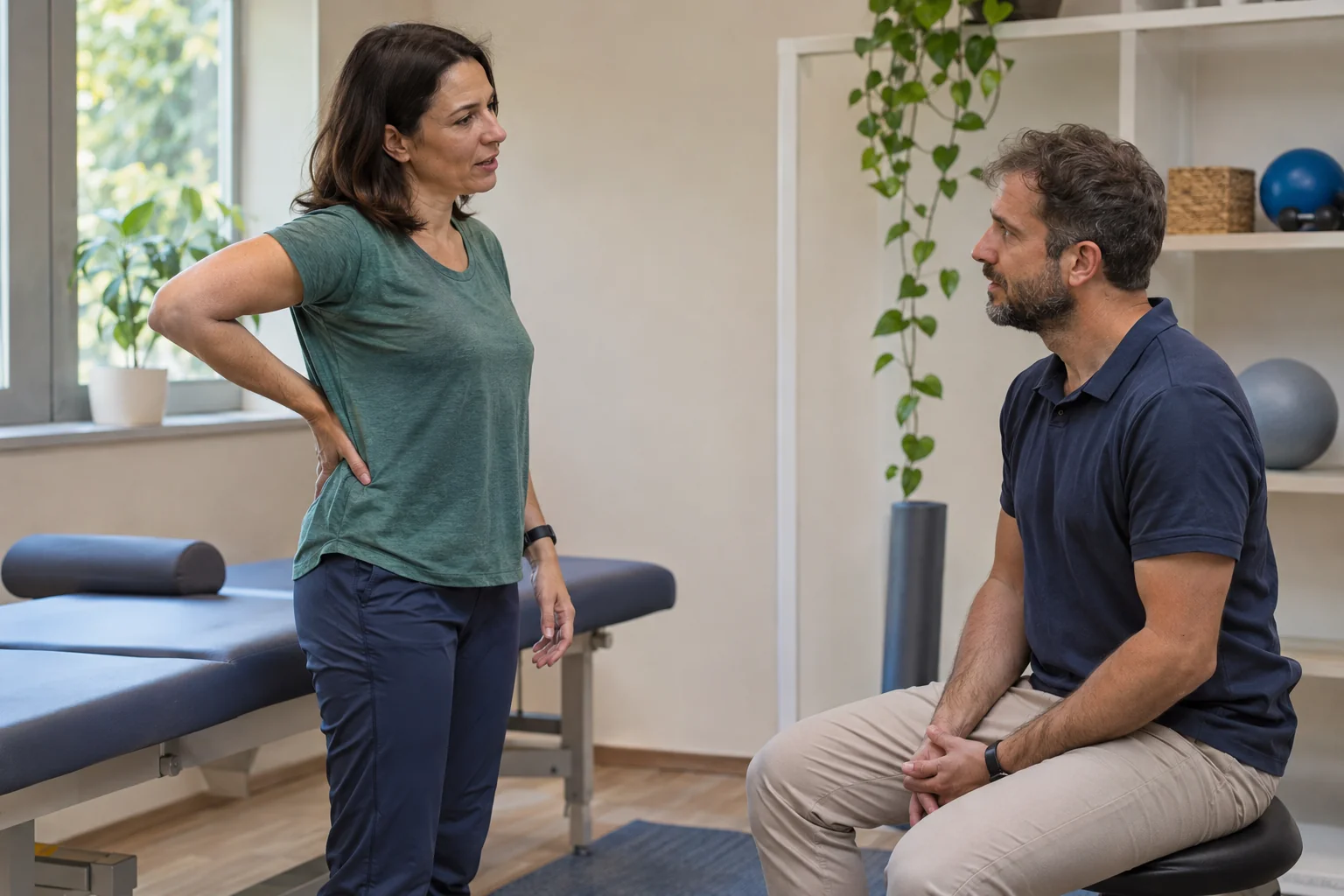
Showing where pain occurs is not the same as provoking it. You do not need to press hard, check with a deep squat or hop on one leg to refine its location. If the symptom has already occurred, you can describe it. The care provider chooses whether and how to examine you based on the whole situation.
When indicating the area, say separately ‘I feel it here’ and ‘it seems to spread from here towards there’. The two statements convey different information. You can draw an arrow on a simple body sketch to show the direction if that helps you remember. This is not a medical diagram or nerve map; it simply helps you refer to the same area in conversation.
The place where you feel a symptom is not necessarily its source. That makes shortcuts such as ‘pain at the back of the hip definitely means this’ unhelpful. Mention lower-back, abdominal or other associated symptoms separately. You need not decide beforehand whether they belong together; individual history-taking and examination may help clarify the connections.
 Enlarge image
The sequence of onset may reveal more than the latest workout’s name
Did it begin during a sudden step, fall or single movement? Did it appear gradually over several occasions? Could you feel it before setting off, or notice it only later? Describe these differences in timing. ‘After trail running’ alone does not say whether an injury occurred or when you first noticed the symptom.
The American AAOS OrthoInfo information on strains discusses both acute injuries and muscle or tendon symptoms developing with repeated loading. Assessment includes the immediate history, general health and individual examination of movement. The AAOS information on hip strains concerns a defined condition; it does not say that every hip pain arising during running is a strain.
If your training changed, describe the actual change. A different distance, pace, route or more consecutive active days may have formed part of the context. Listing these does not establish a proven cause. A training log can provide useful background, but also tell the professional what happened outside running, such as a fall or an unusual everyday task.
Everyday function adds information alongside kilometres
A symptom’s significance is not measured solely by whether you completed the planned distance. Does it affect walking, stairs, putting on shoes, getting up from sitting or sleep? The hospital information lists similar everyday difficulties. The full story also includes which activities you have begun avoiding or doing differently.
You might say: ‘I previously did this without thinking, but now I have to stop because of it.’ You do not need a pain score for every task. A specific change can make an understandable account. Your description should show the actual effect rather than try to confirm a preselected injury.
The NHS advises seeking medical help if hip symptoms interfere with usual activities or sleep, worsen or recur. The NHS page on hip pain in adults also specifically warns against self-diagnosis. You need not wait until every everyday task becomes impossible before asking about a symptom.
Three descriptions that leave the diagnosis open
The following are fictional sentences, not diagnoses assigned to symptom clusters. Each contains a location, sequence and practical effect, but none establishes a definite tissue-related cause. If your story differs, tell that story; you do not have to select the closest-looking example.
| Situation described | A more precise sentence | What remains open without examination |
|---|---|---|
| Symptoms at the front | ‘I feel it around my right groin crease; it began gradually, and now I also notice it on stairs.’ | Where does it come from, and what individual care is appropriate? |
| Symptoms at the side | ‘The left outer hip area bothers me, not at one single point; it also happens towards the end of the day.’ | What explains the area and the change? |
| A sensation at the back that spreads | ‘I also feel it from the buttock towards the thigh, and I have a separate symptom in my lower back.’ | Are the symptoms connected, and how should they be assessed? |
A more precise sentence is not necessarily longer. If all you know is ‘it started here yesterday, and now it is harder to put weight on it’, that can be very important. Preparing a detailed diary must not come before seeking necessary help. Further questions during the conversation can refine the history.
You can also describe the pain in your own words: sharp, dull, tight or difficult to explain. The description alone does not identify the tissue involved. You do not have to fit the sensation to an online list, nor describe it with the same word every time if it has genuinely changed.
When does urgent care matter more than further observation?
Severe hip pain, inability to walk or inability to bear weight on the leg after a fall or injury requires urgent care. The NHS also asks for immediate help with numbness or loss of sensation after injury. Do not try further steps to prove that you really cannot manage. In Hungary, seek the necessary urgent care; call 112 for a serious condition or if you cannot reach care safely.
Sudden severe pain without a fall, a hot swollen hip area, or symptoms with fever or feeling generally unwell may also require urgent medical assessment. Do not treat this as simple training overload just because you are a runner. Urgency does not require a known accident; the present symptom matters too.
This list does not cover every possible situation. Seek help if you notice a serious, rapidly worsening condition. Showing the pain’s location can still help, but drawing a detailed map must not delay care. Lacking a definite diagnosis is no reason to keep trying to travel or train alone when help is needed.
 Enlarge image
Why is a home movement test or photograph of a report insufficient?
An online test may promise to reveal a symptom’s cause from one movement. Individual assessment connects more information: history, symptoms, general condition and checks chosen for that situation. Repeating a painful movement yourself is not the same, and you do not need to turn its result into a single label at home.
The AAOS notes that a bone stress injury can present with symptoms similar to certain hip strains; a professional may choose imaging where needed to exclude it. This does not mean every symptom needs the same examination, but that similarity alone is insufficient to distinguish causes at home. ‘It must just be a muscle’ can close the question too early.
If you have an earlier report, bring it and ask how it relates to the current history. An image or report alone does not describe when and where it hurts, what changed or how it affects your day. Equally, another runner’s similar report is not an explanation of your condition. Individual interpretation also needs your experience.
A little organised information may be enough for the next step
A brief summary for the consultation can include location, onset, change, associated symptoms and everyday effects. Add relevant training history and earlier assessments. You do not need a minute-by-minute account of every run, particularly if it does not relate to the present question.
If you ask about movement, be clear about what you want to clarify: which activity is appropriate with the current symptoms, which symptoms should you report and when will the situation be reviewed? Ask about the purpose of individual advice too. Do not try to resolve an unexplained issue in advance by suppressing pain or automatically buying new shoes.
A more precise description of hip pain ultimately makes a conversation more useful. It requires no anatomy examination, hard pressing or run to prove anything. Show your own location and history, take urgent signs seriously in time and clarify the next step through individual assessment.
Sources
How Futószív articles are prepared: our editorial guidelines.