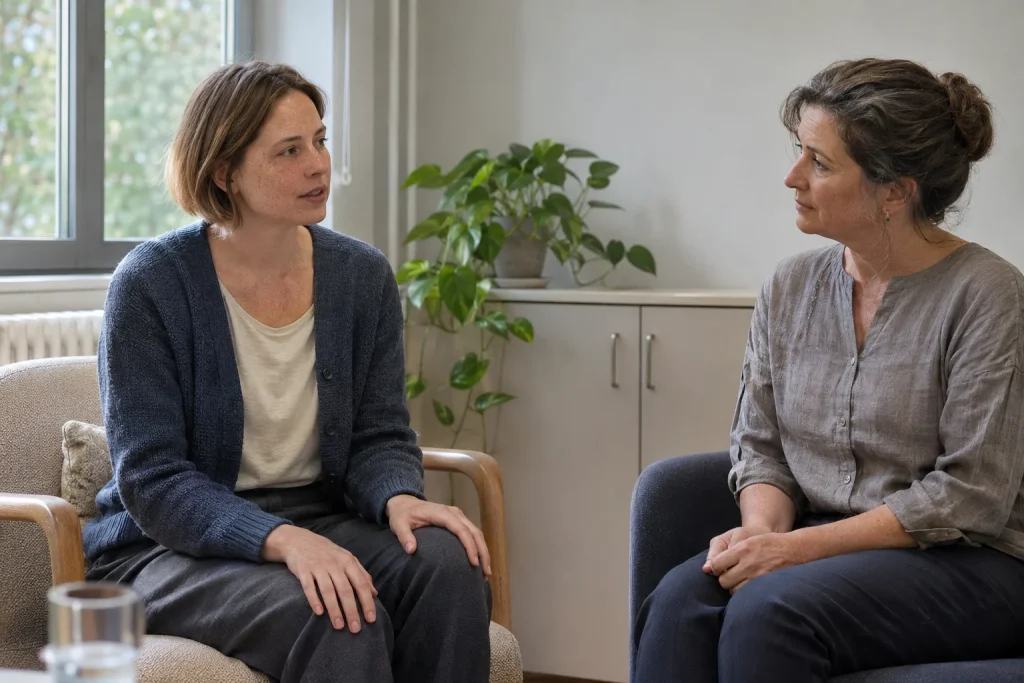
After baby loss, arranging your own postnatal check can be particularly difficult. An invitation, question or clinic situation you had not anticipated may become distressing. Your body’s need for care does not disappear with the loss, however. You are entitled to ask about your recovery whether movement is not on your mind at all, or whether the thought of a walk or your former running life has already appeared.
This article helps you connect with your own care. It does not prescribe a timetable for grieving or claim that sport resolves the pain of loss. Physical follow-up, emotional support and questions about movement can each have their own place. You do not have to bring them together into a single successful comeback story.
Your own postnatal care still has a place
The NHS information on the postnatal check explicitly states that you still need your own check if your baby is not with you or you have lost your baby. The timing and organisation of British care are not Hungarian referral rules, but the underlying message is clear: the mother’s own physical and emotional condition needs attention. The NHS information on the postnatal check states this separately.
If you are unsure who arranges the next appointment, ask your own care providers. You do not have to assume that there is nothing to do because no one has mentioned it. Your discharge summary, instructions and new questions can together provide a basis for discussion. If making calls or organising documents is difficult now, you can ask for specific help with these too.
You do not need to earn a check by justifying future plans. You may need help even if you cannot or do not yet want to discuss a later pregnancy, work or running. Your present condition is a topic for discussion in its own right. You can state the appointment’s purpose beforehand: for now, you mainly want to clarify questions about your own recovery.
You can explain beforehand what makes the appointment difficult
When requesting an appointment, you can say it is your own follow-up after loss and that you would like the staff member organising it to know. You can ask about where you will wait, whether a companion is possible and how the conversation will proceed. You do not need to explain every detail over the phone. Local options vary, so discuss your needs and what is possible beforehand.
If a familiar question is now difficult, you can say so briefly. For example: ‘I would like people to know in advance what happened, so I do not have to begin the story again at every stage.’ This is a practical request, not an expectation that every encounter will be entirely free of distress. The aim is to reduce repeated, avoidable explanations.
You can also decide a companion’s role in discussion with the clinic and according to the situation. Would you like someone to help recall your questions? Would you rather they were available in the waiting room? Or would you prefer to talk alone? A single decision need not apply to every later visit. You can express your current needs each time.
 Enlarge image
Physical recovery can be discussed through specific questions
The HSE information on recovery after loss emphasises that your body still needs time and care after giving birth. Bleeding, pain or breast symptoms can occur; you do not have to face these alone. The HSE recovery page after loss identifies both physical and emotional support. Assessing your own symptoms is an individual healthcare task.
You can write a few short sentences about what is troubling you in everyday life now. What hurts, what change have you noticed, what instructions were you given and what remains unclear? You do not need a detailed daily performance list. The check is not about proving how well you are holding up, but about receiving understandable help based on your actual experience.
If breast fullness or milk production is a particularly difficult subject, you can say that too. Discuss the options with your care provider; you do not have to choose treatment yourself based on an online story. A physical symptom and the feelings associated with it can exist together, and neither makes the other insignificant.
Understanding what happened and your current follow-up may raise different questions
You may want to understand test results or events around the birth while also having questions about your present recovery. The NHS information after loss connects follow-up with checking the mother’s health and discussing any results that have become available. The NHS page on care after stillbirth also suggests writing questions down beforehand.
Not every question will necessarily be answered in the same appointment. You can ask which results are ready, what is still expected and who will discuss them with you. You do not have to fill an uncertain answer with your own explanation of the cause. Interpreting documents and clarifying what caused the event can be parts of a conversation within your care.
The RCOG’s 2024 information explains that even after recommended investigations into the cause, a complete explanation is not always found. The RCOG information on loss regards both understandable information and emotional support as important. This does not mean you must retrospectively derive a cause from your sporting history or an individual movement.
Grief and an enjoyable movement experience do not measure each other
You may want a short walk, find even going out difficult, or feel differently each day. This article makes none of those experiences compulsory. Asking about movement does not mean the loss no longer hurts; a lack of interest in movement is not a performance deficit to correct by setting a running goal.
If running was previously an important part of your life, you can describe the relationship you would like with it now. Perhaps you miss company, quiet time alone, or neither for the moment. You do not need to turn the answer into a later coping achievement. Individual conditions for movement can be discussed while the emotional experience remains an open question.
Do not make running a test of whether you are progressing appropriately through grief. Physical readiness, your chosen activity and emotional support are separate considerations. A comfortable walk does not close emotional questions, and a difficult day does not erase an earlier pleasant moment. You do not need to draw one straight improvement curve from these experiences.
What can you ask about movement without committing to a date?
If the topic is relevant now, you could begin: ‘I do not want to set a target date yet; I just want to understand what matters for my physical recovery.’ This starts the conversation with your current condition. You can ask which symptoms to report, which individual advice to follow and whom to contact if you later want to discuss another form of movement.
The way you gave birth, any complications and your present symptoms do not disappear because of the loss. A general restart programme should not replace your own care instructions. Equally, you do not have to decide every later question at this appointment. ‘Today I only want information’ is also an understandable request.
| Your current need | A possible question | What you do not need to commit to |
|---|---|---|
| Understanding the physical situation | ‘What should I pay attention to in my recovery now?’ | A specific running date or distance. |
| A flexible opportunity for movement | ‘If I later want to ask about walking or sport, whom should I contact?’ | A constantly improving mood or regular sporting updates. |
| An open emotional question | ‘What support is available if I want to talk about this?’ | Sharing the details of the loss publicly. |
Your questions can be brief and may change later. If a sentence is difficult to say now, you can hand it over in writing. The value of a check depends not only on producing a final plan, but also on retaining a clear point of contact for questions that arise later.
 Enlarge image
Practical help can still be available without a sporting programme
You can ask for help with travel, meals, shopping, documents or other family tasks. These do not have to revolve around restarting a training plan. A supportive person does not need to know every intimate symptom to drive you to an appointment or take over an administrative task.
You can also explain in advance how much you want to talk after the visit. You may welcome company on the way home or prefer quiet. Help should not necessarily require another detailed account. If someone accompanies you, agree their role so that your own questions and decisions still have space.
Tell the running community as much as you want to. You can ask for quiet presence instead of messages, a separate occasion or time to decide. You do not have to demonstrate appreciation for support by returning in front of the group. Connection can matter even when there is no shared run or race goal now.
You can seek help for new symptoms and ongoing difficulties alike
With heavy or increasing bleeding, fever, persistent severe abdominal pain, unpleasant-smelling discharge or another new episode of feeling unwell, do not simply prepare for the next routine appointment. The HSE recovery information after loss asks for these symptoms to be reported urgently. Chest pain, breathlessness or feeling seriously unwell requires immediate help; in Hungary, call 112 for a life-threatening or serious condition.
You can also ask for support with emotional difficulties. If you continue to feel unwell or struggle to cope with daily life, tell your own care provider. The NHS page on postnatal depression emphasises the availability of professional help. The NHS information cannot be used to diagnose grief or any condition yourself from a short description.
Your own check can mean reconnecting with care rather than announcing a compulsory restart. You can discuss your body, ask for bereavement support and raise movement now or later. You do not need to fit where you are into a single story. The next step may simply be expressing your own need clearly and knowing whom you can approach with it.
Sources
- NHS: Your 6-week postnatal check
- NHS: Postnatal depression
- HSE: Stillbirth – Recovery and future pregnancies
- NHS: Stillbirth – Follow-up care and bereavement support
- RCOG: When your baby dies before birth
How Futószív articles are prepared: our editorial guidelines.